
"SUICIDE SQUAD" SHOWDOWN
The 2016 D.C. Extended Universe (DCEU) film, "SUICIDE SQUAD", featured an interesting post-credit scene between A.R.G.U.S. Director Amanda Waller and billionaire Bruce Wayne aka Batman. In the wake of Task Force X aka Suicide Squad's confrontation with former team member, the sorceress Enchantress, Ms. Waller requested a meeting with Bruce for a special favor.
Apparently, Ms. Waller found herself in hot water with the U.S. Department of Defense, due to the Enchantress' attempt to wreck havoc upon the world and rule it. After all, the sorceress was known to be a former member of the Suicide Squad. Ms. Waller met with Bruce in order to use his Washington D.C. connections to protect her from the backlash against her role, as Task Force X's creator, in the Enchantress' rampage. In return, she provided him with government files files on the expanding meta-human community . . . along with documents on both Barry Allen aka the Flash and Arthur Curry aka Aquaman. Following Bruce's agreement to help Waller in exchange for the files, the pair had this little conversation:
Amanda Waller: There’s the difference between us. You believe in friendship, I believe in leverage.
Bruce Wayne: Good night.
Amanda Waller: You look tired. You should stop working nights.
Bruce Wayne: You should shut it down, or my friends and I will do it for you.
When Ms. Waller had first hinted that she knew Bruce was Batman, his first response was to warn her to shut down the Task Force X team, also known as the “Suicide Squad”. When I first saw the movie, I had taken Bruce's warning at heart. Especially since she had asked for him to protect her from facing the consequences of using Dr. June Moone aka the Enchantress as part of her Task Force X. And the recently formed Justice League would be more than capable of physically breaking up the squad and keeping its members behind bars. In the end, it took me a while to realize that on a deeper level, Bruce’s warning was hollow. It was just as hollow as Waller's insinuation that she knew he was Batman.
One, the formation of Task Force X "Suicide Squad" was not illegal. It was sanctioned by the Department of the Defense and the White House. With the exception of Task Force X leader Colonel Rick Flagg and his bodyguard, Tatsu Yamashiro aka Katana, the other members were convicted criminals. Which meant that Waller or any other member of the government or law enforcement had the right to “recruit” them to work in the interest of the country/community. The Thirteen Amendment (1865) of the U.S. Constitution abolished slavery and involuntary servitude, except as punishment for a crime. Which meant that convicted and imprisoned criminals can be used as forced labor. And this is exactly what Waller did when she had nano bombs implanted in their necks and coerced them into working on behalf of the government . . . with the threat of death if any Suicide Squad member did not cooperate.
Two, if Batman and other future members of the Justice League had interfered with any of the Task Force X’s operations, they would find themselves in legal trouble. Especially since the Task Force X is a legally sanctioned intelligence unit. And when Bruce had issued his warning about the squad, he should have remembered that Ms. Waller not only knew about his identity as Batman, she also knew about secret identities of the Flash and Aquaman. After all, she was the one who had provided Bruce with information about the pair. Considering Ms. Waller’s talent for acquiring information, it would have been a matter of time before she discovered Diana Prince's identity as Wonder Woman, Victor Stone 's identity as Cyborg and Clark Kent as Superman. If she does not know the truth about them already. After all, Lex Luthor does.
Three, Waller's insinuation that she knew about Bruce's identity as Batman struck me as equally hollow. Even if she had exposed him as the Dark Knight, chances are Bruce would not hesitate to find a way for her to face the consequences of her role in the Enchantress' rampage. If he could not personally achieve, Bruce would probably arrange for his security chief, Alfred Pennyworth to expose Ms. Waller on his behalf.
Perhaps it would have been best for both Bruce and Ms. Waller to realize that when it came to secrets and protection, they were in a standoff. Waller should have never made such a useless threat. And Bruce should have realize there would be legal consequences if he and the other members of the Justice League had interfered with Task Force X. And both should simply consider leaving each other alone.

"FANTASTIC BEASTS: THE CRIMES OF GRINDELWALD" (2018) ReviewFollowing the success of the 2016 movie, "FANTASTIC BEASTS AND WHERE TO FIND THEM", Warner Brothers Studios and author J.K. Rowling continued the adventures of former Hogwarts student, Newt Scamander with the 2018 sequel called "FANTASTIC BEASTS: THE CRIMES OF GRINDELWALD". Starring Eddie Redmayne, the movie was directed by David Yates. "FANTASTIC BEASTS: THE CRIMES OF GRINDELWALD" began in 1927, less than a year after the events of the 2016 movie. In the film's opening, the Magical Congress of the United States of America (MACUSA) is transferring the powerful dark wizard Gellert Grindelwald from their maximum security prison in New York City to London. The latter is be tried for his crimes in Europe. But with the aide of Grindelwald's follower, MACUSA agent Abernathy, the wizard manages to escapes during the transfer. Three months after Grindelwald's escape, magizoologist Newt Scamander appeals to the Ministry of Magic in London to restore his revoked international travel rights following his previous adventures in New York City. While at the Ministry, Newt learns that his former Hogwarts classmate, Leta Lestrange, is engaged to his brother Theseus, an auror in the Department of Magical Law Enforcement. The Ministry offers to restore Newt's travel rights if he assists Theseus in locating Credence Barebone, the American obscurial believed to have been killed in Paris. He has been detected in Paris. Grindelwald is also searching for Credence. He believes that only the latter is powerful enough to kill his "equal", Hogwarts Professor Albus Dumbledore. Newt declines the Ministry's offer, but is is secretly summoned by Dumbledore, who also tries to persuade Newt to locate Credence. Dumbledore under constant Ministry surveillance for refusing to confront Grindelwald, who was a former close friend from the past. Upon his return home, he discovers that his American friends, the non-magical Jacob Kowalski and witch Queenie Goldstein had left New York. Jacob has retained memories of his past adventures with Newt and the Goldstein sisters, despite MACUSA's citywide Obliviation order. Queenie and Jacob had followed Queenie's sister Tina to Europe, where the latter is searching for Credence. Newt also discovers that Queenie has enchanted Jacob into eloping to Europe with her to circumvent MACUSA's marriage ban between wizards and Muggles. After Newt lifts the charm, Jacob and Queenie quarrel about the marriage law, and the upset witch leaves to find Tina. Newt ignores the Ministry's travel ban and with Jacob, head for Paris in search for the Goldstein sisters and Credence."FANTASTIC BEASTS: THE CRIMES OF GRINDELWALD" proved to be an unpopular entry in the HARRY POTTER movie franchise. Even a year before the film's release, many had criticized the film's producers, including J.K. Rowling, for allowing actor Johnny Depp to take over the role of Gellert Grindelwald in the wake of his controversial divorce. Ironically, once "THE CRIMES OF GRINDELWALD" hit the movie theaters, both the critics and many moviegoers expressed other reasons for their displeasure. Either these criticisms were merely used as shields to hide their displeasure at Depp's presence in the movie, or they genuinely did not like it. Although "THE CRIMES OF GRINDELWALD" actually managed to make a profit, it did not make as much as its 2016 predecessor. Nor did it make as much as Warner Brothers Studios had anticipated. So . . . how did I feel about the movie?I will admit that I have some problems with "THE CRIMES OF GRINDELWALD". I never admitted this in my review of "FANTASTIC BEASTS AND WHERE TO FIND THEM", but I had noticed Rowling's habit of creating two or more disjointed story lines and allowing them to connect near the end of the film. As much as I admired her use of this narrative structure, I must admit that there were times when I found it frustrating. To be honest, I found it more frustrating in "FANTASTIC BEASTS AND WHERE TO FIND THEM", especially Newt Scamander's search for his missing animals. But in "THE CRIMES OF GRINDELWALD", there were times when I found myself wondering why Rowling had focused so heavily on Leta Lestrange's character arc/backstory and Queenie Goldstein's problems with her non-magical love, Jacob Kowalski. I also had a problem with Colleen Atwood's costumes. On one level, I found her costumes very attractive, as shown in the images below:
 And yet . . . aside from the costumes and hairstyle worn by actress Katherine Waterston, I found the other costumes and hairstyles reminiscent of the early 1930s, instead of 1927, the film's actual setting. Speaking of the timeline, could someone explain why Minerva McGonagall was a teacher at Hogwarts School of Witchcraft and Wizardry, when either the Harry Potter novels or the franchise's official website made it clear that she was born in 1935, eight years after this movie's setting. Around this time, Dumbledore was teaching Defense Against the Dark Arts, which means that a young McGonagall was teaching Transfiguration. What was McGonagall teaching, when Dumbledore became the Transfiguration teacher by the 1940s?"FANTASTIC BEASTS: THE CRIMES OF GRINDELWALD" had its flaws, like any other movie. But I enjoyed it very much. Actually . . . I enjoyed it slightly more than I did the 2016 movie. The reason why I enjoyed it more than the first film is probably the reason why many others liked it less. J.K. Rowling had written an emotionally complicated tale that reminded me that humans beings are a lot more ambiguous than many are STILL unwilling to admit. They might pay lip service to the ambiguity of humans, but I have encountered too much hostility directed at movies willing to explore the complex nature of humans and society in general . . . especially in pop culture films. Some might claim that such ambiguity has no place in pop culture films and franchises. My response to that claim is . . . why not? I see no reason why humanity's ambiguity should only be tolerated in films being considered for the film industry's award season.I noticed in "THE CRIMES OF GRINDELWALD" that the majority of Gellert Grindelwald's followers were not "dark wizards" or superficially evil. I must admit that the Vinda Rosier, Grindelwald's loyal right-hand follower, seemed to be the film's closest example of the future Deatheaters that followed Lord Voldemort aka Tom Riddle Jr. Most of Grindelwald's other followers seemed to be your typical human beings who had allowed their emotions to indulge in the usual prejudices or make bad choices. One example is the MACUSA agent Abernathy, who had earlier supported President Seraphina Picquery in the 2016 film. But the prime example in "THE CRIMES OF GRINDELWALD" proved to be Queenie Goldstein, the New York-born Legilimens (telepath), who out of her desperation to be with the non-magical Jacob Kowalski, turned to Grindelwald to help her achieve her heart's desire. Many fans had condemned the movie for this portrayal of Queenie. And I do not understand why. "FANTASTIC BEASTS AND WHERE TO FIND THEM" had already hinted Queenie's desperation to be with Jacob, when she conveyed reluctance to follow MACUSA President Seraphina Picquery's orders to ensure the erasure of his recent memories. She broke the rules even further by paying a visit to Jacob's new bakery in one of the film's final scenes. More importantly, Queenie had discovered that Jacob had retained some memories of his adventures with her, Tina and Newt. This is why I am not surprised that Queenie had resorted to desperate measures in "THE CRIMES OF GRINDELWALD" to make Jacob her husband. Love might lead a person to do wonderful things. But it can also lead someone to make questionable or terrible decisions. J.K. Rowling understood this. I never understood why so many people were incapable of doing so.The ironic thing about "FANTASTIC BEASTS: THE CRIMES OF GRINDELWALD" is that the movie not only featured former protagonists like Queenie Goldstein and Agent Abernathy, who had decided to follow Grindelwald, it also featured . . . Leta Lestrange. Any fan of Potterverse will remember another character with the Lestrange name - Voldemort follower Bellatrix Lestrange. Although Bellatrix had married into the Lestrange family, fans learned that her husband was another one of Voldemort's highly murderous and faithful followers. I do recall that the 2016 film may have hinted that Leta was briefly as someone from Newt's past who may or may not have deliberately led him into trouble and expelled from Hogwarts. Thanks to "THE CRIMES OF GRINDELWALD", audiences learned that Leta was NOT someone who lived up to her pure-blood family's name and who proved to be a different kettle of fish. She was not perfect. Her one crime . . . which led to years of guilt . . . stemmed from resentment toward her father's sexist desire for a male heir. As a young girl aboard a sinking ocean liner headed for the United States, she made an ugly decision that affected both her family and Credence Barebone.The characterizations of both Queenie Goldstein and Leta Lestrange, along with Gellert Grindelwald's followers made J.K. Rowling's intent to continue her ambiguous portrayal of the Wizarding World of Harry Potter. But instead of viewing this ambiguity from a growing child, audiences get to witness this ambiguity through the eyes of an adult. Instead of realizing that individuals we might perceive as "bad" can also possess decency within, Rowling seemed to be hinting that those whom we might originally perceive as "good or decent" can allow their emotions to make terrible choices or embrace evil. Granted, fans learned in the previous series that Albus Dumbledore had once skated on the edge of giving into some parts of his baser nature. But through characters like Queenie Goldstein and Agent Abernathy, agents get to see how originally perceived "decent" characters can allow their emotions and desires to embrace evil . . . not for any moral good, but due to their own selfishness or prejudices. It is a pity that so many are unwilling to explore this journey with Rowling.Although I had criticized the film's costumes for resembling the fashions of the early 1930s, instead of the late 1920s, I must admit that I found Colleen Atwood's designs very attractive and very original. I rarely comment on a film's editing, but I found Film Editor Mark Day's work in the movie first-rate. I was especially impressed by his work in two particular sequences - Grindelwald's escape in the film's first action sequence and another one featuring a wizarding freak show in Paris. I was also impressed by Philippe Rousselot's cinematography . . . to a certain extent. Rousselot's photography struck me as beautiful and memorable - especially in the Parisian scenes and one particular flashback scene in the Atlantic Ocean. But I really disliked the monochromatic tones (blue, yellow or green) that seemed to dominate the movie's photography . . . as much as I disliked the brown tones that dominated "FANTASTIC BEASTS AND WHERE TO FIND THEM". Also, production designer Stuart Craig, set designer Anna Pinnock, the art direction team led by Martin Foley and the special effects team all did an exceptional job to re-create the wizarding worlds of New York, London, Scotland and Paris."FANTASTIC BEASTS: THE CRIMES OF GRINDELWALD" featured some first-rate performances. Lead actor Eddie Redmayne, Katherine Waterston, Dan Fogler, Carmen Ejogo, Claudia Kim and Ezra Miller all gave excellent performances. But there were performances that I found more than first-rate. Jude Law was superb as the enigmatic and younger Professor Albus Dumbore, who seemed warm and manipulative as ever. William Nadylam gave a very complex and passionate performance as Yusuf Kama: A French-Senegalese wizard who has spent many years obsessively searching for Credence, whom he believed was responsible for the death of a family member. Callum Turner's portrayal of Theseus Scamander, Newt's brother, first seemed pretty solid. But his performance became more complex and interesting, thanks to Turner's skillful acting. Alison Sudol gave an outstanding performance as the increasingly desperate Queenie Goldstein, who allowed her love for Jacob and emotions to lead to a morally questionable decision. Zoë Kravitz was equally outstanding as Newt's former love, Leta Lestrange, who became emotionally troubled and confused over a morally questionable decision from the past. But the best performance, in my opinion, came from Johnny Depp, who portrayed the film's main villain, Gellert Grindelwald. Depp's Grindelwald seemed like a completely different kettle of fish from the more obvious villains of the Harry Potter novel. More subtle, subversive and manipulative. Insidious. The franchise's Palpatine perhaps? Honestly, Depp's Grindelwald made Tom Riddle Jr. aka Lord Voldemort seem like a rank amateur as far as villains go.This 2018 sequel to "FANTASTIC BEASTS AND WHERE TO FIND THEM" proved to be a disappointment at the box office. Between the controversy over Depp's casting and the hostile reaction to the Queenie Goldstein character, I guess I should not be surprised. But I am disappointed that the majority of moviegoers had failed to appreciate Rowling's story, because I thought it was first-rate, thanks to her screenplay, David Yates' direction and the excellent cast led by Eddie Redmayne. To be honest, I personally feel that it was slightly better than its 2016 predecessor. Perhaps one day, more filmgoers will be able to appreciate it.
 "JUSTICE LEAGUE" (2017) Review
The D.C. Comics Extended Universe (DCEU) released its fifth film utilizing several characters that were either featured or hinted in its previous four films during the fall of 2017. Directed by Zack Snyder (well, most of it), "JUSTICE LEAGUE" proved to be an even more controversial entry than two of its previous films. Only for different reasons.
Set some time after the present-day events of "WONDER WOMAN", "JUSTICE LEAGUE" begins with the Gotham City costumed vigilante Batman aka Bruce Wayne attempting to arrest a thief. However, his efforts are interrupted by the arrival of an alien creature known as a parademon. Realizing that he had dreamed of a similar creature in "BATMAN V. SUPERMAN: DAWN OF JUSTICE", Batman realizes that Earth is about to face another alien threat. Before he can summon Wonder Woman aka Diana Prince, she learns of an even bigger threat from her mother, Queen Hippolyta of Themyscira. A former foe known as Steppenwolf has arrived on Earth to acquire the three Mother Boxes, sentient, miniaturized, portable supercomputers from his homeworld of Apokolips. One of the boxes had been guarded by the Amazons of Themyscira for thousands of years. The pair decides to find the other metahumans - Barry Allen aka the Flash, Victor Stone aka Cyborg (whose body was cured by a Mother Box) and Arthur Curry aka Aquaman - and form a team to fight against Steppenwolf. Bruce manages to easily recruit the Flash, but is unable to recruit Aquaman. And Diana encounters difficulty in recruiting Cyborg. But when Steppenwolf manages to acquire the second Mother Box in Aquaman's world of Atlantis, the "King of the Seven Seas" decides to join the newly formed Justice League to defeat the alien from Apokolips. However, it is not long before the League realizes they need a sixth member to help them defeat Steppenwolf - namely the recently deceased Superman.
Ever since the release of "MAN OF STEEL" in 2013, critics and some moviegoers have been highly critical of the DCEU. With the exception of "WONDER WOMAN", the franchise's movies have either received mixed reviews or panned. In the case of "JUSTICE LEAGUE", it has been panned . . . perhaps even more so than the other four films. Personally, I have been a major fan of the DCEU films before "JUSTICE LEAGUE". Do I believe the movie deserved to panned? Honestly? No. But I do feel that "JUSTICE LEAGUE" is probably the first DCEU film toward which I felt some disappointment.
There was a good deal from "JUSTICE LEAGUE" that I enjoyed. The creation of the Justice League began when Superman, Batman and Wonder Woman formed a team to battle Lex Luthor's creation, Doomsday, in "BATMAN V. SUPERMAN: DAWN OF JUSTICE". This creation continued with Bruce Wayne and Diana Prince's recruitment of the Flash, Cyborg and Aquaman. And if I must be honest, I enjoyed how the movie's screenplay took its time in fusing these characters into the League. I found this especially satisfying, since both Cyborg and Aquaman proved rather difficult to recruit. What finally drove them all together as a team proved to be the threat of Steppenwolf.
This leads me to something else I enjoyed about the film. Steppenwolf's acquisition of two Mother Boxes provided some first-rate action sequences featuring the Amazons on Themyscira and the Atlantis inhabitants' efforts to stop him. And they did not make it easy for him. I especially enjoyed the sequence featuring Steppenwolf's theft of the Mother Box on Themyscira. There were other action sequences that enjoyed. One of them included the League's first encounter with Steppenwolf inside an abandoned facility near the Gotham City Harbor. I also enjoyed the League's second attempt to defeat Steppenwolf and his Parademon army at a small Russian village, where the Apokoliptian planned to fuse the three Mother Boxes and terraform the Earth's surface. I also enjoyed an early action sequence that featured Wonder Woman's confrontation with a group of terrorists in London. But for me, my favorite action sequence featured the League's confrontation with a recently resurrected and amnesiac Superman. Although I found it rather scary, thanks to Henry Cavill's chilling performance, there was a comedic moment that I found very funny.
As much as I enjoyed most of the film's action sequences, I found a good deal of its comedic and dramatic moments even more satisfying. It seemed pretty obvious to me that the film's two comedy relief characters were Barry Allen aka the Flash and Arthur Curry aka Aquaman. And I found both characters more than satisfactory, thanks to Ezra Miller and Jason Momoa's performances. Miller's Barry Allen was an extroverted and nervous personality that was at odds with his inability to easily befriend others. This was especially apparent in one scene that featured the initial meeting between Barry and Bruce Wayne at the former's abode and his attempts to befriend Victor Stone aka Cyborg. But the one scene that truly made me appreciate Miller's comedic talent occurred when the League clashed with a resurrected, yet amnesiac Superman and the Flash attempted to attack the Man of Steel from behind . . . and failed. Jason Momoa's portrayal of Arthur Curry also provided a good deal of the movie's comedic moments. Momoa's portrayal of the blunt and cynical King of the Seven Seas practically had me in stitches. But I especially enjoyed that moment when Aquaman unexpectedly went into a comedic spiel about fighting Steppenwolf and his appreciation for Wonder Woman . . . unaware that he was sitting on her Lasso of Truth.
However, there were many dramatic moments that made me happily realize that "JUSTICE LEAGUE" was not all comedy and action. The movie's opening credits featured a poignant montage that revealed the world's grief over Superman's death. One particular scene - a homeless man holding a "I TRIED" sign next to him - really resonated within me. I thought Martha Kent's visit to Lois Lane in Metropolis and the two women's shared grief over Clark/Superman's demise was particularly poignant, thanks to Diane Lane and Amy Adams' performances. I particularly enjoyed one scene that featured a tense conversation between Cyborg and his father, Dr. Silas Stone over the latter's decision to use a Mother Box to save the former's life. May I be frank? Both Ray Fisher, who portrayed the superhero and Joe Morton, who portrayed his father, really knocked it out of the ballpark in this scene. I was not that impressed by the CGI used for the Steppenwolf character. But I must admit that I enjoyed Ciarán Hinds' voice performance for the villain. The actor projected a good deal of style and menace into the character.
I enjoyed Clark's reunion with both Lois and Martha. Although I feel that it was a bit too brief for my tastes, I cannot deny that I found it emotionally satisfying. And I enjoyed the tense conversation between Aquaman and future love interest, Mera of Atlantis. The scene seemed to give audiences a preview of the screen dynamics between Momoa and Amber Heard, who portrayed Mera. But if I had to pick my favorite dramatic moment in "JUSTICE LEAGUE", it would have to be the scene that featured Bruce Wayne and Diana Prince's conversation regarding his continuing guilt over his past attempt to kill Superman and her lingering grief over the death of her former lover/colleague, Steve Trevor. Thanks to superb and subtle performances from Ben Affleck and Gal Gadot, the scene was a tense and angst-riddled moment that I truly enjoyed.
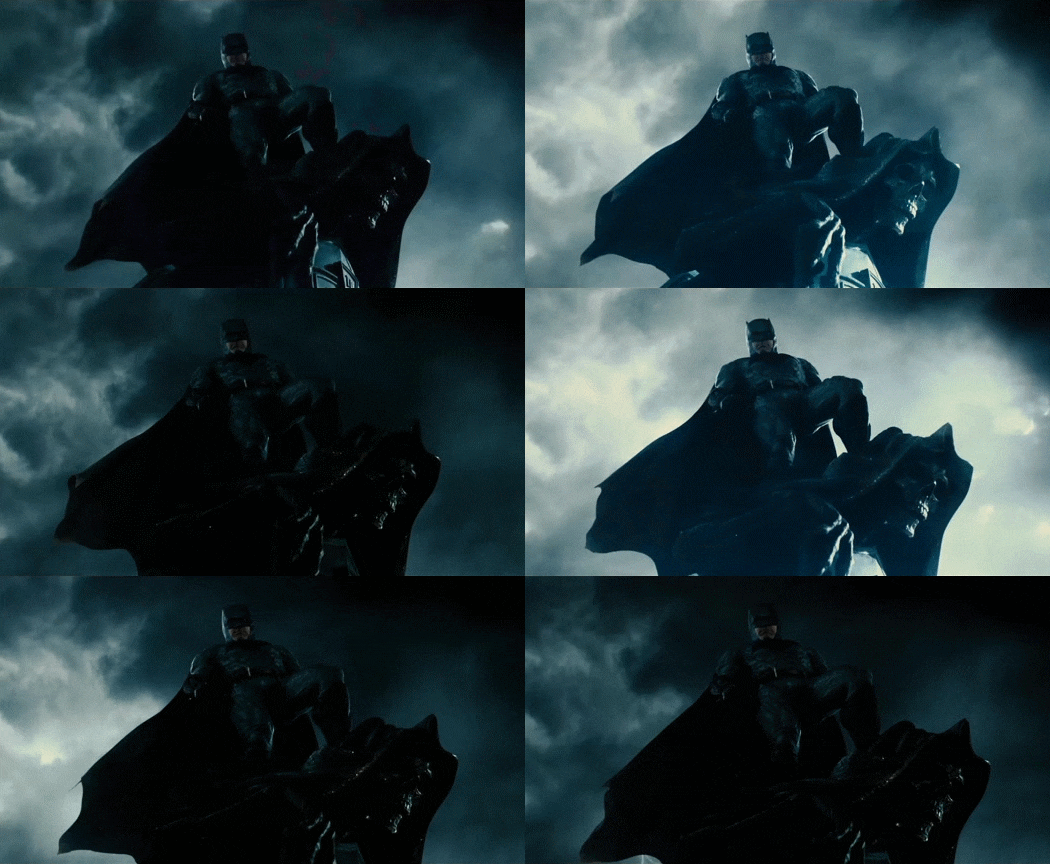
Zack Snyder had collaborated with cinematographer Larry Fong on four films - "300" (2007), "WATCHMEN" (2009), "SUCKER PUNCH" (2011) and especially, "BATMAN V. SUPERMAN: DAWN OF JUSTICE" (2016). For "JUSTICE LEAGUE", Synder ended up collaborating with Fabian Wagner, who had previously spent most of his career in television - especially HBO's "GAME OF THRONES". However, I am not that familiar with Wagner's previous work. But I must admit that I was impressed by his work in "JUSTICE LEAGUE". His work proved to be a bit brighter than Fong's work in "BATMAN V. SUPERMAN". This is not that surprising, considering that the movie's narrative is slightly less angsty than the 2016 film. But I was especially impressed by his photography of the film's protagonists, as shown below:
"JUSTICE LEAGUE" (2017) Review
The D.C. Comics Extended Universe (DCEU) released its fifth film utilizing several characters that were either featured or hinted in its previous four films during the fall of 2017. Directed by Zack Snyder (well, most of it), "JUSTICE LEAGUE" proved to be an even more controversial entry than two of its previous films. Only for different reasons.
Set some time after the present-day events of "WONDER WOMAN", "JUSTICE LEAGUE" begins with the Gotham City costumed vigilante Batman aka Bruce Wayne attempting to arrest a thief. However, his efforts are interrupted by the arrival of an alien creature known as a parademon. Realizing that he had dreamed of a similar creature in "BATMAN V. SUPERMAN: DAWN OF JUSTICE", Batman realizes that Earth is about to face another alien threat. Before he can summon Wonder Woman aka Diana Prince, she learns of an even bigger threat from her mother, Queen Hippolyta of Themyscira. A former foe known as Steppenwolf has arrived on Earth to acquire the three Mother Boxes, sentient, miniaturized, portable supercomputers from his homeworld of Apokolips. One of the boxes had been guarded by the Amazons of Themyscira for thousands of years. The pair decides to find the other metahumans - Barry Allen aka the Flash, Victor Stone aka Cyborg (whose body was cured by a Mother Box) and Arthur Curry aka Aquaman - and form a team to fight against Steppenwolf. Bruce manages to easily recruit the Flash, but is unable to recruit Aquaman. And Diana encounters difficulty in recruiting Cyborg. But when Steppenwolf manages to acquire the second Mother Box in Aquaman's world of Atlantis, the "King of the Seven Seas" decides to join the newly formed Justice League to defeat the alien from Apokolips. However, it is not long before the League realizes they need a sixth member to help them defeat Steppenwolf - namely the recently deceased Superman.
Ever since the release of "MAN OF STEEL" in 2013, critics and some moviegoers have been highly critical of the DCEU. With the exception of "WONDER WOMAN", the franchise's movies have either received mixed reviews or panned. In the case of "JUSTICE LEAGUE", it has been panned . . . perhaps even more so than the other four films. Personally, I have been a major fan of the DCEU films before "JUSTICE LEAGUE". Do I believe the movie deserved to panned? Honestly? No. But I do feel that "JUSTICE LEAGUE" is probably the first DCEU film toward which I felt some disappointment.
There was a good deal from "JUSTICE LEAGUE" that I enjoyed. The creation of the Justice League began when Superman, Batman and Wonder Woman formed a team to battle Lex Luthor's creation, Doomsday, in "BATMAN V. SUPERMAN: DAWN OF JUSTICE". This creation continued with Bruce Wayne and Diana Prince's recruitment of the Flash, Cyborg and Aquaman. And if I must be honest, I enjoyed how the movie's screenplay took its time in fusing these characters into the League. I found this especially satisfying, since both Cyborg and Aquaman proved rather difficult to recruit. What finally drove them all together as a team proved to be the threat of Steppenwolf.
This leads me to something else I enjoyed about the film. Steppenwolf's acquisition of two Mother Boxes provided some first-rate action sequences featuring the Amazons on Themyscira and the Atlantis inhabitants' efforts to stop him. And they did not make it easy for him. I especially enjoyed the sequence featuring Steppenwolf's theft of the Mother Box on Themyscira. There were other action sequences that enjoyed. One of them included the League's first encounter with Steppenwolf inside an abandoned facility near the Gotham City Harbor. I also enjoyed the League's second attempt to defeat Steppenwolf and his Parademon army at a small Russian village, where the Apokoliptian planned to fuse the three Mother Boxes and terraform the Earth's surface. I also enjoyed an early action sequence that featured Wonder Woman's confrontation with a group of terrorists in London. But for me, my favorite action sequence featured the League's confrontation with a recently resurrected and amnesiac Superman. Although I found it rather scary, thanks to Henry Cavill's chilling performance, there was a comedic moment that I found very funny.
As much as I enjoyed most of the film's action sequences, I found a good deal of its comedic and dramatic moments even more satisfying. It seemed pretty obvious to me that the film's two comedy relief characters were Barry Allen aka the Flash and Arthur Curry aka Aquaman. And I found both characters more than satisfactory, thanks to Ezra Miller and Jason Momoa's performances. Miller's Barry Allen was an extroverted and nervous personality that was at odds with his inability to easily befriend others. This was especially apparent in one scene that featured the initial meeting between Barry and Bruce Wayne at the former's abode and his attempts to befriend Victor Stone aka Cyborg. But the one scene that truly made me appreciate Miller's comedic talent occurred when the League clashed with a resurrected, yet amnesiac Superman and the Flash attempted to attack the Man of Steel from behind . . . and failed. Jason Momoa's portrayal of Arthur Curry also provided a good deal of the movie's comedic moments. Momoa's portrayal of the blunt and cynical King of the Seven Seas practically had me in stitches. But I especially enjoyed that moment when Aquaman unexpectedly went into a comedic spiel about fighting Steppenwolf and his appreciation for Wonder Woman . . . unaware that he was sitting on her Lasso of Truth.
However, there were many dramatic moments that made me happily realize that "JUSTICE LEAGUE" was not all comedy and action. The movie's opening credits featured a poignant montage that revealed the world's grief over Superman's death. One particular scene - a homeless man holding a "I TRIED" sign next to him - really resonated within me. I thought Martha Kent's visit to Lois Lane in Metropolis and the two women's shared grief over Clark/Superman's demise was particularly poignant, thanks to Diane Lane and Amy Adams' performances. I particularly enjoyed one scene that featured a tense conversation between Cyborg and his father, Dr. Silas Stone over the latter's decision to use a Mother Box to save the former's life. May I be frank? Both Ray Fisher, who portrayed the superhero and Joe Morton, who portrayed his father, really knocked it out of the ballpark in this scene. I was not that impressed by the CGI used for the Steppenwolf character. But I must admit that I enjoyed Ciarán Hinds' voice performance for the villain. The actor projected a good deal of style and menace into the character.
I enjoyed Clark's reunion with both Lois and Martha. Although I feel that it was a bit too brief for my tastes, I cannot deny that I found it emotionally satisfying. And I enjoyed the tense conversation between Aquaman and future love interest, Mera of Atlantis. The scene seemed to give audiences a preview of the screen dynamics between Momoa and Amber Heard, who portrayed Mera. But if I had to pick my favorite dramatic moment in "JUSTICE LEAGUE", it would have to be the scene that featured Bruce Wayne and Diana Prince's conversation regarding his continuing guilt over his past attempt to kill Superman and her lingering grief over the death of her former lover/colleague, Steve Trevor. Thanks to superb and subtle performances from Ben Affleck and Gal Gadot, the scene was a tense and angst-riddled moment that I truly enjoyed.
Zack Snyder had collaborated with cinematographer Larry Fong on four films - "300" (2007), "WATCHMEN" (2009), "SUCKER PUNCH" (2011) and especially, "BATMAN V. SUPERMAN: DAWN OF JUSTICE" (2016). For "JUSTICE LEAGUE", Synder ended up collaborating with Fabian Wagner, who had previously spent most of his career in television - especially HBO's "GAME OF THRONES". However, I am not that familiar with Wagner's previous work. But I must admit that I was impressed by his work in "JUSTICE LEAGUE". His work proved to be a bit brighter than Fong's work in "BATMAN V. SUPERMAN". This is not that surprising, considering that the movie's narrative is slightly less angsty than the 2016 film. But I was especially impressed by his photography of the film's protagonists, as shown below:
 One would be inclined to wonder why I had regarded "JUSTICE LEAGUE" as something of a disappointment, due to my positive comments on it. Well . . . I had problems with the film. Hell, I have expressed quibbles for about every comic book movie I have seen. My first problem with "JUSTICE LEAGUE" there were times when it seemed I was viewing a movie with two directors . . . with two different styles. Well of course the movie seemed to possess two different director. As everyone knows, Zack Snyder had experienced a family tragedy while dealing with the film's post-production. Unable to continue, he asked Joss Whedon, who had directed the two Avengers films for Marvel/Disney, to complete the post-production reshoots, using his notes. Well . . . Whedon did more than that. At the behest of the Warner Brothers executives, he chopped out a good deal of Snyder's work, re-shot and re-wrote at least 30 percent of the movie in a similar style he had used for the Avengers films. In the end, there were times when "JUSTICE LEAGUE" seemed like a DCEU film trying to look like a Marvel Cinematic Universe (MCU) movie. I found this very confusing - especially in the film's third and final act.
One of the results of this hack job by Whedon and Warner Brothers, was the decision to change the film's composer. They tossed out Junkie XL (who had co-written the "BATMAN V. SUPERMAN" score with Hans Zimmer)'s score and hired Danny Elfman to replace it. Now . . . I have been a fan of some of Elfman's work for years. But what he did for this film's score? As far as I am concerned . . . nothing. Elfman fell back on the nostalgia factor by utilizing his old score from the two Batman films directed by Tim Burton. Worse, there was a moment following Superman's resurrection - I do no know if this happened or not, but I could have sworn that right after the resurrection or when the Man of Steel confronted Steppenwolf for the first time - Elfman even used a few bars from John Williams' score for the 1978 film, "SUPERMAN: THE MOVIE". All I can say that it was a very cringe-worthy moment for me.
Speaking of Superman . . . what in the hell happened? Granted, I really enjoyed the sequences featuring his resurrection, his clash with the League's other members and his reunions with Lois and Martha. But once Superman joined the League's battle against Steppenwolf . . . I just do not know what happened. It seemed as if someone - I suspect it was Whedon - tried to transform him into Christopher Reeve's version of the Man of Steel. Ugh! Look, Chris Reeve's Superman was fine for the late 20th century. But we are nearing the end of the 2010s. Henry Cavill had managed to establish his own version of Superman. There was no need to force him to copy another actor's style. One other fact bothered me. I am referring to the questionable CGI that tried to hide the mustache he was sporting, while filming "MISSION: IMPOSSIBLE - FALLOUT". Apparently, Paramount Studios refused to allow Cavill to shave the moustache for the "JUSTICE LEAGUE" re-shoots. Between the cringe-worthy grinning, the cheesy dialogue and that ridiculous race against the Flash in the first post-credit scene, I simply found myself feeling sorry for Henry Cavill. In fact, either Snyder or Whedon (I suspect the latter) tried to lighten up Affleck's performance as Batman by forcing the latter to spew some pretty lame jokes. Poor man. In their attempt to transform the movie into an Avengers film, the Warner Brothers suits damn near sabotaged both the Man of Steel and the Dark Knight.
But for me, the real problem proved to be the film's last act. It brought back bad memories of the last act of the 2015 movie, "THE AVENGERS: AGE OF ULTRON". The entire sequence featuring the Justice League's battle against Steppenwolf and the latter's parademon army at some Russian village struck me as simply confusing. It was beyond confusing. Between the questionable editing, the unattractive lighting, and the rushed action, I simply found the entire sequence hard to swallow. I can only thank God that Russian village was not rising in the sky, while the Justice League battle Steppenwolf. That shit would have been even more difficult to swallow. The first post-credit scene featuring Superman and the Flash's race to see who was the fastest did not help. Why is it so damn important in a D.C. Comics movie or television production to show a Kryptonian (whether it was Superman or Supergirl) in a race with the Flash? I disliked it in this movie and I disliked it in a Season One episode of the Arrowverse's "SUPERGIRL". Fortunately, the second post-credit scene nearly made up for the film's last thirty minutes or so. I will say that it involved Lex Luthor and one of Batman's former foes, Slade Wilson aka Deathstroke. It proved to be a great surprise.
So, there you have it. Do not get me wrong. "JUSTICE LEAGUE" provided some great action scenes and dramatic moments. It also featured some excellent performances, as well. However, it is quite obvious that the Warner Brothers executives and Joss Whedon made a serious mistake in ignoring Zack Snyder's post-production instructions and trying to transform the movie into their own version of a Marvel Cinematic Universe (MCU) film. In a way, they did. "JUSTICE LEAGUE" strongly reminded me of Marvel's 2015 movie, "THE AVENGERS: AGE OF ULTRON" - both the good and the bad.
One would be inclined to wonder why I had regarded "JUSTICE LEAGUE" as something of a disappointment, due to my positive comments on it. Well . . . I had problems with the film. Hell, I have expressed quibbles for about every comic book movie I have seen. My first problem with "JUSTICE LEAGUE" there were times when it seemed I was viewing a movie with two directors . . . with two different styles. Well of course the movie seemed to possess two different director. As everyone knows, Zack Snyder had experienced a family tragedy while dealing with the film's post-production. Unable to continue, he asked Joss Whedon, who had directed the two Avengers films for Marvel/Disney, to complete the post-production reshoots, using his notes. Well . . . Whedon did more than that. At the behest of the Warner Brothers executives, he chopped out a good deal of Snyder's work, re-shot and re-wrote at least 30 percent of the movie in a similar style he had used for the Avengers films. In the end, there were times when "JUSTICE LEAGUE" seemed like a DCEU film trying to look like a Marvel Cinematic Universe (MCU) movie. I found this very confusing - especially in the film's third and final act.
One of the results of this hack job by Whedon and Warner Brothers, was the decision to change the film's composer. They tossed out Junkie XL (who had co-written the "BATMAN V. SUPERMAN" score with Hans Zimmer)'s score and hired Danny Elfman to replace it. Now . . . I have been a fan of some of Elfman's work for years. But what he did for this film's score? As far as I am concerned . . . nothing. Elfman fell back on the nostalgia factor by utilizing his old score from the two Batman films directed by Tim Burton. Worse, there was a moment following Superman's resurrection - I do no know if this happened or not, but I could have sworn that right after the resurrection or when the Man of Steel confronted Steppenwolf for the first time - Elfman even used a few bars from John Williams' score for the 1978 film, "SUPERMAN: THE MOVIE". All I can say that it was a very cringe-worthy moment for me.
Speaking of Superman . . . what in the hell happened? Granted, I really enjoyed the sequences featuring his resurrection, his clash with the League's other members and his reunions with Lois and Martha. But once Superman joined the League's battle against Steppenwolf . . . I just do not know what happened. It seemed as if someone - I suspect it was Whedon - tried to transform him into Christopher Reeve's version of the Man of Steel. Ugh! Look, Chris Reeve's Superman was fine for the late 20th century. But we are nearing the end of the 2010s. Henry Cavill had managed to establish his own version of Superman. There was no need to force him to copy another actor's style. One other fact bothered me. I am referring to the questionable CGI that tried to hide the mustache he was sporting, while filming "MISSION: IMPOSSIBLE - FALLOUT". Apparently, Paramount Studios refused to allow Cavill to shave the moustache for the "JUSTICE LEAGUE" re-shoots. Between the cringe-worthy grinning, the cheesy dialogue and that ridiculous race against the Flash in the first post-credit scene, I simply found myself feeling sorry for Henry Cavill. In fact, either Snyder or Whedon (I suspect the latter) tried to lighten up Affleck's performance as Batman by forcing the latter to spew some pretty lame jokes. Poor man. In their attempt to transform the movie into an Avengers film, the Warner Brothers suits damn near sabotaged both the Man of Steel and the Dark Knight.
But for me, the real problem proved to be the film's last act. It brought back bad memories of the last act of the 2015 movie, "THE AVENGERS: AGE OF ULTRON". The entire sequence featuring the Justice League's battle against Steppenwolf and the latter's parademon army at some Russian village struck me as simply confusing. It was beyond confusing. Between the questionable editing, the unattractive lighting, and the rushed action, I simply found the entire sequence hard to swallow. I can only thank God that Russian village was not rising in the sky, while the Justice League battle Steppenwolf. That shit would have been even more difficult to swallow. The first post-credit scene featuring Superman and the Flash's race to see who was the fastest did not help. Why is it so damn important in a D.C. Comics movie or television production to show a Kryptonian (whether it was Superman or Supergirl) in a race with the Flash? I disliked it in this movie and I disliked it in a Season One episode of the Arrowverse's "SUPERGIRL". Fortunately, the second post-credit scene nearly made up for the film's last thirty minutes or so. I will say that it involved Lex Luthor and one of Batman's former foes, Slade Wilson aka Deathstroke. It proved to be a great surprise.
So, there you have it. Do not get me wrong. "JUSTICE LEAGUE" provided some great action scenes and dramatic moments. It also featured some excellent performances, as well. However, it is quite obvious that the Warner Brothers executives and Joss Whedon made a serious mistake in ignoring Zack Snyder's post-production instructions and trying to transform the movie into their own version of a Marvel Cinematic Universe (MCU) film. In a way, they did. "JUSTICE LEAGUE" strongly reminded me of Marvel's 2015 movie, "THE AVENGERS: AGE OF ULTRON" - both the good and the bad.


