Showing posts with label henry stephenson. Show all posts

Monday, November 7, 2022

"LITTLE WOMEN" (1933) Review


"LITTLE WOMEN" (1933) Review

There have been many adaptations of Louisa May Alcott's 1868-69 best-selling two-volume novel, "Little Women". And I mean many adaptations - on stage and in movies and television. I have personally seen three television adaptations and four movie adaptations. One of the most famous versions of Alcott's novel is the 1933 movie adaptation, produced by Merian C. Cooper and directed by George Cukor.

Although I have seen at four adaptations more than once, I had just watched this version for the very first time. Judging from the reviews and articles I have read, Cukor's "LITTLE WOMEN" seemed to be the benchmark that all other versions are based upon. So, you could imagine my anticipation about this film before watching it. How did I feel about "LITTLE WOMEN"? That would require a complicated answer.

"LITTLE WOMEN" told the story of the four March sisters of Concord, Massachusetts - Margaret (Meg), Josephine (Jo), Elizabeth (Beth) and Amy - during and after the U.S. Civil War. Since second daughter Jo is the main character, the story focuses on her relationships with her three other sisters, her parents (especially her mother "Marmee"), the sisters' Aunt March, and the family's next-door neighbors, Mr. James Laurence and his grandson Theodore ("Laurie"). Although each sister experiences some kind of coming-of-age throughout the story, the movie focuses on Jo's development through her relationship with Laurie and a German immigrant she meets in New York City after the war, the charming and older Professor Friedrich Bhaer. Jo and her sisters deal with the anxiety of their father's involvement in the Civil War, genteel poverty, scarlet fever, wanted and unwanted romance, and Jo's fear of dealing the family breaking apart as she and her sisters grow older.

I must saw that the production values for "LITTLE WOMEN" were certainly top-notch. One has to credit producer Merian C. Cooper in gathering a team of excellent artists to re-create 1860s Massachusetts and New York for the movie. I was especially impressed by Van Nest Polglase's art direction, Sydney Moore and Ray Moyer's set decorations and art direction team of Hobe Erwin, George Peckham, and Charles Sayers. However, I simply have to single out Walter Plunkett's excellent costume designs for the film. I doubt very much that Plunkett's costumes were an accurate depiction of 1860s fashion, I believe he came close enough. Plunkett's career also included work for 1939's "GONE WITH THE WIND""RAINTREE COUNTY", from 1957 and the 1949 version of "Little Women". I suspect that this film marked his debut for designing costumes for the mid-19th century. I did have a problem with the hairstyles worn by three of the four leads. A good deal of early 1930s hairstyles seemed to have been used - with the exception of the short bob. At least three of the actresses wore bangs . . . a lot. Bangs were not popular with 19th century women until the late 1870s and the 1880s.

Until the release of the 2019 film, George Cukor's adaptation of Alcott's novel has been considered the best by many film critics. Do I agree with this assessment? Well, I cannot deny that I had enjoyed watching "LITTLE WOMEN". One, producer Merian C. Cooper and director George Cukor did an excellent job in their selection of the cast - especially the four actresses who portrayed the March sisters. All four had excellent chemistry. The movie's portrayal of the U.S. Civil War and the years that followed it immediately struck me as pretty solid. And although there were moments when the film threatened to border on saccharine, I must admit that Cukor and the screenplay written by Victor Heerman and Sarah Y. Mason kept both the narrative and the film's pacing very lively. And finally, I enjoyed how the movie depicted Jo's friendship and romance with Professor Friedrich Bhaer. I found it warm, charming, romantic and more importantly . . . not rushed.

However, I do have a few issues with "LITTLE WOMEN". There were times when the movie, especially during its first half hour, seemed in danger of wallowing in saccharine. I get it. Alcott had portrayed the Marches as a warm and close-knit family. But Alcott had included minor conflicts and personality flaws in the family's portrait as well. It seemed as if director George Cukor, along with screenwriters Sarah Y. Mason and Victor Heerman were determined to whitewash this aspect of Alcott's novel as much as possible. This whitewashing led to the erasure of one novel's best sequences - namely Amy March's burning of Jo's manuscript in retaliation for an imagined slight, Amy's conflict with her schoolteacher, the development of Amy and Laurie's relationship in Europe, and Meg's conflict Aunt March over her relationship with tutor John Brooke. These deletions took a lot out of Alcott's story. It amazes me to this day that so many film critics have willingly overlooked this. Do not get me wrong. "LITTLE WOMEN" remained an entertaining film. But in erasing these aspects of Alcott's story, Cukor and the two screenwriters came dangerously close to sucking some of the life out of this film. Ironically, Mason and Heerman repeated their mistake in MGM's 1949 adaption with the same results.

Most critics and movie fans tend to praise Katherine Hepburn's portrayal of Jo March to the sky. In fact, many critics and film historians to this day have claimed Hepburn proved to be the best Jo out of all the actresses who have portrayed the character. Do I agree? No. Although I admired Hepburn's performance in the movie's second half, I found her portrayal of the adolescent Jo in the first half to be a mixed bag. There were times when I admired her spirited performance. There were other times when said performance came off as a bit too strident for my tastes. I honestly do not know what to say about Frances Dee's performance as Meg March. My problem is that I did not find her portrayal that memorable. I barely remember Dee's performance, if I must be honest. I cannot say the same about Joan Bennett's portrayal of the youngest March sibling, Amy. Mind you, Bennett never received the chance to touch upon Amy's less pleasant side of her nature. And it is a pity that the screenplay failed to give Bennett the opportunity to portray Amy's growing maturity in the film's second half. But I have to admit that as a woman who was roughly three years younger than Hepburn, she gave a more subtle performance as a pre-teen and adolescent Amy, than Hepburn did as the teenaged Jo. The one performance that really impressed me came from Jean Parker's portrayal of Beth March, the family's shyest member. I thought Parker did an excellent job of conveying Beth's warmth, fear of being in public and the long, slow death the character had suffered following a deadly bout of scarlet fever.

I can honestly say that Mrs. "Marmee" March would never be considered as one of my favorite Spring Byington roles. Mind you, the actress gave a competent performance as the March family's matriarch. However, there were times when she seemed too noble, good or too ideal for me to regard her as a human being. As is the case in most, if not all versions of "LITTLE WOMEN", the Mr. March character barely seemed alive . . . especially after he returned home from the war. I cannot blame actor Samuel S. Hinds, who portrayed. I blame the screenwriters for their failure to do the character any justice. On the other hand, I did enjoy Henry Stephenson's portrayal of the complicated, yet likeable Mr. Laurence. I enjoyed how Stephenson managed to slowly, but surely reveal the warm human being behind the aloof facade. Edna May Oliver gave a very lively performance as the irascible, yet wealthy Aunt March. In fact, I would go as far to say that her performance had breathed a great deal of fresh air into the production. Not many critics were impressed by Douglass Montgomery's portrayal of the March sisters' closes friend, Theodore "Laurie" Laurence. I can honestly say that I do not share their opinion. Frankly, I felt more than impressed by his portrayal of the cheeky, yet emotional Laurie. I thought he gave one of the film's better performances - especially in one scene Laurie reacted to Jo's rejection of his marriage proposal. I thought Montgomery did an excellent job of reacting emotionally to Jo's rejection, without going over the top. I also enjoyed Paul Lukas' interpretation of Professor Bhaer. There were moments when his performance threatened to get a little hammy. But the actor managed to reign in his excesses - probably more so than Hepburn. And he gave a warm and charming performance as the romantic Professor Bhaer.

Yes, I have some issues with this adaptation of "LITTLE WOMEN". If I must be honest, most of my issues are similar to my issues with the 1949 adaptation. This should not be surprising, since both movies were written by the same screenwriters - Sarah Y. Mason and Victor Heerman. However . . . like the 1949 movie, this "LITTLE WOMEN" adaptation proved to be a solid and entertaining adaptation of Louisa May Alcott's novel. One can thank Mason and Heerman, director George Cukor and the fine cast led by the talented Katherine Hepburn.


Monday, September 5, 2022

"LITTLE WOMEN" (1933) Photo Gallery


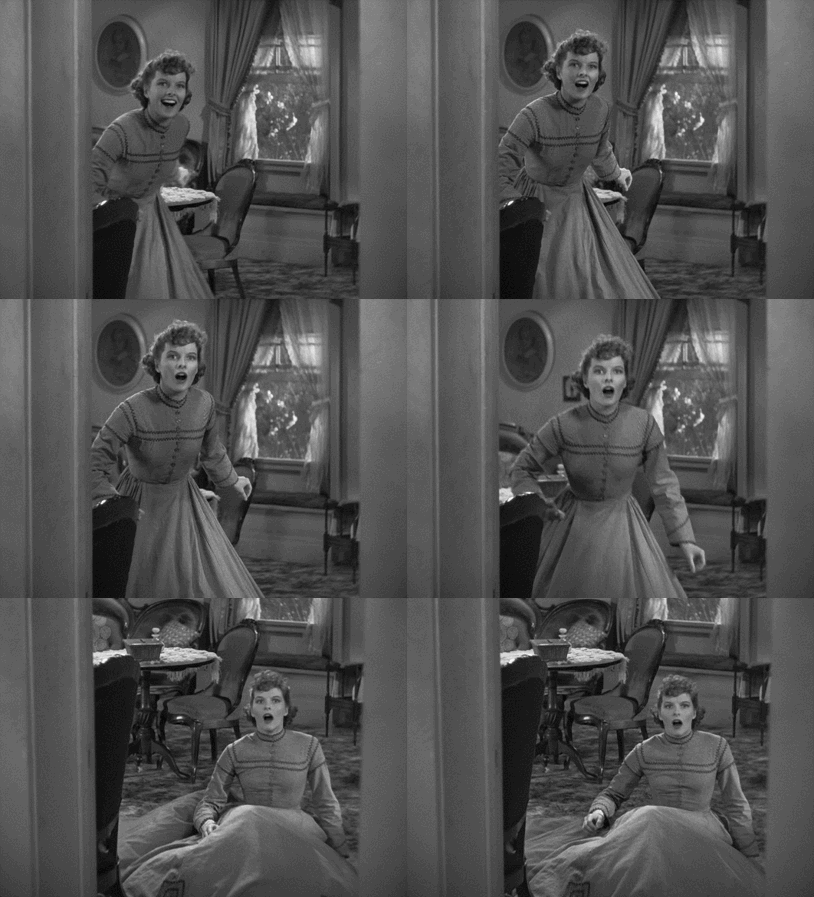
Below are images from "LITTLE WOMEN", the 1933 adaptation of Louisa May Alcott's 1868-69 novel. Directed by George Cukor, the Oscar nominated film starred Katherine Hepburn, Joan Bennett, Frances Dee, Jean Parker and Douglass Montgomery:


"LITTLE WOMEN" (1933) Photo Gallery


Friday, November 6, 2015

"RED-HEADED WOMAN" (1932) Review

39371_original


"RED-HEADED WOMAN" (1932) Review

According to Hollywood legend, at least a handful of movies made during the period known as the Pre-Code Era (1929-1934) had pushed the boundaries of on-screen decency so deeply that they may have been responsible for the stringent enforcement of the Hays Code between the mid-1930s and the late 1960s. One of those movies happened to be MGM's 1932 comedy called "RED-HEADED WOMAN"

Based upon Katherine Brush's 1931 novel, "RED-HEADED WOMAN" told the story of Lilian "Lil" Andrews, a young secretary at the Legendre Company who uses sex to advance her position there by instigating an affair with William "Bill" Legendre Jr., the son of her wealthy boss. During the course of the film, Lil engages in pre-marital sex, breaks up Bill's marriage to his ladylike wife Irene. After Lil marries Bill following his divorce, she finds herself shunned by high society due to not only her home wrecking, but also her lower-class origins. Lil tries to force herself into high society by seducing the Legendres' main customer, wealthy coal tycoon Charles B. Gaerste and blackmailing him into sponsoring her own party. But the plan backfires and a humiliated Lil sets upon a course that ends up threatening her tenuous marriage.

"RED-HEADED WOMAN" proved to be a difficult movie to make for MGM production chief Irving Thalberg. One, he did not care for F. Scott Fitzgerald's first draft, viewing it as too serious. Thalberg believed that the movie would be more of a success if it presented Lil's antics from a humorous bent, so he replaced Fitzgerald with Anita Loos as the movie's screenwriter. He hoped she would provide a story that was more fun and playful. And he proved to be right. Thalberg and associate producer Paul Bern originally hired Clara Bow for the role of "Lil" Andrews. Although she originally agreed to participate in the movie, Bow changed her mind due to her objections to the long-term contract that MGM wanted her to sign for the role. Thalberg and Bern then turned their attention to the studio's new contract player, Jean Harlow, whose contract they had recently purchased from Howard Hughes. Studio contract employee Jack Conway directed the film. Four weeks after production ended, the movie was released in late June 1932. 

In a nutshell, "RED-HEADED WOMAN" is a funny and sexy movie that holds up surprisingly well, even after eighty-one years. For me, "RED-HEADED WOMAN" is a humorous reminder at how little human nature has changed over the years, especially in regard to sex, gender issues, ambition and class bigotry. Used to the idea that single women eighty years ago (or even fifty years ago) never had pre-marital sex, "RED-HEADED WOMAN" must have seemed like a shock to the system to modern viewers. This makes me wonder how present moviegoers would view "RED-HEADED WOMAN", if it had been made in recent years. Think about it. "RED-HEADED WOMAN" featured pre-marital sex, extramarital sex, and rough sex (all which were featured off screen). If made today, most of Lil's sexual encounters would have made it in the final cut . . . along with some on-screen nudity. But for me, it is the story itself, along with actress Jean Harlow's amoral portaryal, that struck me as both sexy and lurid. I suspect that any on-screen sex and nudity would have very little impact on the movie. But I cannot help but wonder if today's writers would have given Lil her happening.

Thalberg was right to dump Fitzgerald's serious screenplay in favor of Loos' more risqué tale. I believe the latter served the story a lot better. Realistically, Lil Andrews is not a sympathetic character. And I suspect that if her tale had told in Fitzgerald's more serious style, the general moviegoers would have been turned off by her antics. And I doubt that the emotional crisis that Lil had suffered from Bill Legendre's first rejection of her following their first tryst or the class bigotry she had faced from her father-in-law and the Legendres' friends would have garnered any sympathy for her. A good number of morality groups from the early 1930s were up in arms over Lil's fate at the end of the movie. If Thalberg had chosen Fitzgerald's script over Loos', I suspect those moviegoers that had made "RED-HEADED WOMAN" such a big hit would have felt the same.

I did have a few problems with the movie. I realize that Thalberg, Loos and director Jack Conway thought it was best to introduce Lil Andrews'in a brief montage that featured Harlow spoofing the "Gentlemen prefer blondes" quote from Loos' famous 1925 novel and the actress wearing a see-through dress (honestly, not much is shown other than her legs). Frankly, I found this introduction rather amateurish and stagy. I think Loos could have done better. Also, the movie seemed to permeate with class prejudice. I realize that Lil was supposed to suffer from such bigotry. But the movie fails to generate any real sympathy toward her situation, due to Lil's role as a home wrecker. Even Lil's best friend, Sally, did not seem particularly repelled by Lil's antics. And it did not help that the movie's most sympathetic female turned out to be the gentle and well-born Irene Legendre. Even Bill Legendre seemed to be viewed in a sympathetic light as a mere victim of Lil's feminine wiles, instead of simply a cheating spouse. If Lil had not emerged triumphant in the movie's last reel, I believe this movie would have turned out to be a real turn off for me . . . despite the comic tone. 

The cast proved to be the best thing about "RED-HEADED WOMAN" . . . at least for me. Although Jean Harlow had become a star two years earlier, thanks to her co-starring role in Howard Hughes' wartime opus, "HELL'S ANGELS"; her career had eventually suffered through a series of questionable roles. Thankfully, Paul Bern saw her potential and convinced the MGM brass to purchase her contract from Hughes. And she was perfect as the amoral and sassy Lil Andrews. She was not the first or would be the last actress to portray a woman who used sex to advance her social position. But thanks to a performance that featured not only perfect comic timing and some surprisingly emotional angst, her Lil Andrews proved to be one of the most memorable female roles not only from the Pre-Code era, but also from 1930s Hollywood.

Harlow received admirable support from Chester Morris, who proved once again his talent for roles that projected a male ideal corrupted by man's inner lusts and other flaws. He did a very good job in combining both Bill Legendre's superficial decency and inner bestiality. Both Lewis Stone and Leila Hyams gave solid support as Bill's snobbish father Legendre Sr. and long-suffering first wife Irene. And I was somewhat surprised to see Charles Boyer in a small, yet charming role as Lil's eventual lover, Albert. But the two performances (other than Harlow and Morris) that really stood out for me came from Una Merkel and Henry Stephenson. Merkel was a delight as Lil's equally sassy friend, Sally, who seemed to enjoy a voyeuristic thrill from Lil's sexy love life. Also, she and Harlow managed to generate a strong chemistry as the two best friends. I wonder if they had made any further movies together. And Henry Stephenson, whom I remember from two Errol Flynn costume swashbucklers, provided some great comic moments as the Legendres' wealthy customer, who ends up in a tawdry affair with Lil.

"RED-HEADED WOMAN" is a comic gem from the early 1930s, despite a few kinks, including a class bigotry that nearly tainted the film. It featured a sexy tale and fine performances from a cast led by the incomparable Jean Harlow that still holds up after eighty years or so. As far as I am concerned, I consider it one of the highlights of the Pre-Code era. Producers Irving Thalberg and Paul Bern, screenwriter Anita Loos and director Jack Conway took on an improbable project and transformed it into a minor classic.

Sunday, October 18, 2015

"RED-HEADED WOMAN" (1932) Photo Gallery

Annex - Harlow, Jean (Red-Headed Woman)_01

Below are images from "RED-HEADED WOMAN", the 1932 adaptation of Katharine Brush's 1931 novel. Directed by Jack Conway and adapted by Anita Loos, the movie starred Jean Harlow and Chester Morris: 


"RED-HEADED WOMAN" (1932) Photo Gallery

Red-HeadedWoman1932DVDRipSiRiUss-12


Annex - Harlow, Jean (Red-Headed Woman)_03


Annex - Harlow, Jean (Red-Headed Woman)_NRFPT_02


Annex - Harlow, Jean (Red-Headed Woman)_NRFPT_04


blog pic 2


blog pic 4


blog pic 7


harlow-morris-red-headed_opt


kinopoisk.ru-Red-Headed-Woman-1323557


kinopoisk.ru-Red-Headed-Woman-1323558


kinopoisk.ru-Red-Headed-Woman-1323559


Red-HeadedWoman1932DVDRipSiRiUss-8


Red-HeadedWoman1932DVDRipSiRiUss-10

Monday, March 2, 2009

”THE CHARGE OF THE LIGHT BRIGADE” (1936) Review


”THE CHARGE OF THE LIGHT BRIGADE” (1936) Review

How is it that a movie about one of the most famous blunders in British military history could remain so entertaining after nearly 72 years? Can someone explain this? Warner Brothers’ take on the famous Charge of the Light Brigade, in which the Light Brigade of the British cavalry charged straight into the valley between the Fedyukhin Heights and the Causeway Heights during the Crimean War, is not what one would call historically accurate. Most of the movie took place in British occupied Northern India in the 1850s. Aside from the last twenty or thirty minutes, the movie really has nothing to do with the Crimean War. And yet . . . who cares? "THE CHARGE OF THE LIGHT BRIGADE" is so damn entertaining that I found myself not even thinking about historical accuracy.

Directed by Michael Curtiz, and written by screenwriters Michael Jacoby and Rowland Leigh; the movie is an entertaining mixture about vengeance against the leader of a treacherous local tributary rajah in Northern India named Surat Khan (C. Henry Gordon); and a love triangle between Geoffrey and Perry Vickers - two brothers who are British Army officers (Errol Flynn and Patric Knowles) who happened to be in love with the same woman – the daughter of a British general (Olivia DeHavilland) named Elsa Campbell. I might as well start with the love story.

On the surface, the love triangle in ”THE CHARGE OF THE LIGHT BRIGADE” seemed pretty simple – one woman torn between two men. Instead of having two best friends in love with the same woman, we have two brothers. But even that is nothing unusual. What turned out to be so unusual about this particular love story – especially in an Errol Flynn movie – is that the leading lady is NOT in love with the leading man. Within fifteen minutes into the story, the movie revealed that the leading man – namely Flynn – lost the affections of the leading woman (and fiancée) – De Havilland – to the secondary male lead – namely Knowles.

At first, it boggled in the mind. What woman in her right mind would prefer Patric Knowles over Errol Flynn? The latter had a more flamboyant character and was obviously the movie’s main hero. However . . . Knowles was not exactly chopped liver. Knowles was just as handsome as Flynn in his own way and a competent actor to boot. And his character – although less flamboyant than Flynn’s – had a quiet charm of its own. I also got the feeling that Flynn’s character seemed more in love with his job as an Army officer during the British Raj than he was with dear Elsa. Geoffrey Vickers seemed to have it all . . . until his brother Perry and Elsa’s little romance pulled the rug from under his self-assured life. And yet, he seemed damn reluctant to admit that Elsa loved Perry more than him. Reluctant may have been a mild word. Geoffrey seemed downright delusional in his belief that Elsa loved him only . . . and that Perry was merely harboring an infatuation for his fiancée. What made matters worse was that everyone – including Elsa’s father (Donald Crisp) and diplomat Sir Charles Macefield (Henry Stephenson) – supported Geoffrey’s illusions. Only Lady Octavia Warrenton (Spring Byington), wife of British General Sir Benjamin Warrenton (Nigel Bruce) seemed aware of Elsa and Perry’s feelings for one another.

Before I discuss the movie in general, I want to focus upon the cast. Flynn, DeHavilland and Knowles were ably supported by a talented cast drawn from the British colony in 1930s Hollywood (with the exception of two). American-born Spring Byington and British actor Nigel Bruce were charmingly funny as the verbose busybody Lady Octavia Warrenton and her husband, the long-suffering Sir Benjamin. They made a surprisingly effective screen pair. Donald Crisp was his usual more than competent self as Elsa’s loving, but humorless father, Colonel Campbell – a by-the-book officer unwilling to accept that his daughter had switched her affections to the younger Vickers brother. Henry Stephenson gave an intelligent performance as the competent diplomat, Sir Charles Macefield, who is charged with not only keeping the peace, but maintaining British control in a certain province of Northern India. It was easy to see why Flynn’s character seemed to hold him in high regard. David Niven was charming, but not very memorable as Geoffrey Vicker’s best friend, James Randall. Only in one scene – in which Randall volunteers to leave the besieged Chukoti Fort in order to warn Sir Benjamin at Lohara of Surat Khan’s attack – did Niven give a hint of the talent that would eventually be revealed over the years. And of course, one cannot forget American actor C. Henry Gordon’s portrayal of the smooth-talking villain, Surat Khan. Gordon could have easily portrayed Khan as another ”Oriental villain” that had become typical by the 1930s. On one level, Gordon’s Khan was exactly that. On another . . . Gordon allowed moviegoers to see Khan’s frustration and anger at the British handling of his kingdom.

Olivia DeHavilland once again proved that even in a costumed swashbuckler, she could portray an interesting female character without sinking into the role of the commonplace damsel-in-distress. With the exception of the sequence featuring the Siege of Chokoti, her Elsa Campbell spent most of the movie being torn between the man she loved – Perry Vickers, the man she has remained fond of – Geoffrey Vickers, and her father’s determination that she marry Geoffrey. Elsa spent most of the movie as an emotionally conflicted woman and DeHavilland did an excellent job of portraying Elsa’s inner conflicts with a skill that only a few actresses can pull off. And DeHavilland was merely 20 years old at the time she shot this film.

I really enjoyed Patric Knowles’ performance in this movie. Truly. One, he managed to hold himself quite well against the powerhouse of both Flynn and DeHavilland. I should not have been surprised. His performance as a sleazy Southern planter in 1957’s ”BAND OF ANGELS” was one of the bright spots in an otherwise mediocre film. And two, his Perry Vickers was a character I found easy to root for in his pursuit of Elsa’s hand. I especially enjoyed two particular scenes – his desperate, yet charming attempt to be assigned to Chokoti (and near Elsa), despite Sir Charles’ disapproval; and his anger and frustration over Geoffrey’s unwillingness to face the fact that Elsa’s affections had switched to him.


There are four movie performances by Errol Flynn that have impressed me very much. Three of those performances were Geoffrey Thorpe in ”THE SEA HAWK” (1940), James J. Corbett in ”GENTLEMAN JIM” (1942) and Soames Forsyte in ”THAT FORSYTE WOMAN” (1949). The fourth happens to be his performance as Captain/Major Geoffrey Vickers in ”THE CHARGE OF THE LIGHT BRIGADE”. Not many film critics or fans have ever paid attention to his performance in this film, which is a pity. I suspect they were so flabbergasted by the idea of him losing Olivia DeHavilland to Patric Knowles that they had failed to pay any real attention to his performance as the complex and slightly arrogant Geoffrey Vickers. Superficially, Flynn’s Vickers is a charming, witty and very competent military officer. He seemed so perfect at the beginning of the film that it left me wondering if there were in cracks in his characters. Sure enough, there were. Thanks to a well written character and Flynn’s skillful performance, the movie’s Geoffrey Vickers became a complex, yet arrogant man who discovers that he is not very good at letting go at things that seem important to him, whether it was Elsa’s love or a desire for revenge against the villain. In the end, Geoffrey’s flaws became the instrument of his destruction. The amazing thing about Flynn’s performance as Geoffrey Vickers was that it was his second leading role. And the fact that he managed to portray such a complex character, considering his limited screen experience at the time, still amazes me.


As I had stated before, the movie’s historical account of the Crimean War and the infamous charge hardly bore any resemblance to what actually happened. The movie seemed to be about the British’s interactions with a Northern Indian minor rajah named Surat Khan. The British, led by diplomat Sir Charles Macefield, struggle to maintain a “friendly” relationship with Khan, while his men harass British troops in the area and he develops a friendship with a visiting Russian Army officer Count Igor Volonoff (Robert Barrat). The phony friendship and minor hostilities culminated in an attack by Khan against one of the British forts in his province – Chukoti, which is under the command of Colonel Campbell. The battle for Chukoti eventually turned into a massacre that only Geoffrey and Elsa survived. But more interesting, it seemed like a reenactment of an actual siege and massacre that happened at a place called Cawnpore, during the Sepoy Rebellion of 1857-58 . . . three to four years after the setting of this movie. For a movie that is supposed to be about the Light Brigade Charge and the Crimean War, it was turning out to be more of a fictional account of British history in India during the 1850s.

But the movie eventually touched upon the Crimean War. After the Chukoti Massacre, Surat Khan ended up in hot water with the British government in India. Due to his friendship with Volonoff, he found refugee with the Russians. And he ended up as a guest of the Russian Army during the Crimean War. Following her father’s death, Elsa finally convinced Geoffrey that she is in love with Perry. And the regiment of both brothers – the 27th Lancers – is also sent to Crimea. According to Sir Charles, their posting to the Crimea would give them an opportunity for revenge against Khan. But when the 27th Lancers finally received an opportunity to get their revenge against Khan, Sir Charles denied it. And so . . . Geoffrey took matters in his own hands and ordered the Light Brigade – which included his regiment – and the Heavy Brigade to attack the artillery on the heights above the Balaklava Valley. This is so far from what actually happened . . . but who cares? I enjoyed watching Flynn express Geoffrey’s struggles to contain his thirst for revenge and eventual failure.

And then the charge happened. My God! Every time I think about that sequence, I cannot believe my eyes. Part of me is horrified not only by the blunder caused by Geoffrey’s desire for revenge . . . but by the fact that 200 horses and a stuntman were killed during the shooting of that scene. Flynn had been so outraged by the deaths of the horses that he openly supported the ASPCA’s ban on using trip wire for horses for any reason. At the same time, I cannot help but marvel at the brutal spectacle of that scene. No wonder Jack Sullivan won the Academy Award for Best Assistant Director for his work on this particular scene.

On the whole, ”THE CHARGE OF THE LIGHT BRIGADE” is a very entertaining and well-paced spectacle. Frankly, I think that it was one of the best movies to be released during the 1930s and certainly one of Errol Flynn’s finest films. For those who honestly believed that the Australian actor could not act . . . well, they are entitled to their opinions. But I would certainly disagree with them. On the surface, Flynn seemed like his usual charming and flamboyant self. However, I was very impressed at his portrayal of the self-assured and slightly arrogant Geoffrey Vickers, who found his private life slowly falling apart. Olivia DeHavilland, Patric Knowles, Donald Crisp, C. Henry Gordon and Spring Byington gave him excellent support. Thanks to Jacoby and Leigh’s script, along with Michael Curtiz’s tight direction, ”THE CHARGE OF THE LIGHT BRIGADE” turned out to be a first-class movie with an interesting love story with a twist, political intrigue, well-paced action and a final sequence featuring the charge that remains mind blowing, even after 71 years.

Monday, November 3, 2008

"THE CHARGE OF THE LIGHT BRIGADE" (1936) Photo Gallery


"THE CHARGE OF THE LIGHT BRIGADE" (1936) Photo Gallery

Almost four months ago, I had written a review of the 1936 version of "THE CHARGE OF THE LIGHT BRIGADE" that starred Errol Flynn, Olivia de Havilland and Patric Knowles. I finally managed to gather a collection of photos and publicity stills from the movie. As they say . . . better late than never: