Showing posts with label patsy kensit. Show all posts

Friday, June 12, 2020

"SILAS MARNER" (1985) Review


"SILAS MARNER" (1985) Review

I have seen a handful of television and movie adaptations of novels written by George Eliot. But the very first adaptation I ever saw was "SILAS MARNER", the 1985 version of Eliot's third novel published back in 1861. My recent viewing of the production led me to reasses it.

"SILAS MARNER" begins with an English weaver living with a small Calvinist congregation in Lantern Yard, a slum street in a Northern England city. His life falls apart when he is framed for stealing the church's funds, while watching over the congregation's ill deacon. Worse, his fiancee leaves him for his so-called best friend, the very man who may have framed him. Shattered and embittered, Silas leaves Lantern Yard and arrives at a rural village in the Midlands called Raveloe. Although he resumes his trade as a weaver, Silas' traumatized past leads him to achieve a reputation as a miser and a loner in the community.

Silas' move to Raveloe eventually leads him to cross paths with the community's leading citizens, the Cass family. The head of the latter is the elderly Squire Cass who has two sons - Godfrey and Dunstan. Godfrey, who is the squire's heir is secretly married to one Molly Farren, a lower-class woman and opium addict from another town, who has given birth to his young daughter. Godfrey is also engaged to a young middle-class woman named Nancy Lammeter. Dunstan is a dissolute wastrel who constantly loses money via excessive gambling. One night, a drunken Dunstan breaks into Silas' cottage, steals the gold coins that the latter has been hoarding and disappears. Through a series of events, Molly plots to expose her marriage to Godfrey and their child during the Cass family's New Year party, but dies in the snow before she can reach it. Silas, who is emotionally upset over the loss of his coins, finds both the dead Molly and the child. Although he informs the partygoers of Molly's death and the child, he assumes guardianship of the latter (renamed Hephzibah "Eppie"), much to the relief of Godfrey, who can now legally marry Nancy. All goes well until Godfrey and Nancy's failure to have children threaten Silas' newfound happiness as Eppie's father years later.

What can I say about "SILAS MARNER"? I can honestly say that it was not one of the best adaptations of a George Eliot novel. Then again, I do not consider the 1861 novel to be one of her best works. I realized that Eliot had set the story either around the end of the 18th century or around the beginning of the 19th century. It was her prerogative. But both the novel and the movie seemed to reek of Victorian melodrama that I found myself feeling that Eliot or any adaptation could have set the story around the time it was originally written and published - the mid 19th century. The story is, at best, a good old-fashioned Victorian melodrama. I would never consider it as particularly original in compare to the likes of "MIDDLEMARCH" or "DANIEL DERONDA".

"SILAS MARNER" tries its best to be profound on the same level as the other two Eliot stories I had mentioned. But I had a few problems with the narrative. What was the point behind Dunstan Cass' disappearance and theft? Yes, he stole Silas' hard earned money before he disappeared. I got the feeling that the stolen coins seemed to serve as a prelude to Silas' emotional attachment to Eppie. But why have Dunstan take it? How else did his disappearance serve the story . . . even after his dead remains were found close by, years later? In Eliot's novel, the discovery of Dunstan led brother Godfrey to form a guilty conscience over his own secret regarding young Eppie and confess to his wife. But in the movie, it was Godfrey and Nancy's inability to conceive a child that seemed to finally force the former to confess. Unless my memories have played me wrong. Frankly, Dunstan struck me as a wasted character. Anyone else could have stolen Silas' money.

I also noticed that Giles Foster, who had served as both screenwriter and director for this production, left out a few things from Eliot's novel. I have never expect a movie or television to be an accurate adaptation of its literary source. But I wish Foster had shown how Eppie's presence in Silas' life had allowed him to socially connect with Raveloe's villagers. Eliot did this by allowing her to lead him outside, beyond the confines of his cottage. The only person with whom Silas managed to connect was neighbor Dolly Winthrop, who visited his cottage to deliver him food or give advice on how to raise Eppie. I also noticed that in the movie, Silas had never apologized to another villager named Jem Rodney for his false accusation of theft. And Jem had never demanded it. How odd. I also wish that Foster could have included the segment in which Silas had revisited his former neighborhood, Lantern Yard. In the novel, Silas' visit revealed how the neighborhood had transformed into a site for a factory and its citizens scattered to other parts. Silas' visit to his old neighborhood served as a reminder of how his life had improved in Raveloe and it is a pity that audiences never saw this on their television screens.

Yes, I have a few quibbles regarding "SILAS MARNER". But if I must be really honest, I still managed to enjoy it very much. Eliot had written a very emotional and poignant tale in which a lonely and embittered man finds a new lease on life through his connection with a child. Thanks to George Eliot's pen and Giles Foster's typewriter, this story was perfectly set up by showing how Silas Marner's life fell into a social and emotional nadir, thanks to the betrayal of a "friend" and the easily manipulated emotions of his neighbors.

Once Silas moved to Raveloe, the television movie did an excellent, if not perfect, job of conveying how he re-connected with the world. It was simply not a case of Silas stumbling across a foundling and taking her in. Even though he had formed a minor friendship with Mrs. Winthrop, having Eppie in his life managed to strengthen their friendship considerably. The movie's narrative also took its time in utilizing how the Cass family dynamics played such an important role in Silas' life in Raveloe. After all, Godfrey' secret marriage to Molly Farren brought Eppie into his life. And Dunstan's theft of his funds led Silas to re-direct his attention from his missing coins to the lost Eppie. And both Godfrey and Nancy Cass proved to be a threat to Silas and Eppie's future relationship.

The production values for "SILAS MARNER" proved to be solid. But if I must be honest, I did not find any of it - the cinematography, production designs and costume designs - particularly memorable. The performances in the movie was another matter. "SILAS MARNER" featured solid performances from the likes of Rosemary Martin, Jim Broadbent (before he became famous), Nick Brimble, Frederick Treves, Donald Eccles, Rosemary Greenwood; and even Elizabeth Hoyle and Melinda White who were both charming as younger versions of Eppie Marner.

Angela Pleasence certainly gave a memorable performance as Eppie's drug addicted mother, Molly Farren. Patsy Kensit not only gave a charming performance as the adolescent Eppie, I thought she was excellent in one particular scene in which Eppie emotionally found herself torn between Silas and the Casses. Freddie Jones gave his usual competent performance as the emotional Squire Cass, father of both Godfrey and Dunstan. I was especially impressed by Jonathan Coy's portrayal of the dissolute Dunstan Cass. In fact, I was so impressed that it seemed a pity that his character was only seen in the movie's first half.

I initially found the portrayal of Nancy Lammeter Cass rather limited, thanks to Eliot's novel and Foster's screenplay. Fortunately, Nancy became more of a central character in the film's second half and Jenny Agutter did a skillful job in conveying Nancy's growing despair of her inability to have children and her desperation to adopt Eppie. I thought Patrick Ryecart gave one of the two best performances in "SILAS MARNER". He did an excellent job of conveying Godfrey Cass' moral ambiguity - his secrecy over his marriage to Molly Farren, the passive-aggressive manner in which he "took care" of Eppie through Silas and his willingness to use Eppie as a substitute for his and Nancy's failure to have children. Ryecart made it clear that Godfrey was basically a decent man . . . decent, but flawed. The other best performance in "SILAS MARNER" came from leading man Ben Kingsley, who portrayed the title character. Kingsley did a superb job of conveying Silas' emotional journey. And it was quite a journey - from the self-satisfied weaver who found himself shunned from one community, to the embittered man who stayed away from his new neighbors, to a man experiencing the joys and fears of fatherhood for the first time, and finally the loving man who had finally learned to re-connect with others.

Overall, "SILAS MARNER" is more than a solid adaptation of George Eliot's novel. I did not find its production designs particularly overwhelming. I did enjoy Eliot's narrative, along with Giles Foster's adaptation rather enjoyable . . . if not perfect. But I cannot deny that what really made this movie work for me were the first-rate performances from a cast led by the always talented Ben Kingsley. Victorian melodrama or not, I can honestly say that I have yet to grow weary of "SILAS MARNER".

Friday, May 8, 2020

"SILAS MARNER" (1985) Photo Gallery


Below are images from "SILAS MARNER", the 1985 television adaptation of George Eliot's 1865 novel, "Silas Marner: The Weaver of Raveloe". Directed by Giles Foster, the movie starred Ben Kingsley in the title role:


"SILAS MARNER" (1985) Photo Gallery


Thursday, January 16, 2020

"ADAM BEDE" (1991) Review


"ADAM BEDE" (1991) Review

Recently, I had come across an old BBC production that I have not seen in years. The production was a television movie based upon author George Eliot's first novel, "Adam Bede".

This adaptation of Eliot's 1859 novel told the story of four young people from the rural English community of Hayslope around the end of the 18th century. This "love rectangle" revolved around a local carpenter named Adam Bede; a beautiful, yet self-absorbed milkmaid named Hetty Sorrel; the local squire's charming grandson and heir, Captain Arthur Donnithorne; and Hetty's cousin Dinah Morris, a beautiful Methodist lay preacher who is also attracted to Adam. How did this "rectangle" come about? Although highly regarded by the Hayslope community as an intelligent and talented carpenter, Adam has a weakness . . . namely his passionate and unrequited love for the beautiful Hetty. Unfortunately for Adam, Hetty was deeply in love, lust or simply dazzled by the handsome and charming Arthur. Did Arthur love Hetty? I honestly do not know.

As I had stated earlier, "Adam Bede" was George Eliot's first novel. Eliot's earlier skill as a writer is very apparent in this television adaptation. Do not get me wrong. I rather enjoyed "ADAM BEDE" very much. But it did not strike me as . . . fascinating or complex as other George Eliot adaptations I have seen. If one must be honest, the whole "servant girl get seduced by rich young man" scenario is not particularly new. I suspect that it was not new when Eliot wrote this novel back in the 1850s. I believe that Eliot had used this trope again when she wrote "Silas Marner", which was published two years after this first novel. Both stories featured "fallen women" and both portrayed the latter in a slightly unsympathetic light. Mind you, Eliot did a good job in conveying Hetty's struggles between the discovery of her pregnancy and the verdict during her trial. But I could not help but suspect a slight taint of Victorian morality in Eliot's portrayal of Hetty. I believe screenwriter Maggie Wadey tried her best to overcome that rigid morality, but thanks to the narrative, I do not think she had fully succeeded. Especially when one considers how "ADAM BEDE" ended.

If I have a real problem with "ADAM BEDE", it is the ending. If the production had been a two-part movie, perhaps . . . You know what? I suspect that stretching out the running time would not have solved what I believe was the narrative's main problem. I believe changing the ending would have helped. One problem proved to be Hetty's fate. After being found guilty of infanticide, Hetty was sentenced to execution. Her sentence was commuted to penal transportation to Australia at the last moment, thanks to Arthur Donnithorne. Ye-ee-ea-ah . . . I found this scenario a bit improbable. It seemed as if Eliot had tacked on this last minute fate for Hetty to avoid a truly tragic ending. Another problem I had with the ending proved to be the main protagonist's relationship with the Dinah Morris character. The movie featured a brief scene in which Adam Bede regarded Dinah as an attractive woman. Despite this, he spent most of the production harboring a passionate, almost possessive love for Hetty Sorrel. Once Hetty was sent away for transportation, Adam became romantically interested in Dinah. Rather fast. Too fast, if you want my opinion. I realize that he was urged to consider Dinah as a romantic partner by others, but . . . yeah, I thought the final romance between the pair happened too fast.

However, "ADAM BEDE" had its virtues. One, the production did an excellent job in conveying the mores and traditions of a rural town in Britain at the end of the eighteenth century. I found it amazing how the town's middle and lower classes were judged a bit more harshly than the upper-class residents. I noticed that although Adam is not regarded as morally questionable, many others tend to judge him based upon his moral compass . . . a lot. I also noticed that many seemed to regard Arthur's morals with a wary eye, they seem willing to give him a pass. I doubt they would have been that generous with Adam. But that is always the case, is it not . . . at least for those who are not part of an elite social group.

If middle and lower-class men had it bad, women of all classes had it worse. Dinah Morris is portrayed as a decent and pious woman. Yet, there seemed to be a slight air of disapproval directed toward Dinah, due to her role as a Methodist lay preacher. But no one is judged more harshly than Hetty Sorrel. Even by Eliot. Audiences are expected to harshly judge Hetty for her desire for a life "above her station". But I will give credit to both Eliot and screenwriter Maggie Wadey for injecting a great deal more of ambiguity and sympathy toward Hetty . . . especially after she became pregnant.

I also have to commend the movie's performances. There was not a bad one in the bunch. Susannah Harker made a very serene Dinah Morris, even I did not find the character particularly interesting. James Wilby had a more interesting character to portray, namely the shallow and sensual Arthur Donnithorne. However, I do not think Wadey's screenplay really gave the actor much of a chance to explore Arthur's ambiguity, aside from one or two scenes. "ADAM BEDE" also featured excellent performances from Jean Marsh, Paul Brooke, Robert Stephens, Freddie Jones, Michael Percival and Alan Cox.

Julia McKenzie struck me as particularly memorable as Mrs. Poyser, the aunt of both Dinah and Hetty. Although Eliot had written her as a comic figure, the actress managed to inject a good deal of pathos and emotion into the character, thanks to the screenplay. Patsy Kensit was superb as the flighty, yet hard-luck Hetty Sorrel, who proved to be the most interesting character in this tale. Kensit managed to skillfully rise the character's one-dimensional portrayal in the movie's first half and embrace the ambiguous quagmire that poor Hetty ended up in the second half. Superficially, Adam Bede did not seem as ambiguous as Hetty. Superficially. But underneath the stalwart and industrious carpenter existed a proud and emotional man, whose world centered around a woman who did not love him. And man did the producers select the right man to portray young Adam - namely Iain Glen. I have been aware of the actor for several decades. And I have noticed that whether he was playing a hero, a villain, anti-hero - you name it - Glen has always managed to convey the emotional depths behind his characters on a level that very few actors have managed to achieve . . . whether through his voice or expressions. Or perhaps both. And he utilized the same level of skill in his portrayal of the emotional and lovelorn Adam. No wonder I have been a fan of his for years.

Overall, I would never regard "ADAM BEDE" as one of my favorite George Eliot adaptations. The problem is that the movie reflected too much of the novel's narrative flaws. But not all was lost with Maggie Wadey's adaptation. I still managed to enjoy the movie, thanks to its intriguing plot and first-rate cast led by Iain Glen. In the end, I believe it had more virtues and flaws.

Monday, December 2, 2019

"ADAM BEDE" (1991) Photo Gallery


Below are images from "ADAM BEDE", the 1991 adaptation of George Eliot's 1859 novel. Adapted by Maggie Wadey and directed by Giles Foster, the television movie starred Iain Glen:


"ADAM BEDE" (1991) Photo Gallery


Saturday, December 5, 2015

"ANGELS & INSECTS" (1995) Review

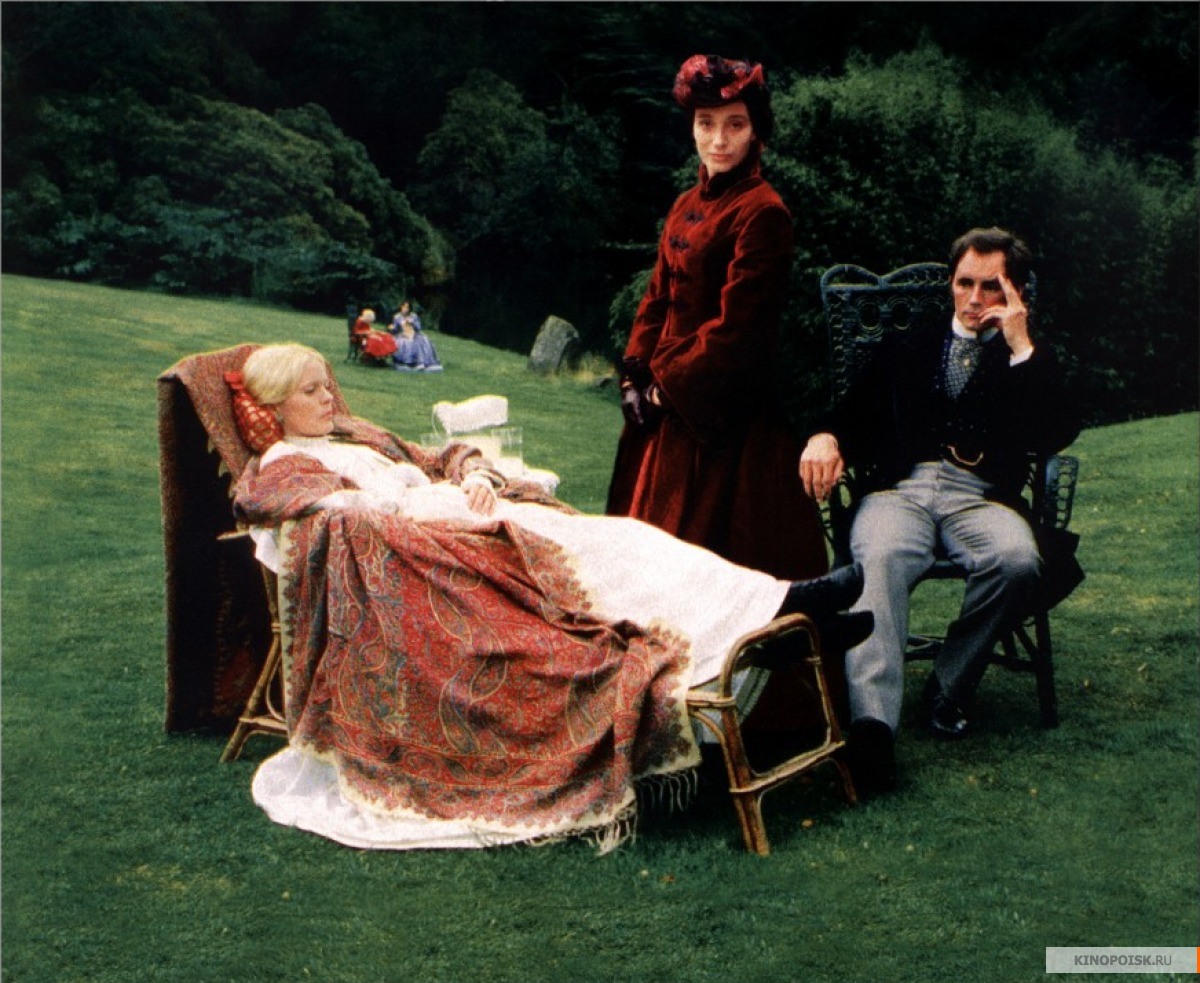
kinopoisk_ru-Angels-and-Insects-1736930


"ANGELS & INSECTS" (1995) Review

I never thought I would come around to writing this review. I have seen the 1995 movie, "ANGELS & INSECTS" a good number of times during the past five years. Yet, I never got around to posting a review of this movie, until recently. Why? I have not the foggiest idea. Nor do I have any idea why I had finally decided to write that review. 

Based upon A.S. Byatt's 1992 novella called "Morpho Eugenia""ANGELS & INSECTS" tells the story of a poor naturalist named William Adamson, who returns home to Victorian England after having spent years studying the natural wildlife - especially insects - in the Amazon Basin. Despite losing all of his possession during a shipwreck, he manages to befriend a baronet named Sir Harald Alabaster, who is also an amateur insect collector and botanist. The latter hires William to catalog his specimen collection and assist his younger children's governess the natural sciences.

William eventually falls for Sir Harald's oldest daughter, Eugenia, who is mourning the suicide of her fiance. Both of them eventually become emotionally involved and decide to marry. Much to William's surprise, both Sir Harald and Lady Alabaster seem supportive of the match. The only member of the Alabaster family who is against their upcoming wedding is Sir Harald's eldest child, the arrogant Edgar. Not only is the latter close to Eugenia, he believes that William is unworthy of his sister's hand, due to having a working-class background. The marriage between William and Eugenia seemed to be a happily lustful one that produces five children (among them two sets of twins). But Eugenia's hot and cold control over their sex life, a constantly hostile Edgar, William's growing friendship to Lady Alabaster's companion Matilda "Matty" Crompton, and William's own disenchantment over his role as Sir Harald's official assistant brings their marriage to a head after several years.

The film adaptation of Byatt's novella seemed to be the brainchild of Philip and Belinda Haas. Both worked on the film's screenplay, while Philip also served as the film's director and Belinda served as both co-producer (there are three others) and film editor. From my perusal of many period drama blogs, I get the feeling that "ANGELS & INSECTS" is not very popular with many of the genre's fans. On the other hand, many literary and film critics seemed to have a very high regard for it. Despite my love for the usual romantic costume drama, I must admit that my opinions of the 1995 film falls with the latter group. It is simply too well made and too fascinating for me to overlook. 

There were times I could not tell whether "ANGELS AND INSECTS" is some look at the age of Victorian science exploration, the close study of an upper-class 19th century family, or a lurid tale morality. Now that I realize it, the movie is probably an amalgamation of them all, wrapped around this view on Darwinism and breeding - in regard to both the insect world and humans. The topic of breeding seemed to seep into the screenplay in many scenes. Some of them come to mind - like Sir Harald and Edgar's debate on the breeding of horses and other animals; William and Eugenia's second encounter with moths in the manor's conservatory; Sir Harald's despairing rant on his declining usefulness within his own household; the reason behind Edgar's hostility toward William; and the visual comparisons between the bees and the inhabitants of the Alabaster estate, with Lady Alabaster serving as some metaphor for an aging Queen bee on her last legs. The metaphor of the Queen bee is extended further into Eugenia. Not only does she assume her mother's role as mistress of the house following the latter's death; but like Lady Alabaster before her, gives birth to a growing number of blond-haired children. If a person has never seen "ANGELS & INSECTS" before, he or she could follow both the script and cinematographer Bernard Zitzerman's shots carefully to detect the clues that hint the cloistered degeneracy that seemed to unconsciously permeate the Alabaster household.

I cannot deny that "ANGELS AND INSECTS" is a gorgeous film to behold. Philip and Belinda Haas, along with the film's other producers did an excellent job in creating a visually stunning film with a bold and colorful look. Cinematographer Bernard Zitzermann, along with production designer Jennifer Kernke and Alison Riva's art direction provided great contributions to the film's visual style. But in my opinion, Paul Brown's Academy Award nominated costume designs not only conveyed the film's theme and colorful visual style more than anything else, but also properly reflected the fashion styles of the early 1860s for women - including the growing penchant for deep, solid colors - as shown below:

29a99a1533aa1f8a8aaf44c2f8eb459e 769078_original

Adding to the movie's rich atmosphere was Alexander Balanescu's memorable score. I thought the composer did an excellent job of reflecting both the movie's elegant setting and its passionate, yet lurid story.

As much as I enjoyed and admired "ANGELS & INSECTS", I believe it had its flaws. I understand why Philip Haas had opened the movie with shots of William Adamson socializing with inhabitants of the Amazonian jungle, juxtaposing with the Alabaster ball given in his honor. Is it just me or did Haas use white - probably British - actors to portray Amazonian natives? I hope I am wrong, but I fear otherwise. I also feel that the movie was marred by a slow pacing that nearly crawled to a halt. I cannot help but wonder if Haas felt insecure by the project he and his wife had embarked upon, considering that "ANGELS & INSECTS" was his second motion picture after many years as a documentarian. Or perhaps he got caught up in his own roots as a documentarian, due to his heavy emphasis on the natural world being studied by William, Matty and the younger Alabaster children. In a way, I have to thank Balanescu's score for keeping me awake during those scenes that seemed to drag.

I cannot deny that the movie featured some top-notch and subtle performances. Mark Rylance, who has a sterling reputation as a stage actor, gave such a quiet and superb performance that I hope his reputation has extended to film. Kristin Scott-Thomas was equally superb as the Matty Crompton, Lady Alabaster's very observant companion, who shared William's interests in natural sciences. I have no idea what reputation Patsy Kensit has as an actress, but I certainly believe she gave an excellent performance as William's beautiful and upper-class wife, Eugenia Alabaster, whose hot and cold attitude toward her husband kept him puzzled. Jeremy Kemp gave one of his more complex and entertaining performances as William's father-in-law, the amateur scientist Sir Harald Alabaster. Douglas Henshall had a difficult job in portraying the bullying Edgar Alabaster, who seemed to view William as both beneath contempt and something of a threat to his views of the world. And he gave a very good performance in the end. The movie also featured solid performances from the likes of Anna Massey, Saskia Wickham, Chris Larkin, Clare Redman and Annette Badlands.

Some fans of period drama might be taken aback by the graphic sexuality featured in the film, along with the story's lurid topic. And director Philip Haas' pacing might be a bit hard to accept. But I feel that enduring all of this might be worth the trouble. Philip and Belinda Haas, along with the crew and a cast led by Mark Rylance, Kristin Scott-Thomas and Patsy Kensit did an excellent in re-creating A.S. Byatt's tale on the screen, and creating a first-rate movie in the end.

Wednesday, June 20, 2012

"ANGELS & INSECTS" (1995) Photo Gallery


Below are images from "ANGELS & INSECTS", the 1995 adaptation of A.S. Byatt's 1992 novella, "Morphia Eugenia".  Directed by Philip Haas, the movie starred Mark Rylance, Kristin Scott-Thomas and Patsy Kensit.


"ANGELS & INSECTS" (1995) Photo Gallery