Showing posts with label peter vaughn. Show all posts

Tuesday, August 5, 2025

"THE MOONSTONE" (1996) Review


"THE MOONSTONE" (1996) Review

Following my viewing of the 1997 television movie, "THE WOMAN IN WHITE", I followed up with an adaptation of another Wilkie Collins' novel, "THE MOONSTONE". Like the other adaption, this adaptation had been produced back in the 1990s as a television movie.

Based on Collins' 1868 novel, "The Moonstone: A Romance", "THE MOONSTONE" was an early modern detective story that centered around the theft of a valuable gem. A young English socialite named Rachel Verinder inherits a large Indian diamond called "a moonstone" on her eighteenth birthday. The gem is a legacy from her uncle, a corrupt British army officer named Colonel Sir John Hardcastle, who had stolen it from a religious idol, while serving in India. The diamond is of great religious significance and extremely valuable, and three Hindu priests have dedicated their lives to recovering it. Although Sir John's theft of the Moonstone had involved murder, he was never punished for his crimes. But he ended up shunned by society and his sister, Lady Julia Verinder. In retaliation for the shunning, Sir John leaves it in his will as a birthday gift to his niece Rachel, exposing her to the attentions of the gem's legal guardians.

On the night of her birthday party, Rachel wears her new present. Lady Julia, Rachel's cousin Franklin Blake and the local Dr. Candy all seem very anxious over Rachel's possession of the Moonstone. Especially since a trio of Indian jugglers had appeared at the Verinder estate. Later that night, the gem disappears from Rachel's room. Stolen. Suspicion first falls upon the three Indian jugglers. But retired Scotland Yard investigator, Sergeant Cuff believes the theft was an inside job. His suspicions fall upon one of the Verinders' servants, Rosana Spearman; and Rachel, whom he believes harbored plans to use the diamond to pay off secret debts.

I really do not know how to start this review, if I must be honest. I believe a good deal of my feelings originated from how I feel about Collins' story. I have never read his novel. But I have seen at least three adaptations of it to get a pretty good grasp of it. I must admit that director Robert Bierman and screenwriter Kevin Elyot did a very good job in setting up Collins' tale in this adaptation. They did not rush through the narrative in order to arrive on the night of the theft. And Elyot's screenplay also did an excellent job in exploring the novel's main characters - especially Rachel Verinder, her mother Lady Julia, the Verinders' major domo Gabriel Betterege and Franklin Blake. The movie also did a first-rate job in conveying the details of Blake and Cuff's investigation of the theft, along with Rachel's strange behavior. But once their investigation hit a dead end and the story moved on to the third act . . . I started having problems with the movie.

I could blame Wilkie Collins and his novel. Or I could blame the movie's screenwriter for trying to adhere as closely to Collins' story as possible. But after Franklin resumed the investigation of the Moonstone's theft a year after the incident, "THE MOONSTONE" seemed to be piled with nothing but contrived writing. I can only assume that Collins had wanted to deliver a surprise twist to his readers when he revealed who had taken the gem. I was certainly surprised when I first saw this film. And after three or four years, I have remained . . . dissatisfied with the revelation. I mean . . . seriously? And the series of events that led to the theft also struck me as contrived. But that was nothing in compare to the events that led to the Moonstone's final fate. To this day, a part of me wishes that the filmmakers had changed some of Collins' narrative for this movie.

At least I had no problem with the film's production values. Sarah Greenwood's production designs struck me as first-rate in her re-creation of Great Britain during the late 1840s. I was especially impressed by her creation of London during that period. Philip Robinson's art direction, the film's Art Department and John Daly's cinematography ably contributed to her work. I especially enjoyed Daly's photography of the marshes in Norfolk that served as the setting for one very memorable scene. I also admired James Keast's costume designs. His costumes struck me as a near accurate reflection of the film's late 1840s setting. I must admit that I found those costumes for the upper-class female characters a bit on the dull side. Was this dullness a direct reflection of elite women's fashion of that period? Perhaps someone can answer that for me.

Both Greg Wise and Keeley Hawes gave solid performances as the movie's romantic leads - Franklin Blake and Rachel Verinder. I cannot deny that the pair possessed some semblance of screen chemistry, especially during the film's first half hour. But they never really had the opportunity to develop that chemistry, since their characters spent most of the film at odds with one another or apart. The movie also featured solid performances from the likes of Scott Handy, Patricia Hodge, Anton Lesser, Peter Jeffrey, Paul Brooke, a menacing performance from Terence Hardiman as the slightly sinister Col. Sir John Hardcastle, and a rather entertaining performance from Kacey Ainsworth as the Verinders' holy roller cousin Drusilla Clark. Which leads me to my favorite performances in the movie.

One of those performances came from Peter Vaughan, who portrayed the Verinder family's steadfast majordomo, Gabriel Betterege. Not only did Vaughan did an excellent job in conveying Betterege's intelligence, but also the character's sharp humor. I really enjoyed his performance. Another performance that impressed me was Antony Sher, who portrayed the botanical loving former Scotland Yard detective, Sergeant Richard Cuff. I believe real life Victorian police detective Jack Whicher had inspired Collins' creation of Cuff. But Sher injected a touch of humorous eccentricity to the character that made his performance so enjoyable to me. One last performance had impressed me and it came from Lesley Sharp, who portrayed one of the Verinders' maids, Rosanna SpearmanR. Sharp gave an etheral, yet intense performance as the lovesick Rosanna, which left a haunting cloud over the story before the last reel.

Would I regard this 1996 television movie as the best adaptation of Wilkie Collins' novel? Hmmm . . . perhaps not. I have seen other adaptations that had delved into the narrative with a bit more detail. And the ending of this film seemed to rush a bit toward the end. However, I did managed to enjoy "THE MOONSTONE" very much. And thanks to Robert Bierman's direction, Kevin Elyot's screenplay and excellent performances from a cast led by Greg Wise and Keeley Hawes, I would have no problems doing a rewatch of this film over and over again.


Saturday, May 24, 2025

"THE MOONSTONE" (1996) Photo Gallery


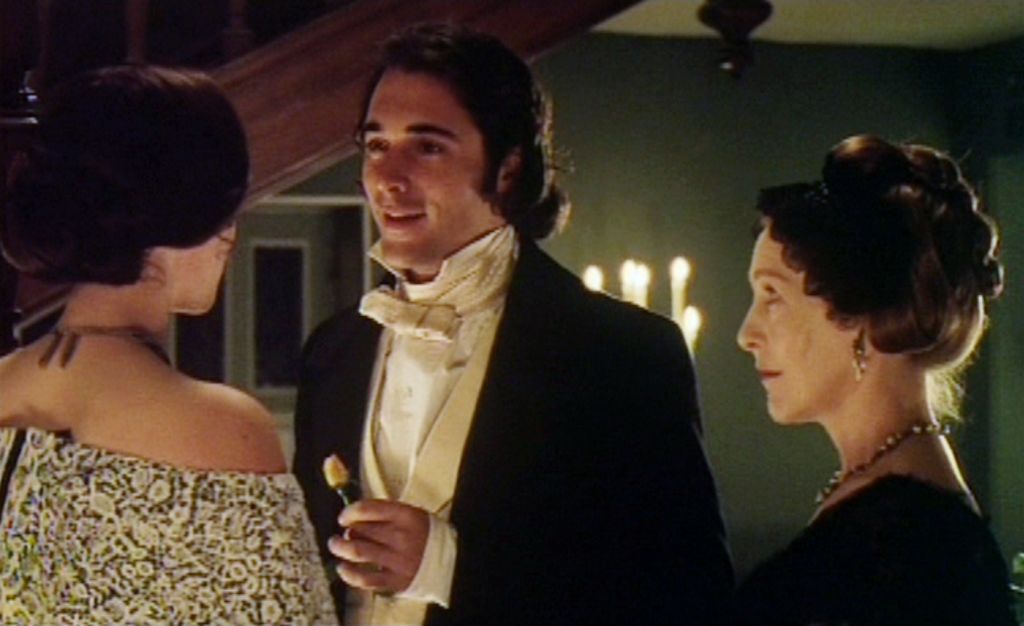
Below are images from "THE MOONSTONE", the 1996 adaptation of Wilkie Collins' 1868 mystery novel.  Directed by Robert Bierman, the television drama starred Greg Wise, Peter Vaughan, Antony Sher and Keely Hawes: 


"THE MOONSTONE" (1996) Photo Gallery


Monday, August 19, 2024

"OUR MUTUAL FRIEND" (1998) Second Review


"OUR MUTUAL FRIEND" (1998) Second Review

Twelve years ago, I had written a review of "OUR MUTUAL FRIEND", the BBC's 1998 adaptation of Charles Dickens' 1865 novel. Needless to say, my opinion of it proved to be mixed. But after numerous re-watches of the four-part miniseries, I came to the conclusion that my views had undergone a tremendous change . . . as the following new review will convey.

During my recent re-watch of "OUR MUTUAL FRIEND", I continued to find it a complicated tale. It featured at least four subplots (and not three, as I had originally assumed). And they all stemmed from the alleged death of John Harmon, the estranged heir to a fortune created by his father, a former collector from London's rubbish. "OUR MUTUAL FRIEND" began with a solicitor named Mortimer Lightwood informing the circumstances on the death of his late client and the details of Mr. Harmon Sr.'s will to his aunt and a group of listeners at a London society party. According to Lightwood, Mr. Harmon made his fortune from London's rubbish. The terms of his will stipulated that his fortune should go to John, returning to Britain after years spent abroad. The will allowed John to inherit his father's money on the condition that he marry a woman he has never met, Miss Bella Wilfer. However, Lightwood received news that John Harmon's body had been found in the Thames River. He and his close friend, Eugene Wrayburn, head toward the river to identify the body. And it was this sequence that led to the following subplots:

*Mr. Harmon's employees, Nicodemus and Henrietta Boffin inherit the Harmon fortune and take Bella Wilfer on as a ward/companion to compensate for her loss, following John Harmon's "death".

*John Harmon fakes his death and assumes the identity of John Rokesmith, the Boffins' social secretary, in order to ascertain Bella Wilfer's character.

*Gaffer Hexam, the waterman and scavenger who found Harmon's "body", ends being accused of murdering "Harmon" by Hexam's duplicitous former partner, Roger "Rogue" Riderhood.

*While accompanying his friend, Mortimer Lightwood, to identify Harmon's body, Eugene Wrayburn meets and falls in love with Hexam's daughter, Lizzie.

*Bradley Headstone, the schoolmaster of Charley Hexam, Lizzie's younger brother, develops a romantic, yet violent obsession with Lizzie and a deep hatred of Eugene.

*Mr. Boffin hires a ballad-seller with a wooden leg named Silas Wegg to read for him. When he finds Harmon's will in one of the Harmon dust piles, Wegg schemes with a taxidermist named Mr. Venus to blackmail the newly rich dustman.

*Mr. and Mrs. Lammle, a society couple who had married each other for money and discovered that neither had any, plot to swindle Mr. Boffin of his money.

I have experienced a handful of movies, novels and television shows in which disparate subplots eventually form into one main narrative. A major example of this was the 2002 novel and its 2008 movie adaptation, "MIRACLE AT ST. ANNA". But I cannot recall any form of fiction in which a particular narrative divides into a series of subplots from one main action or character. When I first saw "OUR MUTUAL FRIEND", I found this narrative device not only original, but rather disconcerting.

The problem I initially had with "OUR MUTUAL FRIEND" was that I only enjoyed only one major subplot - the bizarre "love triangle" between Eugene Wrayburn, Lizzie Hexam and Bradley Headstone. I cannot deny that I found it very interesting and very tense. Yet another re-watch of the miniseries made me aware of the mistakes I had made in judgment. One, my views of the miniseries' other subplots turned out to be more interesting than I had initially assumed. It finally occurred to me how wealth, greed and/or class played major roles in Dickens' story. The Harmon fortune had attracted greedy types like Silas Wegg and the Lammles. Even Bella Wilfer was willing to use the Boffins to find a wealthy husband within London's high society. Gaffar Hexam's discovery of the fake John Harmon's body and the reward he had received led his greedy and jealous former partner to accuse him of murder.

John's deception also exposed a good deal of class bigotry in this tale. Upper-class types like Lady Tippins seemed appalled at the idea of lower-class citizens like the Boffins inheriting a large fortune. She seemed to harbor this attitude that attorney Mortimer Lightwood should automatically take control of the Harmon fortune. As the Boffins' protégé, Bella initially regarded John as beneath her, due to his position as the Boffins' social secretary, John Rokesmith. Class bigotry practically reeked throughout the love triangle between Lizzie, Eugene and Bradley. Despite being in love with Lizzie, the upper-class Eugene seemed more wiling to view her as a potential mistress, instead of a wife. Bradley Headstone, who came from the same class as Lizzie, seemed more than willing to marry her. Yet, he also regarded her as being socially beneath him, due to her lack of education. He seemed to believe Lizzie should be grateful to marry him and reacted with surprise when she rejected his offer. And Eugene not only regarded Bradley as a romantic rival, but also as a man who was socially beneath him. The miniseries ended with Mortimer Lightwood attending a society party aboard a River Thames steamer. He and a shy man named Mr. Tremlow defended a particular marriage that crossed class lines, despite the other partygoers' disapproval and contempt. This ending is one of the main reasons I truly enjoy this adaptation of Dickens' novel. I found it emotionally satisfying, yet very poignant.

Sandy Welch made some changes in Dickens' narrative. Instead of pursuing heiress Georgiana Podsnap and attempting to trap her into marriage with fortune hunter Fascinating Fledgby, Alfred and Sophia Lammles set their sights on the Boffins' money. Welch's screenplay had excluded Fledgby altogether, along with his moneylending business. These changes made sense to me, considering the Lammles' arc with Fledgby and Miss Podsnap had nothing to do with John Harmon or his fortune. The Lammles met a nameless heiress (a stand-in for Georgiana Podsnap?) at a rail station near the end, as they boarded a train for Dover and the English Channel. Due to Welch's erasure of the Fledgby character, she reduced Mr. Riah's character as a close friend of both Lizzie and her friend, dollmaker Jenny Wren. Mr. Riah only played a role by helping Lizzie find a job outside of London.

It seemed a pity that Welch had eliminated the Fledgby character and his arc with Mr. Riah. It would have given the miniseries a peek into Victorian anti-Semitism, something the novel managed to achieve on a small scale. But as I had pointed out - Fledgby and Mr. Riah's arc had no connection to John Harmon, his fortune and his deception. To understand what I am trying to say, let me clarify. All of the other arcs in "OUR MUTUAL FRIEND" either began with Mr. Harmon Sr.'s will or with John Harmon's actions following his arrival in London. The former's will led John to create and participate in his deception in order to judge Bella. If Mr. Harmon had not made that condition for John to marry Bella in order to inherit his fortune, chances are John would have never conceived his deception. He would have never been attacked by the man he had recruited to impersonate him. Hexam would have never found the impersonator's body and found himself falsely accused of murder by his former partner.

Even if Mr. Harmon's will had not changed, John could have simply adhered to and inherit his father's fortune, leading to a possible loveless marriage to Bella. With no body to find, Mortimer and especially Eugene would have never met Lizzie. As Charly Hexam's tutor, Bradley Headstone probably would have met Lizzie and fallen in love with her anyway. But I believe she still would have rejected him. It is possible the Lammles would have focused their attention on John. But I suspect they would have very little success in befriending him. If John had immediately inherited his father's fortune, the Boffins would have inherited one of the Harmons' dust piles. Does this mean Mr. Boffin would have hired Wegg as his reader anyway? I wonder.

I cannot deny that "OUR MUTUAL FRIEND" did such an excellent job in exploring the effects of wealth, greed and class in Victorian London. All or most of the subplots seemed to flow from John Harmon and his decision to fake his death. Like the River Thames that flows through southern England and London. Is it any wonder that Dickens had decided to set his novel along the river - even outside of London? The story began with Lizzie and and her father scavenging along the Thames and ended on that lovely moment when both Mortimer and a shy man named Mr. Tremlow defended a recent marriage that crossed class lines at a society party aboard a steamer on the river.

As for the production values for "OUR MUTUAL FRIEND", I still remain impressed as ever. David Odd's cinematography still strikes me as colorful and epic. I am not surprised that he had received a BAFTA Award nomination for his work. Malcolm Thornton won a BAFTA Award for the miniseries' excellent production designs. His recreation of mid-19th century London and the River Thames struck me as colorful, well-detailed and just outstanding. Mike O'Neil had earned a BAFTA nomination for his costume designs. A part of me wish he had won. I still find them beautiful and a near reflection of Britain in the 1860s, as shown in the images below:


My opinion of "OUR MUTUAL FRIEND" may have improved over the years, but I still have a few issues with it. One of those issues remained John Harmon's deception regarding his identity - namely how it affected Bella Wilfer. I still find it problematic that John did not reveal his true identity to her, until a few months after their wedding. And I found Bella's lack of hostility toward his revelation implausible. Although I found Silas Wegg's attempt to blackmail Mr. Boffin interesting, I found his constant complaints about his target and plotting with Mr. Venus rather irritating after two episodes or so.

The performances featured in the 1998 miniseries more than satisfied me. I found Harmon's gradual love for Bella very interesting to watch, thanks to Steven Mackintosh's subtle performance. And Anna Friel did a great job in developing Bella Wilfur from a materialistic and ambitious young woman, to one for whom love and morality meant more to her than material wealth. "OUR MUTUAL FRIEND" also featured excellent performances from Peter Vaughn and Pam Ferris as the Boffins, Kenneth Cranham as Silas Wegg, Margaret Tyzack as the imperious Tippins, and Dominic Mafham as Mortimer Lightwood. The miniseries also featured first-rate supporting performances from the likes of David Schofield as the no-nonsense Gaffer Hexam, Anthony Calf and Doon Mackichan as the Lammles, Paul Bailey as Charley Hexam, Peter Wight as Mr. Wilfer, Cyril Sharps as the kindly Mr. Riah, Linda Bassett as pub owner Abby Potterson, Edna Doré as the kindly, yet proud Betty Higden; and Robert Lang as the reserved and shy Mr. Tremlow, whom I believe provided one of the best moments in the series.

But there seemed to be performances that I believe stood above the others. Timothy Spall gave one of his more subtle performances as the enigmatic taxidermist Mr. Venus, who found himself drawn reluctantly in Wegg's scheming. Some have complained that Katy Murphy had been too old, as a thirty-something actress, to portray dollmaker Jenny Wren, a character in her late teen or early 20s. But the other two actresses I have seen portray Jenny were either 30 or older, so I do not understand the complaint. And Murphy did such an excellent job in conveying Jenny's emotional, yet blunt personality. I thought David Bradley did a superb job in his portrayal of the sly, yet malevolent waterman, Rogue Riderhood. Unlike other actors in the role, he did not succumb to occasional histrionics.

In my previous review of "OUR MUTUAL FRIEND", I had accused David Morrissey of engaging in histrionics in his portrayal of the violently jealous headmaster, Bradley Headstone. I had been wrong. Morrissey only did it once in a scene that featured Lizzie Hexam's rejection of his marriage proposal. Otherwise, I thought the actor gave a brilliant performance. One would think portraying the reserved Lizzie Hexam would be a walk in the park for any actress. Yet, I believe Keeley Hawes took the portrayal to another level by not only conveying Lizzie's dislike of Headstone, and her wariness toward Eugene Wrayburn's feelings for her; but also her streak of insecurity that led her to doubt her worthiness for someone like Eugene. I had earlier accuse the actress of being unable of to express Lizzie's true feelings for Eugene until the last episode. But I forgot that Hawes did convey moments of attraction toward Eugene. And in portraying a reserved character like Lizzie, she did an effective job of conveying the character's penchant for keeping such feelings closely to her chest. I have said this before and I will say it again - I believe Paul McGann gave the best performance in "OUR MUTUAL FRIEND", for his portrayal of the ambiguous Eugene Wrayburn. If one closely observe the character, he is not exactly a nice man. At least most of the time. McGann did a beautiful job in his portrayal of the indolent, yet patronizing attorney; conveying both the negative and surprisingly, the character's positive traits. And thanks to McGann's performance, one could see Eugene's struggle between his love for Lizzie and his wariness over her class.

Do I still believe "OUR MUTUAL FRIEND" was flawed? Well . . . I point out a few. As I had stated in my previous review, the 1864-65 novel is not considered among Charles Dickens' best works. But my opinion of the 1998 adaptation certainly has improved a great deal over the years. Screenwriter Sandy Welch and director Julian Farino did excellent jobs in translating Dickens' tale to the television screen. And the production not only featured first-rate work from the crew, but also superb performances from an excellent cast led by Steven Mackintosh. If I must be honest, not only has my opinion of "OUR MUTUAL FRIEND" improved over the years, I now consider it one of the best adaptations of any of Dickens' works.


Friday, July 12, 2019

"AN IDEAL HUSBAND" (1999) Review


"AN IDEAL HUSBAND" (1999) Review

I have a confession. I have not seen that many adaptations of Oscar Wilde's plays and novels. And it has been quite a while since I viewed my last adaptation, namely the 1999 film, "AN IDEAL HUSBAND". I was surprised to discover that this 1999 movie was not the first adaptation of Wilde's 1895 stage play. There have been other adaptations - including four other films and several radio productions. But this is the only adaptation I have ever seen. 

Written and directed by Oliver Parker, "AN IDEAL HUSBAND" opens with a ball held at the home of British government minister Sir Robert Chiltern and his wife, Lady Gertrude Chiltern. Among those attending the ball are:

*Arthur, Viscount Goring, a close friend of the Chilterns
*Mrs. Laura Cheveley, a former British socialite and Lady Gertrude's former schoolmate
*Miss Mabel Chiltern, Sir Robert's younger sister
*Earl of Caversham, Lord Arthur's father
*Lady Markby, a friend of Mrs. Cheveley
*Tommy Trafford, Sir Robert's aide and potential suitor for Mabel
*Sir Edward, a newspaper baron


During the ball, Mrs. Cheveley approaches Sir Robert with a request to help support a fraudulent scheme she is financing to build a canal in Argentina. Mrs. Cheveley's request is tainted with blackmail. If Sir Robert does not agree to her request, she plans to reveal that he had sold a Cabinet secret to her late mentor and lover, Baron Arnheim, which enabled the latter to buy shares in the Suez Canal Company three days before the British government announced its purchase of the company. Arnheim's payoff was the basis of Sir Robert's fortune and Mrs. Cheveley has Robert's letter to Arnheim as proof of the latter's crime. In desperation, Robert turns to his friend, Arthur Goring, to help him deal with the blackmailing socialite, who was a former lover of Arthur.

I understand there had been changes made to Oscar Wilde's original plot. Since I have never read or seen the play, I will not comment on these changes. Instead, I want to discuss the movie. Overall, I thought it was an entertaining and charming tale about the slippery slopes of moral ambiguity and social hypocrisy. As I watched the movie's narrative unfold, it occurred to me that it revolved around a good deal of hiding, deception and misconceptions - the very traits that have been a part of romantic comedies in Hollywood for years. The epitome of this kind of storytelling could be found in the sequence in which Lord Goring found himself greeting a variety of visitors inside his home during the space of one night, while he and his valet struggled to keep all or most of them hidden in separate rooms. "AN IDEAL HUSBAND" also featured some sparkling dialogue, thanks to the pens of Oscar Wilde and the movie's screenwriter/director, Oliver Parker. Both Rupert Everett and Julianne Moore received the cream of the lines:

"Fashion is what one wears oneself. What is unfashionable is what other people wear. Other people are quite dreadful. The only possible society is oneself." - Arthur, Lord Goring

"Do you know, Gertrude, I don't mind your talking morality a bit. Morality is simply the attitude we adopt towards people whom we personally dislike. You dislike me, I am quite aware of that, and I have always detested you." - Mrs. Laura Cheveley

"All I know, Gertrude, is that it takes great courage to see the world in all its tainted glory, and still to love it. And even more courage to see it in the one you love. Gertrude, you have more courage than any woman I have ever known. Do not be afraid now to use it." - Lord Goring

As one can see, Lord Goring and Mrs. Cheverley are among my two favorite characters in the story, along with young Mabel Chiltern. Most of the other characters seemed to wallow in arrogance, self-deception or priggishness. My least favorite character proved to be Sir Robert Chiltern. I found him not only priggish, but also hypocritical and dishonest. I realize that audiences are supposed to regard Mrs. Cheveley as the worst kind. And perhaps she is. But her dishonesty did not strike me as hypocritical, as Sir Robert's. 

I have two problems with the plot for "AN IDEAL HUSBAND". I also found it rather annoying that she was the only character who suffered for her dishonesty . . . unlike Sir Robert. The worst he had suffered was a scare and a wife whose disappointment in him only lasted a few days. Then again . . . Oscar Wilde was a man. I should not have been surprised that he would have allowed Sir Robert to suffer as little consequences as possible for his transgressions. Another problem I had with the movie was its last half hour. Following Laura Cheveley's departure from London, Lord Goring finally asked Mable Chiltern for her hand in marriage. However, Sir Robert had refused to give, due to his discovery that Lord Goring and Laura Cheveley had been lovers in the past. The plot for the film's last half hour seemed like a completely different story, aside from it being a consequence of Lord Goring's past. I think Laura Cheveley left the story some twenty to thirty minutes too soon. This made the last half hour feel almost disjointed and unnecessary.

I have no complaints about the movie's production and look. I really enjoyed Michael Howells' production designs for the film. I thought he did an excellent job of re-creating late Victorian London. This was especially apparent in crowd scenes that featuring the elite riding along Hyde Park's Rotten Row and balls and parties for the elite, including the Chiltern's ball during the film's first half. Howells' work was greatly enhanced by Rod McLean's art direction and Katie Lee's set decorations. Yes, I have not forgotten about the costume designs created by Caroline Harris. What can I say? They were exquisite, as shown in the images below:


The performances featured in "AN IDEAL HUSBAND" struck me as first-rate. There was not a performance in this movie that did not failed to impress me. The movie featured solid, yet charming performances from the likes of Ben Pullen, Nikolas Grace, Peter Vaughn, Marsha Fitzlan, Simon Russell Beale and Lindsay Duncan, whom I found especially entertaining as Laura Cheveley's witty friend, Lady Markby. Jeroen Krabbé did an excellent job in conveying the ambiguous, yet corrupt nature of Sir Robert's mentor, Baron Arnheim. John Wood gave a slightly funny performance as Lord Goring's stuffy father, the Earl of Caversham. Minnie Driver's portrayal of Sir Robert's younger sister Mabel Chiltern not only struck me as funny, witty and completely charming.

I must admit that I found the characters of Sir Robert and Lady Gertrude Chiltern a bit off-putting, but I cannot deny that both Jeremy Northam and Cate Blanchett breathed life into their characters. Northam did an excellent job in capturing the hypocrisy and ambition of Sir Robert Chiltern. And Northam also ably conveyed Sir Robert's obvious love for his wife. Blanchett gave an equally skillful performance as Lady Gertrude Chiltern. The actress did an excellent job of portraying how Gertrude's love for Sir Robert dangerously edged toward blind idealism and the character's emotional devastation upon learning about her husband's past transgression. Julianne Moore earned a Golden Globe nomination for her portrayal of Mrs. Laura Cheveley. And it was a well deserved nomination, as far as I am concerned. I thought she gave one of the film's best performances as the scheming blackmailing socialite, who also possessed a talent for acute and pragmatic observations of human nature and society. The film's other best performance came from Rupert Everett, who portrayed the superficially self-absorbed Lord Goring. And that is one of the reasons why I enjoyed Everett's performance so much. He managed to convey the warmth and wisdom underneath the shallow playboy with style, wit and subtlety. Like Moore, Everett managed to earn a Golden Globe nomination.

I enjoyed "AN IDEAL HUSBAND". Well . . . most of it. I thought Oliver Parker did an excellent job of adapting Oscar Wilde's play with a witty script and a first-rate cast led by Rupert Everett. It is a pity that the last act of the movie seemed almost like an afterthought. Oh well.

Wednesday, May 29, 2019

"AN IDEAL HUSBAND" (1999) Photo Gallery


Below is a gallery of images from "AN IDEAL HUSBAND", the 1999 adaptation of Oscar Wilde's 1895 play. Adapted and directed by Oliver Parker, the movie starred Rupert Everett, Cate Blanchett, Jeremy Northam, Minnie Driver and Julianne Moore: 


"AN IDEAL HUSBAND" (1999) Photo Gallery