Showing posts with label rebecca romijn. Show all posts

Monday, November 18, 2024

"STAR TREK DISCOVERY" Commentary: (2.01) "Brother"


"STAR TREK DISCOVERY" COMMENTARY: (2.01) "Brother"

I just did a recent rewatch of the Season Two premiere of "STAR TREK DISCOVERY"(2.01) "Brother" on CBS All Access. On one hand, the episode struck me as a solid entry for a Trek show that set up the second season's story arc and introduction of new characters. This is nothing knew. I have witnessed similar set ups for shows like "BABYLON 5" and "BUFFY THE VAMPIRE SLAYER". But what I did not count on were some differences and characters that would leave me scratching my head.

I do not think I have ever encountered a Trek show that has generated so much conflict and controversy as "STAR TREK DISCOVERY". I take that back. There has been one other series that has generated controversy close to the same level as "DISCOVERY" . . . namely "STAR TREK VOYAGER". This does not strike me as surprising, since both shows featured leading characters who are women. "DISCOVERY" took it to another level in which its leading character, Commander (formerly Specialist) Michael Burnham, is not only portrayed by an African-American actress, but is not the starship/space station's commanding officer.

I noticed that a great deal of what struck me as vague and nitpicking complaints had been inflicted upon "STAR TREK DISCOVERY" during and after its first season. One of those complaints proved to be certain characters, including Michael Burnham, lacked full development by the end of Season One. I found myself scratching my head over this complaint. I mean . . . what on earth? I have never heard of a fictional character in a television show that is fully developed by the end of its first season, let alone before the end of its run. Never. And "DISCOVERY" had only finished its first season. Why on earth were so many of the franchise's fans either criticizing that most of its characters are not fully developed or demanding that they should be after one season? This is not miniseries or television show. If "STAR TREK DISCOVERY" is allowed to complete its full run and the characters are still "not fully developed", then I believe they would have something to complain about.

Another complaint that left me scratching my head was the lack of humor during its first season. In fact, this particular complaint has led many to compare "STAR TREK DISCOVERY" with another science-fiction series that had begun around the same time - "THE ORVILLE". The Trek franchise has never been a franchise that was dominated by humor. And I do recall a good deal of humor in Season One of "STAR TREK DISCOVERY", especially in episodes like (1.07) "Magic to Make the Sanest Man Go Mad" or in scenes featuring Mary Wiseman as Cadet Sylvia Tilly. Aside from those scenes featuring Wiseman and even Rainn Wilson (as con man Harry Mudd), most of the humor featured in Season One tend to be more subtle.

I am relieved to notice that in regard to character development, the show runners for "STAR TREK DISCOVERY" did not rush to portray Michael Burnham or any of the other characters fully developed. The Season Two premiere, "Brother", hinted that the show planned to explore Burnham's past experiences as a member of Ambassador Sarek's household and especially, her relationship with adoptive brother Spock. Judging from the Season Two previews I have seen, Burnham's relationship with Ash Tyler/Voq will also be touched upon. So, if Season Two does not feature the full character development of the series' leading lady and the other supporting characters, I will not be disappointed. If anything, I might feel a sense of relief. The last thing I want is for the series to engage in rushed storytelling.

But one aspect of the Season Two premiere that left me scratching my head was the level of humor featured in the episode. It almost struck me as out of place. Now, "Magic to Make the Sanest Man Go Mad" featured some rather heavy humor. I found nothing wrong with this. Many of the Trek series have aired the occasional humorous episode. The problem with the humor in "Brother" is that there was nothing about the plot or the characters that should have marked it as a humor-filled episode. Many of the familiar characters - including Burnham - were either spouting lines or reacting to situations that made me wonder if screenwriters Ted Sullivan, Gretchen J. Berg and Aaron Harberts may have went a bit too far.

"Brother" also featured the introduction of Commander Denise "Jett" Reno, Chief Engineer of the U.S.S. Hiawatha, who had been rescued by a landing party from the Discovery after spending ten months caring for wounded crew members on an asteroid, during the Federation-Klingon War. Reno, portrayed by actress-comedian Tig Notaro, managed to spout more jokes in a space of five minutes than any other actor or actress who had appeared in a Trek series or movie. I think Notaro might proved to be a rival for Wiseman on who can be the funniest member of the cast. In the end, the humor in "Brother" struck me as a bit over-the-top, especially for an episode that is not obviously a humorous one like "Magic to Make the Sanest Man Go Mad".

So what were the screenwriters thinking? Did they change the tonal style of "STAR TREK DISCOVERY" to appease those fans who had complained that the series was "too serious" or "too angsty"? If so, they have made a mistake. I found this tonal shift for Season Two rather forced and mind boggling. I do not see the necessity of changing the series’ tonal style. I want to watch "STAR TREK DISCOVERY", not some borderline copycat of "THE ORVILLE". Not even the other Trek series from the past had such a drastic tonal shift. After all, the edgier style of Season One did not prevent "STAR TREK DISCOVERY" from being a hit or creating an entire new stable of fans. Had the show runners forgotten this? Or were they too busy paying attention to the narrow-minded fans who wanted the series to simply re-create the past?

I noticed that the introduction of Anson Mount as Captain Christopher Pike of the U.S.S. Enterprise had also contributed to this tonal shift. Mount's Pike came off as slightly humorous and yet, somewhat bland. To me, Pike seemed like the epitome of the white male leading man that so many science-fiction/fantasy geeks seemed to long - especially in the past three to four years. The problem I have with this is that as an old fan of the AMC series, "HELL ON WHEELS", I know that the talented Mount is capable of portraying a character more interesting than Pike. At one point in "Brother", Pike had expressed his regret that the Enterprise did not participate in the Federation-Klingon War. Was this regret a consequence of survivor's guilt? Or is this nothing more than the regret of someone in the military, who wished he or she could have been in the center of the action. I hope that it is the former. On the other hand, watching Pike participate in the landing party that found Reno and the remains of the Hiawatha makes me wonder otherwise. As the Discovery's current temporary captain, his presence in the Away team struck me as questionable. This is not "STAR TREK" circa 1966-68. And so far, I do not find the character’s regret for not participating in the war against the Klingons as not very interesting.

And why is the Christopher Pike character a regular on this show? Why is he a regular for Season Two? Why was Pike, along with two Enterprise officers, needed to investigate those seven red bursts that had appeared in the Alpha Quadrant? The Discovery is originally a science vessel. The Enterprise is not. Why did the show runners have Starfleet order Pike to take command of Discovery in the first place? Mount could have been cast as the Discovery's new captain who was other than Pike. Or Saru could have been promoted as the Discovery's new commander. He deserved it. After all, ever since the discovery that Captain Gabriel Lorca was an imposter from the Mirror Universe, Saru had more or less acted as the ship's captain. He was the one who led Discovery and its crew out of the Mirror Universe. And he stood behind Burnham, Tilly and Tyler when they exposed Starfleet's plot to destroy the Klingon homeworld. Instead, either Alex Kurtzman or Aaron Harberts and Gretchen J. Berg drummed up some lame reason to brng Pike aboard the Discovery so that the show can have some slightly bland and familiar character as the main authority figure in order to soothe the nerves of some very loud and negative fans.

Is it possible that these fans could not deal with the chaotic Gabriel Lorca as captain or who still cannot deal with the non-white Michael Burnham as the show’s lead. Or do they simply want to recapture the past? Right now, it seems as if Kurtzman, Harberts and Berg want to please these fanboys, who want the show to recapture the past. After watching "Brother", I blame them for listening to these fanboys, instead of basking in the success of Season One and moving forward with more innovative stories. It just seems a crime that producers like Kurtzman, Harberts, Berg, the Warner Brothers suits and Kathleen Kennedy are so afraid of the loud and narrow-minded fanboys that they would rather keep their respective franchises either mired in the past or borderline bland to please these fans. And in doing so, they end up ignoring the fact that when their franchises were innovative, they were also box office or ratings successes.

Right now, I find the Trek fandom, along with those for other franchises, rather frustrating and narrow-minded. These fans would rather cling to the past, rather than enjoy something different or innovative. And when producers and show runners like Harberts, Berg or Kurtzman kowtow to the loud and rather conservative-minded fans and critics, entertainment and art in pop culture becomes in danger of declining into a sad affair. Does this mean that Season Two of "STAR TREK DISCOVERY" await such a fate? I hope not. I hope that the season's future episodes might prove to be just as fascinating and innovative as those from Season One. I hope so. Because if I have to be honest, I found "Brother" to be jarring and something of a head scratcher.

Friday, November 8, 2019

"X-MEN" (2000) Review

3603_09577


"X-MEN" (2000) Review

If anyone had asked me what was the first genuine superhero film, based upon Marvel Comics characters, my choice would be the 2000 flick, "X-MEN". In fact, I suspect that it was the first Marvel film ever shown in the movie theaters. Its success spawned a series of superhero films that continue to this day.

Based upon the Marvel Comics series, the plot for "X-MEN" began first in 1944, at a concentration camp in German-occupied Poland. Thirteen year-old Erik Lehnsherr is separated from his parents, upon entry to the camp. And in an attempt to reach them, he causes a set of gates to bend with a magnetic force and is knocked unconscious by the guards. The story jumps several decades later when a 17 year-old girl from Meridan, Mississippi named Marie aka Rogue is flirting with her boyfriend. They kiss and her boyfriend goes into a coma, thanks to Marie's ability to suck an individual's life force. Instead of immediately killing a mutant, Marie's ability manages to suck his or her ability before dying. Upset over the harm she had inadvertently caused, Marie runs away from home and ends up in Laughlin City, Alaska. She meets Logan, an amateur fighter known as "The Wolverine" at a local bar. He also possesses superhuman healing abilities, heightened senses, and metal claws that extend outwards from between his knuckles. Marie hitches a ride with Logan. While on the road together, they are both attacked by Sabretooth, a fellow mutant and an associate of the adult Erik Lehnsherr, who has become known as Magneto. Two mutants - Scott Summers aka Cyclops and Ororo Munroe aka Storm arrive on time to save Wolverine and Rogue, and bring them to Charles Xavier's mansion in Westchester County, New York. Xavier is an old friend of Magneto's.

Xavier's mansion serves as headquarters for Cyclops and Storm, the two mutants who had rescued Rogue and Logan. They are part of a group called the X-Men, who try to seek peace with non-mutant humans, educate young mutants in the responsible use of their powers, and stop Magneto from starting a war with humanity. While Xavier, Cyclops, Storm and a fourth member of the X-Men named Jean Grey try to figure out the reason by Magneto's attempt to kidnap Logan and Marie; Magneto sets his plan in motion with the kidnapping of an anti-mutant politician named Senator Robert Kelly by Sabretooth and another minion, a shapeshifter named Mystique. Kelly is behind a Federal legislation called the "Mutant Registration Act", which would force mutants to publicly reveal their identities and abilities. Magneto uses Kelly as a subject for a machine that artificially induces mutation. He plans to use it on the entire non-mutant population. But a mutant has to generate the machine's power. When it weakens Magneto during his experimentation on Senator Kelly, it becomes clear to the X-Men that Magneto wants to use Rogue's transferring ability and the Statue of Liberty to power the machine.

I never saw "X-MEN" at the movie theater. In fact, I had never heard of Marvel's "X-MEN" comic series, until I saw the movie after its video release in late 2000. Needless to say, I became an immediate fan. I found the idea of a group of people with psychic abilities divided by moral compass and political beliefs, and who are regarded by others as freaks, rather fascinating. I realize that the movie is not particularly faithful to the comic book series that it is based upon. However, director Bryan Singer and screenwriter David Hayter did a pretty solid job of using the comic source to create their own cinematic version of the series. The movie also featured some first-rate acting and excellent production values.

After seeing the film, I saw how the original costumes for the X-Men looked in the comics. And all I have to say is thank goodness Louise Mingenbach designed a more uniformed look for the superheroes . . . even if it involved black leather. Newton Thomas Sigel's photography struck me as solid. His best work seemed to be featured in the Liberty Island sequence. Ann Brodie and her team did excellent work on the makeup for some of the characters - especially Logan, Sabretooth, Toad and Mystique. Mike Fink and his team received an Oscar nomination for the film's visual effects. Fink later expressed dissatisfaction with his work and I can see why. They struck me as . . . okay, but nothing more or less. I found the visual affects used during Logan's fight against Sabertooth atop the Statue of Liberty as somewhat clumsy. And considering that most of the movie was either set indoors or at night, I cannot honestly say that "X-MEN" was a visually stunning film.

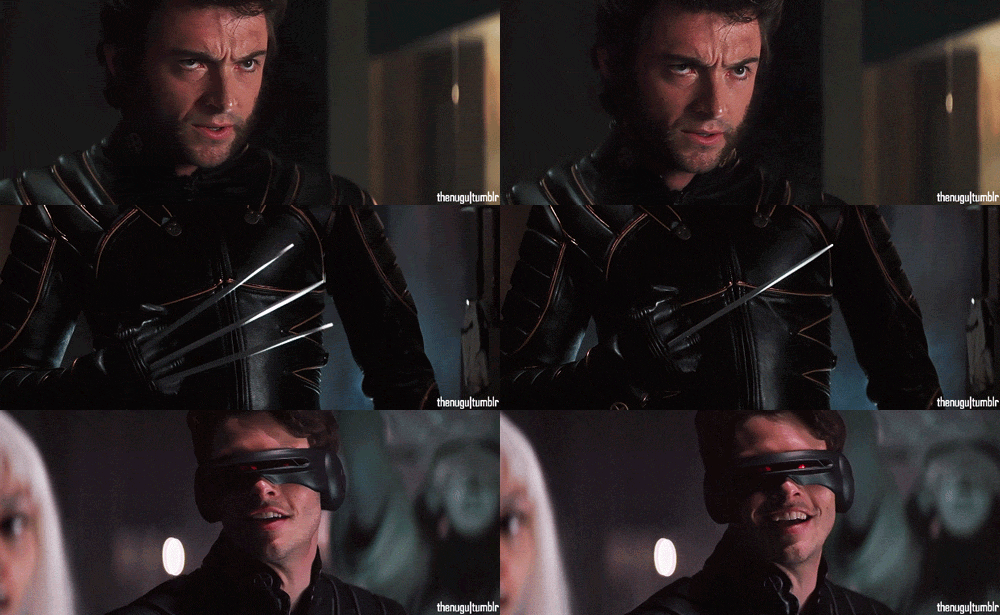
Most of the performances featured in "X-MEN" struck me as solid. There were a few exceptional ones. The movie made a star out of Hugh Jackman and it is easy to see why. Jackman is obviously a talented actor and he had the good luck to be cast in one of the comic franchise's most memorable characters. I could also say the same about Ian McKellen's performance as Erik Lensherr aka Magneto. What I found fascinating about McKellen's take on the character is that he managed to convey Magneto's willingness to pretend that his heinous actions were for the benefit of his fellow mutants, whom he believe should rule the earth. Patrick Stewart gave a fine performance as the more tolerant Charles Xavier, who would rather mutants and non-mutants to live side-by-side, instead of engaging in eternal conflict. I was also impressed by Anna Paquin's poignant performance as the young Marie aka Rogue, who seemed desperate to make some kind of connection to others, despite her ability. Bruce Davidson gave an excellent and complex performance as Senator Robert Kelly, whose fervent anti-mutant stance eventually softens from a traumatic experience and a conversation with Ororo Munroe aka Storm.

Among the movie's solid performances came from James Marsden's Scott Summers aka Cyclops, Famke Jenssen's Jean Grey and Rebecca Romijn as Magneto's hench woman, Mystique. I suspect some might be astonished by my description of Romijn's performance as "solid". I stand by my word. Mind you, I found the Mystique character rather striking - especially physically - but Romijn's performance merely struck me as solid. I wish I could say the same about Ray Park's portrayal of another of Magneto's minions, Toad. Honestly? I found the character cartoonish and one-dimension. Unfortunately, Park failed to rise above the material. I hate to say this, but I have to say the same about Halle Berry's performance as X-Men Storm aka Ororo Munroe. 


image

Most fans tend to blame Berry for the poor portrayal of Storm in this film. I cannot, considering her more positive portrayals of the character in subsequent films. Frankly, I blame Bryan Singer and screenwriter David Hayter. Poor Storm was merely used as a background character, except in a few crucial scenes. And Hayter wrote one of the worst pieces of dialogue in Hollywood history for the character. However, there was one scene in which Berry gave an excellent performance and it featured Storm's poignant conversation with Senator Kelly.

As much as I liked "X-MEN", I feel that it is very overrated by many critics and the franchise's fans. I can honestly say that it is probably my least favorite X-MEN film. The main problem I have with this film is the number of plot holes or lack of logic in the story. I could say that it is indicative of the franchise's growing reputation for plot inconsistency. I never understood how Magneto learned about Rogue's ability to absorb a mutant's ability. I realize he must have learned about what she had done to her boyfriend David. But how did he learn about her ability's impact upon mutants? How did he or Sabretooth discover that she had traveled all the way from Mississippi to Alaska? I was also unimpressed by Logan's first scene at Xavier's school in which he woke up, heard voices in his head and ended up roaming all over the place in confusion. I am confused. Did Professor Xavier used telepathy to awaken him? Or did Logan simply hear voices, thanks to his enhanced hearing?

The one sequence that really puzzles me was Mystique's activities at Xavier's School. The scene began with Mystique shape shifting into Rogue's new boyfriend, Bobby Drake aka Iceman in order to convince the adolescent that Xavier was angry at her for using her ability on Logan to heal herself and that she should leave the school. Why? So that Magneto could have an opportunity to snatch her. Later, Mystique transformed into Xavier in order to infiltrate Cerebro, Xavier's telepathic enhancing machine and sabotage it. Why on earth did Singer and Hayter create such a convoluted situation? They could have easily allowed Mystique to first sabotage Cerebro and then snatch Rogue from the school, herself. I also realize that Jean Grey, being both telepathic and telekinetic, could have easily rescued herself and her fellow X-Men from Magneto's trap inside the Liberty statue's interior. I have already commented on the clumsily shot fight scene between Logan and Sabretooth. The former's fight against Mystique was somewhat better and probably enhanced by slow motion. And if I must be honest, I found the movie's writing and pacing almost episodic. Every time I watch "X-MEN", I get the feeling that it is a first-rate "B" or television movie . . . or a second-rate "A" movie, even if it is entertaining.

In the end, my opinion of "X-MEN" has diminished over the years. It is still an entertaining film with a decent story, and a mixture of solid and first-rate performances from the cast. And I have to give it credit for successful kick-starting not only the X-MEN franchise, but also spawning a reemergence of superhero films - especially from Marvel. However, I believe the movie is tainted by some very questionable writing and a style that nearly strikes me as slightly sub par. I still like the movie, but it has become my second least favorite X-MEN film in the entire franchise.


image

Friday, September 13, 2019

"X-MEN" (2000) Photo Gallery

mutants-x-men-2000-

Below are images from "X-MEN", the 2000 adaptation of the Marvel comic book series. Directed by Bryan Singer, the movie starred Patrick Stewart, Hugh Jackman, Ian McKellen and Anna Paquin:


"X-MEN" (2000) Photo Gallery

3603_1893


174433__xmen_l


27889657-27889669-large


anna-paquin-and-rogue-costume-from-x-men-gallery


bruce-davison-as-senator-kelly-in-x-men-2000


james-marsden-scott-summers-cyclops-and-famke


kinopoisk.ru-X-Men-240013


kinopoisk.ru-X-Men-1366581


kinopoisk.ru-X-Men-1366582


Ray-Park-as-Toad-whose-tongue-can-extend-up-to-fifteen-feet-in-20th-Century-Foxs-X-Men-2000


bruce-davison-as-senator-kelly-in-x-men-2000-a


vlcsnap_2012_05_30_17h37m26s71_large


x1stills_001


x1stills_006


x1stills_007


X-Men


x-men3


x-men-2000_wolverine-02


X-Men2000-02


X-men-2000-15-g


X-Men-2000-lede


x-men-movie-2000_hugh_jackman


x-men-movie-jean-grey-famke-jannsen-cyclops-2000