Showing posts with label anthony andrews. Show all posts

Saturday, August 3, 2024

"THE WOMAN HE LOVED" (1988) Review

 289177__66628_1342533995_500_500


"THE WOMAN HE LOVED" (1988) Review

I have come to the conclusion that any movie producer willing to do a project on Wallis Warfield Simpson, later the Duchess of Windsor would eventually realize that said project is bound to generate a great deal of emotion - not only in Great Britain, but even in the United States. I have never come across a female historical figure who has polarized the public the way this 20th century American-born socialite has.

The first screen production about Wallis Simpson and her romance with Edward, Prince of Wales, later King Edward VIII and the Duke of Windsor I ever saw was the 1978 BBC miniseries, "EDWARD AND MRS. SIMPSON". But I have seen screen portrayals of both Mrs. Simpson and Edward VIII in other productions, including this television movie called "THE WOMAN HE LOVED". The television movie aired on CBS in 1988. I wish I could say this movie was the best on-screen interpretation of the infamous romance that rocked the British monarchy back in the mid-1930s. However, I would be lying if I did. But I certainly do not believe it is the worst.

"THE WOMAN HE LOVED" told the story of the famous romance mainly from Mrs. Simpson's point-of-view, via flashbacks. The movie began in 1972 with her arrival in Britain for the first time in years to attend the funeral of her third and final husband, the Duke of Windsor. While the recently widowed Duchess seeks solitude inside Buckingham Palace as a guest of the Royal Family, she reminisces about about her marriage to American-born businessman Ernest Simpson in 1928 and how it led to her entry into British high society and to her relationship with Edward Windsor. Aside from the 1972 flashbacks, most of the movie began with Wallis' marriage to Simpson and ended with her marriage to the newly created Duke of Windsor in May 1937. It also covered Wallis and Edward's affair, which began when he was Prince of Wales and continued after he became King Edward VIII. Also, Wallis' marital problems with Simpson, along with their divorce and the Abdication Crisis, which occurred during the fall of 1936 were also covered in this film. This is not surprising, considering this is the narrative formula that is used in most productions about the Duke and Duchess of Windsor.

How did I feel about the movie? Well . . . I did not hate it. But I did not exactly love it. I must admit that its production values were top notch for a television film with a foreign setting. One has to give Kenneth Sharp credit for a detailed re-creation of London and Great Britain between 1928 and 1936. If there is one thing I can say about "THE WOMAN HE LOVED" is that it is a beautiful looking period drama. Sharp's work was ably assisted by Brian Morgan's sharp and colorful cinematography. Hell, his work looked better than many period dramas I have seen on both the small and large screen. Although I found Allyn Ferguson's score not particularly memorable, I thought he and director Charles Jarrott did an excellent in selecting certain tunes that added to the movie's 1930s setting. But one aspect of the movie's technical aspect that really blew my mind was Robin Fraser-Paye's costume designs. Can I say . . . WOW? Or better yet, below are images of Fraser-Paye's work:

aa35915e53d9e6e3c347b25afeee299c

tumblr_lt2n6qk0RU1r0jyubo1_500

On the other hand, William Luce's screenplay failed to have the same effect upon me. As I had hinted earlier, the screenplay for "THE WOMAN HE LOVED" was the basic narrative used for most productions about the historic couple. I would go even further to say that Luce's work was basically a paint-by-the-numbers job. There were moments that did impress me. Most of those moments featured conversations between Wallis and Simpson - especially when their marriage was breaking apart. I was especially amused by one particular quarrel between them that ended with Wallis sharply ordering their dog from her bed. Some of the biggest problems I had with "THE WOMAN HE LOVED" is that Wallis and Edward's story was treated solely as a movie adaptation of a romance novel. And I am not a fan of romance novels. I did not expect the movie to be some Charles Higham-style trashy revelation about the Windsor couple. I have seen plenty of recent productions - "UPSTAIRS DOWNSTAIRS (Season One)" and "THE KING'S SPEECH" - that portray Wallis as some kind of gauche, gold digging whore. Unfortunately, "THE WOMAN HE LOVED" went to another extreme - painting Wallis as some kind of American-born Cinderella and Edward as this poor, misunderstood prince who had been denied some sliver of happiness due to royal tradition. The movie did offer crumbs of the couple's ambiguity - Wallis' affair with Edward and the latter's determination to steal another man's wife. But despite these moments of ambiguity, "THE WOMAN HE LOVED" was simply an exercise in romantic gloss.

"THE WOMAN HE LOVED" featured the screen reunion of Jane Seymour and Anthony Andrews, who first co-starred with each other in the 1982 television costume movie, "THE SCARLET PIMPERNEL". Both were outstanding in that film. I wish I could say the same about their performances in "THE WOMAN HE LOVED" . . . but I cannot. I am not saying they gave bad performances. Their screen chemistry remained intact. And both Seymour and Andrews offered some examples of their talent in a few scenes. Most of Seymour's best scenes were with actor Tom Wilkinson, who portrayed Ernest Simpson. Perhaps her performances in these scenes led to her Emmy nomination. Perhaps. However, I found it easy to question this nomination, due to Seymour being forced to portray Mrs. Simpson as an occasionally star-struck adolescent. I could blame her questionable Upper South accent (the American socialite came from an old Baltimore family), but I never believed that a bad or questionable accent could really harm a performance. Andrews had a particularly effective scene in which his Edward angrily expressed his frustration with the British Establishment, who refused to accept Wallis as his future wife. I found this scene to be a breath of fresh air, considering most of his consisted of dialogue that struck me as wooden. But in the end, both actors were simply hampered by Luce's romantically one-note screenplay.

Olivia De Havilland also received an Emmy nomination - a Best Supporting Actress nod for her portrayal of Wallis' aunt, Bessie Merryman. And if I must be honest, I find this puzzling. I am not criticizing De Havilland. I thought she gave a solid performance, considering the slight amount of screen time given to her. But there was nothing about it that dazzled me. Lucy Gutteridge portrayed Edward's previous mistress, the American-born Thelma, Viscountess Furness. By some ironic twist, Gutteridge portrayed Furness' twin sister, Gloria Morgan Vanderbilt, in the 1982 television movie, "LITTLE GLORIA, HAPPY AT LAST" and earned an Emmy nomination. As for her portrayal of Thelma, it was pretty solid, but not particularly mind dazzling. In fact, none of the other supporting performances in the movie - Julie Harris, Robert Hardy, Phyllis Calvert and David Waller - did not strike me as particularly memorable. I must admit I was surprised to see Waller reprise his role as Prime Minister Stanley Baldwin, which he had originated in "EDWARD AND MRS. SIMPSON". Only Tom Wilkinson's wry and cynical portrayal of the cuckolded Ernest Simpson came close to really impressing me. While everyone else seemed to be a bit too theatrical or simply going through the motions, Wilkinson made the low-key Simpson a rather interesting personality.

I really do not know what else to say about "THE WOMAN HE LOVED". I cannot deny that visually, it is a very beautiful looking movie that did an excellent job of re-creating Great Britain during the two decades between the two world wars. But instead of providing a balanced and ambiguous portrait of Wallis Simpson and her third husband, King Edward VIII; director Charles Jarrott and screenwriter William Luce decided to portray their relationship as some kind of cinematic romance novel. And I believe their work may have hampered the performances of the cast led by the usually talented Jane Seymour and Anthony Andrews. If you want a realistic feel of the Wallis Simpson/Edward VIII affair, this may not be your movie. But if it is an onscreen fairy tale romance you are looking for, this might be your cup of tea.

Saturday, June 24, 2017

"THE SCARLET PIMPERNEL" (1982) Review

21


"THE SCARLET PIMPERNEL" (1982) Review

I suspect that many fans of the DC Comics character "Batman" and the "Zorro" character would be nonplussed at the idea that a novel written by a Hungary-born aristocrat had served as an inspiration for their creations. Yet, many believe that Baroness Emmuska Orczy de Orczi's 1905 novel, "The Scarlet Pimpernel" provided Western literature with its first "hero with a secret identity", Sir Percy Blakeney aka the Scarlet Pimpernel. 

There have been at least nineteen stage, movie or television adaptations of Orczy's novel. Some consider the 1934 movie adaptation with Leslie Howard, Merle Oberon and Raymond Massey as the most definitive adaptation. However, there are others who are more inclined to bestow that honor on the 1982 television adaptation with Anthony Andrews, Jane Seymour and Ian McKellen. I have seen both versions and if I must be honest, I am inclined to agree with those who prefer the 1982 television movie.

"THE SCARLET PIMPERNEL" - namely its 1982 re-incarnation - is based upon the 1905 novel and its 1913 sequel, "Eldorado". Set during the early period of the French Revolution, a masked man and his band of followers rescues French aristocrats from becoming victims of the Reign of Terror under France's new leader, Maximilien de Robespierre. The man behind the Scarlet Pimpernel's mask - or disguises - is a foppish English baronet named Sir Percy Blakeney. For reasons never explained in the movie, Sir Percy has managed to gather a group of upper-class friends to assist him in smuggling French aristocrats out of France and sending them to the safety of England. During a visit to France, Sir Percy meets a young French government aide and the latter's actress sister, Armand and Marguerite St. Just. He eventually befriends the brother and courts the sister. 

Sir Percy also becomes aware of Armand's superior and Marguerite's friend, Robespierre's agent Paul Chauvelin. Angered over Marguerite's marriage to Sir Percy, Chauvelin has the Marquis de St. Cyr - an old enemy of Armand's - executed in her name. After being sent to England to learn the identity of the Scarlet Pimpernel, Chauvelin discovers that Armand has become part of the vigilante's band. He blackmails Marguerite - now Lady Blakeney - into learning the identity the identity of the Scarlet Pimpernel. Meanwhile, the Blakeney marriage has chilled, due to the news of the Marquis de St. Cyr's execution and Marguerite's alleged connection. But a chance for a marital reconciliation materializes for Marguerite, when she discovers the Scarlet Pimpernel's true identity.

Thirty years have passed since CBS first aired "THE SCARLET PIMPERNEL". In many ways, it has not lost its bite. Thanks to Tony Curtis' production designs, late 18th century England and France (England and Wales in reality) glowed with elegance and style. Not even the questionable transfer of the film to DVD could completely erode the movie's beauty. The movie's visual style was aided by Carolyn Scott's set decorations, Dennis C. Lewiston's sharp and colorful photography, and especially Phyllis Dalton's gorgeous costume designs, as shown in the following photographs:

SP-1982-the-scarlet-pimpernel-1009098_500_402 scarlet-pimpernel3 

I feel that screenwriter William Bast made the very wise choice of adapting Baroness Orczy's two novels about the Scarlet Pimpernel. In doing so, he managed to create a very clear and concise tale filled with plenty of drama and action. He also did an excellent job in mapping out the development of the story's main characters - especially Sir Percy Blakeney, Marguerite St. Just, Paul Chauvelin and Armand St. Just. I was especially impressed by his handling of Sir Percy and Marguerite's relationship - before and after marriage. Sir Percy's easy willingness to believe the worst about his bride provided a few chinks into Sir Percy's character, which could have easily morphed into a too perfect personality. More importantly, Bast's script gave Paul Chauvelin's character more depth by revealing the latter's feelings for Marguerite and jealousy over her marriage to Sir Percy. Bast's re-creation of the early years of the French Revolution and Reign of Terror struck me as well done. However, I wish he had not faithfully adapted Orczy's decision to allow the Scarlet Pimpernel and his men to rescue the Daupin of France (heir apparent to the French throne), Louis-Charles (who became Louis XVII, upon his father's death). In reality, Louis-Charles died in prison from tuberculosis and ill treatment at the age of ten. Surely, Bast could have created someone else important for the Scarlet Pimpernel to rescue.

"THE SCARLET PIMPERNEL" received a few Emmy nominations. But they were for technical awards - Costume Designs for Phyllis Dalton, Art Direction for Tony Curtis and even one for Outstanding Drama Special for producers David Conroy and Mark Shelmerdine. And yet . . . there were no nominations for Clive Donner and his lively direction, and no nominations for the cast. I am especially astounded by the lack of nominations for Anthony Andrews, Jane Seymour and Ian McKellen. In fact, I find this criminal. All three gave superb performances as Sir Percy Blakeney; Marguerite, Lady Blakeney; and Paul Chauvelin respectively. Andrews was all over the map in his portrayal of the fop by day/hero by night Sir Percy. And yet, it was a very controlled and disciplined performance. Jane Seymour did a beautiful job of re-creating the intelligent, yet emotional Marguerite. At times, she seemed to be the heart and soul of the story. This was the first production in which I became aware of Ian McKellen as an actor and after his performance as Paul Chauvelin, I never forgot him. Not only was his portrayal of Chauvelin's villainy subtle, but also filled with deep pathos over his feelings for Marguerite Blakeney. He also had the luck to utter one of my favorite lines in the movie in the face of his character's defeat:

"Oh, the English, and their STU-U-U-UPID sense of fair play!" 

The movie also featured some first-rate performances by the supporting cast. Malcolm Jamieson did an excellent job in portraying Marguerite's older brother, Armand. I was also impressed by Ann Firbank, who was first-rate as the embittered Countess de Tournay; James Villiers as the opportunistic Baron de Batz; Tracey Childs as the lovesick Suzanne de Tournay; and Christopher Villiers as Sir Percy's most stalwart assistant, Lord Anthony Dewhurst. Julian Fellowes made a very colorful and entertaining Prince of Wales. And Richard Morant proved to be even more subtle and sinister than McKellen's Chauvelin as Maximilien de Robespierre.

After my latest viewing of "THE SCARLET PIMPERNEL", I found myself surprisingly less supportive of the Scarlet Pimpernel's efforts than I used to be. Perhaps I have not only become more older, but even less enthusiastic about the aristocratic elite. It was then I realized that despite the presence of Marguerite and Armand St. Just, "THE SCARLET PIMPERNEL" is based on two novels written by an aristocrat, with views that were probably as liberal as Barry Goldwater. Oh well. I still managed to garner a good deal of entertainment from a movie that has held up remarkable well after thirty years, thanks to some lively direction by Clive Donner, a first-rate script by William Bast and superb performances by the likes of Anthony Andrews, Jane Seymour and Ian McKellen.

Sunday, April 30, 2017

"THE SCARLET PIMPERNEL" (1982) Photo Gallery


Here are some photos from the 1982 television version of Baroness Emmuska Orczy's novel, "THE SCARLET PIMPERNEL". The movie starred Anthony Andrews, Jane Seymour and Sir Ian McKellae: 


"THE SCARLET PIMPERNEL" (1982) Photo Gallery


tumblr_lirvo5GUO71qelclno1_500


SP-1982-the-scarlet-pimpernel-1009098_500_402


scarlet-pimpernel3

Tuesday, March 1, 2011

"THE KING'S SPEECH" (2010) Review


"THE KING’S SPEECH" (2010) Review

Inspirational movies have been the hallmark of Hollywood films over the decades. They especially became popular between the mid-1970s and the early 1990s. After the mid-90s, I never thought they would become popular again. But the recent release of the historical drama, ”THE KING’S SPEECH” proved me wrong.

Directed by Tom Hooper and written by David Seidler, ”THE KING’S SPEECH” told the story of Great Britain’s King George VI’s difficulties with a speech impediment and his relationship with Australian speech therapist Lionel Logue, who helped him overcome his stutter. The movie opened with George VI (then Prince Albert, Duke of York) at the closing of the 1925 Empire Exhibition at Wembley Stadium, with his wife Elizabeth by his side. There he gives a stammering speech that visibly unsettles the thousands of listeners in the audience. After nine years of unsuccessfully finding a speech therapist that can help him, Elizabeth recruits Australian-born Lionel Logue to meet him. The two men eventually bond and Logue helps the Duke of York overcome the latter’s stammer during a series of crises that include the death of George V; his brother, King Edward VIII’s romance with American divorcee, Wallis Simpson; the abdication of Edward; the Duke of York’s ascension to the throne as George VI; his coronation and the start of World War II. Also during this period, both king and speech therapist become close friends.

What can I say about ”THE KING’S SPEECH”? I cannot deny that it was a heartwarming tale about the growing friendship of two men from disparate backgrounds. Seidler’s script was filled with wit, charm, warmth and pathos that filled the heart. The cast, lead by Colin Firth and Geoffrey Rush, did great credit to the script. There have been complaints about the film’s historical accuracy from both the media and historians. And there is a good deal of the story that is historically inaccurate. George VI and Lionel Logue’s collaboration began as far back as 1926, not 1934. And the king was also pro-appeasement in the late 1930s. In fact, the majority of Britons during that period were pro-appeasement. What historians fail to realize is that appeasement was popular due to a lack of desire for another war against Germany. World War I had traumatized a generation that included George VI. One also has to remember that ”THE KING’S SPEECH” is a drama based upon historical fact, not a documentary. One would know by now that complete historical accuracy in a work of fiction is rare. It has been rare for as long as there have been fictional work based upon history. And to be honest, I do not believe that the movie’s fiddling with historical fact has not harmed the story.

One would think that I consider ”THE KING’S SPEECH” to be one of the best movies this year. Frankly, I find labeling what is ”the best” rather subjective. I did enjoy the movie and it made the list of my Top Ten Favorite Movies of 2010. However, I must admit that I do not consider it to be a particularly original film. One, it is one of those inspirational films that moviegoers tend to love – movies like ”SEABISCUIT”, ”CINDERELLA MAN” and the 1976 Oscar winner, ”ROCKY”. And if I must be brutally honest, there was nothing original about ”THE KING’S SPEECH” - even for an inspirational film. I already have a nickname for it - ’ROCKY in the Palace’. Another problem I have with the movie is that I was not that impressed by its visual style. I found Danny Cohen’s photography rather pedestrian. And Eve Stewart’s production designs and Judy Farr’s set decorations were very disappointing. Only the movie’s exterior shots prevented ”THE KING’S SPEECH” from becoming another filmed stage play. And the actual sets struck me as very dull. My hopes of a rich look at London and the rest of Great Britain during the 1920s and 30s fell short. I suppose I should not have been surprised by the movie’s uninspiring visual style. It only had a budget of $15 million dollars. I suspect the producers had very little money to work with.

With a few exceptions, the cast turned out to be first-rate. Colin Firth gave a superb and complex performance as the insecure sovereign with the speech impediment. I am not that surprised that he managed to earn nominations and win a good number of acting awards. Geoffrey Rush, who portrayed Lionel Logue, gave a first-rate performance filled with a great deal of sly humor. Also, he and Firth generated a strong screen chemistry. Helena Bonham-Carter was a charming and witty Duchess of York/Queen Elizabeth. However, I would have never considered her performance worth of any acting award nomination. She was simply portraying the “loyal wife” schtick. I was surprised to find Guy Pearce portraying the love obsessed and selfish Edward VIII. And I must he was very subtle and effective in revealing the man’s less admirable traits. The movie also benefitted solid performances from the likes of Michael Gambon as King George V, Claire Bloom as Queen Mary, and Anthony Andrews, who was surprisingly effective as Prime Minister Stanley Baldwin.

However, there were some performances that I found unsatisfying. Being a fan of Jennifer Ehle, I was disappointed in the limitations of her role as Logue’s wife, Myrtle. She hardly had a chance to do anything, except murmur a few words of encouragement to Logue. Her only great moment occurred in a scene that featured Myrtle Logue’s realization that the King of England was one of her husband’s clients. Seeing Ehle and Firth in the same scene together brought back memories of the 1995 adaptation of ”PRIDE AND PREJUDICE”. I also had a problem with Eve Best’s portrayal of American divorcee, Wallis Simpson. Her Wallis came off as more extroverted than the divorcee in real life. And I hate to say this, but Timothy Spall’s interpretation of Winston Churchill seemed more like a parody than a serious portrayal. Every time he was on the screen, I could not help but wince.

In conclusion, I enjoyed ”THE KING’S SPEECH” very much. Despite its lack of originality, I found it heartwarming, humorous, and dramatic; thanks to Tom Hooper’s direction and Seidler’s writing. And aside from a few performances, I was impressed by the cast, especially leading men Colin Firth and Geoffrey Rush. I would never consider it artistically worthy of the Best Picture Oscar that it won. But I cannot deny that it was entertaining.

-----------------

As an extra treat, below is a video clip featuring a speech given by King George VI at the an Empire Exhibition at Ibrox Park, Glasgow, Scotland; 1938.

Monday, January 17, 2011

"THE KING'S SPEECH" (2010) Photo Gallery


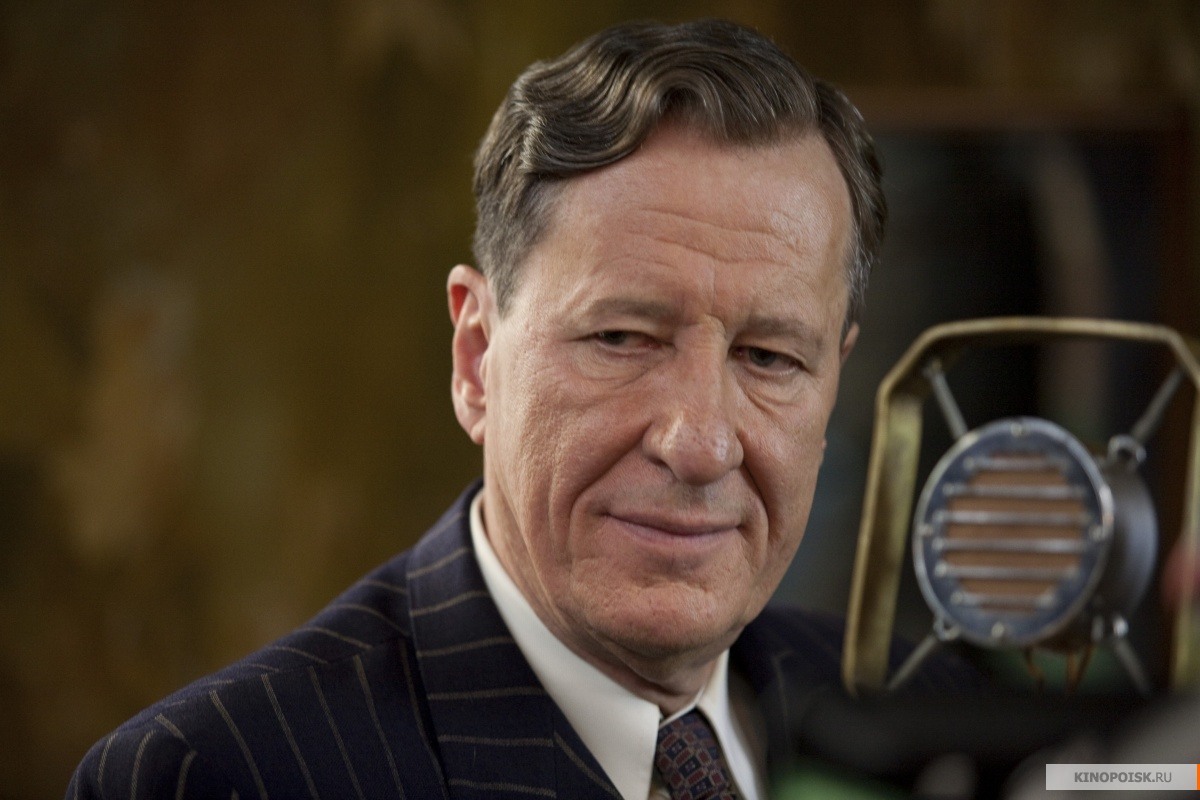
Below are images from the 2010 historical drama called "THE KING'S SPEECH". Directed by Tom Hooper, the movie stars Colin Firth, Geoffrey Rush and Helena Bonham-Carter:


"THE KING'S SPEECH" (2010) Photo Gallery