Showing posts with label dale robertson. Show all posts

Monday, December 4, 2023

"THE KANSAS CITY MASSACRE" (1975) Review


"THE KANSAS CITY MASSACRE" (1975) Review

Following the release of the 1967 movie, "BONNIE AND CLYDE", Hollywood release a spurt of biopics - for the theaters and television - about Midwestern and Southern-born gangsters (mainly bank robbers and kidnappers) during the Depression-era. Mind you, Hollywood had waited a few years before releasing or airing these films in earnest. One of these productions happened to be the 1975 television movie, "THE KANSAS CITY MASSACRE".

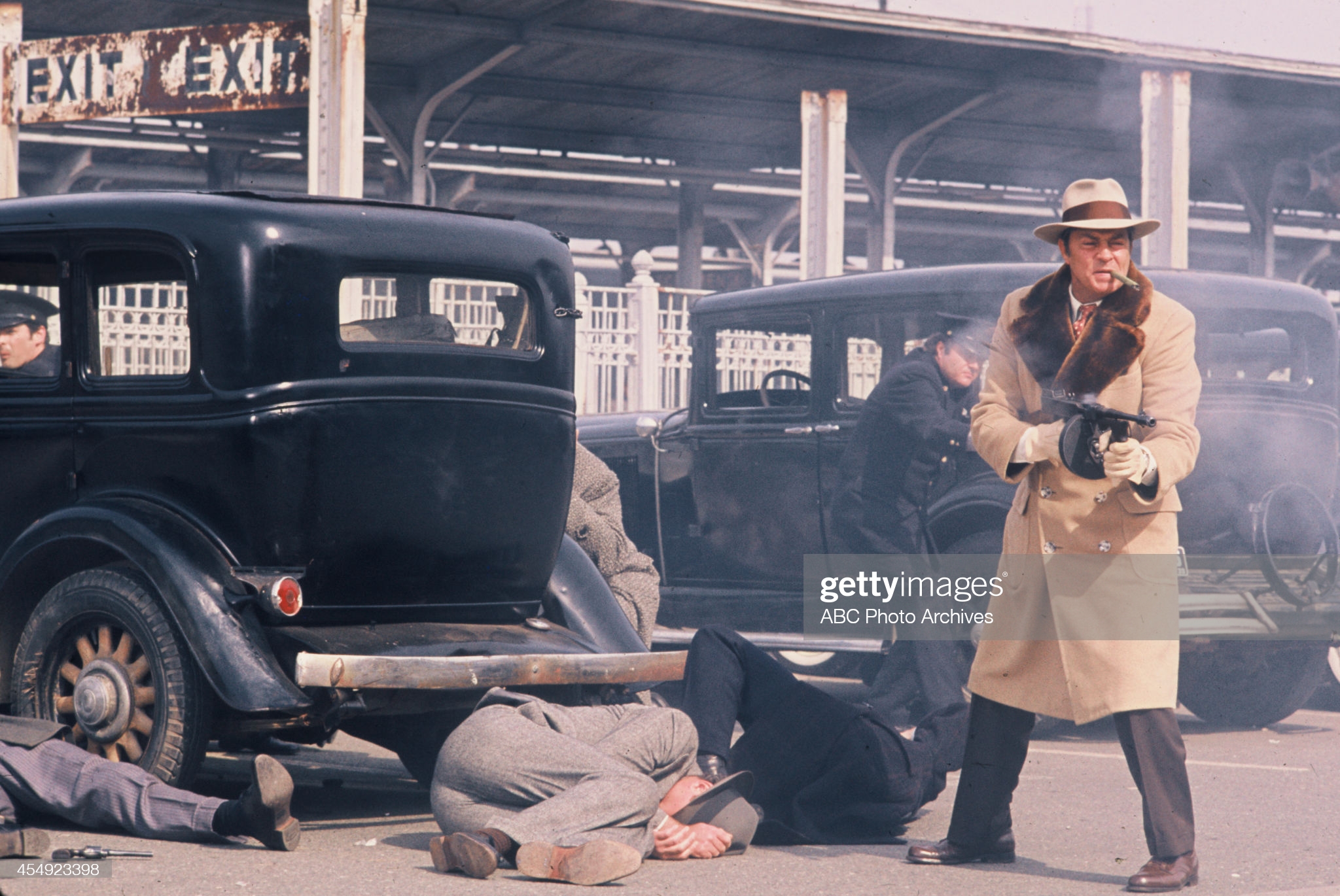
The 1975 film, directed by Dan Curtis (producer and director of the 1983 miniseries, "THE WINDS OF WAR"), "THE KANSAS CITY MASSACRE" is a spin-off of the 1974 television movie, "MELVIN PURVIS: G-MAN". The latter was a fictionalized account of F.B.I. Special Agent Melvin Purvis's hunt for gangster/kidnapper Machine Gun Kelly. In "THE KANSAS CITY MASSACRE", Purvis hunts down Charles "Pretty Boy" Floyd, Adam Richetti and Frank "Jelly" Nash; following their robbery of an Oklahoma bank. This hunt eventually leads to a famous shootout involving local gangsters, lawmen and the F.B.I. at the Kansas City Union Station in June 1933, which is set a year earlier than the 1974 production.

The movie begins with Floyd and Richetti helping Nash escape from a prison chain gang. Following Nash's escape, the trio robs a bank in Enid, Oklahoma; where they encounter fellow Depression-era gangsters. A who's-who's list of these gangsters - including John Dillinger, Homer Van Meter and Lester "Baby Face" Nelson - converge at the Floyd homestead to discuss the money laundering of their heists. Purvis' efforts to capture all or most of them at Floyd's home is ruined by an ambitious state trooper with an itchy trigger finger. Purvis' pursuit and the trio's efforts to evade him and get their money laundered eventually put them in the crosshairs of the Kansas City crime and political scenes of local gangster/club owner Verne Miller, organized crime figure John Lazia and local city commissioner Herbert Tucker McElwaine; along with the infamous shootout at Kansas City's Union Station.

Many were right to regard "THE KANSAS CITY MASSACRE" as a spin-off of 1974's "MELVIN PURVIS: G-MAN". Granted, both telecasts featured Dale Robertson as the famous F.B.I. special agent. Also, both productions are set during the Depression era of the early-to-mid 1930s and featured actors Harris Yulin and John Karlen. However, Yulin and Karlen ended up portraying different characters in "THE KANSAS CITY MASSACRE" from the ones they had portrayed in "MELVIN PURVIS: G-MAN". So . . . the 1975 movie was definitely not a prequel. Like "THE KANSAS CITY MASSACRE" and many other historical dramas, this 1975 docudrama is a mixture of fact and fiction. The narrative used Dale Robertson's voiceover to give historical gravitas to the production, especially in the movie's introductions to the infamous criminals that appear. But yes, "THE KANSAS CITY MASSACRE" is just as much fiction as fact. One, Melvin Purvis never played a direct role in the Kansas City shootout. Historians are not certain if Kansas City gangster John Lazia had played a role in what happened at Union Station. Some believe he may have informed Pretty Boy Floyd and Adam Richetti about the plot to rescue Nash from the F.B.I. But the movie would have you believe he had personally recruited Verne Miller to appear at Union Station with a handful of gunmen . . . to kill Nash, instead of rescuing him. As for Nash, he had escaped from prison earlier than 1933. Honestly, there are many aspects of the film's narrative I would regard with a wary eye. And that includes most of the characters wearing long or heavy coats, despite the movie's setting of April-June 1933. Did these inaccuracies limit my enjoyment of the movie? Well . . .

Who am I kidding? Inaccurate or not, I cannot deny that "THE KANSAS CITY MASSACRE" was an entertaining television production. One, the televised movie featured some interesting action sequences. For me, the best included the shootout at Floyd's farm early in the story, the actual massacre at the Kansas City Union Station and what I regard as the pièce de résistance, Floyd and Richetti's confrontation against Miller, with Purvis and the F.B.I. arriving at the last minute. Two, I have to give kudos to television movie's production values. With the contribution of Paul Lohmann's cinematography, Charles Pierce's set decorations, the Art Department coordinated by William M. Bell and John S. Perry's costume supervision; Dan Curtis managed to recreate the Midwest and Southwest of the early 1930s. Granted, I found the hairstyles worn by some of actresses in this production seemed to be lacking. A few hairstyles looked as if they came straight from the mid-1970s and others, including the one worn by actress Lynn Loring, looked as if they were trying to reflect the early 1930s and failing. There were moments when I actually felt I had traveled back some 90 years in time. As for Curtis, I thought he managed to keep the movie's pacing on track with his energetic pacing. Ironically, his direction seemed a far cry from the slightly ponderous style of the 1983 miniseries, "THE WINDS OF WAR".

I think the best virtue for "THE KANSAS CITY MASSACRE" proved to be its cast. The real Melvin Purvis had been a 29-to-30-year-old South Carolinian during the spring and summer of 1933. Dale Robertson, who had hailed from Oklahoma, was at least 51-to-52 years old, when he shot this movie. Honestly, he should have been the last actor on Earth to portray the Special F.B.I. agent. However, this was his second time at bat as Purvis and as before, he did a stupendous job as the Federal lawman, carrying the movie and allowing his presence to be felt without any real effort. Another first-rate performance came from Bo Hopkins, whose portrayal of Charles "Pretty Boy" Floyd seemed to be as laconic and skillful as Robertson's. And like the older actor, he managed to effectively allow his presence to be felt. "THE KANSAS CITY MASSACCRE" also featured excellent performances from Matt Clark, who struck me as perfect, as the volatile gangster Verne Miller; and the always excellent Robert Walden, who seemed spot-on as the romantic Adam Richetti. Other first-rate performances came from Mills Watson as the ambitious, yet pragmatic Frank "Jelly" Nash; Scott Brady, who oozed with slimy charm as the corrupt Commissioner Herbert McElwaine; Sally Kirkland as Floyd's long-suffering ex-wife Wilma Floyd; Harris Yulin (a veteran of "MELVIN PURVIS, G-MAN") as the venal gangster John Lazia; John Karlen (another veteran from the 1974 TV-movie) as Purvis's right-hand man, the stalwart Sam Cowley; and Philip Burns as the ambitious and trigger-happy state policeman, Captain Jackson. I especially want to compliment Lynn Loring's performance as Vi Morland. I thought she did a first-rate job conveying the complex and flaky nature of the Kansas City nightclub singer, who seemed to be conflicted between her memories of her past romance with Richetti and her volatile relationship with the unreliable Miller.

Look, "THE KANSAS CITY MASSACRE" is not perfect. The movie seemed a bit too in love with the "Pretty Boy" Floyd character, which explained why it never revealed his fate. Yes, it had its share of historical inaccuries, including questionable hairstyles. Lead actor Dale Robertson was at least 20 years too old to be portraying F.B.I. Agent Melvin Purvis. And the influx of Depression-era gangsters in the film's first 30 minutes had struck me as unnecessary. But I cannot deny that despite its lack of historical accuracies, "THE KANSAS CITY MASSACRE" told a first-rate and exciting story, thanks to screenwriters William F. Nolan and Ric Hardman. It also benefited from strong production values, energetic direction from Dan Curtis and some excellent performances from a first-rate cast led by Robertson. It may not be perfect, but I thought it was pretty damn good and entertaining.

Monday, October 2, 2023

"THE KANSAS CITY MASSACRE" (1975) Photo Gallery


Below are images from "THE KANSAS CITY MASSACRE", the 1975 prequel to the 1974 television movie, "MELVIN PURVIS, G-MEN".  Directed by Dan Curtis, the television movie starred Dale Robertson as F.B.I. Special Agent Melvin Purvis:


"THE KANSAS CITY MASSACRE" (1975) Photo Gallery


Friday, November 30, 2018

"THE GAMBLER FROM NATCHEZ" (1954) Review


"THE GAMBLER FROM NATCHEZ" (1954) Review

A few years ago, I had reviewed an old 1953 Tyrone Power movie called "THE MISSISSIPPI GAMBLER". This 1953 movie proved to be a mixture of a costume melodrama and adventure that chronicled the adventures of a Northern-born gambler who moves to New Orleans to start his own casino. The following year saw the release of another movie with a similar theme called "THE GAMBLER FROM NATCHEZ". 

There are differences between "THE GAMBLER FROM NATCHEZ" and "THE MISSISSIPPI GAMBLER". The latter film featured a top film star - Tyrone Power. And I can only assume that it was one of Universal Pictures' "A" films for 1953. It was certainly a big hit. On the hand, one glance at "THE GAMBLER FROM NATCHEZ" and a person was bound to regard it as a "B" movie. The film's lead, Dale Robertson, was never big as Power. He was mainly known as a television star during the 1950s and 1960s. And his Hollywood career had only started five years before this film. 

"THE GAMBLER FROM NATCHEZ" began in 1848 Baton Rouge with the arrival of a discharged Army militia officer named Captain Vance Colby, who had fought in Texas and Mexico during the Mexican-American War. In response to a message from a close family friend, Vance planned to travel down to New Orleans on horseback to meet his father, a famous and successful professional gambler named Chip Colby. During his journey, he meets a beautiful Creole aristocrat named Ivette Rivage and comes to her aid, when her carriage's horse becomes lame. She invites him to her family's plantation, Araby, where he meets her brother Andre Rivage and her fiance Claude St. Germaine. The two men react coldly upon learning of Vance's relation to his father, who has recently been accused of being a card cheat. 

Following Vance's departure from Araby, he is attacked by Andre's hired thug, Etienne. Riverboat captain Antoine Barbee and his daughter Melanie, whom Vance had first met in Baton Rouge, come to the wounded Vance's aid. Upon his arrival in New Orleans, Vance learns that his father was killed and framed for card cheating by three men - casino owner Nicholas Cadiz, Claude St. Germaine and Andre Rivage. Colby Sr. had won half interest in a new gambling vessel that the three accusers had plans to launch. Upon learning this Vance vows revenge against his father's enemies.

I first saw "THE GAMBLER FROM NATCHEZ" on late night television when I was a teenager. Which means that MANY years had passed since my recent viewings. I wondered if my opinion of the film would change. To my surprise, I discover that it had not. As I had earlier stated, "THE GAMBLER FROM NATCHEZ" struck me as a "B" swashbuckler. Although the film was released through Twentieth Century Fox, it was made by a production company called Panoramic Pictures that released a series of low budget films during the 1950s. And yes . . . it was quite obvious that "THE GAMBLER FROM NATCHEZ" was a low budget film.

I noticed that for a movie set in the lower Mississippi River Valley, I cannot recall seeing any hint or sign of water in it, aside from the swamp (or a back lot pond) where Vance Colby was wounded and the body of water (or back lot pond) where one of the villains fell from a riverboat. I am still amazed that Chester Bayhi's set decorations and art director Leland Fuller managed to convey the movie's late 1840s setting with some plausibility - especially in scenes featuring the interior sets for the Araby plantation, Nicholas Cadiz's New Orleans casino and the parlor of Andre Rivage's new steamboat. 

On the other hand, I had a problem with Travilla's costumes. His costumes for the movie's actors, especially leading man Dale Robertson. Travilla did an excellent job in recapturing the men's fashion for that era, including the U.S. Army officer uniform that Robertson wore during the film's first half hour. I wish I could say the same for the women's costumes in the movie. Well, I found most of them a somewhat adequate representation of women's fashion in the late 1840s - especially those costumes worn by actress Lisa Daniels. But Travilla's designs for leading lady Debra Paget's costumes . . . what on earth?


Paget wore at least two or three more costumes in the film that struck me as a bit more tolerable. But she wore the one featured in the image above more than the others Now, I realize that her character, Melanie Barbee, was the daughter of a man who owned and operated a minor steamboat. But this is the 1840s we are talking about. Melanie was definitely not a prostitute or daughter of a poor backwoodsman. Her father owned a steamboat, even if it was second-class. A woman of her background and time would never be caught dead wearing such an outfit out in the open for everyone to see, let alone in the lobby of an exclusive New Orleans hotel.

I might have some issues with "THE GAMBLER FROM NATCHEZ". But if I must be honest, my opinion of the film has not changed over the years. I still managed to enjoy it. During my review of "THE MISSISSIPPI GAMBLER", I had complained about the film's vague and episodic narrative. I certainly had no such problems with "THE GAMBLER FROM NATCHEZ". I thought Gerald Adams and Irving Wallace had created a solid and entertaining story about a mid-19th century gambler who sought revenge against the men who had killed his father and ruined the latter's reputation. In fact, I cannot help but feel somewhat impressed by how Adams and Wallace had structured the movie's plot.

The two screenwriters set up the plot by allowing the protagonist, Vance Colby, to encounter a series of mysteries surrounding his father. From the fight he participated in with another gambler during his arrival at Baton Rouge via steamboat to the discovery of Chip Colby's death, Vance seemed encounter one mystery after another. Midway into the film, Adams and Wallace allowed Vance to finally discover the true mysteries behind Colby Senior's recent reputation as a card cheat, Andre Rivage's murder attempt on his life and Colby Senior's death. Upon this point, the plot for "THE GAMBLER FROM NATCHEZ" focused solely on Vance's desire for revenge against the three men responsible for his father's death. Through it all, Adams and Wallace created a light love triangle between Vance and two women - the steamboat captain's daughter, Melanie Barbee; and Ivette Rivage, who proved to be more superior than her morally bankrupt brother. 

The movie also benefited from a first-rate cast. By 1954, Dale Robertson had been around Hollywood for five years. Although he never became a big star like Tyrone Power, his excellent performance as the strong-willed and determined Vince Colby made it pretty obvious why his acting career lasted for the next four decades - mainly in television. He also managed to create a strong screen chemistry with his leading lady, Debra Paget. She gave a very entertaining and superb performance as the feisty Melanie Barbee, who quickly fell in love with Vance while saving his skin on at least two or three occasions. Robertson also had a strong screen chemistry with Lisa Daniels, the British actress who portrayed the Creole aristocrat, Ivette Rivage. I believe Ivette proved to be a more complex character than any other in this film. She had to be regarded as the wrong woman for Vance, yet portrayed in a more sympathetic light than her brother. And I believe Daniels managed to skillfully achieve this balance in her performance.

I find it odd that Kevin McCarthy ended up in a low-budget film some three years after appearing in the film adaptation of Arthur Miller's play, "DEATH OF A SALESMAN". Well . . . regardless of how he must have felt at the time, McCarthy proved to be the first-rate actor and consummate professional who portrayed Andre Rivage as the charming, yet violent aristocrat whose temper and gambling addiction set the story in motion. Another excellent supporting performance came from Thomas Gomez, who portrayed Vance's new friend and Melanie's father, steamboat Captain Antoine Barbee. Gomez did an excellent job in conveying Captain Barbee's friendly and pragmatic personality . . . and providing a brief father figure for Vance. The movie also featured solid performances from Douglas Dick (who portrayed the spineless Claude St. Germaine), John Wengraf (who portrayed the intimidating Nicholas Cadiz), Jay Novello, Peter Mamakos, Donald Randolph, and Henri Letondal. And guess who else was in this film? Woody Strode, who portrayed Josh, one of Captain Barbee's crewmen. Or only crewman. Hell, I am not even certain whether he portrayed a free man or a slave. But his character did help the main hero defeat the "Big Bad" in a way that will prove to be very surprising for a film made in the 1950s.

I realize that "THE GAMBLER FROM NATCHEZ" is not perfect. But for a low-budget film, it proved to possess a very well-structured and well-written narrative, thanks to screenwriters Gerald Adams and Irving Wallace. Although I regard the story to be the backbone of any film, director Henry Levin could have have ruined it with bad direction. But he did not. Instead, I believe Levin and a cast led by Dale Robertson did more than justice to the screenplay. Perhaps this is why after so many years, I still managed to enjoy this film.

Wednesday, September 19, 2018

"THE GAMBLER FROM NATCHEZ" (1954) Photo Gallery


Below are images from the 1954 costume adventure film, "THE GAMBLER FROM NATCHEZ". Directed by Henry Levin, the movie starred Dale Robertson and Debra Paget: 


"THE GAMBLER FROM NATCHEZ" (1954) Photo Gallery