Showing posts with label elsa lancaster. Show all posts

Sunday, May 18, 2025

"THAT DARN CAT!" (1965) Review


"THAT DARN CAT!" (1965) Review

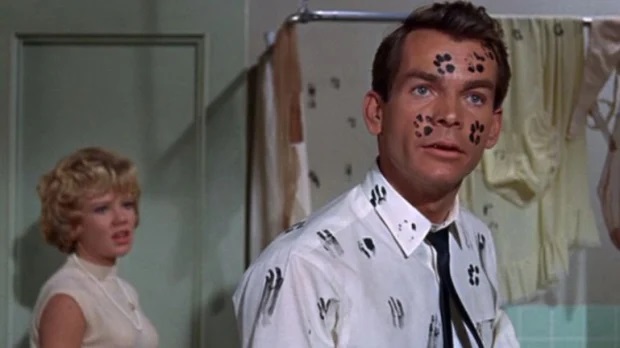
Does anyone know when the Golden Age for the Walt Disney Studios had existed? Initially, I would have selected the decade of the 1960s. But . . . the studio had released too many mediocre or bad movies during that decade for me to stick with this assessment. However, I cannot deny that Disney Studios had also released a good number of superb films during the Sixties. At least two performers - Hayley Mills and Dean Jones - were featured in a handful of them. Both Mills and Jones co-starred in one of those films - 1965's "THAT DARN CAT!".

Based on Gordon and Mildred Gordon's 1963 novel, "Undercover Cat", "THAT DARN CAT!" told the story of a wily Siamese tomcat named "Darn Cat" or "DC" who lives with two sisters, Ingrid and Patricia "Patti" Randall in a Californian suburb. DC's habit of evening wanderings around town usually results in teasing local dogs, leaving muddy paw prints on cars and swiping food. One evening, DC follows a man carrying a grocery bag to the latter's low-rent apartment. The man turned out to be one of two bank robbers - Iggy and Dan - hiding out after committing a daytime heist and kidnapping a bank teller named Margaret Miller. Miss Miller takes an opportunity to switch DC's collar with her wristwatch, with the words "HELP" carved on the back. Upon his return to the Randall household, Patti discovers the watch and realizes that it belongs to Miss Miller. She reports her discovery to the F.B.I. and a doubtful Special Agent Zeke Kelso. Despite his doubts and allergy to cats, Kelso's supervisor Special Agent Newton orders the younger agent to set up a surveillance of DC, in the hopes that the latter will lead them to the kidnapped woman and the bank robbers. And Patti . . . insists upon offering her help.

Not long after viewing "THAT DARN CAT!", I had come across a review of the film that seemed to dismiss it as outdated. Considering the film had been made back in the mid-1960s, I can see how one would regard the film as such. However, I have never been that concerned about a film's original date, as long as I liked the movie. I tried to think of a few complaints about "THAT DARN CAT!". For instance, I was aware that California served as the movie's setting. But where in California? At first, I thought the movie was set in Southern California when one of the robbers mentioned "the Valley". This made sense, considering Patti's boyfriend, Canoe Henderson, was a surfer. Then another character mentioned Fresno and I became confused. Fresno? A city situated in the southern half of California's Central Valley. A habitual surfer like Canoe would have to travel a bit on a daily basis in order to engage in his love of surfing. I also found the idea of Patti's sister, Ingrid, willing to offer herself as a possible girlfriend for their toxic neighbor, Gregory Benson, in order to remain in his carpool, very difficult to swallow. Frankly, I found this minor story arc a bit distasteful, almost bordering on "political incorrectness".

Despite my quibbles about the movie, I genuinely enjoyed "THAT DARN CAT!". Perhaps I should rephrase that. After many years, the movie remained very enjoyable to me and has not lost its bite one bit. Yes, the movie had its share of silly humor - especially during the sequence featuring DC's nighttime adventures, while prowling the streets. The sight of F.B.I. agents following him, while struggling to maintain their distance only contributed to the humor. But not only did the movie feature silly humor, but also a good deal of some pretty sharp wit. Some of the best scenes featured the verbal clashes between the Randalls' neighbors - the nosy Mrs. MacDougall and her sharp-tongued, yet long-suffering husband (the Disney version of Gladys and Abner Kravitz of "BEWITCHED"); DC's clashes with the obnoxious Gregory; Patti's scheme to renew the F.B.I.'s interest in the operation after their initial failure; and especially Special Agent Kelso's struggles to deal with DC and his cat allergy.

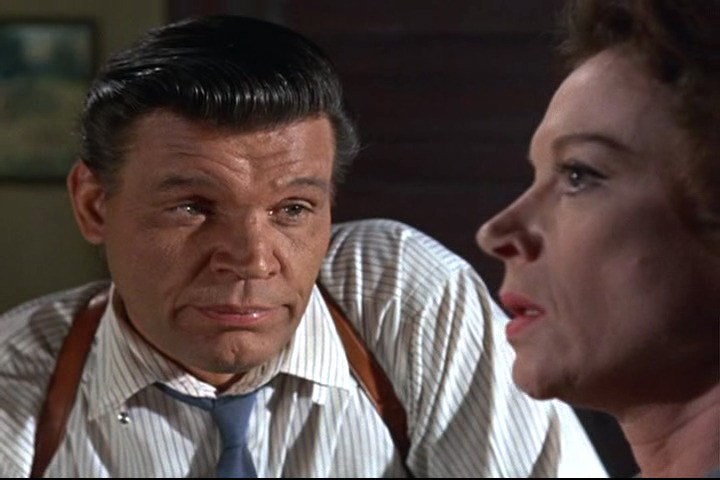
Amidst all of the humor, the screenplay written by the Gordons and Bill Walsh never forgotten that "THAT DARN CAT!" was also a crime thriller. Although the movie never showed the bank robbery that kickstarted the film's narrative on screen, it did an excellent job of conveying its after effects not only on DC, Patti and Kelso; but also on the unlucky Miss Miller. Mind you, "THAT DARN CAT!" featured some comedic moments with the two bank robbers - especially in scenes in which they argued with each other, along with Iggy's interactions with DC. However, the movie also included scenes that reminded movie audiences just how dangerous the two robbers were. Iggy struck me as an emotional and slightly unhinged personality, whose temper and penchant for violence could be easily triggered. However, one scene featuring Miss Miller's attempt to attract the police quickly proved that Dan, the older robber, was the pair's true menace.

I never thought I would live to see the day when I found myself impressed by a non-human's performance in a movie. But I must admit that I was more than impressed by the cat who portrayed the contrary DC - namely a cat actor named Syn. The latter not only proved to be quite the scene stealer, but also received the PATSY (Picture Animal Top Star of the Year) for his performance in "THAT DARN CAT!".

However, Syn did not give the only outstanding performance. "THAT DARN CAT!" featured a strong cast that not even a scene-stealing feline could overshadow. Frank Gorshin was a year away from his iconic portrayal of the DC Comics villain, the Riddler, in the "BATMAN". But in this film, he gave both a hilarious, yet terrifying performance as Iggy, the volatile bank robber with a fondness for DC and a hair-trigger temper. Neville Brand's portrayal of the older bank robber, Dan, seemed benign . . . until the actor skillfully conveyed how the older man could could be even more dangerous than Iggy with a subtle, yet powerful menace. That one scene, which featured Miss Miller's attempt to attract the cops with a burning trash can nearly had me on the edge of my seat, thanks to Brand's performance. "THAT DARN CAT!" was the first of five Disney movies Roddy McDowall had made for the studio between 1965 and 1979. He portrayed Gregory Benson, the Randalls' slimy neighbor with a romantic eye for the older sister. I think Gregory proved to be one of the best villains McDowall had ever portrayed, conveying the character's aggressive nature, sense of entitlement, unhealthy attachment to his mother and willingness to exploit Ingrid Randall's need for a carpool in order to romance her. Gregory was a real piece of work and McDowall had portrayed him beautifully.

I do not know whose idea it was to cast British-born Elsa Lancaster and William Demarest as the nosy Mrs. MacDougall and her caustic husband, Mr. MacDougall. They seemed like the last two people I would cast as a suburban middle-aged to elderly married couple. And yet . . . Lancaster and Demarest complimented each other like ducks to water. I would consider their screen teaming as one of those happy accidents. The Disney Studios brought back Ed Wynn, last seen in 1964's "MARY POPPINS", to portray Mr. Hofstedder, the nervous jeweler whom Patti recruits to help her renew the F.B.I.'s interest in the case. Although I found Wynn's performance funny, there were times when I found his portrayal of Mr. Hofstedder's tics a bit overdone. Iris Adrian managed to give a perfectly garish performance as Dan and Iggy's boorish landlady without being over-the-top. I really enjoyed Tom Lowell's hilarious portrayal of Canoe Henderson, Patti's slacker boyfriend, who seemed to center his life around surfing and food. I especially enjoyed those scenes that featured Canoe's fears that Patti may have moved on to the older Zeke Kelso. The movie also featured solid and competent performances from the likes of Grayson Hall, Richard Eastman and Richard Deacon.

My only complaint about Dorothy Provine's performance in "THAT DARN CAT!" is she did not have more scenes. Not only did I really enjoy her portrayal of Ingrid Randall, Patti's sardonic sister, I also enjoyed her screen chemistry with Hayley Mills. Like the pairing of Lancaster and Demarest, the pairing of Provine and Mills as two sisters struck me another happy casting accident, despite one actress being British and the other American. "THAT DARN CAT!" turned out to be Dean Jones' first movie for the Disney Studios for the next twelve years. Needless to say, the actor struck gold in his portrayal of Zeke Kelso, a pragmatic F.B.I. agent who had the misfortune to be allergic cats. Granted, Jones gave a skillful performance as a pragmatic and intelligent law enforcement agent. But his scenes with featuring Kelso's allergic reactions and handling of DC practically had me on the floor, laughing. Where as the 1965 comedy was Jones' first movie for Disney, it was Hayley Mills' last one after five years with the studio . . . at least until another twenty-three years later. Someone had once dismissed Mills' portrayal of Patti Randall as another one of those Disney roles that had the actress prattling on needlessly before coming to the point. A rather superficial assessment of a performance, if you ask me. I thought Mills gave a fabulous performance as the energetic and intelligent Patti, whose boredom with her life led her to become involved in a case regarding a bank robbery and a missing bank teller. This was especially apparent in scenes involving Patti's boredom with her boyfriend's obsession with surfing and the cunning she utilizes to reignite the F.B.I.'s interest in DC and the case. It was a great way for Mills to end her association with Disney.

"THAT DARN CAT!" may have possessed a few issues. Overall, I thought it was an excellent comedy thriller that more than deserved its success at the box office. Even after nearly six decades, it still managed to produce a great deal of laughter and thrills, thanks to a first-rate script written by Gordon and Mildred Gordon, along with Bill Walsh; excellent direction by the always superb Robert Stevenson; and a first-rate cast led by Hayley Mills, Dean Jones and a scene-stealing cat actor named Syn.


Thursday, March 13, 2025

"THAT DARN CAT!" (1965) Photo Gallery


Below are images from "THAT DARN CAT!", Disney's 1965 adaptation of Gordon and Mildred Gordon's 1963 novel, "Undercover Cat". Directed by Robert Stevenson, the movie starred Hayley Mills and Dean Jones:


"THAT DARN CAT!" (1965) Photo Gallery


Friday, February 4, 2022

"MARY POPPINS" (1964) Review


"MARY POPPINS" (1964) Review

Looking at the 1964 movie about a magical nanny, one would be amazed that it took nearly 20 years to make it. I suspect that many did not predict it would become critically acclaimed. But if one is ever interested in the behind-the-scenes production of the film, one would have to read about it . . . or watch the 2013 movie, "SAVING MR. BANKS". I am here to discuss the actual movie, "MARY POPPINS".

Based upon a selection of short stories written by P.L. Travers, "MARY POPPINS" tells the story of how two Edwardian Age children named Jane and Michael Banks, who request a particular kind of nanny after their latest one quits her job after enduring one too many pranks from the two siblings. Their father, a banker named George Banks, is too busy with his career and projecting the image of an ideal Englishman in order to pay attention to them. Their mother, although slightly more concerned about their welfare, is either caught up in the Suffregette Movement or too busy adhering to their father's demands. After the departure of their latest nanny, Katie Nanna, Jane and Michael write a letter describing what they want in a new nanny. But Mr. Banks has different ideas - a nanny who is an effective disciplinarian - and tears up their letter.

However, the children's letter magically reaches a woman named Mary Poppins. She appears at the Banks' home the following morning to apply (or appoint herself) as Jane and Michael's new nanny. Despite his initial reservation, Mr. Banks is impressed by Mary Poppins' firm manner and hires her. With the help of friend named Bert, Mary Poppins introduces the Banks children to a new magical world. In doing so, she also manages to shake up Mr. Banks, his household and his livelihood.

I first saw "MARY POPPINS" as a child and immediately fell in love with it. For years, I have regarded the movie as one of the highlights of my childhood and one of the best films to be released from the Disney Studios. But recent criticism of Mary Poppins as a sugar-coated character of no substance, and of the film as an infantilization of P.L. Travers' work and vision has led me to wonder if my childhood opinion of "MARY POPPINS" may have been overrated. After all, I had spent years judging the movie from the viewpoint of a child. How would I judge this movie from an adult who has spent the last ten to twenty years viewing movies with a critical eye?

As many have recently pointed out, the Disney Studios made a good number of changes to Travers' stories. They also left out a great deal. To point out "all" of the changes and deletions would require an essay. And I am not interested in writing such an essay. Were there any aspects of "MARY POPPINS" that I disliked? Honestly? No. But there are aspects of the movie's production that I wish could have been handled in a slightly different manner.

For quite some time, I never understood why "MARY POPPINS" was shot at the studio's Burbank lot, instead of at England's Pinewood Studios, where 1963's "DR. SYN, ALIAS THE SCARECROW" and "THE THREE LIVES OF THOMASINA" were filmed. Like the two 1963 films, "MARY POPPINS" mainly featured a cast of British actors. Only four cast members were American born - Dick Van Dyke, Ed Wynn, Jane Darwell and Reta Shaw. I feel that if the movie had been shot in Great Britain, its exterior shots of the Banks and Uncle Albert's neighborhoods and the City of London would have featured a bit more details - add more oomph to the movie's visual British style. As for Tony Walton's costume designs, I must admit that I found them rather charming, if not particularly mind blowing. However . . . I could not help but wonder why Mary Poppins' skirts seemed a tad short for 1909-10 fashions. And I also end up wondering why Winifred Banks' wardrobe seemed so limited. Unless I am mistaken, actress Glynis Johns wore only three costumes in "MARY POPPINS". In fact, I suspect she wore one particular costume twice. And Walton designed her costumes either in yellow, powder blue or a combination of both colors. Although I found Johns' costumes rather charming, they also struck me as a bit limited.

Although the film's production designs struck me as a bit limited, I cannot help but admire the film's cinematography and visual style. Edward Colman earned a much-deserved nomination for his colorful and sharp photography for the film. Colman's photography also enhanced Tony Walton's matte paintings created by Peter Ellenshaw. Since "MARY POPPINS" was filmed on the Disney Studios backlot in Burbank, Walt Disney and director Robert Stevenson not only had to depend upon Carroll Clark and William H. Tuntke's art direction, but also the visual effects and special effects teams. But "MARY POPPINS" was set in Edwardian London. And since Disney, Stevenson and the film's crew could not film in Great Britain, the production team had to rely on Ellenshaw's beautiful and colorful matte paintings to add to the film's visual look for its setting, as shown in the following images:


"MARY POPPINS" may not have been free of any flaws, but it still remains one of my favorite movies of all time. I had earlier pointed out that some critics have pointed out the movie's failure to be completely faithful to Travers' stories. Honestly? I do not care. It would have been near impossible for any screenwriter to be completely faithful. Travers did not write a single novel. She wrote a series of short stories and novellas. And since it is impossible for a screenplay to be completely faithful to a novel or stage play, what on earth made these critics believe Bill Walsh and Don DaGradi could have been completely faithful to Travers' stories and still fashion a single narrative for the film? Ridiculous!

Personally, I am amazed that Walsh and DaGradi managed to wring a single narrative out of so many short stories in the first place. That must have not been an easy task. As the 2013 movie, "SAVING MR. BANKS", had pointed out, Mary Poppins' purpose within the Banks' household was to save George Banks and his relationship with his children. And she did this in the most interesting way. Mary Poppins used her role as the children's nanny to indirectly affect the family's patriarch. Instead of utilizing traditional means to care for the children, Mary Poppins exposed Jane and Michael to her world - using magic to clean the nursery, an excursion into a sidewalk chalk drawing of the English countryside, and an afternoon tea party on the ceiling with Mary Poppins' Uncle Albert. The children's revelations of their activities naturally shook up Mr. Banks, along with the magical nanny's subversive and cheerful impact upon the Banks' household.

Unable to accept Mary Poppins' impact upon his family and servants, Mr. Banks threatened to fire her. And this is where Mary Poppins, as the film's trickster, pulled off a pièce de résistance. Before Mr. Banks could fire her, Mary Poppins managed to manipulate him into agreeing to take the children on an outing to his bank. However, the night before this outing, she decides to sing a song to the children about an old beggar woman who sits on the steps of St Paul's Cathedral, selling bags of breadcrumbs to passers-by for two pence a bag,so that they can feed the many pigeons that surround her. Between the song and the children spotting the Bird Woman on their way to their father's bank set in motion the chaos that followed and Mary Poppins' plan to save Mr. Banks' relationship with his family. Brilliant.

If the narrative that Walsh and DaGradi had created from Travers' short stories had struck me as brilliant, the songs written by Robert and Richard Sherman seemed even more so. Aside from the performances, the Sherman Brothers' songs seemed to be the heart and soul of the film. If someone was to ask me which song was my favorite, I honestly could not answer that question. Aside from two of them, I found most of their songs very memorable . . . even to this day. One of their songs - "Chim Chim Cher-ee" - was nominated for the Best Song Oscar and won. However, I must admit to being surprised that the beautiful and rather haunting "Feed the Birds" failed to garner any kind of nomination or award. Perhaps it was not as fully appreciated back in 1964-65 as it is today.

Both "Jolly Holiday" and "Step in Time" were not only entertaining songs, but they also provided the background for some very first-rate dance numbers. The first featured the very agile Dick Van Dyke and a quartet of animated pigeons. I found this dance sequence both funny and a joy to watch. You have to see it to believe it. As for the second song, it was featured in a show stopping dance routine that involved Van Dyke, Julie Andrews . . . and chimney sweeps. Between the song, the dance routines choreographed by the husband-and-wife team of Marc Breaux and Dee Dee Wood, and the London rooftops background, the entire sequence is one of the film's highlights.

Another addition to the magic of "MARY POPPINS" proved to be its cast. The movie featured excellent voice performances in the chalk picture sequence from the likes of J. Pat O'Malley, Marni Nixon, Dallas McKinnon, and Alan Napier. Even Julie Andrews and David Tomlinson also provided voice performances. The supporting and cameo performances featured in this film were marvelous. The movie included excellent performances from Reginald Owen as the cankerous Admiral Boom; Elsa Lancaster as the disgruntled Katie Nanny; Arthur Treacher as the kindly Constable Jones; Arthur Malet as Mr. Dawes Jr., one of the board members of the bank that employed Mr. Banks; Hermione Baddeley and Reta Shaw as Ellen and Mrs. Brill, the Banks' gregarious maid and cook; and a poignant cameo by Jane Darwell, who was convinced by Disney to make a brief appearance as the Bird Lady.

"MARY POPPINS" marked the second teaming of Karen Dotrice and Matthew Garber, who portrayed the magical nanny's charges, Jane and Michael Banks. It seemed pretty simple to me why Disney had used this pair in three movies. Not only were they were first-rate actors who more than kept up with the likes of Julie Andrews, Dick Van Dyke and David Tomlinson; they also had a great screen chemistry. In P.L. Travers' books, Mrs. Banks was an easily intimidated woman who could barely maintain control of her household. In this movie, Mrs. Banks was a woman more occupied by her suffragette activities than her children. And she was portrayed by actress Glynis Johns. The latter gave a marvelous performance as a woman who seemed to hide her inability to protect her children from their father's neglect with a few sympathetic words and her own brand of neglect.

If I had to select the most complex character in this movie, it would have to be Mr. George Banks of 17 Cherry Tree Lane and the Dawes Tomes Mousley Grubbs Fidelity Fiduciary Bank. Thanks to actor David Tomlinson in his first appearance in a Disney film, movie audiences were treated to a superb performance. Tomlinson skillfully transformed George Banks from a highly driven and disciplined man who was obsessed with order to an affectionate family man who had found a new lease on life. It almost seems criminal that the actor never received any kind of acting nomination for his performance.

Unlike Tomlinson, Dick Van Dyke did receive a Golden Globe nomination for Best Actor, thanks to his performance as Bert, Mary Poppins' closest friend and jack-of-all-trades. Whenever Van Dyke's performance in "MARY POPPINS" is mentioned, people seemed to comment on his Cockney accent. Granted, it was not perfect. But I have never considered it to be a travesty. I have noticed that whenever he spoke words with a long vowel, his Cockney accent seemed exaggerated. Otherwise, I had no problems. And if someone like Sean Connery can win an Oscar for portraying an Irish immigrant with a Scots accent, I see no reason why Van Dyke's portrayal of Bert should only be condemned for a questionable Cockney accent. Besides . . . accent aside, Van Dyke gave a superb performance in so many other ways. He captured Bert's charm, wit and a slight talent for manipulation with such perfection. Van Dyke was also given the opportunity to portray another character in the film - namely Mr. Banks' elderly boss, Mr. Dawes Senior of the Dawes Tomes Mousley Grubbs Fidelity Fiduciary Bank. How often does one find an actor in his late 30s effectively portraying a 90-something year-old man? In my personal experience, very rarely. And to put the cherry on the icing, Van Dyke was never criticized for his British accent, while portraying Mr. Dawes . . . for good reason. Although there have been hints of his talent as a song-and-dance man in his first television series, "THE DICK VAN DYKE SHOW", this movie really provided an opportunity to convey how truly talented he could be.

Julie Andrews managed to capture the big prize for her portrayal of the film's leading character, Mary Poppins. She won the Academy Award for Best Actress. Whereas many were distracted from Van Dyke's performance because of his accent, others have lamented on how Andrews' portrayal of the magical nanny seemed a far cry from her literary version. Granted, the latter was a plain-looking woman, somewhat more pompous and stricter. Although Andrews' Mary Poppins was more beautiful looking and slightly warmer than her literary counterpoint, she could still be quite sharp-tongued - especially when disciplining Jane and Michael and somewhat reserved. Andrews also did a great job in conveying Mary Poppins' no nonsense behavior and massive talent for emotional manipulation. That one scene in which the magical nanny manipulated Mr. Banks into taking his children on an outing to his bank was just a joy to watch. Thanks to her skillful and award-winning performance, Andrews managed to convey the reason why Mary Poppins is regarded as a trickster.

What else can I say about "MARY POPPINS"? Over fifty years have passed since the movie's initial release, and it is still - at least to me - a magical movie to watch. Yes, it had a few flaws. What movie did not? But thanks to P.L. Travers' stories, Robert Stevenson's marvelous direction, Robert and Richard Sherman's music, the movie's visual effects teams and the superb cast led by Julie Andrews and Dick Van Dyke; "MARY POPPINS" remained timeless and magical as ever.


Friday, December 10, 2021

"MARY POPPINS" (1964) Photo Gallery

 mary_poppins-640x481


Below are images from "MARY POPPINS", the 1964 Disney adaptation of P.L. Travers' series of children's books. Directed by Robert Stevenson, the movie starred Oscar winner Julie Andrews and Dick Van Dyke:


"MARY POPPINS" (1964) Photo Gallery

1-Mary Poppins


10148529_1-640x469


20121010153421


mary-poppins-all-roads-lead-to-cherry-tree-lane-elsa-lanchester-feat-1


kdmpop023


Mary Poppins2


mary_poppins_1964_9


marypoppinsC


tumblr_my6xi54JIb1rcb0d2o1_500


tumblr_mztrrlHLfb1rli56do3_1280


15


507c802bd351c.preview-620


3435_0_screenshot


104154_0


1386356689_1


2802244161_eb43b19dbd


1386356689_2


1386356689_3


8408886671_5609d9b308_z


chalk-dance


dick-van-dyke-mary-poppins


karen_dotrice12


kinopoisk.ru-Mary-Poppins-580391


kinopoisk.ru-Mary-Poppins-1602693


kinopoisk.ru-Mary-Poppins-1602696


kinopoisk.ru-Mary-Poppins-2272028


kinopoisk.ru-Mary-Poppins-2272396


Mary Poppins Julie Andrews


Mary_Poppins12


mary_poppins-15


marypoppins_6


MaryPoppins2


mary-poppins-musical-imgs


poppins4


vlcsnap-2014-09-24-21h30m43s159


vlcsnap-2014-09-24-22h06m43s31