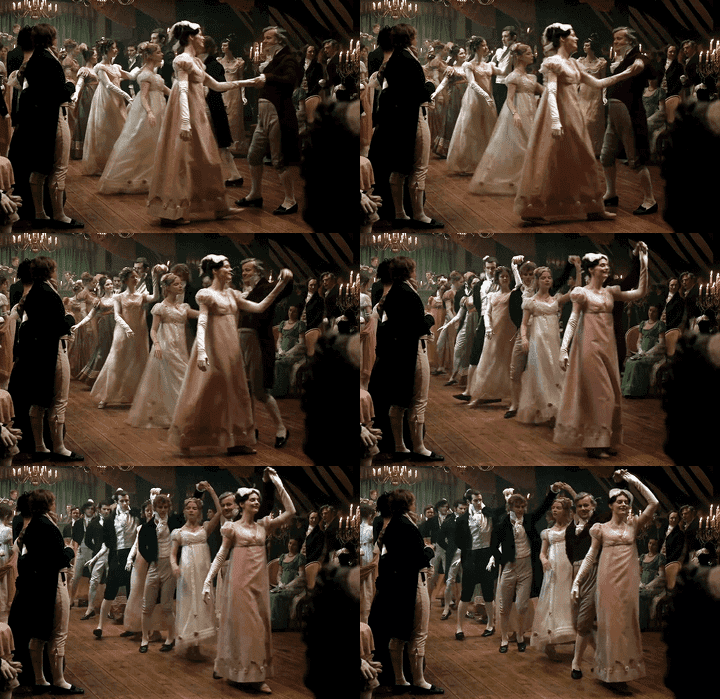
"THE TENANT OF WILDFELL HALL" (1996) ReviewI cannot count the number of times I have seen either movie or television adaptations of either Charlotte Brontë's 1847 novel, "Jane Eyre" or Emily Brontë's novel of the same year, "Wuthering Heights". There was also a third sister who was also a novelist, namely Anne Brontë. She had also written a famous novel. Published in 1848, it was titled "The Tenant of Wildfell Hall".Despite the novel's success upon its publication, the reputation of "The Tenant of Wildfell Hall" seemed to have faded over the years . . . to the point that many literary critics had developed a dismissive attitude toward it by the early 20th century. However, the novel's reputation has grown considerably during the last decades of the 20th century. Although there have been references to Brontë's novel during this later period, there have been only two on-screen adaptations of the novel by the BBC - a four-part miniseries in 1968 and a three-part miniseries in 1996. I have yet to see the 1968 production, but I have seen the more recent miniseries at least three times. After my latest viewing, I decided to write a review."THE TENANT OF WILDFELL HALL" begins with the arrival of a mysterious woman in black named Mrs. Helen Graham and her young son Arthur at Wildfell Hall, an Elizabethan manor located in Yorkshire. Helen is determined to establish an independent existence as an artist in order to support herself and Arthur. Due to her aloof and blunt manner, her new neighbors become determined to pry into her private life and learn everything about her. Only one neighbor, an attractive local farmer named Gilbert Markham manages to befriend her. But when Helen becomes aware of the growing attraction between her and Gilbert, she decides to reveal the truth about her past. Gilbert learns from reading her diary that she had fled from her husband, who is an alcoholic landowner. He also happens to be an abusive spouse, a womanizer, and a destructive influence on their young son.As far as I know, there have been three previous Brontë productions in which its narratives were conveyed in a non-linear fashion - "WUTHERING HEIGHTS" (1939), "JANE EYRE" (2006) and "JANE EYRE" (2011). However, both Emily and Charlotte Brontë wrote their respective novels with linear narratives. Anne Brontë did not . . . at least for her 1848 novel. The story began from Gilbert Markham's point-of-view in a series of letters to a friend and his diary. The novel's middle narrative shifted from Gilbert to Helen's POV, as Gilbert learns the truth about her background and troubled marriage through the diary she gave him to read. The only difference between Brontë's novel and the 1996 miniseries is that screenwriter David Nokes began the story from Helen's point-of-view with her arrival at Wildfell Hall. Throughout the first episode, the narrative's POV shifted between Helen and Gilbert, with the occasional foray to another supporting character - especially Gilbert's mother or sister. Once the narrative shifted toward Helen's past history with Arthur Huntingdon in the second episode, she became the narrative's sole narrator until the third episode. Many movie and television productions have proven incapable of shifting time periods, let alone narrators with such ease.Yet, there is another aspect of "THE TENANT OF WILDFELL HALL" that I found even more remarkable than its narrative structure - namely the story itself. Do not mistake me . . . I have enjoyed the numerous adaptations of "Wuthering Heights" and "Jane Eyre". But thanks to Anne Brontë's novel and David Nokes' screenplay, I prefer "THE TENANT OF WILDFELL HALL" over the other Brontë adaptations I have seen. I thought Nokes did an excellent job in capturing Brontë's tale about a young woman who had endured a toxic marriage and found herself struggling to put her memories behind her and eventually, facing them. Unlike her sisters Emily and Charlotte, Anne did not appease her readers with some Byronic hero whom the heroine either saves or reunite with in the afterlife. If I may say so, neither Gilbert Markham or Arthur Huntingdon struck me as Byronic. Gilbert struck me as an earthy, hot-tempered and slightly spoiled young man. His acquaintance and eventual romance with Helen forced him to mature. Arthur originally struck me as a dashing rogue, whose wit and managed to win Helen's hand in marriage. Yet, that wit and charm hid unfaithful and at times, vicious drunk who failed to overcome his addiction and insecure nature. We finally have Helen Graham/Huntingdon, whose character arc underwent quite a journey. The story began with a portrayal of Helen as this slightly hard, reserved and blunt woman who seemed leery of forming relations with her new neighbors - including Gilbert. Through the flashbacks from the second and third episodes, audiences learn how Helen had developed from a naive and slightly sanctimonious eighteen-year-old debutante to that blunt and paranoid mother of a five-year-old son.What I truly liked about Anne Brontë's tale is that she did not pull any punches in her portrayal of Helen's experiences as Mrs. Arthur Huntingdon. Nor did she make any attempt to whitewash Helen's fear, sense of betrayal at Arthur's infidelity or her disappointment over her failure to transform him into a better man. What impressed me even further is that screenwriter David Nokes and director Mike Barker did more than justice to Brontë's novel. Both did an excellent job of recapturing trauma Helen must have experienced as a woman trapped in an abusive marriage. I also have to compliment both director and screenwriter for their treatment of Helen's experiences with her new neighbors near Wildfell Hall, as she dealt with their resentment toward her aloof manner and their vicious gossip. And I must admit that I really enjoyed how Helen's relationship with the earthy Gilbert Markham and the lively manner in which they developed from polite neighbors to close friends and potential lovers. More importantly, neither Helen or Gilbert were portrayed as perfect.I must confess that my only issue with the narrative was the ending. Unlike Brontë's novel, it ended with Gilbert erroneously suspecting that Helen had married Frederick Lawrence, her "landlord", following Arthur's death. Mind you, I did not care for that ending, which I found it a shallow and overused trope in many romance stories. David Nokes solved that problem by revealing Mr. Lawrence's true identity by the end of Episode 1. Unfortunately, he also repeated this same trope by having Helen suspect that Gilbert was about to marry his former love interest following her return to Wildfell Hall. Sigh. It was the same minor, yet shallow crap, but with a different character. Oh well . . . nothing is perfect.I have no problems with the production values for "THE TENANT OF WILDFELL HALL", save for one issue. I thought production designer Sarah Greenwood did an excellent job in re-creating the two Yorkshire communities during the 1820s in this miniseries. Daf Hobson's cinematography, Sarah Jane Cornish's art direction and the series' art department certainly added to the authenticity of Greenwood's work. I was especially impressed by Jean Speak's hair and makeup work and Rosalind Ebbutt's costume designs, as shown in the images below:

 Needless to say, Greenwood, Hobson, Speak and Ebbutt all earned BAFTA (British Academy of Film and Television Arts) nominations. Only Speak won. That one issue I had with the three-part miniseries centered around its film. I had no problems with Hobson's photography. But I had a problem with the film stock used for this production. I hate to say this, but I believe the color for the 1996 miniseries is in danger of fading in the coming years, unless the BBC can do something to save it. I wonder what kind of film Hobson or perhaps the BBC used for this production. I have noticed similar problems for other BBC productions during the 1990s.Regardless of Nokes' excellent adaptation and Barker's direction, I feel this production would not have worked without the excellent performances that dominated it. "THE TENANT OF WILDFELL HALL" featured some strong performances from the likes of Kenneth Cranham, Aran Bell, Karen Westwood, and Miranda Pleasance who portrayed Helen's new tight-minded and conservative neighbors. Pam Ferris, Paloma Baeza and Joe Absolom gave first-rate performances as Gilbert's mother and two siblings. James Purefoy seemed to be very solid as Helen's "landlord", Frederick Lawrence. Livelier performances came from those who portrayed Arthur's predatory friends - Sean Gallagher, Jonathan Cake, Cathy Murphy and especially Beatie Edney, whose Annabella Lowborough struck me as deliciously corrupt. Dominic Rowan did an excellent job in portraying the more complicated Lord Lowborough, who proved to be repelled by his friends and wife's behavior. I thought Sarah Bidel gave the most poignant performance as Helen's loyal friend and caregiver, Rachel. Young Master Arthur Huntingdon proved to be the second role in Jackson Leach's short career. Eight to nine years old at the time, I thought he gave an excellent performance as the young Arthur, torn between his parents' influence."THE TENANT OF WILDFELL HALL" not only benefited from a strong supporting cast, but also from superb performances by the three leads. Rupert Graves gave one of his best performances as Helen's alcoholic and abusive husband, Arthur Huntington. What I admired about Graves' performance was that he did not portray Arthur as some one-note villain. His Arthur was charming, witty, romantic, cold, dismissive, manipulative and yes . . . scary. In the end, Graves also managed to convey how pathetic Arthur was at his core. One would think Toby Stephens had it easier as Helen's true love interest, Gilbert Markham. Fortunately, Brontë's portrayal of Gilbert proved to be more complex. The production's casting director had been smart enough to hire a superb actor like Stephens who brought out the best and worst of Gilbert's character without making audiences question Helen's attraction to him. Tara Fitzgerald deserved top honors for her portrayal of the story's protagonist, Helen Graham (aka Huntington). I thought she did a superb job of conveying Helen's emotional journey from a naive debutante who fell in love with the wrong man, to a wiser, yet strong-willed young mother, whose past history with an abusive mother had led her to become somewhat paranoid and brusque with her neighbors. Yet, Fitzgerald also managed to retain Helen's capability for love through the character's relationship with her son and her burgeoning romance with Gilbert. It is a pity that none of the leads - Fitzgerald, Stephens or Graves had received any accolades or nominations for their performances.What else can I say about "THE TENANT OF WILDFELL HALL"? Nothing really. Yes, I found the romantic misunderstanding from the ending a little old and cliched. And yes, I believe the film that the miniseries was shot with in danger of fading. But if I must be brutally honest, I believe this adaptation of Anne Brontë's novel to be one of the best costume productions from the 1990s, let alone the past three or four decades, thanks to David Nokes' screenplay, Mike Barker's direction and a superb cast led by Tara Fitzgerald. Hell, I will go even further and state that this version of "THE TENANT OF WILDFELL HALL" might be my favorite adaptation of any Brontë novel.
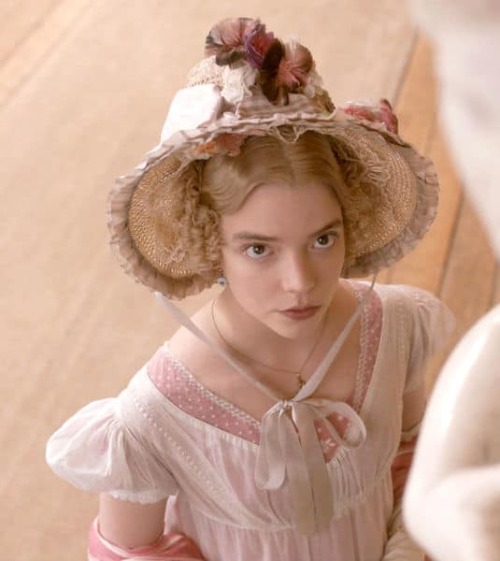
"EMMA" (2020) ReviewBetween 2009 and 2020, Hollywood and the British film/television industries have created a handful of productions that either spoofed or were inspired by Jane Austen's novels. Actually, I can only recall one movie that was more or less a straightforward adaptation - 2016's "LOVE & FRIENDSHIP", an adaptation of Austen's novella, "Lady Susan". So imagine my surprise when I learned a new and straightforward adaptation of an Austen novel was due to hit the theaters.I was even more thrilled that this new movie would be a straightforward adaptation of Austen's 1815 novel, "Emma" . . . which happened to be my favorite written by her. This new adaptation, helmed by Autumn de Wilde and written by Eleanor Catton, starred Anya Taylor-Joy in the title role. I am certain that many Austen fans are familiar with the 1815 novel's narrative. "EMMA" is the story of a spoiled and over privileged young Englishwoman named Emma Woodhouse, who resides at her wealthy father's country estate near the town of Highbury. Emma is not only spoiled and over privileged, but overestimates her own matchmaking abilities and is blind to the dangers of meddling in other people's lives.Ever since its release in February 2020, film critics and moviegoers have been praising "EMMA" to the skies. In fact, the movie is so high on the critical list that I would not be surprised if it ends up receiving major film award nominations next winter. A great deal of this praise has been focused on the performances of Anya Taylor-Joy, Johnny Flynn for his portrayal of George Knightley, Bill Nighy's portrayal of Mr. Woodhouse; and Autumn de Wilde's direction. Does the movie deserve such high praise? Perhaps. Perhaps not.I certainly cannot deny that "EMMA" is a beautiful looking film. I found Christopher Blauvelt's photography to be very sharp and colorful. In fact, the film's color palette almost seemed similar to the color schemes found in Alexandra Byrne's costume designs. Overall, the visual style for "EMMA" seemed to radiate strong and bright colors with a dash of pastels. Very stylized. But as much as I found all of this eye catching, I also found myself a little put off by this stylized artistry - especially for a movie in a period rural setting.Speaking of artistry, there has been a great deal of praise for Byrne's costumes. And I can see why. Granted, I am not fond of some of the pastel color schemes. I cannot deny I found her creations - especially those for the movie's women characters - were eye catching, as shown below:
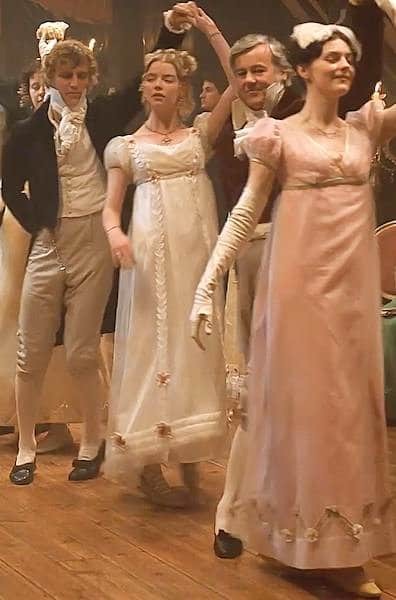
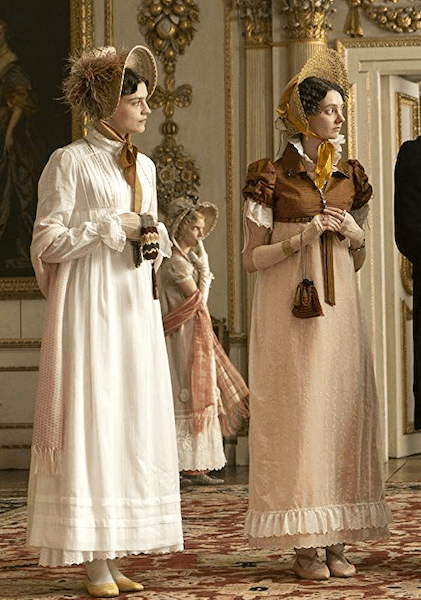 I had a few complaints regarding the film's costumes and hairstyles. The men's trousers struck me as a little too baggy for the 1810s. I get it. Actors like Bill Nighy found historical trousers a bit tight. But I feel the trousers featured in "EMMA" struck me as a bit too comfortable looking from a visual viewpoint. And then there was the hairstyle used by Anya Taylor-Joy in the film. For some reason, I found her side curls a bit too long and rather frizzy looking. Instead of the mid-1810s, her hairstyle struck me as an example of hairstyles worn by women during the early-to-mid 1840s.Someone had claimed that "EMMA" was a very faithful adaptation of Austen's novel. Was it? Frankly, I thought it was no more or less faithful than any of the costumed versions. De Wilde and screenwriter Eleanor Catton followed the major beats of Austen's novel, except for one scene - namely the Crown Inn ball. I will discuss that later. The movie also did an excellent job in capturing the comic nature of Austen's novel. This was apparent in nearly every scene featuring Bill Nighy as Mr. Woodhouse. I also enjoyed those scenes featuring the introduction of Augusta Elton, Emma's reactions to Jane Fairfax and her attempts to play matchmaker for Harriet Smith and Mr. Elton. But the movie also featured some good dramatic moments, thanks to De Wilde's direction and the film's cast. I am speaking of the scenes that featured Mr. Knightley's scolding of Emma for her rudeness towards the impoverished Miss Bates at the Box Hill picnic; Mr. Knightley's marriage proposal and the revelation of Harriet's engagement to tenant farmer Robert Martin."EMMA" has received a great deal of acclaim from film critics, moviegoers and Jane Austen fans. Many are claiming it as the best adaptation of the 1815 novel. Do I feel the same? No. No, I do not. In fact, out of the five film and television adaptations I have seen, I would probably rank it at number four. Perhaps I had very high expectations of this movie. It is an adaptation of my favorite Austen novel. And it is the first straightforward Austen adaptation since the 2009 television miniseries of same novel. Perhaps this movie is better than I had original assume. Then again, looking back on some of the film's aspects - perhaps not.A good deal of my problems with "EMMA" stemmed from the portrayal of the main character, Emma Woodhouse. How can I say this? Thanks to Catton's screenplay and De Wilde's direction, Emma came off as more brittle and chilly than any other version I have ever seen. Granted, Emma Woodhouse was a snob. This was apparently in her strong sense of class status, which manifested in her erroneous belief that Harriet Smith was the illegitimate daughter of an aristocrat or gentry landowner, instead of someone from a lower class. Emma's snobbery was also reflected in her contempt towards the impoverished Miss Bates, despite the latter being a "gentlewoman" and a member of the landed gentry. Emma's snobbery, a product of her upbringing, also manifested in her own ego and belief that she is always right. Yes, Emma possessed negative traits. But she also had her share of positive ones. She possessed a warm heart, compassion for the poor (at least those not from her class), intelligence, and an ability to face her faults. This cinematic portrayal of Emma Woodhouse as a brittle and slightly chilly bitch struck me as a little off putting and extreme.Another example of the exaggeration in this production was Mr. Knightley's reaction to his dance with Emma at the Crown Inn ball. Many have not only praised the sensuality of the pair's dance, but also Mr. Knightly's reaction upon returning home to his estate, Donwell Abbey. What happened? George Knightley seemed to be in some kind of emotional fit, while he stripped off some of his clothes and began writhing on the floor. What in the fuck was that about? That scene struck me as so ridiculous. Other actors who have portrayed Knightley have managed to portray the character's awareness of his love for Emma without behaving like a teenager in heat.Speaking of heat, who can forget Harriet Smith's orgasmic reaction to the idea of being Mrs. Elton? Many critics and Austen fans thrilled over the sight of a female character in a Jane Austen production having an orgasm. I will not castigate De Wilde for this directorial choice. I am merely wondering why she had included this scene in the first place. If Harriet was going to have an orgasm, why not have her bring up the subject to a possibly flabbergasted Emma? Why include this moment without any real follow through? Having an orgasm must have been something of a novelty for a young woman like Harriet, who was inexperienced with sexual thoughts or feelings.And then there was Emma and Mr. Knightley's dance at the Crown Inn ball. The latter sequence is usually one of my favorites in any adaptation of "EMMA". The one exception proved to be the 1972 miniseries, which ended the sequence after Emma had suggested they dance. I almost enjoyed the sequence in this film . . . except it featured Emma obviously feeling attracted to Mr. Knightley during this dance. And I thought this was a big mistake. Why? Because Emma was never that consciously aware of her attraction to Mr. Knightley, until Harriet had confessed her crush on the landowner. And that happened near the end of the story. In other words, by showing Emma's obvious feelings for Knightley during the ball, Autumn De Wilde rushed their story . . . and was forced to retract in the scene that featured Harriet's confession. I feel this was another poor decision on the filmmaker's part.If I have to be honest, I think De Wilde, along with screenwriter Eleanor Catton, made a number of poor decisions regarding the film's narrative. I have already pointed out three of those decisions in the previous paragraphs. But there were more. De Wilde and Catton changed the dynamics between Mr. Woodhouse and his older daughter and son-in-law, Isabella and John Knightley. In the novel and previous adaptations, the younger Mr. Knightley had always seemed more annoyed and at times, cankerous toward Mr. Woodhouse's hypochondria. In this version, Isabella's hypochondria is portrayed as more irritating. And instead of reacting to his wife's complaints, John suppressed his reactions and ended up being portrayed as a henpecked husband. For some reason, De Wilde and Catton thought it was necessary to take the bite out of John Knightley, making him a weaker character. Why? I have not the foggiest idea, but I did miss the character's biting wit.In my review of the 1996 television version of "Emma", I had complained how screenwriter Andrew Davies and director Diarmuid Lawrence had minimized part of Harriet's character arc and focused just a bit too much on Frank Churchill and Jane Fairfax. In the 1996 movie version, the opposite happened. Writer-director Douglas McGrath had focused more on Harriet's arc than the Frank/Jane arc. Well De Wilde and Catton ended up repeating McGrath's mistake by focusing too much on Harriet, at the expense of Frank and Jane. Worse, Frank and Jane's arc seemed focused on even less than in the 1996 McGrath film. The couple barely seemed to exist. And a result of this is that Frank's father, Colonel Weston, barely seemed to exist. Mrs. Weston fared better due to her being Emma's former governess. But I was really shocked at how little De Wilde and Catton focused on Mr. Elton and his overbearing bride, Augusta Elton. The movie did focus a good deal on Mr. Elton in those scenes featuring Emma's attempts to match him with Harriet. But following his marriage, his character - along with Mrs. Elton's - seemed to slowly recede into the background following their tea at Hartfield with the Woodhouses. By allowing very little focus on these characters, De Wilde and Catton had left out so many good moments in their effort to streamline Austen's story for theatrical film. Even more so than the two versions from 1996.Because of this streamlining, a good deal of the cast had very little opportunity to develop their characters on screen. Oliver Chris and Chloe Pirrie gave solid comic performances in their portrayal of John and Isabella Knightley, despite my irritation at the changing dynamics of their relationship. Rupert Graves was pretty much wasted as the over-friendly Colonel Weston. Miranda Hart gave a funny performance as the impoverished spinster Miss Bates. Unfortunately, I was distracted by her less-than-impoverished wardrobe in several scenes. If you had asked for my opinion of Amber Anderson's portrayal of Jane Fairfax, I would not have been able to give it to you. I have no memory of her performance. She made no impact on the movie or its narrative. Tanya Reynolds struck me as a rather funny Mrs. Elton . . . at least in the scene featuring the Eltons' tea with the Woodhouses at Hartfield. Otherwise, I have no real memory of her other scenes in the movie. Callum Turner has always struck me as a memorable performer. And I have to admit that his portrayal of Frank Churchill certainly made an impression on me. But the impression was not always . . . negative. One, he did not have enough scenes in this movie and his character arc struck me as rather rushed. And two, I thought his Frank Churchill was a bit too smarmy for my tastes.Thankfully, "EMMA" did feature some memorable supporting performances. Gemma Whalen gave a lovely and warm performance as Emma's former governess and close friend, Mrs. Weston. Josh O'Connor gave an excellent performance as the social-climbing vicar, Mr. Elton. I must say that I found his comic timing impeccable and thought he gave one of the best performances in the movie. However, I thought there were times when his Mr. Elton came off as a sexual predator. I get it . . . Mr. Elton was basically a fortune hunter. But I thought O'Connor went too far in the scene that featured Emma's rejection of his marriage proposal. For a moment, I thought he was going to sexually assault her. That was a bit too much. Mia Goth's portrayal of the clueless Harriet Smith struck me as spot-on and very skillful. Granted, I did not care for the "Harriet has an orgasm" moment, but I cannot deny that Goth's acting was excellent in the scene. Bill Nighy gave a skillfully comic portrayal as the hypochondriac Mr. Woodhouse. Yes, there were moments when his usual tics (found in many of his performances) threatened to overwhelm his performance in this film. But I think he managed to more or less keep it together.One performance that seemed to be garnering a great deal of acclaim came from Johnny Flynn, who portrayed Mr. Knightley. In fact, many are regarding him as the best Mr. Knightley ever seen in the movies or on television. I believe Flynn is a pretty competent actor who did an excellent job of conveying his character's decency, maturity and burgeoning feelings for Emma. I was especially impressed by his performance in the Box Hill sequence in which Mr. Knightley chastised Emma for her rude comments at Miss Bates. But I do not regard him as the best screen Mr. Knightley I have seen. If I must be honest, I do not regard his interpretation of the character as even among the best. My problem with Flynn is that his Knightley struck me as a bit of a dull stick. And Knightley has always seemed like a man with a dry sense of humor, which is why I have always regarded him as one of my favorite Austen heroes. For me, Flynn's Knightley simply came across as humorless to me. Perhaps "humorless" was the wrong word. There were scenes of Flynn's Mr. Knightley reacting to the comedic actions of other characters and uttering the occasional witty phrase or two. But there was something about Flynn's demeanor that made it seem he was trying too hard. I guess no amount of ass display, singing, laughing or writhing on the floor like a lovesick adolescent could make him more interesting to me.Then we have the film's leading lady, Anya Taylor-Joy. Unlike Flynn, the actress was given the opportunity to display her skills as a comic actress. And she more than lived up to the task. Honestly, I thought Taylor-Joy displayed excellent comic timing. Yet . . . I could never regard her as one of my favorite screen versions of Emma Woodhouse. She was too much of a bitch. Let me re-phrase that. I thought Taylor-Joy overdid it in her portrayal of Emma's bitchiness and snobbery. To the point that her performance struck me as very brittle. Yes, Emma Woodhouse was a snob. But she could also be a warm and friendly young woman, capable of improving her character. I saw none of this in Taylor-Joy's performance. If Catton's screenplay demanded that Emma became aware of her flaws, the actress' conveyance of those moments did not strike as a natural progression. Otherwise, she made a satisfying Emma Woodhouse. I also have one more criticism to add - Taylor-Joy did not have great screen chemistry with her leading man, Johnny Flynn. Their on-screen chemistry struck me as pedestrian at best, if I must be honest.One would think that I disliked "EMMA". Honestly, I did not. The movie managed to stick with Austen’s narrative. And although it did not change Austen’s story, it did feature some changes in some of the characteristics and character dynamics, thanks to director Autumn De Wilde and screenwriter Eleanor Catton. And some of these changes did not serve the movie well, thanks to De Wilde’s occasional bouts of ham-fisted direction. However, I still managed to enjoy the movie and the performances from a cast led by newcomer Anya Taylor-Joy. And if it had not been for the current health crisis that has struck the world, I probably would have seen it again in theaters.