"THE MIRROR CRACK'D FROM SIDE TO SIDE" (1992) Review
Many critics tend to look upon Agatha Christie's later novels with less favor. Among those novels viewed with less than any real enthusiasm was her 1962 novel, "The Mirror Crack'd from Side to Side". I find this interesting, despite the fact that one movie and two television adaptations have been made from this story.
"THE MIRROR CRACK'D FROM SIDE TO SIDE" delved into the world of Hollywood movies through the new tenants of Gossington Hall, the former home of Colonel Arthur and Dolly Bantry. After the death of Colonel Bantry, Mrs. Bantry sold the manor to Hollywood movie star Marina Gregg and her husband, director Jason Rudd. Marina and Jason host a fête for the citizens of St. Mary Mead. Miss Jane Marple is one of the guests. Another is Heather Badcock, an annoying housewife and St. John Ambulance helper with a penchant for being self involved. During the reception inside the manor, Heather dies after drinking a poisoned cocktail. When the local police and Scotland Yard investigate Heather's death, they realize that the cocktail had been meant for Marina Gregg. And they have plenty of suspects:
*Jason Rudd
*Dr. Gilchrist - Marina's personal doctor
*Ella Zeilinsky - Jason's lovesick secretary
*Lola Brewster - Hollywood starlet and Marina's rival
*Ardwyck Fenn - Hollywood producer and Lola's husband
*Margot Bence - Professional photographer and Marina's former adopted daughter
*Arthur Badcock - Heather's milequoast husband, who might had a reason to kill her
It is quite obvious that T.R. Bowen's screenplay for "THE MIRROR CRACK'D" remained faithful to Christie's 1962 novel. However, I did notice a few differences. The main police investigator, Dermot Craddock, turned out to be Miss Marple's nephew, as he was in the 1980 adaptation with Angela Landsbury. And Marina and Jason's Italian butler, Giuseppe Murano, had been murdered in the novel. In this movie, he was regulated to a minor supporting character and survived. Most fans would view the movie's close similarity to Christie's novel as a sign of its superiority as an adaptation. Faithfulness to the source material is not a sign of superior adaptation for me. I will admit that "THE MIRROR CRACK'D" is a pretty damn good adaptation. But I feel it had a few problems.
One of my problems with "THE MIRROR CRACK'D" is the casting of Judy Cornwell as Heather Badcock. Upon reading Christie's novel, I had the impression that Heather must have been at least in her mid-30s or early 40s when she was killed, and in her 20s when she first met Marina Gregg during World War II. However, Judy Cornwell was in her early 50s when this movie was made and looked it. And since "THE MIRROR CRACK'D" took place in the 1950s - at least a little over a decade before Heather and Marina's first meeting - I found it hard to accept Cornwell as the clueless Heather. I was also not that enamored of the scene featuring the revelation of the murderer very unsatisfying. But if I must be honest, the killer revelation scenes have never impressed me in most of the Miss Marple movies that starred Joan Hickson. They tend to be rather badly written. And what made revelation in this movie unsatisfying was T.R. Bowen and director Norman Stone's decision to have Miss Marple reveal the killer's identity to a cab driver, who was driving her to Gossington Hall. What on earth were they thinking? Talk about ruining a pretty good movie with a bad ending.
My biggest problem with "THE MIRROR CRACK'D" turned out to be Detective Inspector Dermot Craddock's character background. As I had stated earlier, Bowen's screenplay revealed Craddock as one of Miss Marple's nephew, repeating the 1980 film's characterization of him. If this had been John Castle's first appearance as Detective-Inspector Craddock, I would not be making this complaint. But the actor first portrayed the character in 1985's "A MURDER IS ANNOUNCED", which also starred Joan Hickson as the elderly sleuth. And in that movie, Miss Marple and Craddock were strangers who had met for the first time, not blood relations. This was truly sloppy writing on Bowen's part.
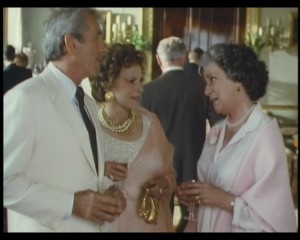
Fortunately, I still managed to enjoy "THE MIRROR CRACK'D" very much. I have to attribute this to Norman Stone's lively direction. Most of the Jane Marple adaptations that starred Hickson had a tendency to drag in many parts. Aside from a few productions, I usually have difficulty staying alert, while watching them. I can thankfully say that I had no such problems with "THE MIRROR CRACK'D". Not only did the movie benefited from Stone's pacing, but also Bowen's screenplay, and the cast. But I suspect that the movie's subject matter - Hollywood in Britain - really helped to make "THE MIRROR CRACK'D" a lively affair. Not only did the story delved into the world of small town life in mid-20th century Britain, but also the Hollywood movie system during the same era. The movie featured some humorous interactions between the citizens of St. Mary Mead and its Hollywood visitors, along with a tension-filled dinner party featuring Marina, Jason, the latter's secretary Ella Zeilinsky, producer Ardwyck Fenn and rival starlet Lola Brewster. Mind you, the movie lacked the entertaining bitch fest from the 1980 film, the script still managed to provide a few moments of bitchery from Marina, Ella and Lola. "THE MIRROR CRACK'D" also featured an amusing subplot featuring a companion hired by Miss Marple's other nephew to take care of her. It seems the companion Miss Knight possessed a condescending manner that irritates the elderly woman.
I have to say that I found the movie's production values very impressive. Merle Downie and Alan Spalding did an excellent job of re-creating 1950s Britain through their production designs. I suspect they had to add a bit of glamour to the movie, due to the story's subject matter. The costumes for Hickson's Miss Marple movies have always been first-rate. And Judy Pepperdine did a marvelous job in not only creating costumes for the St. Mary Mead citizens, but also the Hollywood characters. Cinematographer John Walker contributed to the movie's sleek look with his colorful, yet sharp photography.
"THE MIRROR CRACK'D" featured Joan Hickson's last performance as Jane Marple. Needless to say, she proved to provide her usual above-average performance. I was especially impressed by her comedic skills in the scenes featuring Miss Marple's exasperation with the condescending Miss Knight. Claire Bloom gave a complicated and very skillful performance as the talented, yet high-strung Marina Gregg. I did not find this surprising. Only a first-rate actress like Bloom could portray a high-maintenance character like Marina, without resorting to hamminess. I was equally impressed by Barry Newman, who was marvelous as Marina's husband, Jason Rudd. He did an excellent job of portraying an emotional and passionate character with great subtlety. Despite my annoyance at Dermot Craddock being written as one of Miss Marple's nephews, I must admit that I was happy to see John Castle back in the role. I really enjoyed his performance as the intelligent and cool Craddock in "A MURDER IS ANNOUNCED". When he failed to appear in 1987's "4.50 TO PADDINGTON", I must admit that I felt very disappointed. Thankfully, my disappointment was eradicated by his appearance and performance in this film.
Aside from the 1980 miniseries, "PRIDE AND PREJUDICE" and one or two other films, I have rarely seen Elizabeth Garvie in other film or movie productions. I certainly enjoyed her portrayal of Ella Zeilinsky, Jason Rudd's sarcastic, yet love struck secretary. I may have had issues with Judy Cornwell being cast as Heather Badcock, but I have to admit that she did a pretty damn good job in portraying the self-involved woman. David Horovitch returned as Superintendent Slack. I found his appearance in the movie unnecessary, since he was not in the novel, but I must admit that Horovitch gave a rather funny performance. Margaret Courtenay was even funnier as the condescending companion, Miss Knight, who treated Miss Marple like a brainless child. The movie also featured solid performances from the likes of Glynis Barber, Ian Brimble, Norman Rodway and Gwen Watford. However, I found Constantine Gregory's portrayal of Hollywood producer Ardwyck Fenn to be ridiculously over-the-top. One, he seemed to think that all Hollywood producers sounded and acted like gangsters from an old Warner Brothers film. And two, his American accent sucked. It is a pity that he did not study the American-born Newman, when he had the chance.
"THE MIRROR CRACK'D FROM SIDE TO SIDE" had its flaws. But they were only a few. Overall, I found it entertaining and well-paced, thanks to Norman Stone's direction and the movie's production values. In the end, it proved to be a well made epilogue to Joan Hickson's tenure as the cinematic Jane Marple.