Showing posts with label mira sorvino. Show all posts

Friday, December 6, 2013

"THE GREAT GATSBY" (2000) Review

2977-3


"THE GREAT GATSBY" (2000) Review

I am amazed at how long I have ignored F. Scott Fitzgerald's 1925 opus, "The Great Gatsby". I saw the 1974 movie adaptation of the novel years ago, but I found it difficult to appreciate the story. It was not until I saw Baz Luhrmann's recent adaptation that my full interest in the story was finally ignited. After watching that particular film, I came across this adaptation that aired on the A&E Channel in 2000. 

Directed by Robert Markowitz and adapted by John J. McLaughlin, "THE GREAT GATSBY" is a 90 minute teleplay set in the early years of the Jazz Age. The movie told the story of a mysterious young millionaire named Jay Gatsby, who settles in a large house on the West Egg side (for the newly rich) on prosperous Long Island. Narrated by Gatsby's neighbor; the well-born, yet impoverished Nick Carraway; audiences become aware of the millionaire's desire to woo and win back the heart of Daisy Fay Buchanan, an old love he had first met during World War I, who also happens to be Nick's cousin. However, standing in Gatsby's way is Daisy's wealthy and boorish husband and Nick's former Yale schoolmate, Tom Buchanan; Daisy's own uncertainty about a serious relationship with the lovesick Gatsby and the latter's questionable origin of his fortune. This clash between class and romantic aspirations leads to an emotional clash in a New York City hotel suite and later, tragedy and death.

There are some aspects of "THE GREAT GATSBY" that I found admirable. The best aspect of this television movie proved to be the showdown between Jay Gatsby and Tom Buchanan for the love of one Daisy Fay Buchanan. I thought it was well-acted - especially by Mira Sorvino and Martin Donovan as the Buchanans. And director Robert Markowitz injected with a good deal of intensity. I was also impressed by Markowitz's handling of the tragic hit-and-run of Myrtle Wison, Tom's working-class mistress, near her husband's Valley of Ashes gas station. This is the only version in which a distraught Daisy is briefly distracted by the infamous "Eyes of Dr. T.J. Eckleburg" billboard before she avoids an oncoming car and kills Myrtle, while driving Gatsby's white convertible. I suspect this was an addition created for this movie, not featured in the novel. By allowing the billboard to indirectly lead to Myrtle's death struck me as inspired writing on McLaughlin's part, or inspired direction from Markowitz. Who knows? And it seemed a pity that no one else - Fitzgerald included - never considered it. The Nick Carraway-Jordan Baker romance had never seemed as sexy as it did in this movie. In fact, this is the only adaptation in which their relationship seemed to radiate with any real sexuality.

But despite these virtues, "THE GREAT GATSBY" seemed marred by a great deal of flaws. Perhaps too many flaws. There is so much about this movie that seemed off. One could tell at first glance that this production was lacking in serious cash. I realize that "THE GREAT GATSBY" is supposed to be a television production. But I find it odd that a production financed by both the A&E Cable Network in the United States, and Granada Productions in Great Britain; could look like a poor man's version of Fitzgerald's novel. The costumes designed by Nicoletta Massone left me shaking my head in disbelief. The clothes worn by wealthy characters such as Gatsby, the Buchanans and Jordan Baker seemed more appropriate for middle-class characters of the same era - the early 1920s. In one scene, Tom Buchanan made a snarky comment about Gatsby's wardrobe. Mind you, the latter was not wearing the infamous pink suit (much to my disappointment). But the cream-colored suit with the dark tie, white socks and dark shoes even made wince. Since the Nick Carraway character wore a similar outfit in the same scene, I found myself wondering why Tom did not extend his contempt to his cousin-in-law's wardrobe. Although elegant, the Buchanans' home struck me as more quaint than opulent. The exteriors of Gatsby's home seemed more opulent, but it had an elegant quality that seemed beyond Gatsby's tastes. And the interiors struck me as somewhat drab and middle-class. So much for the ostentation - and somewhat tasteless - mansion owned by the mysterious millionaire. I really enjoyed Carl Davis' score for this movie. But it seemed more appropriate for a neo-noir movie like "L.A. CONFIDENTIAL" or"MULHOLLAND FALLS", instead of a period drama like "THE GREAT GATSBY". 

Although I had complimented Markowitz's direction in two sequences, I found most of his direction rather flaccid and uninspiring. There were moments I felt that he was simply going through the motions. And both he and McLaughlin did not do the audience any favors by including flashbacks of Gatsby and Daisy's World War I courtship. Those scenes were not only shot in soft focus, but also nearly put me to sleep. My God, they were boring! The parties held by Gatsby disappointed me, as well. Most of it - with the exception of the party attended by the Buchanans - struck me as mediocre and a ghost of those parties featured in Fitzgerald's novel and the other movie adaptations. And why on earth did McLaughlin's screenplay begin with Gatsby's murder? Was he and Markowitz trying to be different? Unique? It is bad enough that Fitzgerald's prose, in the form of Nick's narration, hinted that Gatsby was no longer around. Why wipe away the mystery altogether by starting the movie with Gatsby's murder? But if there is one thing that nearly tripped up "THE GREAT GATSBY", it had to be its casting.

Due to Granada Productions being a co-producer of the film, it was inevitable that a British actor or actress would be cast. That person turned out to be Toby Stephens, who was given the leading role of Jay Gatsby. Before I continue, I want to say that I have been a fan of Stephens for years, thanks to his outstanding work. Unfortunately, I cannot view Jay Gatsby as one of his best performances. He simply seemed so wrong for the role. Not only did he portray Gatsby with a stiff and unconvincing American accent, but also with a grin that threatened to form a smirk. Aside from a few emotional . . . or semi-emotional moments, I found his portrayal of Gatsby rather cocky. Paul Rudd could have made a decent Nick Carraway, if it were not for the bored expression on his face that occasionally marred his performance. I realize that Nick harbored some contempt toward Gatsby when they first met. But that contempt had disappeared by the time he arranged Gatsby and Daisy's afternoon reunion. Unfortunately, Rudd's Nick maintained that same contempt even throughout the reunion and did not really disappear until the blow up at the Plaza Hotel. What the hell? I wish I could simply blame Rudd, but I cannot. As the director, Markowitz should have realized what was going on and put a stop to it. He failed to do so. Martin Donovan gave an excellent performance as the brutish Tom Buchanan. However, he still proved to be the wrong actor for the role. Donovan's Tom never struck me as an egotistical ex-jock . . . merely an ill-tempered Moaning Minnie with too much money on his hands. Not only did I also have great difficulty in viewing him as a ladies' man, but also Nick's classmate at Yale. Martin Donovan and Paul Rudd are a good deal twelve years apart. And it shows. Jerry Grayson's brief portrayal of gambler/gangster Meyer Wolfsheim did not strike me as memorable. On the other hand, I will never forget William Camp's portrayal of Myrtle's loser husband, George Wilson. I found it incredible bad.

The three actresses in "THE GREAT GATSBY" fared better. Somewhat. I enjoyed Mira Sorvino's performance as the very feminine and flaky Daisy Buchanan. She did an excellent job of recapturing Daisy's warm, flirtatious personality and shallowness. My only problem with Sorvino is that she utilized a Northeastern accent to portray Daisy. And the latter came from the Upper South - Louisville, Kentucky. Thankfully, Francie Swift, who hails from Texas, used a soft Southern accent in her portrayal of Daisy's Louisville friend, golfer Jordan Baker. Mind you, Swift's Jordan did not strike me as a female athlete. But she gave a sly and sexy performance that I found satisfying. In fact, she might be the best Jordan Baker I have seen on screen - despite the Dutch Boy haircut and dull wardrobe. Heather Goldenhersh did a pretty good job of portraying the vulgar and ambitious Myrtle Wilson. I said good . . . not great. The actress portrayed a high, light voice that I would not associate with a character like Myrtle. And I did not find her desperation to escape from a life with the dull George Wilson particularly convincing. But I was impressed by Goldenhersh's one scene in which she conveyed Mrytle's account of her first meeting with Tom.

"THE GREAT GATSBY" had a few virtues - including some well done performances from the movie's three leading ladies and two exceptional sequences. But the flaws overwhelmed the virtues - including lackluster direction from Robert Markowitz and the producers' miscasting of Toby Stephens in the leading role. I have seen at least three versions of F. Scott Fitzgerald's 1925 novel. I hate to say it, but this 2000 television movie has to be the least impressive I have seen.

Thursday, November 21, 2013

"THE GREAT GATSBY" (2000) Photo Gallery

Untitled

Below are images from "THE GREAT GATSBY", the 2000 television adaptation of F. Scott Fitzgerald's 1925 novel. Directed by Robert Markowitz, the movie starred Toby Stephens, Mira Sorvino, Paul Rudd and Martin Donovan: 


"THE GREAT GATSBY" (2000) Photo Gallery

2977-3


whiteconv1_1106


Toby-Stephens-as-Jay-Gatsby-in-The-Great-Gatsby-2000


-The-Great-Gatsby-2000-the-great-gatsby-35064843-1027-692


-The-Great-Gatsby-2000-the-great-gatsby-35064842-1039-694


-The-Great-Gatsby-2000-the-great-gatsby-35064841-1037-697


-The-Great-Gatsby-2000-the-great-gatsby-35064839-1039-688


-The-Great-Gatsby-2000-the-great-gatsby-35064838-1176-683


-The-Great-Gatsby-2000-the-great-gatsby-35064837-1044-679


-The-Great-Gatsby-2000-the-great-gatsby-35064836-1036-695


-The-Great-Gatsby-2000-the-great-gatsby-35064834-1036-698


-The-Great-Gatsby-2000-the-great-gatsby-35064833-1054-682


-The-Great-Gatsby-2000-the-great-gatsby-35064832-1028-687


-The-Great-Gatsby-2000-the-great-gatsby-35064831-1035-691


-The-Great-Gatsby-2000-the-great-gatsby-35064830-1039-682


-The-Great-Gatsby-2000-the-great-gatsby-35064829-862-575


-The-Great-Gatsby-2000-the-great-gatsby-35064828-861-575


i440826


hqdefault


great-gatsby


rsvux3

Monday, January 7, 2013

"GODS AND GENERALS" (2003) Review


"GODS AND GENERALS" (2003) Review

In 1993, producer Ted Turner and director Ronald Maxwell released "GETTYSBURG", a film adaptation of Michael Shaara's 1974 novel, "The Killer Angels". Shaara's son, Jeffrey, wrote a prequel to his novel called "Gods and Generals" in 1996. Both Turner and Maxwell teamed up again 2002-2003 to make a film adaptation of the latter novel. 

Set between April 1861 and May 1863, "GODS AND GENERALS" related the American Civil War events leading up to the Battle of Gettysburg. Although the movie began with Virginia-born Robert E. Lee's resignation from the U.S. Army, following his home state's secession from the Union; the meat of the film focused on on the personal and professional life of Confederate general Thomas "Stonewall" Jackson during those two years. It also touched on how Bowdoin College professor Joshua L. Chamberlain became second-in-command of the 20th Maine Volunteer Infantry Regiment, his military training and his experiences during the Battle of Fredricksburg. But trust me . . . most of the movie is about Jackson. It covered his departure from the Virginia Military Institute; his experiences with the famous "Stonewall Brigade"; his experiences at the Battle of Bull Run; his relationships with both his wife Mary Anna, his servant Jim Lewis and a five year-old girl from an old Virginia family; and his experiences at the Battle Chancelorville.

"GODS AND GENERALS" had its virtues. One of them turned out to be Michael Z. Hanan's production designs. Hanan and his team did a superb job in re-creating Virginia of the early 1860s. I was especially impressed by their recreation of mid-19th century Fredricksburg during that famous battle in December 1862. I wonder who had the bright idea of using Harper's Ferry, West Virgina for that particular setting. Hanan's work was ably supported by Kees Van Oostrum's photography and Gregory Bolton's art direction. Oostrum's photography and Corky Ehlers' editing was also put to good use during the Fredricksburg battle sequence. And I really enjoyed the costumes designed by Richard La Motte, Maurice Whitlock and Gamila Smith. All three did their homework in re-creating the fashions and uniforms of the period. Unlike "GETTYSBURG", "GODS AND GENERALS" featured major female characters. I suspect this gave the trio the opportunity to indulge their romantic streak with crinolines and hoop skirts galore.

There were some admirable performances in "GODS AND GENERALS". Frankie Faison gave a warm performance as Thomas Jackson's free cook, Jim Lewis. I was also impressed by Brian Mallon's subtle portrayal of the concerned Major General Winfield Hancock, a role he had first portrayed in the 1993 film. It is a pity that Bruce Boxleitner did not receive more screen time for his role as Lieutenant General James Longstreet. He had taken over the role from Tom Berenger and gave a pretty solid performance. But alas, he did not receive enough time to do anything with the role. Alex Hyde-White gave an interesting portrayal of Major General Ambrose Burnside, whose decisions led the Union Army to disaster at Fredricksburg. Matt Letscher, whom I last remembered from 1998's "THE MASK OF ZORRO" was very memorable as the 20th Maine's founder and first regimental commander, Colonel Adelbert Ames. I could also say the same for Mira Sorvino's portrayal of Frances "Fanny" Chamberlain, Colonel Chamberlain's passionate and pessimistic wife. In fact, I believe she had the good luck to portray the most interesting female character in the movie.

So . . . what about the other performances? What about the stars Stephen Lang, Jeff Daniels and Robert Duvall? I am not claiming that they gave bad performances. Honestly, they did the best they could. Unfortunately, all three and most of the other cast members had the bad luck to be saddled with very uninteresting characters, stuck with either bad dialogue or self-righteous speeches. In other words, I found them BORING!!! I am sorry, but I truly did. 

First of all, Lang's Thomas Jackson dominated the film just a little too much. Why bother calling this movie "GODS AND GENERALS"? Why not call it "THE LIFE AND TIMES OF STONEWALL JACKSON"? Even worse, Jackson is portrayed in such an unrelenting positive light that by the time the movie came around to his fate after the Battle of Chancelorville, I practically sighed with relief. Jeff Daniels' Joshua Chamberlain did nothing to rouse my interest in his story. In fact, he disappeared for a long period of time before he made his reappearance during the Battle of Fredricksburg sequence. And his appearance in that particular sequence was completely marred by him and other members of the 20th Maine Volunteer Regiment quoting William Shakespeare's "JULIUS CAESAR", while marching toward Marye's Heights. Oh God, I hate that scene so much! As for Robert Duvall's Robert Lee . . . what a waste of his time. Ronald Maxwell's script did not allow the actor any opportunity to explore Lee's character during those two years leading to Gettysburg. I realize this is not Duvall's fault, but I found myself longing for Martin Sheen's portrayal of the Confederate general in "GETTYSBURG".

There is so much about this movie that I dislike. One, Maxwell's portrayal of the movie's two main African-American characters - Jim Lewis and a Fredricksburg slave named Martha, as portrayed by actress/historian Donzaleigh Abernathy - struck me as completely lightweight. Now, I realized that there were black slaves and paid employees who managed to maintain a friendly or close relationship with their owner or employer. But in "GODS AND GENERALS", Lewis seemed quite friendly with his employer Jackson and Martha seemed obviously close to the family that owned her, the Beales. I could have tolerated if Lewis or Martha had been friendly toward those for whom they worked. But both of them? I get the feeling that Maxwell was determined to avoid any of the racial and class tensions between the slave/owner relationship . . . or in Lewis' case, the employee/employer relationship. How cowardly. 

In fact, this lack of tension seemed to permeate all of the relationships featured in "GODS AND GENERALS". Aside from one Union commander who berated his men for looting in Fredricksburg, I can barely recall any scenes featuring some form of anger or tension between the major characters. Everyone either seemed to be on his or her best behavior. And could someone please explain why every other sentence that came out of the mouths of most characters seemed to be a damn speech? I realize that Maxwell was trying to re-create the semi-formality of 19th century American dialogue. Well . . . he failed. Miserably. The overindulgence of speeches reminded me of the dialogue from the second NORTH AND SOUTH miniseries, 1986's "NORTH AND SOUTH: BOOK II". But the biggest problem of "GODS AND GENERALS" is that it lacked a central theme. The majority of the movie seemed to be about the Civil War history of Thomas Jackson. But the title and Shaara's novel told a different story. However, I do not believe a detailed adaptation of the novel would have done the trick. Like the movie, it lacked a central theme or topic. 

Perhaps I am being too arrogant in believing I know what would have made the story worked. After all, it is not my story. Jeff Shaara was entitled to write it the way he wanted. And Ronald Maxwell was entitled to adapt Shaara's story the way he wanted. But I do know that if I had written "GODS AND GENERALS", it would have been about the Battle of Fredricksburg. It turned out to be the only part of the movie that I found interesting.

Thursday, December 6, 2012

"GODS AND GENERALS" (2003) Photo Gallery


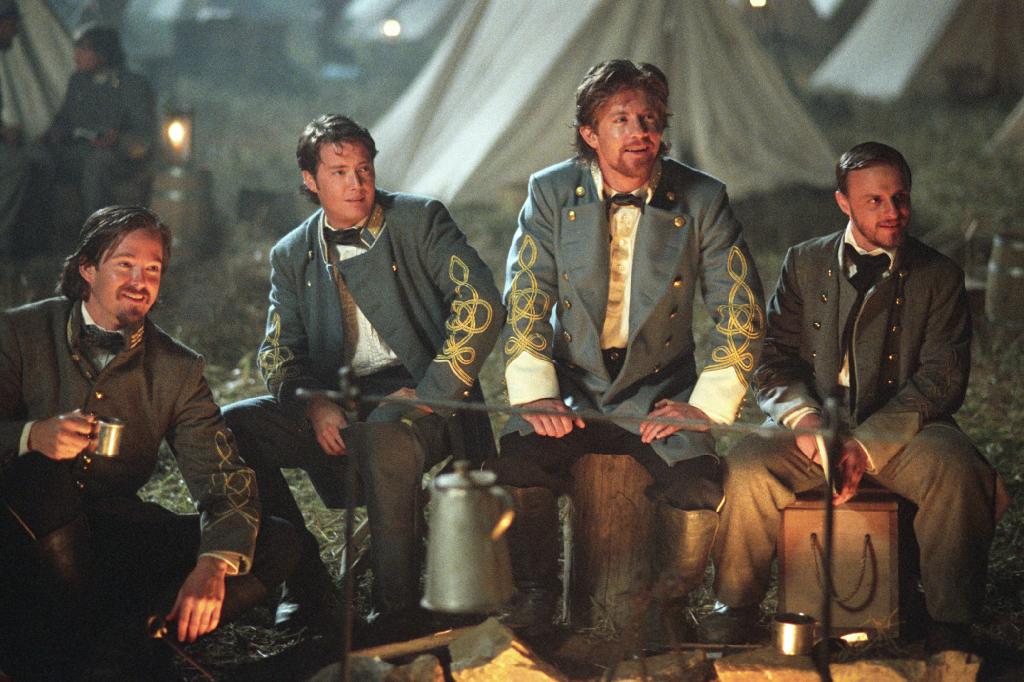
Below are images from "GODS AND GENERALS", the 2003 prequel to the 1993 movie, "GETTYSBURG".  Based upon  Jeff Shaara's 1996 novel; and written and directed by Ronald Maxwell, the movie starred Stephen Lang, Jeff Daniels and Robert Duvall:


"GODS AND GENERALS" (2003) Photo Gallery


Friday, September 16, 2011

"THE BUCCANEERS" (1995) Review

539675864


"THE BUCCANEERS" (1995) Review

Several years ago, I had anticipating watching for the first time, "THE BUCCANEERS", the 1995 television adaptation of Edith Wharton’s last novel. After all, I have been a major fan of "THE AGE OF INNOCENCE", Martin Scorcese’s 1993 adaptation of Wharton’s award-winning 1920 novel for years. But my eager anticipating nearly ebbed away, when I discovered that "THE BUCCANEERS" only managed to rouse a lukewarm reception from many television critics.

The five-part miniseries turned out to be an unusual production from the BBC. One, it was based upon a novel written by an American author – namely Edith Wharton. There have been other British television productions based upon the literary works of an American, but they are very rare. Another interesting aspect of Wharton’s "The Age of Innocence" is that the author did not finish it, due to her death at the age of 75. Fifty-six years later, Wharton scholar Marion Mainwaring finished the novel, which was published by Viking. Around the same time, the BBC hired screenwriter Maggie Wadey to adapt and finish the novel for the television adaptation. As a result the novel has two slightly different endings. Another aspect of this miniseries that struck me as unusual was that instead of hiring British actresses to portray four of the five leads, the BBC hired four Amercian actresses – Carla Gugino, Mira Sorvino, Alison Elliott and Rya Kihlstedt.

The plotline for "THE BUCCANEERS" is very simple. The story begins in 1873 Newport, Rhode Island; in which two sisters of a noveau riche businessman and their two friends are introduced – Virginia "Ginny" and Annabel "Nan" St. George, Conchita "Connie" Closson and Elizabeth "Lizzy" Elmsworth. Whereas the Brazilian born Conchita manages to snare Lord Richard Marabel, the dissolute second son of the Marquess of Brightlingsea, the other three girls struggle to find a place amongst the members of old New York society. When a prank committed by Ginny and Lizzy backfires, Nan’s English governess Laura Testvalley proposes to Mrs. St. George that Ginny and Nan have a London season amongst the upper-class British. She argues that their acceptance by the British high society would assure them a place amongst the upper-class New Yorkers. Due to their friendship with the vibrant Conchita, Virginia and Annabel are introduced to Lord Richard’s family – the impoverished Brightlingseas and their neighbors, the equally impoverished Sir Helmsey Thwaite and his son Guy. As they get settled to conquer British society, Ginny and Nan are surprised by the arrival of Lizzy, who has arrived in Britain for her own season.

Although the girls’ original purpose for visiting Britain was to enjoy a London season, a friend of Laura Testvalley has other plans for them. Thirty years earlier, the American born Jackie March had been engaged to a British aristocrat – namely the very young Lord Brightlingsea, who abandoned her at the altar. Miss March remained in Britain and became something of a sponsor/matchmaker for young society girls. It was Miss March who recommended that the visiting Americans rent a villa owned by one of her former sponsors, Lady Idina Hutton. She also recommended that the girls do more than just enjoy a London season in order to impress old New York society. She recommended that they consider marrying into upper-class British society. Miss March’s plans eventually come to fruition:

*Virginia or namely her father’s wealth attracted the attention of Lady Idina Hutton’s lover and Lord Richard’s older brother, Lord Seadown.

*Lizzy ended up marrying a self-made aspiring politician named Hector Robinson

*Annabel fell in love with Guy Thwaite, but ended up marrying the very wealthy Julian Folyat, Duke of Trevennick; when Guy left Britain to find his fortune in South America.

As I had stated earlier, most critics were not initially kind to "THE BUCCANEERS". Most British critics dismissed it as a costumed soap opera of the second-rate kind, with an ending that had been "Hollywoodized" (happy ending). These same critics also accused the miniseries of mocking the British aristocracy. The American critics, at least those who considered themselves Wharton purists, accused the miniseries’ screenwriter, Maggie Waddey, of changing the elements of the author’s story by including topics such as marital rape and homosexuality. Personally, I found all of these arguments irrelevant. Most dramas about personal lives – whether first-rate or not – tend to possess soap-operish elements. This hostility toward soap operas has always struck me as infantile and irrelevant. And why are all Hollywood productions guilty of having a happy ending, when that has not been the case? Other literary works and their adaptations have mocked the British aristocracy. Why was there such a big hullabaloo over how the aristocracy was portrayed in this particular story? As for the additions of marital rape and homosexuality, these elements did no harm to the story, as far as I am concerned. And I must admit that I have become increasingly weary of demands that all movie or television adaptations should be completely faithful to their literary source. Such demands strike me as impractical.

My complaints about "THE BUCCANEERS" are very few. In fact, I only have two. The first time I ever saw actress Gwen Humble on the television screen was in a miniseries called "THE REBELS", an adaptation of a John Jakes novel. Although I had no problems with her performance in that particular production, I must admit that I had a problem with her performance as Virginia and Annabel’s mother, Mrs. St. George. I understand that Mrs. St. George was supposed to be a shallow and somewhat silly woman. But I feel that Humble went a little too far in conveying those certain traits. Her performance struck me as exaggerated and a little amateurish. Another problem I had with "THE BUCCANEERS" is a rather minor one. It has to do with Virginia’s husband, Lord Seadown. His father is a marquess – which is ranked somewhere between a duke and an earl (count). As the eldest son, he is entitled to a courtesy title. But what was Seadown’s courtesy title? His younger brother was called Lord Richard Marable, which is correct for the younger son of a marquess. The courtesy title for the eldest son of a marquess is usually an earldom – namely Earl of Something. Was Seadown’s name a courtesy title - Earl of Seadown? Or was he supposed to be regarded as Lord Seadown Marable? If the latter, what was the courtesy title he used? I found it all slightly confusing.

However, "THE BUCCANEERS" has been one of my all time favorite miniseries, ever since I first saw it. And there is so much about it that has made it such a favorite of mine. One, producer-director Philip hired a production crew that did justice to Wharton’s story. The miniseries featured some elegant locations that served as the story’s various settings. Some of these locations included Castle Howard, Burghley House and Newport, Rhode Island. I also enjoyed Remi Adefarasin’s photography. It had a deep and rich color that did justice to a story filled with emotions and passion. Colin Towns provided an elegant and entertaining score that remained memorable for me, since the first time I heard it years ago. But it was Rosalind Ebbutt’s costumes that really blew my mind. She provided exquisitely outfits that were beautiful and elegant – especially those for the lead actresses. More importantly, her costumes not only reflected the fashions wore by the American and British upper-classes during the 1870s, they also reflected the change in the main characters’ status and in women’s fashion throughout the decade, as the following photographs show:


Another one of the major virtues of "THE BUCCANEERS" turned out to be its cast. Wharton’s novel is filled with interesting characters. And Saville and his casting director did an excellent job in finding the right actor/actress for the right role. Aside from Gwen Humble’s portrayal of Mrs. St. George, there were so many first-rate performances in the miniseries that it would take me another article just to describe them. But the supporting performances that stood out for me came from the likes of Sheila Hancock, whose portrayal of the Dowager Duchess of Trevenick was an expertly performed mixture of cool haughtiness, sharp wisdom and long suffering; Michael Kitchen, who skillfully conveyed both the charming and shallow nature of Sir Helmsley Thwaite; Jenny Agutter, who was excellent as Lady Idina Hatton, Lord Seadown’s insecure and tragic mistress; Dinsdale Landen and Rosemary Leach, who both portrayed the Marquess and Marchioness of Brightlingsea with a mixture of class haughtiness, charm and great humor; Peter M. Goetz, who seemed to personify the self-made 19th century American businessman; and Connie Booth, who gave one of her best performances as the ambitious and sharp-minded Jackie March.

Richard Huw gave a humorous, yet intelligent performance as Hector Robinson, the ambitious young Member of Parliament who ends up winning Lizzy Elmsworth’s hand. And Mark Tandy was pretty solid as Lord Brightlingsea’s heir, the mercenary Lord Seadown who marries Virginia for Colonel St. George’s money. I was very impressed by Ronan Vibert’s portrayal of the dissolute Lord Richard Marabel, Conchita’s husband and Lord Brightlingsea’s younger son. But the two male performances that really impressed me came from Greg Wise and James Frain. The latter portrayed the haughty Julian Duke of Trevenick, who manages to win the hand Annabel St. George (much to the surprise of her governess), before alienating her with his lack of skills as a husband. Frain could have easily portrayed Julian as a one-note villain, especially when one considers the act of marital rape that his character committed against his wife in Episode Three. Being the skillful actor that he is, Frain conveyed all facets of Julian’s personality – both the good and the bad. And his assertion near the end of Episode Four that he is "not a monster" may have been one of Frain’s finest moments on screen. Greg Wise probably gave one of what I consider to be three of his best performances in his portrayal of Guy Thwaite, Sir Helmsley’s only son. His Guy could have been one of your typical handsome, romantic heroes. But Wise did an excellent job in revealing how Guy’s insecurities regarding his lack of funds led him to lose Annabel to Julian. And he also conveyed how in the throes of love, Guy could be a slightly selfish man with no thought to how his "friendship" with Annabel might affect her social standing. Thanks to Wise’s performance, his Guy Thwaite proved to be equally complex.

We finally come to our five leads in the story – the four American heiresses and Annabel St. George’s English governess, Laura Testvalley. I have noticed that whenever someone brings up Cheri Lunghi, he or she inevitable brings up her role in "THE BUCCANEERS", the Anglo-Italian governess Miss Testvalley. I certainly cannot blame them. Lunghi proved to be the glue that held the story together, skillfully serving as its eyes and narrator at the beginning of each episode. Rya Kihlstedt gave a charming and solid performance as the blunt and level-headed Lizzy Elmsworth, who seemed more impressed by Hector Robinson’s ambitions than any aristocrat. She and Richard Huw managed to create a very credible screen presence. Alison Elliott’s Virginia St. George proved to be one of the most complicated characters in the story. Thanks to the actress’ excellent performance, she conveyed Virginia’s haughtiness and obsession with being connected to an aristocratic family; and at the same time, garnered sympathy by expressing the character’s love for her husband and disappointment upon discovering that he had only married her for money. And less than a year before she won her Academy Award, Mira Sorvino proved just how first-rate she could be as an actress in her portrayal of the Brazilian-born Conchita Closson. Her Conchita was a delicious and complicated minx torn by her desire for the luxurious and glamorous lifestyle of the British aristocracy and her contempt for what she deemed as their cold personalities. If Cheri Lunghi’s Laura Testvalley was the story’s eyes and narrator, Carla Gugino’s Annabel St. George aka the Duchess of Trevenick proved to be the heart and soul of "THE BUCCANEERS". Thanks to Gugino’s superb performance, the actress literally transformed Nan from the childish and naïve sixteen year-old girl, to the bewildered nineteen year-old bride and finally to the weary twenty-one year-old wife, disappointed by a failed marriage and in love with another man. There are times that I wondered if any other actress could have accomplished what she did. It seemed a pity that none of the major television and critics awards organizations never acknowledged her performance with a nomination.

Many critics have heaped a great deal of scorn upon Maggie Wadey’s adaptation of Wharton’s novel. Frankly, I believe this scorn was undeserved. I may not have been that impressed by her other works, but I honestly believe that "THE BUCCANEERS" was her masterpiece by far. Many accused her of failing to adapt Wharton’s “spirit” or “style” by including marital rape and homosexuality into the story. Since both topics where added without any tasteless sensationalism, I had no problems with these additions. And Wadey also made sure to give the story’s happy ending something of a bittersweet edge. Despite leaving Julian for the man she loved, Guy Thwaite, Annabel found herself ostracized by society and especially by Virginia – as was proven at the Marquess of Brightlingsea’s funeral. Annabel and Guy’s elopement also left the latter disinherited by his father, Sir Helmsley. And her assistance in the elopement left Laura Testvalley rejected by Sir Helmsley and unemployed. So much for the "happy ending". Because the story revolved around four American heiresses marrying into the British upper-classes, "THE BUCCANEERS" also proved to be an interesting study in culture clash between two Western nations in the mid-to-late nineteenth century. But in all of the articles I have read about the miniseries, I find it surprising that no one has bothered to noticed that the topic of the continuing decline of the British aristocracy was also mentioned . . . more than once. It almost became a secondary theme. The Brightlingseas’ interest in the St. George family certainly seemed an indication that they were more willing to marry money – regardless from where it came – rather than find a way to earn it. Unlike Guy Thwaite, who preferred to create his own wealth with two years in South America, rather than marry it. And the character of the Marquess of Brightlingsea literally became a symbol of the aristocracy’s decline in scenes like a heated conversation between him and Hector Robinson; and a speech by Guy Thwaite to the House of Commons during a montage that featured a montage of his death.

Now that I think about it, why should I care what others feel about "THE BUCCANEERS"? Every time I watch it, I always fall in love with the miniseries over and over again. Maggie Wadey wrote an excellent adaptation of Wharton’s novel – probably her best work, as far as I am concerned. Led by the likes of Carla Gugino, Cheri Lunghi, Greg Wise and James Frain, the cast proved to be first-rate. And Philip Saville did justice to both the cast and Wadey’s screenplay in his direction of the miniseries.

Monday, August 1, 2011

"THE BUCCANEERS" (1995) Photo Gallery


Below are images from "THE BUCCANEERS", the 1995 television adaptation of Edith Wharton's 1938 novel. Adapted by Maggie Wadey and directed by Philip Saville, the five-part miniseries starred Carla Gugino, Alison Elliott, Rya Kihlstedt, Mira Sorvino and Cherie Lunghi:


"THE BUCCANEERS" (1995) Photo Gallery