Showing posts with label captain america. Show all posts

Thursday, June 29, 2023

High Point of the Marvel Cinematic Universe (MCU)


HIGH POINT OF THE MARVEL CINEMATIC UNIVERSE (MCU)

I have watched the movies and some of the television shows from the Marvel Cinematic Universe (MCU) since its inception with 2008's "IRON MAN". I am sure that many of the franchise’s fans have their own favorite movies and shows.

In my case, I have a favorite period of the franchise, which I personally consider its high point. Which is that period, you may ask? Well … I think the high point of the MCU had occurred during the spring and summer of 2014.


For me, it began with the airing of the "AGENTS OF S.H.I.E.L.D." episode, (1.13) "T.R.A.C.K.S.". It continued on for the next three episodes, until (1.16) "End of the Beginning". Then came my favorite MCU movie of all time, "CAPTAIN AMERICA: THE WINTER SOLDIER", which started the MCU’s best story arc in my opinion, "The Fall of S.H.I.E.L.D.". This story continued in the superb "AGENTS OF S.H.I.E.L.D." episode, (1.17) "Turn, Turn, Turn". This story arc finally completed in the series’ Season One finale, (1.22) "Beginning of the End".


Two-and-a-half months after Season One of "AGENTS OF S.H.I.E.L.D." ended, along with "The Fall of S.H.I.E.L.D." story arc, the MCU released my second or third favorite MCU movie of all time, "GUARDIANS OF THE GALAXY".


I do not think I have truly enjoyed the MCU franchise since that six-month period between February and August of 2014 that not only unveiled "The Fall of S.H.I.E.L.D.", but also introduced the Guardians of the Galaxy to the franchise’s fans. That whole period of 2014 was so enjoyable and well-written to me. And I personally feel that the MCU has never been able to recapture that consistent level of excellence again . . . even after five-and-half years.

Wednesday, February 19, 2020

High Point of the Marvel Cinematic Universe (MCU)


HIGH POINT OF THE MARVEL CINEMATIC UNIVERSE (MCU)
I have watched the movies and some of the television shows from the Marvel Cinematic Universe (MCU) since its inception with 2008′s “IRON MAN”.  I am sure that many of the franchise’s fans have their own favorite movies and shows.
In my case, I have a favorite period of the franchise, which I personally consider its high point.  Which is that period, you may ask?  Well … I think the high point of the MCU had occurred during the spring and summer of 2014.
image
For me, it began with the airing of the “AGENTS OF S.H.I.E.L.D.” episode, (1.13) “T.R.A.C.K.S.”.  It continued on for the next three episodes, until (1.16) “End of the Beginning”.  Then came my favorite MCU movie of all time, “CAPTAIN AMERICA: THE WINTER SOLDIER”, which started the MCU’s best story arc in my opinion, “The Fall of S.H.I.E.L.D.”.  This story continued in the superb “AGENTS OF S.H.I.E.L.D.” episode, (1.17) “Turn, Turn, Turn”.    This story arc finally completed in the series’ Season One finale, (1.22) “Beginning of the End”. 
Two-and-a-half months after Season One of “AGENTS OF S.H.I.E.L.D.” ended, along with “The Fall of S.H.I.E.L.D.” story arc, the MCU released my second or third favorite MCU movie of all time, “GUARDIANS OF THE GALAXY”.
I do not think I have truly enjoyed the MCU franchise since that six-month period between February and August of 2014 that not only unveiled the Fall of S.H.I.E.LD., but also introduced the Guardians of the Galaxy to the franchise’s fans.  That whole period of 2014 was so enjoyable and well-written to me.  And I personally feel that the MCU has never been able to recapture that consistent level of excellent again . . . even after five years.

Thursday, September 12, 2019

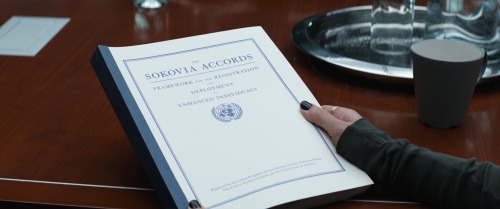
"The Sokovia Accords: A Narrative Blunder"

image


"THE SOKOVIA ACCORDS: A NARRATIVE BLUNDER"

Three years ago, the Marvel Cinematic Universe (MCU), along with Marvel Films and the Disney Studios, introduced to the world the thirteenth entry of the movie franchise, "CAPTAIN AMERICA: CIVIL WAR". Although the movie is officially regarded as a Captain America solo film, many moviegoers and critics tend to view it as an unofficial Avengers film. The film also introduced a new story arc to the franchise called the Sokovia Accords.

In reality, the Sokovia Accords is supposed to be a cinematic version of the Marvel Comics legislative law called the Mutant Registration Act and was the main focus behind the famous 2006-2007 seven-issue story arc known as "Civil War". In this story, the U.S. government passed a Superhero Registration Act, ostensibly designed to have super powered individuals act under official regulation, somewhat akin to law enforcement. Those superheroes opposed to the act, led by Captain America, found themselves in conflict with those like Iron Man and Ms. Marvel who supported the act. Spider-Man found himself caught in the middle and the X-Men took a neutral stance.

About a decade later, the MCU released "CAPTAIN AMERICA: CIVIL WAR" and introduced the world to the Sokovia Accords. For a while, I had wondered why Kevin Feige had allowed this story arc to be introduced in the middle of the franchise's on-going Infinity Stones arc. Then I had stumbled across an ARTICLE in which directors Anthony and Joe Russo had claimed the plot for the third Captain America movie was changed to compete against the DCEU's 2016 movie, "BATMAN V. SUPERMAN: DAWN OF JUSTICE". In this film, the U.S. government and the United Nations created the Sokovia Accords to regulate the actions of the Avengers and other enhanced beings in the wake of a deadly incident in Lagos, Nigeria; after Captain America and his team prevented a group of HYDRA terrorists from stealing biological weapons. Some of the Avengers - including Iron Man, War Machine, Black Panther and the Black Widow - supported the Accords for their own personal reasons. And some of them - the Falcon, Scarlet Witch and Captain America - refused to sign it. This schism between the Avengers, along with a bombing incident at the document's ratification in Vienna, widened the schism between the former teammates. Especially when Captain America's former best friend, Bucky Barnes aka the Winter Soldier, became the number one suspect behind the bombing.

"CAPTAIN AMERICA: CIVIL WAR" managed to successfully compete against "BATMAN V. SUPERMAN: DAWN OF JUSTICE". The MCU proved to be more financially successful. And it managed to acquire critical acclaim from most film critics, unlike the DCEU movie, which had received a good deal of negative review. And yet . . . the movie had failed to succeed with me. I found this surprising back in 2016, considering that I was more of a MCU fan than one of the D.C. Comics franchise. At least before I saw "BATMAN V. SUPERMAN: DAWN OF JUSTICE". Whereas I found myself harboring a low opinion of "CIVIL WAR", I became a fervent fan of the Zack Snyder film. And over the next three years, I have found it increasingly difficult to maintain my high opinion of the MCU. And a major factor of my burgeoning disappointment with the franchise proved to be the Sokovia Accords.

download.jpg CW_TCHAKAHD.jpg

Ever since 2016, I have harbored many misgivings about the Sokovia Accords arc. My first misgiving proved to be its portrayal in "CAPTAIN AMERICA: CIVIL WAR". I had assumed that the document would be the main factor to divide the Avengers. Instead, screenwriters Christopher Markus and Stephen McFeely included another subplot regarding the hunt for Bucky Barnes to divide the Avengers even further - especially Captain America and Iron Man - in the most contrived manner. One of the first advocates of the Sokovia Accords was King T'Chaka of Wakanda (father of the current Black Panther). Why? When the Avengers had prevented Brock Rumlow and other HYDRA operatives from stealing from that biological weapons lab in Nigeria, Scarlet Witch had used her telekinesis to divert the explosion from Rumlow's suicide bomb to another building that contained several Wakandan humanitarian workers. The problem with is scenario is that the 2018 movie, "BLACK PANTHER" made it clear that Wakanda was an isolationist country around the time of "CIVIL WAR" that did NOT involve itself in the affairs of other countries - including those on the African continent. Great. "BLACK PANTHER" managed to contradict certain plot points of "CIVIL WAR" and no one realized this. More importantly, King T'Chaka no longer had a reason to be an advocate of the Sokovia Accords. And the mistakes kept on going.


A major blooper regarding the Sokovia Accords had manifested in the 2018 movie, "ANT-MAN & THE WASP". In this film, Scott Lang aka Ant-Man found himself near the end of his house arrest, which manifested from his involvement with Captain America in "CIVIL WAR" and his violation of the Sokovia Accords. While incarcerated in the Raft (U.S. underwater prison for enhanced beings), Scott had mentioned Dr. Hank Pym, the first Ant-Man and creator of the Ant-Man suit. After being rescued from the Raft by Captain America; both Ant-Man and Clint Burton aka Hawkeye made a deal with the Federal courts and settled for two years of house arrest for violating the Accords. Both Hank Pym and his daughter Hope van Dyne became Federal fugitives because Hank had failed to register the Ant-Man suit. This proved to be problematic in so many ways. One, the Accords had not been ratified by the United Nations around the time of Scott's arrest, due to the bombing in Vienna. Two, Hank had first created the Ant-Man suit back in the 1980s and had been unaware of Scott’s use of the suit during the Avengers' battle at the airport in Berlin. After being freed by Steve, Scott had shrunken the suit and mailed it to his daughter Cassie, while declaring that it had been destroyed. If the suit was officially considered destroyed, why was Scott arrested anyway without the crucial evidence any prosecutor would need to convict him? Why were Hank and Hope declared as fugitives for failing to register a suit that officially no longer existed? Why did they become fugitives in the first place? Scott had used the Ant-Man suit without Hank's permission, something that he could or may have easily pointed out. The latter had created the suit some thirty years ago. And the Federal authorities remained unaware of Hank's creation of the Wasp suit and Hope's use of it. And she had played no role in the creation of the Ant-Man suit. Also, the writers did not need the Sokovia Accords as a reason for Scott to face conviction and house arrest. He had violated his parole when he left the United States to help Captain America, the Falcon, the Winter Soldier and others to deal with the potential threat of other HYDRA-created "Winter Soldiers".


Ever since I first saw "CAPTAIN AMERICA: CIVIL WAR", I found myself wondering about Thaddeus Ross' role in this story arc. By the time of the 2016 movie, he was no longer a general in the U.S. Army. He had become the new Secretary of State. It was Ross who had delivered the news of the Sokovia Accords to the Avengers. In his argument, he had pointed out the collateral damage caused - in his eyes and the eyes of others - by the Avengers. I found this idea ridiculous . . . to a certain extent. Asgardian Loki and a Chitauri army were mainly responsible for the damage inflicted upon downtown Manhattan in 2012's "THE AVENGERS". Malekith and the Dark Elves were responsible for the damage inflicted upon Greenwich, England in 2013's "THOR: THE DARK ELVES". The Royal Air Force had contributed to the damage . . . along with Thor. Obadiah Stane and his armored suit was responsible for the damage inflicted in downtown Los Angeles in 2008's "IRON MAN". As for the events in "THE AVENGERS: AGE OF ULTRON" . . . only two Avengers were responsible, Tony Stark (Iron Man) and Dr. Bruce Banner (the Hulk). They were the ones who had created the artificial intelligence (A.I.) known Ultron. The other Avengers were forced to help them clean up their mess. I noticed that no one had bothered to point this out. I also noticed that Ross had failed to bring up the Harlem battle between the Hulk and Abomination (Emil Blonsky) in 2008's "THE INCREDIBLE HULK". It seemed only natural that he would avoid the topic, considering that he played a major role in the creation of both the Hulk and Abomination. Also, the U.S. Army had managed to inflict a good deal of damage upon Harlem, while battling Abomination. I found it odd that neither Tony Stark and Natasha Romanoff, who both knew about Ross' role in the event, had said a word. Then again, I found it odd that Ross had become President Matthew Ellis's new Secretary of State in the first place. Why on earth did President Ellis select Ross to be his Secretary of State? Why did he think that a narrow-minded, uber-aggressive personality like Ross’ would be the right man for that particular position? Why did the MCU writers?


There is another aspect of the MCU's portrayal of the Sokovia Accords that I found mind boggling is that it was barely mentioned in the franchise's films between "CAPTAIN AMERICA: CIVIL WAR" and "THE AVENGERS: INFINITY WAR". I could understand that the document was not mentioned in films like "GUARDIANS OF THE GALAXY, VOL. 2" and "THOR: RAGNAROK". Both were set on worlds other than Earth. Well, Manhattan appeared briefly in the third film, but not long enough for the topic of the Accords to be brought up. However, I found it odd that Sokovia Accords were never mentioned in films like "DOCTOR STRANGE", "SPIDER-MAN: HOMECOMING" and "BLACK PANTHER", especially since these films were set on Earth. Considering that King T'Chaka's role in the creation of the Sokovia Accords had inadvertently led to his death, I found it odd that the document was never brought up in the 2018 movie. Did Wakanda drop its advocacy of the document, considering that the new King T'Challa gave refuge to Bucky Barnes? If not, why?


Even most of the MCU television shows had failed to mention the Sokovia Accords. In fact, I can only mention one that did - "AGENTS OF S.H.I.E.L.D." - and one that vaguely referenced the document - "JESSICA JONES". Most or all of the characters in Season Four of "AGENTS OF S.H.I.E.L.D.", including then former Director Philip J. Coulson, seemed to support the document. And I found this disappointing. Coulson and his team were willing to protect Inhumans and other enhanced people from xenophobic bigots like the organization called the Watchdogs. Season Four began with Inhuman Daisy Johnson aka Quake being on the run for her vigilante activities after leaving S.H.I.E.L.D. Seven episodes later, then S.H.I.E.L.D. Director Jeffrey Mace had cleared her name of past crimes . . . after she had agreed to sign the Sokovia Accords and re-join the agency. Everyone seemed fine with that, including Coulson. I found that disturbing. Season Two of the Marvel Netflix series, "JESSICA JONES", the Raft was mentioned as a possible destination for the title character's mother, another enhanced being who was proving to be dangerous to New York City's citizens and her adoptive sister, a talk-show host-turned dangerous vigilante. And yet . . . not one character managed to express disapproval of the Accords or that damn Raft. The Marvel Netflix franchise had featured three attorneys as major characters - Matt Murdock aka Daredevil, Franklin "Foggy" Nelson and Jeri Hogarth. and not one of them had discussed the legal ramifications of the Accords.


Ironically, only one person had ended up questioning the Sokovia Accords after "CAPTAIN AMERICA: CIVIL WAR". That person was Colonel James "Rhodey" Rhodes, USAF aka War Machine. What I find disturbing about the Marvel Cinematic Universe is that only one person has expressed disapproval of the Sokovia Accords since "CIVIL WAR". And that was James “Rhodey” Rhodes aka War Machine in "THE AVENGERS: INFINITY WAR". Yes, he had supported the Sokovia Accords in "CIVIL WAR". I did not find that surprising, since he was an Air Force officer. But nearly two years later, he had rejected the Accords when he had refused to obey Ross' order to arrest Captain America, the Falcon, Black Widow, Scarlet Witch, Vision and the Hulk following their return to the Avengers headquarters in "THE AVENGERS: INFINITY WAR". It took six films after "CIVIL WAR" for a MCU protagonist to either express disapproval of the Sokovia Accords or refuse to adhere to it. Yet, at the same time, Rhodey never really went into details over his eventual rejection of the document.


Why? Why did it take the MCU so long to find characters others than Captain America or the Falcon to express disapproval of the Accords? Why was the MCU so reluctant explore the legal ramifications of this document, especially since the franchise had went out of its way to introduce it in the first place? As several articles, including THIS ONE, have made clear - the Sokovia Accords is a violation of a citizen's right. It is a violation of the U.S. Constitution. Period. Any attorney, civil rights activist or civil rights organization could have easily pointed this out in any of the other Phase Three movies or MCU television shows. McFeely, Markus and other screenwriters could have easily pointed the unconstitutional aspect of the Sokovia Accords in "CIVIL WAR", "AGENTS OF S.H.I.E.L.D.", "JESSICA JONES", "INFINITY WAR" or any other MCU production set on Earth. Either McFeely, Markus and these other writers were idiots or for some reason, Kevin Feige had lost interest in exploring the consequences of the Accords. Perhaps Feige simply wanted to use the Accords as a plot device to battle "BATMAN V. SUPERMAN: DAWN OF JUSTICE" at the box office.


There is another aspect of the Sokovia Accords that many do not seem aware of or willing to discuss. The Sokovia Accords should not have been presented as a law in the MCU. Why? Because an accord is an agreement, not a law. Those enhanced beings who did not sign the Accord should NOT have been held accountable for using their powers, unless the latter were used for the usual crimes – robbery, burglary, kidnapping, murder, etc. Now, many would dismiss this criticism, claiming that "CAPTAIN AMERICA: CIVIL WAR" was a movie set in the world of comic books. Well, so were other similar documents. The Marvel Comics series, "Civil War" had the Mutant Registration Act. The document that affected enhanced beings and costumed vigilantes in Alan Moore's comic novel, "Watchmen" and Zack Snyder's 2009 movie adaptation of it was called the Keene Act. And "act" is a law. Mark Millar, Alan Moore and Zack Snyder had managed to get it right. Why had Christopher Markus and Stephen McFeely failed to do so? The problem with this is that if an enhanced being does not sign this accord, agreement or treaty; then their actions should not be dictated by it. The Sokovia Accords is an agreement, not a decree or a law.

If an enhanced or non-enhanced vigilante, who did not sign the accord, practices vigilantism, then that individual should be asked to cease such activity or face imprisonment for practicing vigilantism. To me, a vigilante is like a person pursuing a criminal or going into a foreign country to find a criminal without contacting the police or government agency. Nothing more, nothing less. Which is why I find it odd that in "SPIDER-MAN: FAR FROM HOME", Spider-man aka Peter Parker was never pursued by the police for his vigilante activities. Had he signed the Sokovia Accords and agree to cooperate with law enforcement? Do the Accords still exist by this latest MCU entry? If not, why is Spider-man practicing vigilantism without law enforcement breathing down his back?

In the end, I get the feeling that Kevin Feige and the MCU seem undecided on what to do with the Sokovia Accords arc. Worse, the franchise seems incapable of utilizing this story arc with any real competency. How can it if its writers do not know the difference between an accord and a law? But the more I think about the Sokovia Accords, the more I cannot help but feel that its creation was one of the biggest mistakes made by the Marvel Cinematic Universe.


Wednesday, August 2, 2017

"Comic Book Movies: Critical Hypocrisy"


"COMIC BOOK MOVIES: CRITICAL HYPOCRISY"

It just occurred to me that none of Marvel’s Captain America films ended on a happy note. Yet, they have never been criticized for possessing too much angst or being depressing. On the other hand, D.C. Comics films like 2016's "BATMAN V. SUPERMAN: DAWN OF JUSTICE" have been accused of being dominated by these traits. And I have never understood this contrasting attitude toward the two comic book movie franchises. 

In "CAPTAIN AMERICA: FIRST AVENGER", Steve Rogers lost his close friend, James “Bucky” Barnes during a mission. He was forced to crash the HYDRA plane into the cold Atlantic Ocean, where he froze for the next 66 to 67 years. Because of the crash, his burgeoning relationship with S.S.R. Agent Peggy Carter abruptly ended, with her believing that he had died. The movie ended with Steve awakening in 2011 New York City as a fish out of water and the world completely changed.

Although I love it with every fiber in my body, "CAPTAIN AMERICA: THE WINTER SOLDIER" proved to be a rather depressing film, if one is completely honest. The only positive thing that came out of it was Steve’s new friendship with Afghanistan War veteran, Sam Wilson. Otherwise, the movie featured the downfall of S.H.I.E.L.D., the very agency that his old love Peggy Carter, Howard Stark and Chester Philips had created, due to a major mistake they had committed. And that mistake turned out to be the recruitment of former HYDRA scientist, Armin Zola into the newly formed S.H.I.E.L.D. agency. Steve discovered that despite Johann Schmidt aka the Red Skull’s death, HYDRA continued to exist and that it had infiltrated S.H.I.E.L.D. and the U.S. Senate. He also discovered that his former best friend, Bucky Barnes, was not only alive, but also a brainwashed assassin for HYDRA. Everything eventually went to shit by the end of film, including Steve’s career with S.H.I.E.L.D.

"CAPTAIN AMERICA: CIVIL WAR" proved to be another depressing film. It introduced the Sokovia Accords, a United Nations sponsored document that forced enhanced beings like himself and other members of the Avengers to register with and be regulated by various governments. The main drive behind the Accords was Secretary of Defense and former U.S. Army General Thaddeus Ross, who had been the nemesis of Bruce Banner aka the Hulk. The Sokovia Accords finally gave Thaddeus Ross the opportunity to control a team of enhanced beings. The ninety-something Peggy Carter finally died. And the Avengers faced another threat - a Sokovian named Zemo, who wanted revenge for the destruction of his country - an event caused by Tony Stark’s creation of an artificial intelligence (A.I.) called Ultron. And Zemo also used the still brainwashed Bucky Barnes, whose past involved being coerced by HYDRA into murdering Howard and Maria Stark, to get his revenge. Between the Accords and Zemo, the Avengers suffered a permanent split by the end of the movie.

On the other hand, many film critics and moviegoers have criticized about "darker" aspects of the DCEU films. They have accused director Zack Snyder and the production teams behind the DCEU movie franchise of being too depressing or portraying its major protagonists as a bit too angsty. One, I see nothing wrong with morally and emotionally complex comic book hero movies. Also, at least two of the DCEU movies, "MAN OF STEEL" and "SUICIDE SQUAD" ended on a happier note. 

"MAN OF STEEL" ended with Clark Kent aka Superman moving to Metropolis and joining the staff of The Daily Planet as a junior reporter and exchanging a knowing smile with his love, Lois Lane - the only person other than his mother who knew of his identity as Superman. "SUICIDE SQUAD" told the story of a group of super villains (two of them, meta-humans) who were forced to battle a powerful sorceress, bent upon world-domination by the director of A.R.G.U.S., Amanda Waller. Although Waller's right-hand man, Colonel Rick Flagg, had allowed the villains to walk away after she had been kidnapped, the "Suicide Squad" assisted Flagg in taking down the Enchantress anyway. They were repaid with a reduced prison sentence and a few benefits. Also, "SUICIDE SQUAD" was filled with a great deal of humor - something that many critics and moviegoers have complained that the DCEU was lacking. 

I find it ironic that "MAN OF STEEL" and "SUICIDE SQUAD" have been criticized for being "depressing and angst-riddled", along with the DCEU's boogeyman, "BATMAN V. SUPERMAN: DAWN OF JUSTICE" (which I also adore with every fiber of my being). Yet, the MCU's Captain America films have managed to evade such criticisms, despite their ambiguous endings. Why have many critics and moviegoers have been so hard on the DCEU films about their ambiguity and given the Captain America films a pass? Hypocrisy much?

Thursday, June 15, 2017

"Irrelevant Bashing"


"IRRELEVANT BASHING"

I am another moviegoer who is getting sick and tired of the regarding Marvel/Disney’s Marvel Cinematic Universe (MCU) films and Warner Brothers/D.C. Comics’ D.C. Extended Universe (DCEU) films. I have come across articles in which fans of both movie universes have accused the other of excessive bashing. 

I never understood this rivalry between Marvel and DC Comics movie franchises. To be honest, I find it unnecessary. And I believe today's audiences are getting too caught up in this so-called rivalry, thanks to the media, the studios and the two comic book conglomerates. I have seen both DC Comics and Marvel since "SUPERMAN: THE MOVIE" first came out in 1978. Why do certain films from one comic book company need to be better than those from another one? I have seen films from both that I found very impressive. And I have seen films from both that left me feeling disappointed. For me to decide whether the Marvel films or the DC films are better strikes me as ridiculous.

Some fans have claimed that since the MCU films perform better at the box office, they are without a doubt, the superior series of films. One major problem with this reasoning was the box office performance of the five major comic book movies released in 2016. Marvel’s "CAPTAIN AMERICA: THE CIVIL WAR" proved to be the second (or third) biggest box office success of that year. Yet, D.C. Comics’ "BATMAN v. SUPERMAN: DAWN OF JUSTICE" proved to be that year’s fifth biggest box office success. Although both the DCEU’s "SUICIDE SQUAD" and the MCU’s "DOCTOR STRANGE" never reached those heights in terms of box office, both were successful and ironically, the DCEU movie proved to be a bit more successful.

However, I believe that box office performance is not a true reflection of a movie’s worth. No one knows the true reason behind the critics’ current and more positive reaction to the Marvel films. Not really. True, some film critics might honestly believe they are better. Then again, it is possible that some film critics were bribed to praise the Marvel films to the sky and/or bash the D.C. Comics movies. Personally, I had stopped regarding their opinion as fact a long time ago. After all, their opinions are dictated by personal tastes, or . . . other means, just as the opinions of moviegoers are dictated by personal tastes. - Yes, there might be more people who believe that the current Marvel films are better. But I have encountered a great number of opinions that favor the current DC Comic movies. And I cannot help but wonder if the MCU fans are simply the loudest. Also, judging a film based upon box office success or the number of fans for a certain franchise strikes me as irrelevant. There are a lot of fans of the "TRANSFORMER" films. A lot. Which is why those movies generated a good deal of money. In the end, it is all subjective. 

I am fans of both the MCU and the DCEU. I have been aware of some bashing of the MCU films by certain DCEU fans. However, their bashing seemed to be minor in compare to the consistent and excessive stream of criticism and bashing directed toward the DCEU films … and I believe this bashing is getting out of control.

Sometimes, I get the feeling that a lot of Marvel fans (or perhaps I should say the Marvel/Disney company is threatened by the three movies released by DC Comics between 2013 and 2016. These three movies signaled the end of the Marvel/Disney’s monopoly on a series of comic book movies based upon a collection of titles. The bashing for the DCEU has become utter ridiculous and excessive. I am also beginning to wonder if those who had accused Disney/Marvel of paying off the critics to bad mouth ALL THREE DCEU movies that have been released so far … had been right after all. Because this criticism has become over the top. It has now extended to both "WONDER WOMAN" and "JUSTICE LEAGUE" and they have yet to be released. Has bashing the DCEU movies become the "in" thing to do? Just as bashing the "STAR WARS" Prequel films is still a popular past time? I hope not. For I had almost bought it myself. 

When "MAN OF STEEL", "BATMAN v. SUPERMAN: DAWN OF JUSTICE" and "SUICIDE SQUAD" first hit the theaters, I was reluctant to see all three, because I had stupidly accepted the bad opinions about them. Yet, I overcame my reluctance and went to see them, anyway. And when I finally saw those three movies, I enjoyed them. All of them. Very much. In fact, I regard "BATMAN v. SUPERMAN: DAWN OF JUSTICE" as one of the best comic book hero movies I have ever seen. And that was when I finally realized that a film critic’s opinion was worth dog shit. No more. I am simply going to form my own opinion of any movie I am interested in seeing. And I refuse to be some mindless drone and accept the views of others simply because it is the in-thing to do.

The idea that we are supposed to be accept that the Marvel or MCU films are better than the DCEU films, because many film critics or movie fans say so is irrelevant. It is irrelevant, because their views are matters of opinion. Preference. I do not accept this view "numbers matter" regarding the artistic quality of a film, because I do not share it. I have watched a lot of comic book movies in my time. From my perspective, only my opinion of an individual movie count. I do not care whether any those movies are based upon the titles of Marvel, DC Comics or any other comic book company that exists. And considering that art and entertainment are subjective in the end, what is the point in declaring that MCU films are better or that DCEU movies are better? It seems like a waste of time to me. I think we all should focus on which individual movies that appeals to us and not bother on which company makes the better films.

Warner Bros./DCEU is scheduled to release two movies in 2017. Disney/MCU has scheduled three to be released. I plan to see all five movies this year. And I will be damned if I pay attention to any film critics or moviegoer . . . until after I have seen these movies. Regardless of who performs better at the box office, I am the one who will decide which films I want to see and which ones I want to buy, regardless of whether they came from DC Comics or Marvel.

Sunday, June 5, 2016

How Iron Man Ruined “CAPTAIN AMERICA: CIVIL WAR″ For Me


HOW IRON MAN RUINED "CAPTAIN AMERICA: CIVIL WAR" FOR ME

I am so disappointed with Marvel. And I am especially disappointed with its latest entry for the Marvel Cinematic Universe - namely"CAPTAIN AMERICA: CIVIL WAR". I never thought I would be so disappointed with a Captain America film, considering how much I loved "CAPTAIN AMERICA: THE FIRST AVENGER" and especially "CAPTAIN AMERICA: THE WINTER SOLDIER". 

As for "CIVIL WAR", I found it disappointing. Worse, I left the movie theater feeling unusually angry. And a great deal of my anger was focused on Tony Stark aka Iron Man’s role as the movie’s co-lead, which the writers had allowed to nearly dominate the film. Someone on the TREK BBS forum had pointed out that "CAPTAIN AMERICA: CIVIL WAR" had sewn up the plot lines left dangling from "THE WINTER SOLDIER". And the movie did so . . . WITH BAD WRITING! 

"CIVIL WAR" started with a flashback of Tony’s parents getting killed in 1991. The screenplay tried to make a mystery of it, but even a dummy would have known who was the killer. 
Steve’s romance with Sharon Carter was rushed, because the Sokovia Accords story line and Tony’s man pain made it impossible for the screenwriters to do justice to it. Now, we have fans demanding that Steve become a bisexual, so that he can have a romance with his old buddy, Bucky Barnes. One, I cannot believe that these fans are so unwilling to see how badly written that Steve and Sharon’s romance was that they would rather he become a bisexual. Really? Because the screenwriters had failed to follow up the promise of Steve and Sharon? And two, I find it ironic (or not) that they would not consider Steve having a romance with Sam Wilson, who is African-America. 

Speaking of Sam and Bucky, I noticed that their relationship was never really explored. Instead, the movie presented their rivalry over the role of Steve’s "best friend" in a series of silly comedy routines in which they are mildly hostile toward one another. The movie spent 10 to 15 minutes showing how Tony Stark recruited Peter Parker (who really had no business being in this movie) for Team Iron Man. They could have saved this first meeting in MCU’s upcoming "SPIDER-MAN" movie. Yet, "CIVIL WAR" failed to explain or show why Scott Lang and Clint Barton had decided to side with Steve. 

Zemo’s whole revenge plot was all about Tony finding out that Bucky, as the brainwashed Winter Soldier, had killed his parents in order to break up the Avengers for what happened in Sokovia. Again, it became all about Tony. The worst aspect of all of this is that Marvel ended Steve and S.H.I.E.L.D.’s conflict with HYDRA in such a weak manner. The studio ended it on "AGENTS OF S.H.I.E.L.D." - with Phil Coulson and Glenn Talbot coordinating a series of bombing on HYDRA bases . . . off screen. I found that incredibly pathetic. Someone on Tumblr had pointed out that Steve Roger’s personal arc in "CIVIL WAR" had been weakened by the screenwriters’ unnecessary focus on Tony Stark. After seeing this movie, I heartily agree. What is really sickening about this is that Marvel Studios came up with the idea to focus the Civil War arc in a Captain America movie in order to lure Robert Downey Jr. into another Marvel film. 

You would think after the box office successes of movies like "CAPTAIN AMERICA: THE WINTER SOLDIER" and"GUARDIANS OF THE GALAXY" that this idea was unnecessary. But apparently, Marvel thought otherwise and decided to shove an Avengers film into a Captain America movie . . . all because they could not do without the increasingly overrated Robert Downey Jr. And because of this decision, I have now developed deep contempt toward Marvel Studios.

Thursday, November 26, 2015

Favorite Films Set in the 1940s

The-1940s

Below is a list of my favorite movies (so far) that are set in the 1940s: 


FAVORITE FILMS SET IN THE 1940s


1-Inglourious Basterds-a

1. "Inglourious Basterds" (2009) - Quentin Tarantino wrote and directed this Oscar nominated alternate history tale about two simultaneous plots to assassinate the Nazi High Command at a film premiere in German-occupied Paris. The movie starred Brad Pitt, Melanie Laurent and Oscar winner Christoph Waltz.


2-Captain America the First Avenger

2. "Captain America: The First Avenger" (2011) - Chris Evans made his first appearance in this exciting Marvel Cinematic Universe installment as the World War II comic book hero, Steve Rogers aka Captain America, who battles the Nazi-origin terrorist organization, HYDRA. Joe Johnston directed.


3-Bedknobs and Broomsticks

3. "Bedknobs and Broomsticks" (1971) - Angela Landsbury and David Tomilinson starred in this excellent Disney adaptation of Mary Norton's series of children's stories about three English children, evacuated to the countryside during the Blitz, who are taken in by a woman studying to become a witch in order to help the Allies fight the Nazis. Robert Stevenson directed.


4-The Public Eye

4. "The Public Eye" (1992) - Joe Pesci starred in this interesting neo-noir tale about a New York City photojournalist (shuttlebug) who stumbles across an illegal gas rationing scandal involving the mob, a Federal government official during the early years of World War II. Barbara Hershey and Stanley Tucci co-starred.


5-A Murder Is Announced

5. "A Murder Is Announced" (1985) - Joan Hickson starred in this 1985 adaptation of Agatha Christie's 1950 novel about Miss Jane Marple's investigation of a series of murders in an English village that began with a newspaper notice advertising a "murder party". Directed by David Giles, the movie co-starred John Castle.


6-Hope and Glory

6. "Hope and Glory" (1987) - John Boorman wrote and directed this fictionalized account of his childhood during the early years of World War II in England. Sarah Miles, David Hayman and Sebastian Rice-Edwards starred.


7-The Godfather

7. "The Godfather" (1972) - Francis Ford Coppola co-wrote and directed this Oscar winning adaptation of Mario Puzo's 1969 novel about the fictional leaders of a crime family in post-World War II New York City. Oscar winner Marlon Brando and Oscar nominee Al Pacino starred.


8-Valkyrie

8. "Valkyrie" (2008) - Bryan Singer directed this acclaimed account of the plot to assassinate Adolf Hitler in July 1944. Tom Cruise, Bill Nighy and Tom Wilkinson starred.


9-The Black Dahlia

9. "The Black Dahlia" (2006) - Brian DePalma directed this entertaining adaptation of James Ellroy's 1987 novel about the investigation of the infamous Black Dahlia case in 1947 Los Angeles. Josh Harnett, Scarlett Johansson, Aaron Eckhart and Hilary Swank starred.


10-Stalag 17

10. "Stalag 17" (1953) - Billy Wilder directed and co-wrote this well done adaptation of the 1951 Broadway play about a group of U.S. airmen in a prisoner-of-war camp in Germany, who begin to suspect that one of them might be an informant for the Nazis. Oscar winner William Holden starred.