Showing posts with label hattie mcdaniel. Show all posts

Friday, July 24, 2020

"This Is a Mistake"


"THIS IS A MISTAKE"

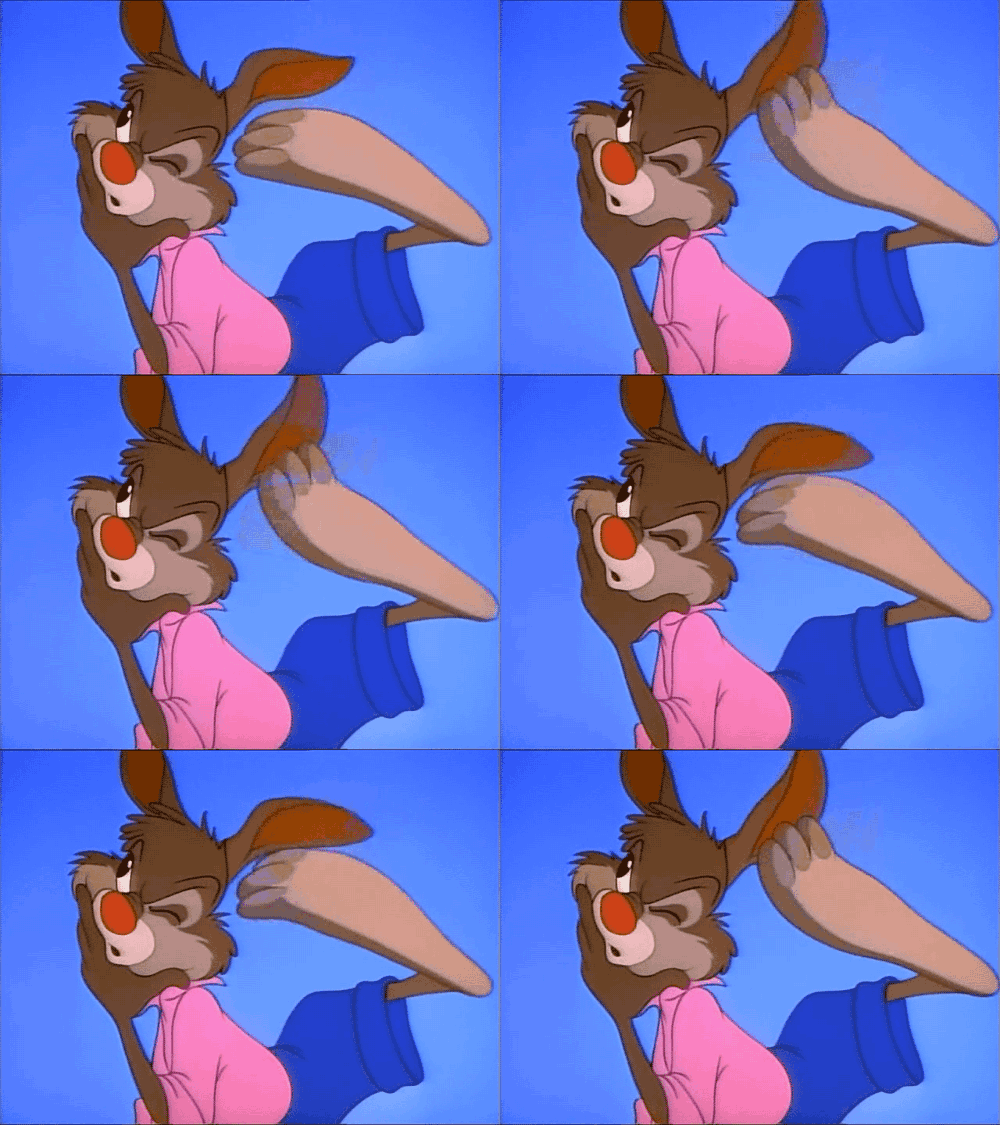
I have heard that in the wake of the Black Lives Matter movement and the recent protests against police brutality, Disney Parks have decided to change the theme of its Splash Mountain attraction in all of its theme parks. Instead of an attraction based on the 1949 animated film, "SONG OF THE SOUTH" and the Uncle Remus stories by Joel Chandler Harris, Disney Parks has decided to change the attraction’s theme to one based on the 2009 animated film, "THE PRINCESS AND THE FROG". And I believe this is a big mistake.

First of all, why can Disney Parks not consider the idea of maintaining the present theme of Splash Mountain and create a new one based on "THE PRINCESS AND THE FROG"? What is the point of erasing the "SONG OF THE SOUTH" theme from its Splash Mountain attraction? "THE PRINCESS AND THE FROG" theme . . . with a mountain setting? That does not make any sense to me, considering the 2009 movie was set in late 1920s New Orleans and the swamps of Southern Louisiana. "SONG OF THE SOUTH" was set near the region of Stone Mountain, somewhere between Northern and Central Georgia.

If Disney thinks it is being politically correct in the wake of the Black Lives Matters movement, they are mistaken. The Brer Rabbit stories are basically AFRICAN-AMERICAN folklore,which served as a metaphor for the struggles of African-American slaves before and immediately after the Civil War. Three African-Americans on a Georgia plantation had told these stories to Joel Chandler Harris, a white teenager they had befriended during and after the Civil War. Harris had worked for their owner and later, employer. When he later became a journalist and a writer, Harris took those stories and had them published under the "Uncle Remus Tales" title between 1880 and 1907. The character of Uncle Remus served as a metaphor for those three slaves-turned-freedmen, whom Harris had befriended. What Disney Parks is doing is misguided lip service to the Black Lives Matter movement. If Disney Parks really want to pay tribute to the movement, it would maintain Splash Mountain’s original theme and create a new attraction based on "THE PRINCESS AND THE FROG".

Now that I think about it, what is really racist about "SONG OF THE SOUTH"? The Uncle Remus character? The fact that he is a former slave? Or that he was friendly with two white kids? Or that he still lived on a plantation after the Civil War? Uncle Remus was based on the three slaves that Joel Harris had befriended on a plantation. How else does anyone thinks Harris had found out about the Brer Rabbit stories? By eavesdropping on the plantation workers? Are people upset that Uncle Remus had served as a narrator, telling these stories to white kids? I also noticed two other aspects of this situation. The 1946 movie was set during the post-Civil War era. One of the film's main protagonists, a young Georgian white boy named Johnny, who happened to be the son of an Atlanta newspaper journalist in post-Civil War Georgia. Aside from Uncle Remus, Johnny had befriended a poor white girl and the son of a black sharecropper during his family's visit to his grandmother's plantation. The movie has nothing to do with reinforcing the so-called "glories" of the pre-Civil War Old South. None of the live-action characters in "SONG OF THE SOUTH" - including Uncle Remus - or the film's actual plantation setting is featured inside Splash Mountain. So again . . . why does Disney Parks feel it needs to change the attraction’s theme?

The Brer Rabbit stories are metaphors about how generations black Americans had SURVIVED the horrors of American slavery, after they and their ancestors had been dragged to North American and to different parts of the South and forced to work for nothing against their will. Do many people have a problem that comedy was an element in the stories? That is how the original stories were framed. At least "SONG OF THE SOUTH" is actually based on African-American culture or folklore. Despite having an African-American woman as its leading character, "THE PRINCESS AND THE FROG" is not. It is a movie based on "The Frog Princess", a 2002 novel written by E.D. Baker, a white American woman. She had based her novel on who based her story on "The Frog Prince", the 1812 novel written by the Brothers Grimm . . . two white European men.

By replacing the "SONG OF THE SOUTH" theme inside Splash Mountain attraction at the Disney theme parks with one from "THE PRINCESS AND THE FROG", Disney Parks is erasing one theme based on African-American culture and replacing it with one based on European culture. Replacing "THE PRINCESS AND THE FROG" lead character from a white European woman to an African-American woman does not change that fact.


image

Sunday, August 27, 2017

Ten Favorite WILLIAM WELLMAN Movies

1e256a912856fa20c2bdae40ba6e9b27

Below are my top ten favorite movies directed by the winning director, William Wellman: 


TEN FAVORITE WILLIAM WELLMAN MOVIES

1 - Beau Geste

1. "Beau Geste" (1939) - Gary Cooper, Ray Milland and Robert Preston starred in this exciting adaptation of P.C. Wren's 1924 novel about three British brothers who join the French Foreign Legion to stave off a potential family scandal.


2 - Westward the Women

2. "Westward the Women" (1951) - Robert Taylor starred in this unusual Western about a wagonmaster hired to guide a wagon train of marriageable women to a region in 1850s California. Denise Durcel, Henry Nakumara and John McIntire co-starred.


3 - A Star Is Born

3. "A Star Is Born" (1937) - Janet Gaynor and Fredric March starred in this award winning drama about a rising Hollywood actress and her marriage to a fading movie star. Wellman won the Best Writing (Original Story) Oscar for this movie.


4 - Safe in Hell

4. "Safe in Hell" (1931) - Dorothy Mackaill starred in this fascinating tale about a New Orleans prostitute who struggles to survive and avoid the law, while dealing with an array of men out to exploit her.


5 - Wild Boys of the Road

5. "Wild Boys of the Road" (1933) - This highly acclaimed adaptation of Daniel Ahern's novel, "Desperate Youth", told the story about a group of teenagers forced to become hobos during the Great Depression. Frankie Darro, Edwin Phillips and Dorothy Coonan (Wellman's fourth and final wife) starred.


6 - Nothing Sacred 

6. "Nothing Sacred" (1937) - Carole Lombard and Fredric March starred in this biting comedy about a young woman erroneously diagnosed with radiation poisoning and a newspaper reporter pretending that she really is dying for the sake of money and a series of articles.


7 - Night Nurse

7. "Night Nurse" (1931) - Barbara Stanwyck starred in this neat crime thriller about a young nurse who enlists the help of a petty criminal to foil a sinister plot to murder two children from a wealthy family. Ben Lyon, Joan Blondell and Clark Gable co-starred.


8 - Heroes For Sale

8. "Heroes For Sale" (1933) - Richard Barthelmess starred in this poignant tale about a World War I veteran who suffers a series of personal mishaps from the post-war period to the Great Depression. Loretta Young and Aline MacMahon co-starred.


9 - The Public Enemy

9. "The Public Enemy" (1931) - James Cagney became a star portraying a young Chicago hoodlum who becomes a successful bootlegger via a bloody mob war. Edward Woods, Jean Harlow and Joan Blondell co-starred.


10 - The High and the Mighty

10. "The High and the Mighty" (1954) - John Wayne starred in this tense disaster movie, an adaptation of Ernest K. Gann's 1953 novel, about a commercial airplane that develops engine trouble during a trans-Pacific flight. Robert Stack, Claire Trevor and Larraine Day co-starred.

Monday, June 5, 2017

"CHINA SEAS" (1935) Review

china01


"CHINA SEAS" (1935) Review

For years, film critics and moviegoers have claimed that either Steven Spielberg's 1975 movie, "JAWS" or George Lucas' 1977 movie, "STAR WARS: EPISODE IV - A NEW HOPE" ushered in or created the summer box office film. I had believed this for years, until I saw Metro-Goldwyn-Mayer's 1935 film, "CHINA SEAS"

To understand how "CHINA SEAS" came about, one would have to look into the career of MGM producer, Irving Thalberg. For several years, he served as the studio's Production Chief, supervising the output of movies being released by MGM. After suffering a heart attack around Christmas Eve 1932, he was ordered by his doctor to take a long rest. Thalberg and his wife, Norma Shearer, spent several months traveling in Europe. When they finally returned during the summer of 1933, Thalberg discovered that studio chief Louis B. Mayer and the CEO of parent company Loew's, had changed the studio's managerial structure. The position of Production Chief had been eliminated and Thalberg became one of many producers on the lot with their own production unit. Thalberg struggled for two years to personally produce a major hit. He scored a few hits. But he did not really hit it big, until this 1935 movie that starred Clark Gable, Jean Harlow and Wallace Beery.

Based on the 1931 novel written by Crosbie Garstin, "CHINA SEAS" is an ocean going adventure film about a merchant ship carrying both passengers and important cargo from Hong Kong to Shanghai. British sea captain Alan Gaskell is recruited by his company's owner to transport a secret shipment of gold in order to fool high seas pirates into believing that the gold is being transported by another ship. Naturally, the plan fails due to an old friend named Jamesy McArdle's discovering the plot. The latter recruits Malay pirates to board the ship as passengers and crewman so that the gold can be hijacked during the voyager. Also along for the ride are two of Captain Gaskell's former paramours - a brassy prostitute, dance hall girl or mistress (hell, I have no idea which one) named Dolly Portland and Sybil Barclay, the elegant widow of an old friend; an alcoholic American named Charlie McCaleb; a disgraced ship's officer formerly accused of cowardice named Tom David; an elegant Chinese lady named Soo Young; and Dolly's extroverted maid, Isabel McCarthy . . . among others. Not only does Gaskell and his crew have to deal with marauding pirates, but also a typhoon.

Undoubtedly, "CHINA SEAS" is an entertaining movie. It possesses one of the elements that make certain movies particularly enjoyable for me - namely a story featuring long distance travel. In fact, watching "CHINA SEAS" strongly reminded me of a film released by Paramount Pictures over three years ago - 1932's "SHANGHAI EXPRESS". Both movies were set in or around Asia. Both movies featured long distance traveling with Shanghai as the final destination . Both movies featured a leading male character who is British, a leading female character in a sexual profession, and a Chinese woman as a supporting character. Both movies featured the violent takeover by non-Western men - Chinese troops in "SHANGHAI EXPRESS" and Malay pirates in "CHINA SEAS". And both movies featured Jules Furthman as screenwriter. The similarities between the two movies are so strong that their differences almost seem irrelevant to me. If it were not for the fact that "CHINA SEAS" was an adaptation of Garstin's novel, I would have accused Thalberg and MGM of plagarism.

The reason I brought up the topic of summer blockbusters when I first began this review is that "CHINA SEAS" seemed like a prime example of one. Think about it. "CHINA SEAS" possessed a cast of major stars like Clark Gable, Jean Harlow and Wallace Beery. Rosalind Russell was not quite a star when she co-starred in this film. The movie was given a large budget for its production - at least one million dollars. A good deal of that budget was spent on visual effects. The movie featured heavy action and over-the-top melodrama. And even more ironic, "CHINA SEAS" was released during the summer of 1935, made tons of money and put Irving Thalberg back on top, professionally. If the movie had been made today, Roland Emmerich probably would have directed it. After watching "CHINA SEAS", I could not help but wonder why film critics and historians failed to remember this film, when citing the origins of the summer blockbuster movie.

Mind you, "CHINA SEAS" is not a terrible film. I would rank it between very good and mediocre. But for some reason, I hardly found it appealing. The problem is that I it did not strike me as particularly original. The movie's portrayal of its non-white characters struck me as wince-inducing. One aspect of the movie that really annoyed me was how the movie portrayed the Malay pirates a lot worse than Jamesy McArdle, despite the fact that the ship's hijacking was his plan. However, Hattie McDaniel managed to overcome this racial limitation with a very entertaining performance and warm chemistry with leading lady Jean Harlow. And like 1937's "THE PRISONER OF ZENDA", most of the action in "CHINA SEAS" is set during its second half. The violence, by the way, struck me pretty harsh for a mid-1930s film - especially the tortures of Clark Gable and Lewis Stone's characters. 

Most of the characters struck me as cardboard archetypes, even the more amusing ones portrayed by McDaniel, Bencheley, Edward Brophy and Akim Tamiroff. Lewis Stone's character, the doomed Tom Davids, came close to being an interesting and complex. But when all said and done, even his "coward who redeems himself" character proved to be a cliche. I love Jean Harlow. And I found her Dolly Portland a lively addition to the cast. And the insecurities that plagued her character proved to be very interesting. But in the end, her performance came off as a bit too shrill for my tastes. I have to give kudos to Rosalind Russell for giving a credible portrayal of an upper-class Englishwoman . . . even if the Sybil Barclay character struck me as one-dimensional. Only Wallace Beery's Jamesy McArdle managed to avoid any one-dimensional or cliched characterization. His Jamesy proved to be the most complex and ambiguous character in the movie. This would explain why despite his villainy, his character was portrayed with a good deal of sympathy. 

From a casting point of view, the biggest problem for me proved to be Clark Gable as Captain Alan Gaskell. Gable was not the first American actor to portray a British character . . . even during that period in Hollywood. Gary Cooper did it. So did Robert Taylor. But they got away with it, due to their ability to project the image of a European (especially British) male without losing their American accent. Through body language and attitude, certain American actors like Cooper and Taylor knew how to get away with portraying British men. They knew how to sell it. Gable, on the other hand, did not. Mind you, as a Midwesterner from Ohio, he did a damn good job in portraying an aristocratic Southerner in 1939's "GONE WITH THE WIND". But he was still portraying an American. When Gable's Captain Gaskell started spouting sentiments about the glories of England, I swear I was simply to astounded to break into laughter. During my second viewing of "CHINA SEAS", I laughed. I am sorry. Gable was a first-rate actor. The torture sequence obviously proved this. But he lacked . . . something that prevented him from portraying an Englishman with an American accent with any plausibility.

From the numerous reviews I have read, many seemed to view "CHINA SEAS" as an example of the best that Old Hollywood had to offer. Look, the movie is filled with a good deal of action and melodrama that prevents it from being boring. And one can thank director Tay Garnett for keeping it lively. But for me, it is basically a 1930s version of a summer blockbuster movie - one that did not particularly knock my socks off. I do not hate the movie, but I certainly do not view it as among the best that Old Hollywood had offered.

Friday, April 14, 2017

"CHINA SEAS" (1935) Photo Gallery

china02

Below are images from "CHINA SEAS", the 1935 adaptation of Crosbie Garstin's 1931 novel. Directed by Tay Garnett, the movie starred Clark Gable, Jean Harlow and Wallace Beery: 


"CHINA SEAS" (1935) Photo Gallery

10-ChinaSeas-1935_m


china01


china-seas


china-seas1


China-Seas-classic-movies-22710662-1067-800


Clark-Gable-in-China-Seas-clark-gable-22798434-1067-800


cs5


Gable china seas jacket back


Jean-Harlow-in-China-Seas-jean-harlow-22776368-1067-800


Jean-Harlow-in-China-Seas-jean-harlow-22776411-1067-800


normal_china83


russell-gable


tellthemwherethegoldis


tumblr_m0cmvscBla1qanwe4o1_500

Friday, November 28, 2008

"GONE WITH THE WIND" (1939) Review


"GONE WITH THE WIND" (1939) Review

Several years ago, I had come across an article that provided a list of old classics that the author felt might be overrated. One of those movies turned out to be the 1939 Oscar winning film, "GONE WITH THE WIND". Not only did the author accuse the movie of being both racist and sexist, he also claimed that the movie had not aged very well over the past seven decades. 

Did I agree with the author? Well, let me put it this way. I would say that "GONE WITH THE WIND" has managed to withstand the tests of time . . . to a certain extent. As the author had pointed out, the sexism and racism are obvious and rather off-putting. First of all, the slaves came across as too servile for my taste. Although there were moments when it seemed the slave Prissy did not particularly care for the movie's heroine, Scarlett O'Hara. And although Prissy was not the only dimwitted character in the story (think of Melanie and Charles Hamilton's Aunt Pittypatt, the Tarleton brothers, and yes, even Charles Hamilton himself), she had the bad luck to spout that unfortunate line that must have been the bane of actress Butterfly McQueen’s life - "Miz Scarlett, I know nothin’ bout birthin’ no babies.". The movie's portrayal of the newly freed slaves struck me as schizophrenic. They either remained loyal to their former masters - like Mammy, Prissy and Pork (the O'Hara house servants); or they were shiftless, lazy blacks who easily "bought the Yankees' lies" and preyed upon their former masters and mistresses - especially white women. This last sentence reminded me of the Shantytown sequence. And I just remembered that both a white man and a black man nearly attacked Scarlett before she was rescued by Big Sam. In other words, this film was just as insulting to working-class whites (think former overseer Jonas Wilkerson and Emmy Slattery), as it was to the black characters. I forgot that despite its occasional celebration of the working-class (especially during the Depression Era), many Hollywood films tend to reek of class bigotry. 

And the sexism was no better. I found the story's male romantic lead Rhett Butler’s determination to view Scarlett as his own personal child bride rather distasteful – along with his act of marital rape. The first half of the movie allowed Rhett to express some kind of respect toward Scarlett's pragmatism and ruthlessness. But once she became his wife, he seemed to long for some kind of child bride as well. But if I must be honest, I have seen movies that are just as bad or even worse. I realize that the Melanie Hamilton character is highly regarded by many as the ideal woman, I personally found the character hard to accept. I nearly rolled my eyes in one scene that featured her sacrificing her wedding ring for "the Cause"(namely the Confederacy). That woman put the Madeline Fabray character from John Jakes' North and South" trilogy to shame. Ideal characters - especially ideal women - have always been a turn off for me. They tend to smack of illusions of the worst kind.

I had once seen "GONE WITH THE WIND" at one of my local movie theaters when it had been re-released to celebrate its 50th anniversary in 1989. The first half of the film struck me as being well-paced and filmed. The dialogue sparkled and Vivian Leigh and Clark Gable, and the rest of the cast could not have been better. I could not say the same for the film’s second half. The real problem with "GONE WITH THE WIND" manifested in Part Two. Once Scarlett had married Rhett . . . the movie slowly began to fizzle. Oh sure, it had its iconic moments – Scarlett appearing at Ashley’s birthday party in the infamous red dress, Bonnie Blue Butler’s death and Mammy's grief-stricken reaction. Unfortunately, it did not take me very long to fall asleep . . . even before poor Bonnie Blue’s death. I managed to wake up in time to witness Hattie McDaniel's brilliant monologue on the decline of Butlers' marriage and Bonnie Blue's death. I do not think one can really blame the movie's credited screenwriter, Sidney Howard and the screenwriters who worked on the project. Margaret Mitchell's novel had this same problem as the movie. Namely, it started brilliantly and ended with me crying in despair for the story to end. I suspect that Selznick had decided not to risk earning the fans' ire by refraining from changing the novel's structure too much after the other changes he had made.

And the main reason why "GONE WITH THE WIND" threatened to fizzle out in the end? Quite frankly, the story seemed unable to maintain the same pace throughout the film. Even worse, this seemed to have turned "GONE WITH THE WIND" into a movie with conflicting genres. I do not know whether to list it as a historical drama or a costumed melodrama. Most of the movie seemed like a historical drama – especially the first half that ends with Scarlett’s return to Tara. But once Scarlett’s second husband - Frank Kennedy – was killed during the Shantytown attack sequence, the movie purely became a costumed melodrama. This change in genre not only made the movie seemed slightly schizophrenic, it nearly grounded the film's pacing to a halt.

There were other minor aspects of "GONE WITH THE WIND" that I found rather questionable. Why was Melanie Wilkes living in Atlanta, following her marriage to Ashley Wilkes? Why did she not live with her in-laws at the Wilkes' plantation, Twelve Oaks? One featured a brief scene in which Eddie Anderson's Uncle Peter chasing a chicken in the Wilkes' backyard proclaiming it to be "the last chicken in Atlanta". Really? In December 1863, when the Union Army had yet to set foot in the state of Georgia, except for Fort Polaski, off the coast of Savannah? And could someone explain why social leaders like Mrs. Mayweather, Mrs. Meade and Aunt Pittypat Hamilton needed Melanie's approval for an auction regarding the city's young female elite at the local charity bazaar and ball? Melanie was only a year or two older than Scarlett and probably eighteen to nineteen years old at the time. I found the entire moment implausible. And who exactly created the infamous green dress that Scarlett wore to pay Rhett a visitor, when he was a prisoner of the Union Army? Scarlett? Her sisters? Mammy, who was a housekeeper and not a seamstress? Prissy? Why was Rhett a prisoner of the Union Army . . . after the war ended? And why did Big Sam have that ludicrous argument with the other O'Hara slave over who would order the other field slaves to stop working? He was the foreman. It was his job. The other man should have known that. 

Speaking of Big Sam, he was also featured in a scene in which Scarlett spotted him and other former Tara field slaves marching through Atlanta and on their way to dig ditches for the Confederate Army defending the city. What made me shake my head in disbelief was not only Sam's cheerful attitude toward this task, but the fact that his fellow slaves were singing "Go Down Moses", a song associated with American slaves' desire to flee bondage and the Underground Railroad. Either David O. Selznick or his production team had no knowledge of the historical significance of this song, or . . . this scene was some kind of ironic joke. Last, but not least, one scene in the movie's second half found Scarlett and Ashley arguing over their use of convicts as labor for her lumber mill. The problem is that the convicts were all white, and most convicts - then and now - were African-Americans. Is it possible that Selznick may have been guilty of whitewashing? Apparently so.

"GONE WITH THE WIND" does have its virtues. Most of the performances were first-rate. It especially benefited from Vivian Leigh as the movie's lead, Scarlett O'Hara; Clark Gable as the roguish Rhett Butler; Hattie McDaniel as Mammy; Olivia De Havilland as the sweetly Melanie Hamilton Wilkes; Thomas Mitchell as Gerald O'Hara; Barbara O'Neil as Ellen O'Neil; Butterfly McQueen as Prissy Laura Hope Crews as Aunt Pittypat, and even Leslie Howard, who had the thankless job of portraying the aristocratic loser, Ashley Wilkes. In fact, one has to give Leigh credit for basically carrying a nearly four-hour movie on her own. But there were other performances that I found memorable - including Oscar Polk, Victor Jory, Harry Davenport, Evelyn Keyes, Ann Rutherford, Everett Brown, Carroll Nye and Rand Brooks. Leigh, Gable, De Havilland and McDaniels all received Academy Award nominations. Both Leigh and McDaniels won in their respective categories.

The movie also benefited from a strong first half, which covered the war years. From the movie's opening on Tara's porch to that last moment when a besieged Scarlett vowed to "never go hungry again" in the middle of one of Tara's fields, the movie steamed ahead with drive, without rushing along too face. In fact, I would say that the film's strongest sequence began with the Union Army's siege of Atlanta and ended with Scarlett, Melanie and Prissy's arrival at Tara. That sequence alone did an excellent job of expressing the horrors of war not only from the military point of view, but also from the viewpoints of civilians like Scarlett. Marceella Rabwin, producer David O. Selznick's former executive assistant, had credited Victor Fleming not only for his direction of this sequence, but also the film's strong drive and pacing. And since he ended up as the movie's main director, I guess I will also give him credit. It still amazes me that a Civil War movie with no battle scenes whatsoever, could have such a strong and well-paced narrative - at least in its first half. The movie also benefited from the hiring of the Oscar winning production designer William Cameron Menzies, who used storyboards (a first in Hollywood for a live-action film) to provide the movie's look and style. He was able assisted by another Oscar winner, Lyle R. Wheeler, who created the movie's art designs. Many have complimented Walter Plunkett for his costume designs for the film. Granted, he had created some beautiful costumes. But my two favorite costumes worn by Vivian Leigh in the images below, are not particularly well-known:


However, I do have a problem with some of Plunkett's designs. He had a bad habit of injecting modern fashion styles into some of his 19th century designs. Another virtue of the movie came from the score written and orchestrated by Max Steiner. Although he had received a nomination for his work, Steiner was defeated by Herbert Stothart's work for "THE WIZARD OF OZ". But words cannot describe Ernest Haller and Lee Garmes' beautiful photography. I believe the following images can only do justice to the film's striking visuals:

Gone-With-the-Wind-gone-with-the-wind-4370166-1024-768 Gone-With-the-Wind-gone-with-the-wind-4371112-1024-768

What else can I say about "GONE WITH THE WIND"? Unlike many other film critics and fans, it is not my favorite Best Picture winner. It is not even my favorite 1939 film. Between the overt political incorrectness and a weak second half, I would have never voted it as the 1939 Best Picture Oscar. But . . . despite its political incorrectness and the dull last hour of the film, "GONE WITH THE WIND" still managed to hold up pretty well after 69 years, thanks to its talented cast and crew and the drive of producer David O. Selznick.


Thursday, November 13, 2008

"GONE WITH THE WIND" (1939) Photo Gallery


Below is a gallery of photos and publicity stills from the 1939 classic, "GONE WITH THE WIND":


"GONE WITH THE WIND" (1939) Photo Gallery