Showing posts with label lesley sharp. Show all posts

Tuesday, August 5, 2025

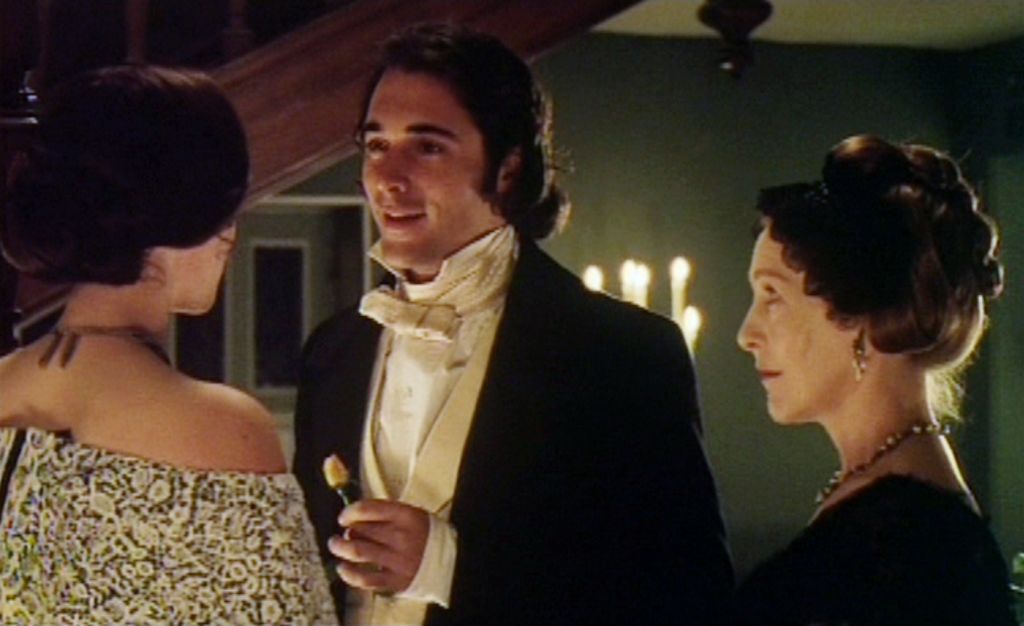
"THE MOONSTONE" (1996) Review


"THE MOONSTONE" (1996) Review

Following my viewing of the 1997 television movie, "THE WOMAN IN WHITE", I followed up with an adaptation of another Wilkie Collins' novel, "THE MOONSTONE". Like the other adaption, this adaptation had been produced back in the 1990s as a television movie.

Based on Collins' 1868 novel, "The Moonstone: A Romance""THE MOONSTONE" was an early modern detective story that centered around the theft of a valuable gem. A young English socialite named Rachel Verinder inherits a large Indian diamond called "a moonstone" on her eighteenth birthday. The gem is a legacy from her uncle, a corrupt British army officer named Colonel Sir John Hardcastle, who had stolen it from a religious idol, while serving in India. The diamond is of great religious significance and extremely valuable, and three Hindu priests have dedicated their lives to recovering it. Although Sir John's theft of the Moonstone had involved murder, he was never punished for his crimes. But he ended up shunned by society and his sister, Lady Julia Verinder. In retaliation for the shunning, Sir John leaves it in his will as a birthday gift to his niece Rachel, exposing her to the attentions of the gem's legal guardians.

On the night of her birthday party, Rachel wears her new present. Lady Julia, Rachel's cousin Franklin Blake and the local Dr. Candy all seem very anxious over Rachel's possession of the Moonstone. Especially since a trio of Indian jugglers had appeared at the Verinder estate. Later that night, the gem disappears from Rachel's room. Stolen. Suspicion first falls upon the three Indian jugglers. But retired Scotland Yard investigator, Sergeant Cuff believes the theft was an inside job. His suspicions fall upon one of the Verinders' servants, Rosana Spearman; and Rachel, whom he believes harbored plans to use the diamond to pay off secret debts.

I really do not know how to start this review, if I must be honest. I believe a good deal of my feelings originated from how I feel about Collins' story. I have never read his novel. But I have seen at least three adaptations of it to get a pretty good grasp of it. I must admit that director Robert Bierman and screenwriter Kevin Elyot did a very good job in setting up Collins' tale in this adaptation. They did not rush through the narrative in order to arrive on the night of the theft. And Elyot's screenplay also did an excellent job in exploring the novel's main characters - especially Rachel Verinder, her mother Lady Julia, the Verinders' major domo Gabriel Betterege and Franklin Blake. The movie also did a first-rate job in conveying the details of Blake and Cuff's investigation of the theft, along with Rachel's strange behavior. But once their investigation hit a dead end and the story moved on to the third act . . . I started having problems with the movie.

I could blame Wilkie Collins and his novel. Or I could blame the movie's screenwriter for trying to adhere as closely to Collins' story as possible. But after Franklin resumed the investigation of the Moonstone's theft a year after the incident, "THE MOONSTONE" seemed to be piled with nothing but contrived writing. I can only assume that Collins had wanted to deliver a surprise twist to his readers when he revealed who had taken the gem. I was certainly surprised when I first saw this film. And after three or four years, I have remained . . . dissatisfied with the revelation. I mean . . . seriously? And the series of events that led to the theft also struck me as contrived. But that was nothing in compare to the events that led to the Moonstone's final fate. To this day, a part of me wishes that the filmmakers had changed some of Collins' narrative for this movie.

At least I had no problem with the film's production values. Sarah Greenwood's production designs struck me as first-rate in her re-creation of Great Britain during the late 1840s. I was especially impressed by her creation of London during that period. Philip Robinson's art direction, the film's Art Department and John Daly's cinematography ably contributed to her work. I especially enjoyed Daly's photography of the marshes in Norfolk that served as the setting for one very memorable scene. I also admired James Keast's costume designs. His costumes struck me as a near accurate reflection of the film's late 1840s setting. I must admit that I found those costumes for the upper-class female characters a bit on the dull side. Was this dullness a direct reflection of elite women's fashion of that period? Perhaps someone can answer that for me.

Both Greg Wise and Keeley Hawes gave solid performances as the movie's romantic leads - Franklin Blake and Rachel Verinder. I cannot deny that the pair possessed some semblance of screen chemistry, especially during the film's first half hour. But they never really had the opportunity to develop that chemistry, since their characters spent most of the film at odds with one another or apart. The movie also featured solid performances from the likes of Scott Handy, Patricia Hodge, Anton Lesser, Peter Jeffrey, Paul Brooke, a menacing performance from Terence Hardiman as the slightly sinister Col. Sir John Hardcastle, and a rather entertaining performance from Kacey Ainsworth as the Verinders' holy roller cousin Drusilla Clark. Which leads me to my favorite performances in the movie.

One of those performances came from Peter Vaughan, who portrayed the Verinder family's steadfast majordomo, Gabriel Betterege. Not only did Vaughan did an excellent job in conveying Betterege's intelligence, but also the character's sharp humor. I really enjoyed his performance. Another performance that impressed me was Antony Sher, who portrayed the botanical loving former Scotland Yard detective, Sergeant Richard Cuff. I believe real life Victorian police detective Jack Whicher had inspired Collins' creation of Cuff. But Sher injected a touch of humorous eccentricity to the character that made his performance so enjoyable to me. One last performance had impressed me and it came from Lesley Sharp, who portrayed one of the Verinders' maids, Rosanna SpearmanR. Sharp gave an etheral, yet intense performance as the lovesick Rosanna, which left a haunting cloud over the story before the last reel.

Would I regard this 1996 television movie as the best adaptation of Wilkie Collins' novel? Hmmm . . . perhaps not. I have seen other adaptations that had delved into the narrative with a bit more detail. And the ending of this film seemed to rush a bit toward the end. However, I did managed to enjoy "THE MOONSTONE" very much. And thanks to Robert Bierman's direction, Kevin Elyot's screenplay and excellent performances from a cast led by Greg Wise and Keeley Hawes, I would have no problems doing a rewatch of this film over and over again.


Saturday, May 24, 2025

"THE MOONSTONE" (1996) Photo Gallery


Below are images from "THE MOONSTONE", the 1996 adaptation of Wilkie Collins' 1868 mystery novel.  Directed by Robert Bierman, the television drama starred Greg Wise, Peter Vaughan, Antony Sher and Keely Hawes: 


"THE MOONSTONE" (1996) Photo Gallery


Wednesday, October 23, 2019

"THE CLOCKS" (2009) Review


"THE CLOCKS" (2009) Review

While perusing the list of novels written by Agatha Christie between 1957 and 1973, I noticed that only five of them featured Belgian detective Hercule Poirot as the main detective. Five out of sixteen novels during this period. Considering how the author used to churn out Poirot novels and short stories like nobody's business in the previous decades, I could not help but wonder if the author's interest in the Belgian detective was on the wane.

This certainly seemed to be the case for her 1963 novel, "The Clocks". Although Poirot was the investigator who solved the mystery, he barely played a role in this investigation. Major supporting characters like Colin Lamb and Inspector Richard Hardcastle visited the crime scenes and questioned the suspects and other witnesses. They fed the information to Poirot, who exercised his "little grey cells" and solved the case. This is one reason why the 1963 novel was not a particular favorite of mine. Thankfully, the 2009 adaptation of "The Clocks" proved to be a different kettle of fish. Unlike his literary version for this tale, actor David Suchet's Poirot was, without a doubt, the mystery's main character.

Although the 2009 television movie, "THE CLOCKS", provided some minor changes to Christie's novel, it also featured two major changes. I have already commented on how Poirot had a bigger role (as he should) in this television adaptation. The setting for "THE CLOCKS" also underwent a major change. Instead of being set during the heyday of the Cold War, the 2010 television movie was set near the end of the 1930s, with Europe (and eventually the rest of the world) on the cusp of World War II. And the narrative's B-plot reflected this. In "THE CLOCKS", the character of Colin Lamb has been changed to Colin Race, conveying the idea that he is the son of of an old friend of Poirot's. And instead of being an MI-5 (Special Branch) agent investigating a pro-Communist spy ring, Colin is a Royal Navy officer working for MI-6 and investigating a possible pro-Nazi spy ring in Dover. Also, the character of Richard "Dick" Hardcastle has become a slightly xenophobic police officer, who resented Poirot's presence in the investigation. Despite these changes, the core of Christie's narrative managed to survive for this adaptation.

"THE CLOCKS" began as a spy story in which MI-6 operative Colin Race finds himself investigating the theft of classified documents from a naval base at Dover Castle. Apparently, Colin's girlfriend had spotted the thief/German spy, but was killed by a speeding car before she could apprehend the thief. Colin's girlfriend left a clue, leading Colin to a neighborhood in Dover. Upon reaching one house on a street shaped like a crescent, a young woman named Sheila Webb races out of it, screaming that she had found a murdered man inside, along with a collection of clocks. Colin seeks Poirot's help to solve the murder mystery, in case the murder proves to be connected with the spy ring he had been investigating and his girlfriend's death.

As I had earlier stated, I am not a big fan of Christie's 1963 novel. While some might find the idea of Poirot being reduced to a minor character who solves the mystery in an armchair rather amusing, I did not. I could not, especially if this was supposed to be a "Poirot" mystery. And as I had earlier pointed out, screenwriter Stewart Harcourt director Charlie Palmer ensured that Poirot would be the main character in this adaptation. I also enjoyed how the narrative allowed Poirot and Colin's search for the spy ring and missing document overshadow their efforts to find the killer responsible for the mystery man's death, along with the deaths of two other characters - Edna Brent, a typist and colleague of Sheila Webb's; and Merlina Riva, a former stage actress who claimed to be the widow of the dead man discovered by Colin and Sheila. Throughout the story, those viewers unfamiliar with Christie's novel might find themselves wondering if Sheila was responsible for the deaths, if the deaths had anything to do with the German spy ring, or if the three victims had been killed for another reason. Overall, I believe "THE CLOCKS" is a solid adaptation of Christie's novel, but also an improvement.

However, there is one aspect of Harcourt and Palmer's adaptation that I do not regard as an improvement. I refer to the character of Colin Race. One, this secondary lead character came off as less than intelligent than his literary counterpart. Colin was able to solve the mystery of the spy ring without Poirot's help. And two, in the television movie, he struck me as a slightly shallow man who was able to transfer his affections from one woman to another within a few days. I found this rather tacky. I believe Harcourt's screenplay made the mistake of having Colin involved with the doomed Fiona Hanbury, whose activities led him to another clue regarding the spy ring, at the beginning of the story. Worse, it did not take Colin very long to develop romantic feelings for Sheila Webb after meeting her. And he met Sheila in less than a week after Fiona's death. Even when he was still mourning Fiona's death, he was falling in love with Sheila. Really? This is just tackiness beyond belief. Colin's romantic relationships in this movie made him look like a shallow idiot who seemed to have this need for romance in his life 24/7.

The television movie's production values struck me as very impressive. I thought Jeff Tessler's production designs did a great job in recreating Dover circa 1939. His work was ably supported by Miranda Cull's art direction and Sheena Napier's costume designs. I have mixed feelings about Peter Greenhalgh's cinematography. On one hand, I found movie's photography very colorful and beautiful. In fact, I thought it did justice to the production's locations in London and Kent. But I did not care for the hazy veneer that I felt almost spoiled the photography. I found it an unnecessary device for indicating that this story was set in the past. And it reminded me of numerous period dramas in the 1970s that also used this camera device . . . unnecessarily.

I certainly had no problems with the movie's cast. David Suchet, as always, gave a sharp and elegant portrayal of Hercule Poirot. In fact, his performance reinforced my relief that the screenwriter and director had given Poirot a bigger presence in this adaptation than in Christie's novel. Despite my irritation with the Colin Race character, I cannot deny that Tom Burke gave an exceptionally skillful performance. He almost made me believe in the plausibility of Colin falling in love with one woman, while still grieving for another. I was very impressed by Jaime Winstone's portrayal of the ambiguous Sheila Webb. I thought she did an excellent job in conveying both the character's desperate need for everyone to believe in her innocence and her occasional lapses in morality. Phil Daniels was excellent as the slightly aggressive and xenophobic Inspector Richard "Dick" Hardcastle. Lesley Sharp gave a very subtle performance as Sheila's no-nonsense boss Miss Martindale. And I was very impressed with Anna Massey's performance as Miss Pebmarsh, the blind owner of the house that contained the dead man and the actress's final role before her death. Like Winstone, Massey did an excellent job of portraying a very complicated and ambiguous character, who was haunted by the deaths of her sons during World War I. The television movie also featured excellent performances from Geoffrey Palmer (father of the director), Tessa Peake-Jones, Jason Watkins, Beatie Edney, Abigail Thaw, Guy Henry, Stephen Boxer, and Frances Barber.

In the end, I believe that "THE CLOCKS" was a solid adaptation of Agatha Christie's 1963 novel, thanks to a first-rate script by Stewart Harcourt and first-rate direction by Charlie Palmer. My only true complaint was their handling of the Colin Race character. The television movie also featured excellent performances by a talented cast that included David Suchet, Anna Massey and Jaime Winstone.

Wednesday, September 4, 2019

"THE CLOCKS" (2009) Photo Gallery


Below are images from "THE CLOCKS", the 2009 adaptation of Agatha Christie's 1963 novel. The movie starred David Suchet as Hercule Poirot: 


"THE CLOCKS" (2009) Photo Gallery