
Below is my ranking of the episodes from "THE LAST TYCOON", Amazon Studios' 2016-2017 loose adaptation of F. Scott Fitzgerald's 1941 unfinished novel that was published posthumously. Developed by Billy Ray, the limited series starred Matt Bomer as Monroe Stahr:"THE LAST TYCOON" (2016-2017) EPISODES RANKING 1. (1.08) "An Enemy Among Us" - While production chief Monroe Stahr commence upon a campaign to secure Brady-American Pictures first Oscar nominations, studio chief Pat Brady seeks for a solution to balance the studio's account books and get the Board of Directors off his back. Meanwhile, starlet-to-be Kathleen Moore plots to escape from her dangerous deception.
 2. (1.03) "More Stars Than There Are in Heaven" - Brady proves his worth as studio chief as he plans to woo film star Margo Taft to sign up with Brady-American. Due to the loan he had given Brady, MGM studio boss Louis B. Mayer tries to interfere in the studio's projects. Brady's daughter Celia forms a connection with office boy Max Miner. And Monroe's relationship with Kathleen blossoms.
 3. (1.09) "Oscar, Oscar, Oscar" - In this season finale that focuses on the Academy Awards ceremony, Brady makes a decision that causes a rift between him and Monroe and Celia. Monroe and Kathleen grapple with the emotional fallout of her deception.
 4. (1.06) "A Brady-American Christmas" - During the Christmas holiday, Stahr encourages Kathleen to join Fritz Lang's secluded rehearsal, leaving him alone on Christmas Eve. Brady schemes to boost ticket sales for "Angels on the Avenue". Celia and Max are brought closer by tragedy.
 5. (1.01) "Pilot" - The series premiere and pilot introduces Monroe as Brady-American Pictures' production chief, who constantly clashes with Brady over the content of the studio's films, fends of Celia's infatuation with him and falls in love with Kathleen, whose nationality reminds him of his late wife, Minna Davis.
 6. (1.06) "Eine Kleine Reichmusik" - Stahr orchestrates an extravagant Hollywood party that masks a secret agenda involving Austrian-Jewish musicians. Brady continues to courts Margo Taft to become Brady-American's permanent leading lady. And Celia becomes aware of director Fritz Lang's provocative private life.
 7. (1.04) "Burying the Boy Genius" - The death of MGM production chief Irving Thalberg sends shock waves throughout the Hollywood industry and leaves Brady pondering over Monroe's shaky health. Meanwhile, the latter risks his budding relationship with Kathleen to save a movie and Brady American.
 8. (1.07) "A More Perfect Union" - Brady hatches a bold business ploy that has sweeping consequences for the studio's employees and forces Monroe to contain the repercussions. Kathleen struggles to manage her tangled web of half-truths.
 9. (1.02) "Nobody Recasts Like Monroe" - Monroe continues his pursuit of Kathleen, who rejects the idea of being a replacement for Minna. Pat Brady's pet project has a devastating debut, forcing him to accept Monroe's help. Celia gets cozy in her role as producer, so Hackett takes it upon himself to give her an education.
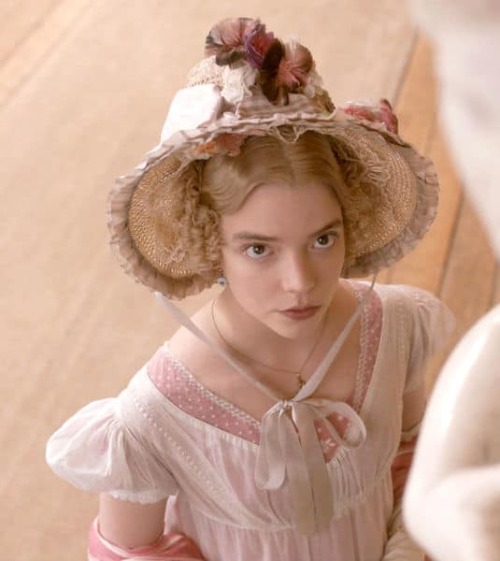
"EMMA" (2020) ReviewBetween 2009 and 2020, Hollywood and the British film/television industries have created a handful of productions that either spoofed or were inspired by Jane Austen's novels. Actually, I can only recall one movie that was more or less a straightforward adaptation - 2016's "LOVE & FRIENDSHIP", an adaptation of Austen's novella, "Lady Susan". So imagine my surprise when I learned a new and straightforward adaptation of an Austen novel was due to hit the theaters.I was even more thrilled that this new movie would be a straightforward adaptation of Austen's 1815 novel, "Emma" . . . which happened to be my favorite written by her. This new adaptation, helmed by Autumn de Wilde and written by Eleanor Catton, starred Anya Taylor-Joy in the title role. I am certain that many Austen fans are familiar with the 1815 novel's narrative. "EMMA" is the story of a spoiled and over privileged young Englishwoman named Emma Woodhouse, who resides at her wealthy father's country estate near the town of Highbury. Emma is not only spoiled and over privileged, but overestimates her own matchmaking abilities and is blind to the dangers of meddling in other people's lives.Ever since its release in February 2020, film critics and moviegoers have been praising "EMMA" to the skies. In fact, the movie is so high on the critical list that I would not be surprised if it ends up receiving major film award nominations next winter. A great deal of this praise has been focused on the performances of Anya Taylor-Joy, Johnny Flynn for his portrayal of George Knightley, Bill Nighy's portrayal of Mr. Woodhouse; and Autumn de Wilde's direction. Does the movie deserve such high praise? Perhaps. Perhaps not.I certainly cannot deny that "EMMA" is a beautiful looking film. I found Christopher Blauvelt's photography to be very sharp and colorful. In fact, the film's color palette almost seemed similar to the color schemes found in Alexandra Byrne's costume designs. Overall, the visual style for "EMMA" seemed to radiate strong and bright colors with a dash of pastels. Very stylized. But as much as I found all of this eye catching, I also found myself a little put off by this stylized artistry - especially for a movie in a period rural setting.Speaking of artistry, there has been a great deal of praise for Byrne's costumes. And I can see why. Granted, I am not fond of some of the pastel color schemes. I cannot deny I found her creations - especially those for the movie's women characters - were eye catching, as shown below:
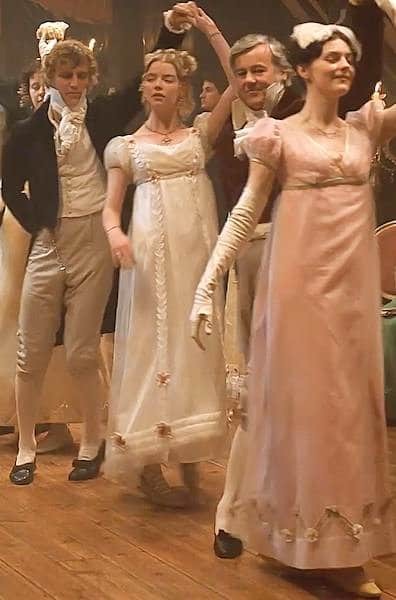
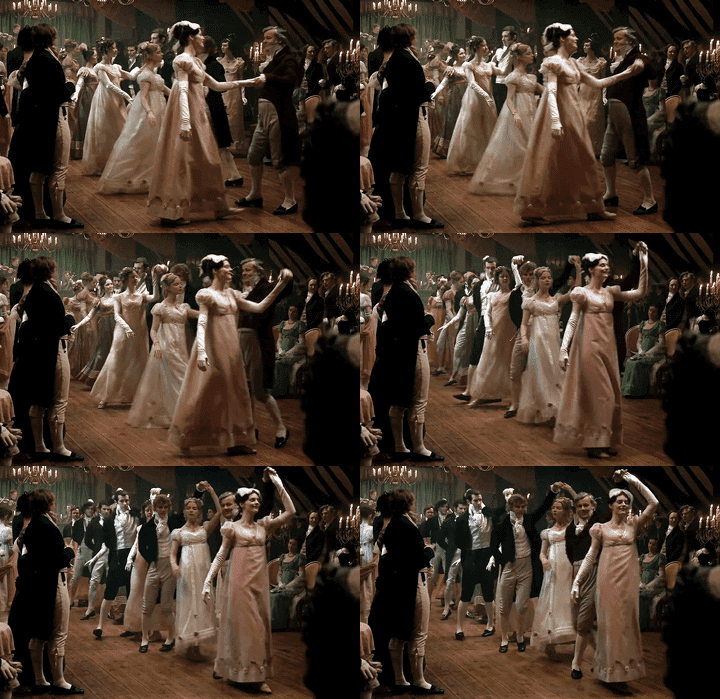
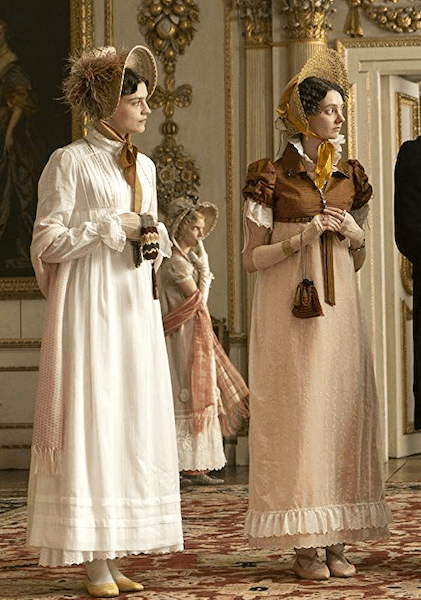 I had a few complaints regarding the film's costumes and hairstyles. The men's trousers struck me as a little too baggy for the 1810s. I get it. Actors like Bill Nighy found historical trousers a bit tight. But I feel the trousers featured in "EMMA" struck me as a bit too comfortable looking from a visual viewpoint. And then there was the hairstyle used by Anya Taylor-Joy in the film. For some reason, I found her side curls a bit too long and rather frizzy looking. Instead of the mid-1810s, her hairstyle struck me as an example of hairstyles worn by women during the early-to-mid 1840s.Someone had claimed that "EMMA" was a very faithful adaptation of Austen's novel. Was it? Frankly, I thought it was no more or less faithful than any of the costumed versions. De Wilde and screenwriter Eleanor Catton followed the major beats of Austen's novel, except for one scene - namely the Crown Inn ball. I will discuss that later. The movie also did an excellent job in capturing the comic nature of Austen's novel. This was apparent in nearly every scene featuring Bill Nighy as Mr. Woodhouse. I also enjoyed those scenes featuring the introduction of Augusta Elton, Emma's reactions to Jane Fairfax and her attempts to play matchmaker for Harriet Smith and Mr. Elton. But the movie also featured some good dramatic moments, thanks to De Wilde's direction and the film's cast. I am speaking of the scenes that featured Mr. Knightley's scolding of Emma for her rudeness towards the impoverished Miss Bates at the Box Hill picnic; Mr. Knightley's marriage proposal and the revelation of Harriet's engagement to tenant farmer Robert Martin."EMMA" has received a great deal of acclaim from film critics, moviegoers and Jane Austen fans. Many are claiming it as the best adaptation of the 1815 novel. Do I feel the same? No. No, I do not. In fact, out of the five film and television adaptations I have seen, I would probably rank it at number four. Perhaps I had very high expectations of this movie. It is an adaptation of my favorite Austen novel. And it is the first straightforward Austen adaptation since the 2009 television miniseries of same novel. Perhaps this movie is better than I had original assume. Then again, looking back on some of the film's aspects - perhaps not.A good deal of my problems with "EMMA" stemmed from the portrayal of the main character, Emma Woodhouse. How can I say this? Thanks to Catton's screenplay and De Wilde's direction, Emma came off as more brittle and chilly than any other version I have ever seen. Granted, Emma Woodhouse was a snob. This was apparently in her strong sense of class status, which manifested in her erroneous belief that Harriet Smith was the illegitimate daughter of an aristocrat or gentry landowner, instead of someone from a lower class. Emma's snobbery was also reflected in her contempt towards the impoverished Miss Bates, despite the latter being a "gentlewoman" and a member of the landed gentry. Emma's snobbery, a product of her upbringing, also manifested in her own ego and belief that she is always right. Yes, Emma possessed negative traits. But she also had her share of positive ones. She possessed a warm heart, compassion for the poor (at least those not from her class), intelligence, and an ability to face her faults. This cinematic portrayal of Emma Woodhouse as a brittle and slightly chilly bitch struck me as a little off putting and extreme.Another example of the exaggeration in this production was Mr. Knightley's reaction to his dance with Emma at the Crown Inn ball. Many have not only praised the sensuality of the pair's dance, but also Mr. Knightly's reaction upon returning home to his estate, Donwell Abbey. What happened? George Knightley seemed to be in some kind of emotional fit, while he stripped off some of his clothes and began writhing on the floor. What in the fuck was that about? That scene struck me as so ridiculous. Other actors who have portrayed Knightley have managed to portray the character's awareness of his love for Emma without behaving like a teenager in heat.Speaking of heat, who can forget Harriet Smith's orgasmic reaction to the idea of being Mrs. Elton? Many critics and Austen fans thrilled over the sight of a female character in a Jane Austen production having an orgasm. I will not castigate De Wilde for this directorial choice. I am merely wondering why she had included this scene in the first place. If Harriet was going to have an orgasm, why not have her bring up the subject to a possibly flabbergasted Emma? Why include this moment without any real follow through? Having an orgasm must have been something of a novelty for a young woman like Harriet, who was inexperienced with sexual thoughts or feelings.And then there was Emma and Mr. Knightley's dance at the Crown Inn ball. The latter sequence is usually one of my favorites in any adaptation of "EMMA". The one exception proved to be the 1972 miniseries, which ended the sequence after Emma had suggested they dance. I almost enjoyed the sequence in this film . . . except it featured Emma obviously feeling attracted to Mr. Knightley during this dance. And I thought this was a big mistake. Why? Because Emma was never that consciously aware of her attraction to Mr. Knightley, until Harriet had confessed her crush on the landowner. And that happened near the end of the story. In other words, by showing Emma's obvious feelings for Knightley during the ball, Autumn De Wilde rushed their story . . . and was forced to retract in the scene that featured Harriet's confession. I feel this was another poor decision on the filmmaker's part.If I have to be honest, I think De Wilde, along with screenwriter Eleanor Catton, made a number of poor decisions regarding the film's narrative. I have already pointed out three of those decisions in the previous paragraphs. But there were more. De Wilde and Catton changed the dynamics between Mr. Woodhouse and his older daughter and son-in-law, Isabella and John Knightley. In the novel and previous adaptations, the younger Mr. Knightley had always seemed more annoyed and at times, cankerous toward Mr. Woodhouse's hypochondria. In this version, Isabella's hypochondria is portrayed as more irritating. And instead of reacting to his wife's complaints, John suppressed his reactions and ended up being portrayed as a henpecked husband. For some reason, De Wilde and Catton thought it was necessary to take the bite out of John Knightley, making him a weaker character. Why? I have not the foggiest idea, but I did miss the character's biting wit.In my review of the 1996 television version of "Emma", I had complained how screenwriter Andrew Davies and director Diarmuid Lawrence had minimized part of Harriet's character arc and focused just a bit too much on Frank Churchill and Jane Fairfax. In the 1996 movie version, the opposite happened. Writer-director Douglas McGrath had focused more on Harriet's arc than the Frank/Jane arc. Well De Wilde and Catton ended up repeating McGrath's mistake by focusing too much on Harriet, at the expense of Frank and Jane. Worse, Frank and Jane's arc seemed focused on even less than in the 1996 McGrath film. The couple barely seemed to exist. And a result of this is that Frank's father, Colonel Weston, barely seemed to exist. Mrs. Weston fared better due to her being Emma's former governess. But I was really shocked at how little De Wilde and Catton focused on Mr. Elton and his overbearing bride, Augusta Elton. The movie did focus a good deal on Mr. Elton in those scenes featuring Emma's attempts to match him with Harriet. But following his marriage, his character - along with Mrs. Elton's - seemed to slowly recede into the background following their tea at Hartfield with the Woodhouses. By allowing very little focus on these characters, De Wilde and Catton had left out so many good moments in their effort to streamline Austen's story for theatrical film. Even more so than the two versions from 1996.Because of this streamlining, a good deal of the cast had very little opportunity to develop their characters on screen. Oliver Chris and Chloe Pirrie gave solid comic performances in their portrayal of John and Isabella Knightley, despite my irritation at the changing dynamics of their relationship. Rupert Graves was pretty much wasted as the over-friendly Colonel Weston. Miranda Hart gave a funny performance as the impoverished spinster Miss Bates. Unfortunately, I was distracted by her less-than-impoverished wardrobe in several scenes. If you had asked for my opinion of Amber Anderson's portrayal of Jane Fairfax, I would not have been able to give it to you. I have no memory of her performance. She made no impact on the movie or its narrative. Tanya Reynolds struck me as a rather funny Mrs. Elton . . . at least in the scene featuring the Eltons' tea with the Woodhouses at Hartfield. Otherwise, I have no real memory of her other scenes in the movie. Callum Turner has always struck me as a memorable performer. And I have to admit that his portrayal of Frank Churchill certainly made an impression on me. But the impression was not always . . . negative. One, he did not have enough scenes in this movie and his character arc struck me as rather rushed. And two, I thought his Frank Churchill was a bit too smarmy for my tastes.Thankfully, "EMMA" did feature some memorable supporting performances. Gemma Whalen gave a lovely and warm performance as Emma's former governess and close friend, Mrs. Weston. Josh O'Connor gave an excellent performance as the social-climbing vicar, Mr. Elton. I must say that I found his comic timing impeccable and thought he gave one of the best performances in the movie. However, I thought there were times when his Mr. Elton came off as a sexual predator. I get it . . . Mr. Elton was basically a fortune hunter. But I thought O'Connor went too far in the scene that featured Emma's rejection of his marriage proposal. For a moment, I thought he was going to sexually assault her. That was a bit too much. Mia Goth's portrayal of the clueless Harriet Smith struck me as spot-on and very skillful. Granted, I did not care for the "Harriet has an orgasm" moment, but I cannot deny that Goth's acting was excellent in the scene. Bill Nighy gave a skillfully comic portrayal as the hypochondriac Mr. Woodhouse. Yes, there were moments when his usual tics (found in many of his performances) threatened to overwhelm his performance in this film. But I think he managed to more or less keep it together.One performance that seemed to be garnering a great deal of acclaim came from Johnny Flynn, who portrayed Mr. Knightley. In fact, many are regarding him as the best Mr. Knightley ever seen in the movies or on television. I believe Flynn is a pretty competent actor who did an excellent job of conveying his character's decency, maturity and burgeoning feelings for Emma. I was especially impressed by his performance in the Box Hill sequence in which Mr. Knightley chastised Emma for her rude comments at Miss Bates. But I do not regard him as the best screen Mr. Knightley I have seen. If I must be honest, I do not regard his interpretation of the character as even among the best. My problem with Flynn is that his Knightley struck me as a bit of a dull stick. And Knightley has always seemed like a man with a dry sense of humor, which is why I have always regarded him as one of my favorite Austen heroes. For me, Flynn's Knightley simply came across as humorless to me. Perhaps "humorless" was the wrong word. There were scenes of Flynn's Mr. Knightley reacting to the comedic actions of other characters and uttering the occasional witty phrase or two. But there was something about Flynn's demeanor that made it seem he was trying too hard. I guess no amount of ass display, singing, laughing or writhing on the floor like a lovesick adolescent could make him more interesting to me.Then we have the film's leading lady, Anya Taylor-Joy. Unlike Flynn, the actress was given the opportunity to display her skills as a comic actress. And she more than lived up to the task. Honestly, I thought Taylor-Joy displayed excellent comic timing. Yet . . . I could never regard her as one of my favorite screen versions of Emma Woodhouse. She was too much of a bitch. Let me re-phrase that. I thought Taylor-Joy overdid it in her portrayal of Emma's bitchiness and snobbery. To the point that her performance struck me as very brittle. Yes, Emma Woodhouse was a snob. But she could also be a warm and friendly young woman, capable of improving her character. I saw none of this in Taylor-Joy's performance. If Catton's screenplay demanded that Emma became aware of her flaws, the actress' conveyance of those moments did not strike as a natural progression. Otherwise, she made a satisfying Emma Woodhouse. I also have one more criticism to add - Taylor-Joy did not have great screen chemistry with her leading man, Johnny Flynn. Their on-screen chemistry struck me as pedestrian at best, if I must be honest.One would think that I disliked "EMMA". Honestly, I did not. The movie managed to stick with Austen’s narrative. And although it did not change Austen’s story, it did feature some changes in some of the characteristics and character dynamics, thanks to director Autumn De Wilde and screenwriter Eleanor Catton. And some of these changes did not serve the movie well, thanks to De Wilde’s occasional bouts of ham-fisted direction. However, I still managed to enjoy the movie and the performances from a cast led by newcomer Anya Taylor-Joy. And if it had not been for the current health crisis that has struck the world, I probably would have seen it again in theaters.

Below is a list of my favorite television productions (so far) that are set in the 1900s and the 1910s:FAVORITE TELEVISION PRODUCTIONS SET IN THE 1900s AND 1910s 1. "Howards End" (2017) - Hayley Atwell and Matthew McFadyen starred in this superb and underrated adaptation of E.M. Forster's 1910 novel about class conflict in Edwardian Britain. Written by Kenneth Lonergan and directed by Hettie MacDonald, the miniseries co-starred Philippa Coulthard and Joseph Quinn.
 2. "Ellis Island" (1984) - Jerry London directed this excellent adaptation of Fred Mustard Stewart's 1983 novel about the lives of four immigrants in New York City between 1907 and 1917. The three-part miniseries starred Peter Reigert, Gregory Martin, Faye Dunaway and Richard Burton.
 3. "The Good Soldier" (1981) - Robin Ellis, Susan Fleetwood, Jeremy Brett and Vickery Turner starred in this excellent adaptation of Ford Madox Ford's 1915 novel about the lives of two couples at a German spa and resort. Kevin Billington directed.
 4. "An Inspector Calls" (2015) - David Thewlis starred in this first-rate adaptation of J.B. Priestley's 1945 stage play about a police inspector's investigation of a wealthy family's connection to a working-class who had committed suicide. Aisling Walsh directed.
 5. "The Irish R.M." (1983-1985) - Peter Bowles and Doran Godwin starred in this very entertaining adaptation of E. Somerville and M. Ross' series of novels about the experiences of a former British Army officer who becomes a registered magistrate in turn-of-the-century western Ireland.
 6. "The Flame Trees of Thika" (1981) - Roy Ward Baker directed this interesting adaptation of Elspeth Huxley's 1959 memoirs about British settlers in 1913-14 Kenya. The miniseries starred Hayley Mills, Holly Aird and David Robb.
 7. "The Young Indiana Jones Chronicles" (1992-1993) - George Lucas created this television series about the childhood and adolescent experiences of Dr. Henry "Indiana" Jones. Sean Patrick Flanery and Corey Carrier starred as the future archaeologist during two periods in his life.
 8. "Berkeley Square" (1998) - Suzanne van de Velde created this limited series about the lives of three young women employed as nannies for wealthy families living on exclusive Berkeley Square. Clare Wilkie, Victoria Smurfit and Tabitha Wady starred.
 9. "Titanic" (1996) - Robert Lieberman directed this two-part miniseries about the experiences of several characters during the doomed maiden voyage of the R.M.S. Titanic. Peter Gallagher, Catherine Zeta-Jones and George C. Scott starred.
 10. "S.O.S. Titanic"(1979) - William Hale directed this television movies about the sinking of the R.M.S. Titanic from the perspective of three distinct groups of passengers in First, Second, and Third Class. David Janssen, Cloris Leachman, Susan Saint James and David Warner starred.
 Honorable Mentioned - "Parade's End" (2012) - Tom Stoppard wrote this adaptation of Ford Madox Ford's tetralogy of his 1924-1928 novels about the experiences of three people during the late Edwardian Age and World War I. Benedict Cumberbatch, Rebecca Hall and Adelaide Clemens starred in this five-part miniseries.

"TAP ROOT" (1948) Review
I am sure that many are aware of Mississippi-born Confederate soldier-turned-Unionist Newton Knight and his formation of the "Free State of Jones", which opposed Confederate forces during the U.S. Civil War. I first heard about Knight and his men while watching Ken Burns' 1990 documentary, "THE CIVIL WAR". But I had no idea that knowledge of this little corner of Civil War history went back even further.
Recently, Hollywood released a movie version about Knight and his followers in the 2016 historical drama, "FREE STATE OF JONES". However . . . some seventy-four years earlier, a novel titled "Tap Roots", which had been written by James H. Street, hit the bookstores. It told the story of a cotton planter, his family and a newspaper publisher; who had decided to remain neutral during the first year of the Civil War. Unfortunately, their decision to remain neutral led to disastrous consequences for the planter and his family, along with other local men who decided to follow them. Six years later in 1948, Universal Pictures made a movie adaptation of Street's novel.
In a nutshell . . . "TAP ROOT" begins in the fall of 1860. Northern Mississippi plantation owner Big Sam Dabney and his son Hoab express concern over Abraham Lincoln's election as the 16th president and the possibility of Southern states seceding from the Union. Both men begin to consider having Levington County in Lebanon Valley, location of the family's cotton plantation, remain neutral if a civil war breaks out. Meanwhile, Hoab's older daughter, Morna Dabney, becomes engaged with Army officer, Clay McIvor. Younger sister Aven is jealous, due to also being in love with Clay. As for Morna, local newspaper owner Keith Alexander becomes attracted to her.
Before 1860 ends, Big Sam dies, leaving Hoab in full control of the family's neutral stance. And poor Morna has a riding accident, leaving her physically disabled and her engagement to Clay in jeopardy. Apparently, the latter is unable to maintain interest in a disabled woman and transforms his sexual interest to Morna's younger sister, Aven. This gives Keith the opportunity to court Morna and help her recover from Clay's rejection. However, Mississippi secedes from the Union, driving Hoab, Keith and the Dabney family's Choctaw friend, Tishomingo, to organize Levington County's neutral stance and secession from Mississippi.
There are aspects of "TAP ROOTS" that I found admirable. Alexander Golitzen's production designs for a Northern Mississippi community between 1860 and 1861 struck me as pretty admirable, if not mind blowing. I could say the same about Yvonne Wood's costume designs. However, there were some signs of 1940s fashion getting in the way, especially in the men's costumes. The shoulders for Van Heflin's jackets struck me as so wide that I found myself wondering if he had portrayed a time traveler from the 1940s. On the other hand, I found Winton C. Hooch and Lionel Lindon's photography of the Southern California and North Carolina locations rather beautiful, thanks to its sharp color. And I thought director George Marshall did an admirable job with the film's action scenes. I was especially impressed by the final conflict between Levington County's "rebels" and the local Confederate forces. Between Marshall's direction, Hooch and Lindon's photography, and Milton Carruth's editing, that final action sequence proved to be one of the film's finer aspects.
If I must be honest, I did not have any problems with the performances featured in "TAP ROOTS". Well . . . with most of the performances. Van Heflin gave an entertaining, yet commanding performance as the cynical newspaper editor Keith Alexander. Susan Hayward was equally commanding as Southern belle Moana Dabney, who endured her own trials while her own personal life fell apart. I did not care for the character of Clay McIvor, who struck me as something of a jerk; but I cannot deny that Whitfield Connor did a solid job in bringing his character to life. A very young Julie London really held her own as Moana's younger sister, Aven Dabney, who managed to win Clay's love from Moana, following the latter's riding accident. Russell Simpson gave a entertaining performance as Moana's colorful grandfather, Big Sam Dabney. Ruby Dandridge, mother of Dorothy Dandridge, gave a solid performance as the Dabneys' housekeeper, Dabby. And I can say the same about Richard Long's portrayal of Moana's younger brother, Bruce Dabney; Arthur Shields as Reverend Kirkland; and Sondra Rogers as Shellie Dabney.
Despite the solid performances that permeated "TAP ROOTS", two of them proved to be problematic for me. First, there was Ward Bond's portrayal of Hoab Dabney, the Mississippi planter who not only inherit the family's cotton plantation following his father's death, but also the latter's plans for a neutral Mississippi. I might as well say it. I found Bond's performance to be an exercise in histrionics. I found this surprising since Bond has never struck me as a hammy acting. I wish that director George Marshall had found a way to rein in his acting - especially in one scene in which Hoab came into conflict with Moana over her past relationship with Clay McIvor. Alas, I thought Bond gave his hammiest performance in that one scene. The other problematic performance came from Boris Karloff, who portrayed the Dabney family's Choctaw friend and retainer, Tishomingo. Mind you, Karloff gave a competent and subtle performance as one of the few sensible characters in this movie. And although many may have been put off by a British actor portraying a Native American, I was surprised to discover that Karloff had possessed both English and East Indian ancestry from both of his parents. I do not know if that gave the actor a pass, considering he still lacked any Native American ancestry. But if I really had a problem with Karloff's performance is that he had portrayed Tishomingo as if the character was an Englishman. Even if Karloff had been portraying a white American, I still would have found his performance slightly problematic.
And what about the narrative for "TAP ROOTS"? Did I like it? Honestly? No. For me, the 1948 movie had failed to impress me. And this is a pity. I believe the problem stemmed from the movie's original source, the 1942 novel. Author James H. Street had claimed he was inspired by the life of Newton Knight, when he wrote his novel. However, out of fear that Knight's life was too controversial - namely his common-law marriage to former slave Rachel Knight - Street changed the nature of Knight's story. The leading characters of "TAP ROOTS" were portrayed as members of Mississippi's planter class. They opposed slavery - at least one or two characters had claimed this - but also owned slaves. But aside from the Dabneys' "faithful" housekeeper Dabby, all other slaves were minor characters who barely spoke. If a movie is going to have its main characters claim to be anti-slavery, why ignore the topic for the rest of the film? Newton Knight's grandfather was a major slave owner in northern Mississippi during the early 19th century. But Knight and his father had opposed slavery and became yeoman farmers who never owned slaves. Knight had been an Army deserter and managed to successfully opposed the Confederate authority in Jones County between 1863 and 1865. The Daubey family and Keith Alexander had no such success in "TAP ROOTS". And I never understood this. Why did Street and later, the movie's writers did not follow Knight's Civil War experiences? What was the point of creating this story if they were not willing to closely follow Knight's conflict with the Confederate authorities? Why not allow the Daubey family to be yeoman farmers who opposed slavery? Street and the filmmakers could have still kept out Newton Knight's relationship with Rachel Knight.
Instead, I found myself watching a movie in which the main protagonists claimed they opposed slavery, yet practiced it and barely touched upon the subject for most of the film. The movie literally dragged its feet between Abraham Lincoln's election in November 1860 and the outbreak of the Civil War in April 1861. And although I disliked Moana Dabney's romance with the unworthy Clay McIvor, I found Keith Alexander's "courtship" of her rather troubling. In Keith's attempt to get Moana to forget about Clay, he resorted to bouts of manhandling her that seemed to border on sexual assault. For some reason, this reminded me of the Scarlett O'Hara/Rhett Butler relationship from "GONE WITH THE WIND". And not in a good way. I also had a problem with the film's portrayal of Lebanon Valley's citizens. I noticed that the film seemed to portray them as mindless citizens who followed the Dabneys' anti-Confederate stance without any real explanation. Like the Dabney slaves, Hoab's followers lacked any real agency. Did author James Street, along with the filmmakers of this movie really lacked the courage to convey a story about how a Southern-born yeoman farmer and others from his class had successfully fought against the Confederacy? Or even exploring his anti-slavery stance? Back in the 1940s?
In the end, this is my real problem with "TAP ROOTS". James Street and producer Walter Wanger took a historical event from the Civil War and used fiction - a novel and its Hollywood adaptation - to render it toothless. Its main historical figure Newton Knight had been transformed into a borderline hysterical and controlling cotton planter and member of the elite. The story failed to explore what led many of the planter's combatants to follow him. The story barely touched upon the topic of anti-slavery, while including slaves as minor and background characters. And the movie dumped some tepid attempt at a "GONE WITH THE WIND" clone romance to keep movie goers interested. The movie had some virtues. But in the end, the movie vague adaptation of Newton Knight's Civil War experiences simply fell flat. I hope and pray I am never inclined to watch this film again.


