Showing posts with label jerry doyle. Show all posts

Tuesday, May 28, 2024

Remembering "BABYLON 5" Season Five (1998)


REMEMBERING "BABYLON 5" SEASON FIVE (1998) For years, I have been aware that many fans of the 1990s science-fiction series, "BABYLON 5" have expressed disappointment in its final season - "The Wheel of Fire" (1998). Some have found it anti-climatic. And some believe it was simply terrible. However, I do not agree with either assessment.

The two biggest conflicts featured in "BABYLON 5" - the Shadow War and the Earth Civil War - finally ended during the series' fourth season, "No Surrender, No Retreat" (1996-1997). Showrunner and creator J. Michael Straczynski had originally planned for one or both of these arcs to end after five seasons. But Warner Brothers shut down its Prime Time Entertainment Network (PTEN) channel (which aired "BABYLON 5") during the series' Season Four, the series' fifth season seemed in danger. This situation had led Straczynski to complete the Shadow War and the Earth Civil War during the fourth season. However, the Turner Network Television (TNT) network picked up the series for its fifth and final season. This led Straczynski to concentrate the fifth season around the consequences of both conflicts and the creation of the Interstellar Alliance. However, a good number of fans found it difficult to accept or appreciate this new narrative. Many, even to this day, believe that Straczynski should have allowed the series to end following the end of the Earth Civil War and the Interstellar Alliance creation in the Season Four episode, (4.21) "Rising Star" and the series' final episode, (5.22) "Sleeping in the Light", which had been taped during Season Four. Allow the series to end on a high note, following a great victory for the series' protagonists, instead of the bittersweet note upon which it had actually ended. When I had claimed that Season Five had focused a lot on the consequences of the Shadow War and the Earth Civil War, I was not kidding. This especially seemed to be the case with the Shadow War. To be honest, some of those consequences had originated in previous seasons. Discovering that Shadow technology was susceptible to telepaths, the Volons had created telepaths within the younger races a long time ago. This act had eventually resulted in the creation of the Psi Corp on Earth; along with telepath Lyta Alexander's revelation of this fact to Byron Gordon, leader of a group of telepaths that had arrived on the station; the hostage situation that developed inside the Medlab; and Lyta's developing as the rogue telepaths' new leader. Michael Garabaldi's disappearance in early Season Four, along with his confrontational behavior during that scene and his discovery that Psi Corp had brainwashed him for a certain task, led toward a renewal of his alcoholism during Season Five. The Shadow War had not only ended with the Vorlons and Shadows' departures from the galaxy, but also with some of the latter's allies at loss. One of those allies were the Drahk, who first made their appearance in the Season Three episode, (3.17) "War Without End (Part 2)". They appeared again in two Season Four episodes - (4.07) "Epiphannies" and (4.11) "Lines of Communication". The Drahk finally became the major villains during Season Five. But unlike the Shadows, the Vorlons, and President Clark; they were never defeated - at least in Season Five. Chances are many years had passed - probably close to two decades - before the Interstellar Alliance and Centauri Prime finally rid themselves of the aliens. But since "BABYLON 5" had ended years before the Drahk left, audiences never saw what happened to them in the end. I would not be surprised if this was a source of frustration. Personally, I believe that the series’ fifth season proved to be a lot better than many had believed it was. I think it had suffered in popularity, due to its focus on the consequences from both the Shadow War and the Earth Civil War. Especially the Shadow War. People rarely want to see a story that explores the aftermath of a major war or event. Which is probably why it has rarely done in movies and television. I can only think of three sagas that did this - "ROOTS", the "NORTH AND SOUTH" trilogy and "BABYLON 5". The "STAR TREK" franchise, on the other hand, had never explored the aftermath of the Dominion War, following the end of "STAR TREK: DEEP SPACE NINE". The TREK franchise was never able to explore this in "STAR TREK VOYAGER", since that series was set in another part of the galaxy, the Delta Quadrant. And the "STAR TREK: NEXT GENERATION" movie that had followed - "NEMESIS" - never bothered to explore the consequences of the Dominion War. Instead, the franchise has focused on the years before the 1966-69 series, "STAR TREK" or way into the future. As I had earlier stated, most stories tend to finish with the end of a major conflict or event. If "BABYLON FIVE" had finished with the end of the Earth Civil War in late Season Four, I suspect many fans would have been happy or satisfied. If I must be honest, I would have been satisfied with this ending. But I have to give kudos to Stracynski's willingness to explore the consequences of the show's conflicts during Season Five, especially since he had already hinted the consequences through dialogue, flash forward scenes and brief character appearances in earlier episodes. These consequences were explored through the situation regarding the telepaths, the fate of certain major characters and the emergence of the Drahk. Would they have preferred if Sheridan and his forces had defeated the Drahk by the end of Season Five? Perhaps. But (3.16-3.17) "War Without End" had established that the Drahk still had control over Centauri Prime as late as 2278, nearly 16 years after the events of Season Five. Such a resolution would have been false and against canon. Did I have any problems with Season Five of "BABYLON 5"? Well . . . yes. My major problem proved to be the underwhelming quality of most of its early episodes - something that has been the norm for the show's other seasons (aside from early Season Four) and shows like "BUFFY THE VAMPIRE SLAYER" and "ANGEL". I had a problem with the initial portrayal of the telepath fugitive Byron Gordon and his followers. I do not mean to seem biased, but they reminded me of some clichéd version of the Flower Children from the late 1960s and early 1970s. Very irritating. I also had a problem with Stracynski's portrayal of Lyta Alexander. In a character arc that began in mid-to-late Season Four, Stracynski had portrayed Lyta as someone who had used by Sheridan and the station's command staff during the Shadow War . . . and later callously discarded. She had eventually rejoined the Psi Corps as a means to support herself. I found this portrayal problematic, since Lyta had her own reasons for supporting Sheridan's efforts during that war. The idea that she was simply used by the Babylon 5 staff and then discarded, because she was a telepath, never really worked for me. But I really had a problem with her characterization in Season Five. Lyta eventually became romantically involved in Byron and his attempts to blackmail or coerce the Interstellar Alliance Council into finding a home world for Human telepaths. Following Byron's death, Sheridan ordered those telepaths involved with Byron off the station . . . except Lyta. And I never understood why she became the exception or why Sheridan had waited until she became a real threat in order to kick her off the station. I also had a problem with the two episodes that proceeded the series finale - (5.20) "Objects in Motion" and (5.21) "Objects in Rest". I found them dull and slow-paced. These two episodes brought back bad memories of the second half of the series finale for "DEEP SPACE NINE", (7.26) "What You Leave Behind - Part II". Many fans had problems with the fate of Lennier, aide to the Minbari ambassador Delenn, during Season Five. Following Delenn's marriage to Sheridan near the end of Season Four, Lennier left his post as her aide and joined the Anla'Shok aka the Rangers, a small elite force first commanded by Jeffrey Sinclair to serve as peacekeepers and watchers of the galaxy. Despite becoming a Ranger, Lennier managed to appear on Babylon 5 every now and then. He had been with Delenn when her White Star ship had nearly been destroyed by a Drahk-controlled Centauri battleship. In a move that surprised and outraged many fans, Lennier had left Sheridan and another Ranger behind to die during a toxic leak accident aboard their White Star ship. Many fans felt Lennier would never do such a thing. I never understood their reaction. Stracynski had established Lennier's motive as far back as mid-Season Three, when he had revealed his unrequited love for Delenn in the episode, (3.11) "Ceremonies of Light and Dark"</i> to the former Ranger, Marcus Cole. Although Lennier had admired Sheridan as a leader, I do not recall him ever being emotionally attached to the latter. But I do recall his caustic, yet silent disappointment over Sheridan's return from dead in Season Four's (4.03) "The Summoning". When it came to fandom's outrage, their anger over Lennier's fate seemed like nothing in compared to their outrage over the portrayal of former Security Chief Michael Garibaldi's alcoholism. The latter had first reared its ugly head in a single episode, Season One's (1.11) "Survivors". Garabaldi had fallen under the suspicion of being a terrorist plotting to assassinate the late Luis Santiago, Earth Alliance's former president. These same fans seemed to resent Stracynski's decision to allow Garibaldi to succumb to the bottle again, after so many years. What can I say? Perhaps they had regarded Garibaldi's addiction as something that had been cured by the end of "Survivors". But that is not how alcoholism or any addiction work. No one can be cured of an addiction. Former addicts and alcoholics have to struggle to manage and refrain from giving in to addiction for all of their lives. It is a lifelong struggle. But many fans had not only resented the return of Garibaldi's alcoholism, but they also seemed to resent how it affected Garibaldi's performance as the Interstellar Alliance's intelligence chief and help set in motion the tragedy that engulfed Centauri Prime near the end of Season Five. Strange. These fans used to consistently make jokes about Dr. Stephen Franklin's stim addiction during Season Three. But when it came to Garibaldi's alcoholism - the least shown, the better - as far as they were concerned. You know what. Perhaps it was not strange . . . just hypocritical on their parts. Yes, I had my issues with Season Five of "BABYLON 5". Then again, the show's other seasons also provided some issues for me, as well. For years, I could recall many "BABYLON 5" fans expressing a desire for the series to end following the Earth Civil War in late Season Four. And there have been many complaints about Lennier's fate and the impact of Michael Garibaldi’s alcoholism on Season Five's overall plot. For some reason, people did not want to see stories about the aftermath or consequences of a major war. I suspect they still do not. And I cannot help but wonder why.


Wednesday, September 21, 2016

Five Favorite Episodes of "BABYLON 5" (Season Five: "The Wheel of Fire")

Wallpaper-babylon-5-32359648-1280-720


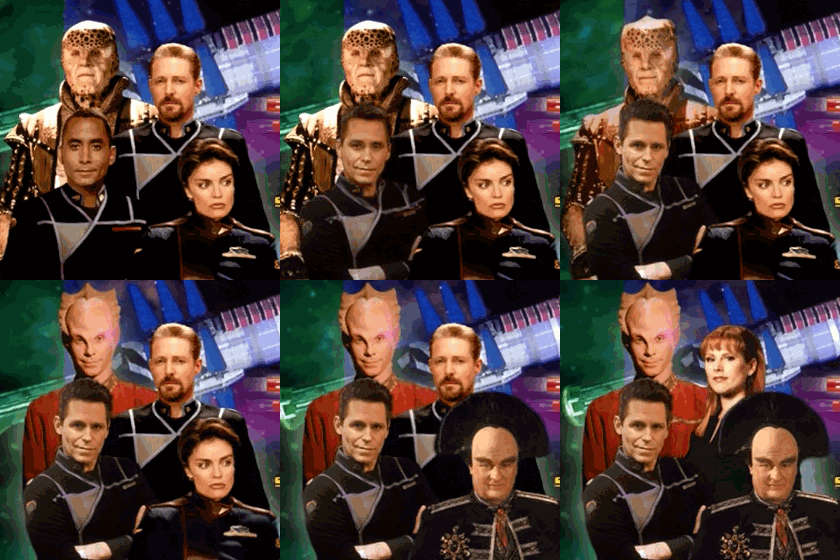
Below is a list of my top five (5) favorite episodes from Season Five (1998) of "BABYLON 5". Created by J. Michael Straczynski, the series starred Bruce Boxleitner, Mira Furlan, Jerry Doyle and Tracy Scoggins: 


TOP FIVE FAVORITE EPISODES OF "BABYLON 5" (SEASON FIVE: "THE WHEEL OF FIRE")

5 - 5.04 A View from the Gallery

1. (5.04) "A View from the Gallery" - An attack on Babylon 5 by an alien race is witnessed by two maintenance workers, Mack and Bo, as they work to keep the station running in this entertaining episode.


2 - 5.11 Phoenix Rising

2. (5.11) "Phoenix Rising" - The standoff between Babylon 5's personnel and the new group of telepaths holding the inhabitants of Med Lab hostage deteriorates into bloodshed and tragedy when Psi Corp cop Alfred Bester arrives. Centauri ambassador Londo Mollari and G'Kar discover an old friend in the Centauri Royal Court.


3 - 5.18 The Fall of Centauri Prime

3. (5.18) "The Fall of Centauri Prime" - As Interstellar Alliance President John Sheridan races to stop the Alliance ships from attacking Centauri Prime, thanks to the presence of former Shadow allies, the Drakh; the fate of Londo and the other Centauri is decided.


1 - 5.09 The Ragged Edge

4. (5.12) "The Ragged Edge" - In this interesting episode, head of the Interstellar Alliance Intelligence Michael Garabaldi's relapse into alcoholism jeopardizes an important covert mission to the Drazi homeworld. G'Kar discovers that he has become a religious leader to the Narn.


4 - 5.08 Day of the Dead

5. (5.08) "Day of the Dead" - Babylon 5 unknowingly participates in the Brakiri's "Day of the Dead" festival, in which individuals like Garibaldi, Londo and new station commander Captain Elizabeth Lochley are visited by the deceased from their past. Famous entertainers Rebo and Zooty also visit the station. A very poignant episode.


12_garibaldi_picture_no_2

R.I.P. Jerry Doyle (July 16, 1956 – July 27, 2016)

Wednesday, September 30, 2015

"BABYLON 5" RETROSPECT: (1.11) "Survivors"

111_cap623


"BABYLON 5" RETROSPECT: (1.11) "Survivors"

For the first time during its five-season run, the award-winning science-fiction series, "BABYLON 5", focused on the major supporting character of Security Chief Michael Garibaldi. The name of the episode was Season One's (1.11) "Survivors". And I never realized until now, how much it foreshadowed future events in the series' major story arc, until recently. 

"Survivors" begins with the news network, ISN, announcing President Luis Santiago's intention to pay a visit to Babylon 5 during his tour of Earth Alliance outposts. The president also intends to present a new wing of starfuries (fighter planes) to the station. While Garibaldi and Babylon 5's second-in-command, Lieutenant-Commander Susan Ivanova, discuss Santiago's upcoming visit, the station is rocked by an explosion inside its Cobra landing bay. An injured crewman named Nolan is tended in Medlab by medical officer, Dr. Stephen Franklin; while Garibaldi, Ivanova and Commander Jeffrey Sinclair (the station's commanding officer) discuss the possibility of sabotage. Santiago's security detail, led by one Major Lianna Kemmer, arrives on Babylon 5. Kemmer, who knew Garibaldi when she was a child, treats him coldly and demands that her detail investigate the Cobra Bay explosion. She and her aide Cutter, interrogate the badly wounded Nolan against Dr. Franklin's wishes and manages to extract one name from him - Garibaldi's - before his death. Kemmer demands that Sinclair put Garibaldi on suspension. And when Cutter finds the Cobra Bays blueprints and a bag of Centauri ducats inside Garibaldi's quarters, Kemmer tries to arrest the security chief. But the latter makes his escape and tries to learn who had framed him.

Judging from the episode's initial plot, one might be led to wonder what the title had to do with it. I mean . . . "Survivors" . . . in a tale about a political assassination plot? Once the episode moved into the details of Garibaldi's history with Lianna Kemmer, I understood . . . completely. Babylon 5's security chief had been a twenty-something Earthforce security guard at the ice-mining station on Europa, when he first met a shuttle pilot named Frank Kemmer and his family. Garibaldi had also developed a drinking problem to deal with the strains of working at the station. Garibaldi managed to make a few enemies on Europa, who decided to retaliate by rigging his friend's shuttle pod to explode. Frank Kemmer was killed, Garibaldi was blamed and retreated further into the bottle. He eventually became estranged from Frank's wife and daughter, Lianna, when he left Europa without any further word to them. Lianna grew resentful and angry over Garibaldi's disappearance from the Kemmers' lives. This continuing resentment spilled over into her willingness to quickly assume his guilt on the word of a dying terrorist. The presence of Lianna brought back painful memories of Europa for Garibaldi. His situation grew even worse after being named as a collaborator in the bombing and stripped of his position on the station. Once viewers became of Garibaldi's history with Lianna, it became easy for me to see that the episode's title referred to both characters.

I read a few reviews of "Survivors" online and noticed that most critics seemed to regard this episode as either a filler or an opportunity to flesh out the Michael Garibaldi character. On a certain level, they might be correct. The events of "Survivors" were never referred to again in the few episodes that followed, aside from a brief mention of the Cobra Bay bombing and President Santiago's visit. And yet . . . I noticed something else. This episode also featured some major foreshadowing that not only played out by the end of this first season, but also as late as Season Five. One of the episode's foreshadows featured Garibaldi's alcoholism, which will rear its ugly head in future episodes. Many fans have never been able to deal with it. They were barely able to tolerate his alcoholism, as long as he was able to overcome it by the end of this episode. But when he succumbed to it again, they complained. Loudly. Apparently, they could not deal with him succumbing to it . . . again. And I never understood their attitude. Surely, they understood the struggles for any addict not to succumb again. But it seemed as if they could not deal with a guy like Garibaldi possessing such a major problem in the first place.

I must admit that it was interesting to watch someone like Garibaldi, an authority figure who knew more about the in and outs of Babylon 5 than anyone else, find himself stripped of his authority, neutralized from his friends and hunted down by an authority higher than the station's commander, Sinclair. What made it even more interesting is that Garibaldi's situation led him back to the bottle and at his lowest, before he could climb out of the gutter. It was also interesting to watch both Sinclair and Ivanova try their best to help Garibaldi. The commander came to Garibaldi's rescue in a brief, yet rousing fight; while the latter was being beaten down by bounty hunters. And I found Ivanova's subtle, yet brief threat to Lianna, when the latter tried to enforce her authority in the station's Command and Control Center rather amusing. But in reality, there was very little they could do. It was Garibaldi who had to climb out of the bottle, do his own investigation and convince Lianna that he was an innocent man.

"Survivors" featured solid performances from the likes of Michael O'Hare, Claudia Christian, Richard Biggs, Tom Donaldson, David L. Crowley, Andreas Katsulas and Peter Jurasik. But the real stars of this episode were Jerry Doyle as Garibaldi and Elaine Thomas as Lianna Kemmer. At first, I was not that sure about Thomas. She seemed stiff and a little uncomfortable in her early scenes. But once her character's determination to hunt down Garibaldi became prominent, Thomas really grew into the role. And she did a marvelous job in her final scene. Jerry Doyle gave an outstanding performance as the increasingly besieged Garibaldi. Not only was he very effective in portraying his character's growing desperation to escape the situation he found himself in, Doyle was surprising effective in portraying Garibaldi's alcoholism. And I have noticed that portraying a drunken character does not seemed to be an easy thing to do.

I would never count "Survivors" as one of my favorite "BABYLON 5" episodes. I would not count it as one of my favorite Michael Garibaldi episodes. But I must admit that I have always managed to enjoy myself, while watching it. Unlike many other "BABYLON 5" fans, I have never been put off or outraged over the show's portrayal of Garibaldi's alcoholism. It gave Jerry Doyle an opportunity to really strut his stuff. And show runner J. Michael Straczynski managed to reap narrative gold out of this character trait - not only in this episode but also in future ones.

Friday, August 14, 2015

Top Five Favorite Episodes of "BABYLON 5" (Season Four: "No Surrender, No Retreat")

4seasonCast

Below is a list of my top five (5) favorite episodes from Season Four (1996-1997) of "BABYLON 5". Created by J. Michael Straczynski, the series starred Bruce Boxleitner, Claudia Christian, Jerry Doyle and Mira Furlan:


TOP FIVE FAVORITE EPISODES OF "BABYLON 5" (SEASON FOUR: "NO SURRENDER, NO RETREAT")

1- 4.15 No Surrender No Retreat

1. (4.15) "No Surrender, No Retreat" - Provoked by EarthForce President Clark's latest actions, former Captain John J. Sheridan leads the White Star fleet against EarthForce to liberate Proxima 3.


2 - 4.17 The Face of the Enemy

2. (4.17) "The Face of the Enemy" - Thanks to his new employer, CEO William Edgars, former Security Chief Michael Garibaldi is faced with the decision of whether or not to betray Sheridan to EarthForce. Babylon 5's Dr. Stephen Franklin and telepath Lyta Alexander arrive on Mars with a cargo of frozen telepaths for the final battles in the Earth Civil War.


3 - 4.05 The Long Night

3. (4.05) "The Long Night" - Sheridan make plans for the final strike against the Shadows and the Vorlons during the Shadow War. Meanwhile, Centauri Prime Ambassador Londo Mollari and his aide, Vir Cotto, make the final plans for assassinating Emperor Cartagia.


4 - 4.20 Endgame

4. (4.20) "Endgame" - Following his rescue by Garibaldi, Franklin and Lyta; Sheridan leads the final assault against President Clark's forces with the help of his rescuers and the Mars Resistance.


5 - 4.14 Moments of Transition

5. (4.14) "Moments of Transition" - During the last days of the Minbari Civil War, the Warrior Caste demands the surrender of Ambassador Delenn and the Religious Caste. Meanwhille, Psi cop Alfred Bester makes an offer to an increasingly desperate Lyta and Sheridan receives horrible news from Ivanova.


HM - 4.06 Into the Fire

Honorable Mention: (4.06) "Into the Fire" - Sheridan stages a final showdown between the Vorlons and the Shadows at Coriana 6 toward the end of the Shadow War.

Saturday, September 13, 2014

"BABYLON 5" RETROSPECT: (2.16) "In the Shadow of Z'ha'dum"


babylon5-216_0719


"BABYLON 5" RETROSPECT: (2.16) "In the Shadow of Z'ha'dum"

About eighteen months ago, I had posted a list of my favorite Season Two episodes from the 1993-1998 syndicate series,"BABYLON 5". And one of those episodes happened to be (2.16) "In the Shadow of Z'ha'dum". For the sake of sentiment, I recently re-watched the episode to see if my views on it had changed. 

The series' second season - titled "The Coming of Shadows" - introduced a new character to the "BABYLON 5" universe. Captain John J. Sheridan first appeared in the season's premiere episode, (2.01) "Points of Departure" to replace Babylon 5's first commanding officer, Commander Jeffrey Sinclair. Like the latter, Captain Sheridan was a veteran of Earth Alliance's last major conflict, the Earth-Minbari War, which was fought over a decade before the series' setting. Sheridan was the only Earth military commander who scored a major victory over the Minbari, who possessed superior forces and weapons. Sheridan was also a married man, who became a widower following the death of his wife, Anna Sheridan. Two years earlier, Anna was killed while serving as a member of a planetary expedition aboard a ship called the Icarus for a mission to explore an obscure planet called Z'ha'dum.

The episode (2.02) "Revelations" dealt with Sheridan allegedly coming to terms with Anna's death. But the events of "In the Shadow of Z'ha'dum" proved otherwise. The story began with the arrival of a Human named Mr. Morden to Babylon 5. Following his first appearance in the Season One episode, (1.13) "Signs and Portents", Mr. Morden managed to form an alliance with Ambassador Londo Mollari of Centauri Prime. Using his connections with an ancient and powerful race of aliens known as "the Shadows" - whose homeworld happened to be Z'ha'dum, Morden helped the Centauri deal with its main enemy, the Narns. During Morden's latest visit to Babylon 5, Security Chief Michael Garibaldi unintentionally identifies him as a regular visitor to the station during a private conversation with Sheridan. When the captain realizes that Morden had been a member of the Icarus expedition that led to Anna's death, he has the man arrested and placed in a holding cell. Sheridan becomes obsessed with learning about the details of Anna's fate; and also the details behind Morden's survival and failure to inform Earth Alliance. This obsession leads the good captain to break security rules, alienate members of command staff and attract the attention of the Centauri, Minbar and Vorlon ambassadors.

During my latest viewing of "In the Shadow of Z'ha'dum", I tried to pinpoint what I did not like about it. I managed to find one aspect that struck me as unappealing. Sheridan's manipulation of resident telepath Talia Winters' only meeting with Morden struck me as rather forced. David J. Eagle's direction and Christopher Franke's score tried a little too hard in making this scene dramatic by amping up the suspense. The scene's build up struck me as over-the-top that it almost overshadowed the pay-off of Talia and Morden's actual meeting. It is a flaw I have spotted in other "BABYLON 5"episodes - even in some of its best.

"In the Shadow of Z'ha'dum" may not have be perfect, but I believe it might be one of the best episodes of Season Two . . . and in the entire season. The ironic thing is that hardly any action occurred in this episode, aside from a well deserved slap that Sheridan received from Talia. And yet, "In the Shadow of Z'ha'dum not only helped drive the series' main narrative forward, it also foreshadowed two major story arcs in future episodes - Sheridan's conflict with the Shadows and Garabaldi's role as Babylon 5's security chief. It also foreshadowed a minor plot - namely Morden's future fate. These story lines are major examples of series creator J. Michael Straczynski's use of foreshadow in his writing. And as far as I am concerned, no one else did it better other than George Lucas for his "STAR WARS" movie franchise.

However, I believe the best thing about "In the Shadow of Z'ha'dum" was the development of the John Sheridan character. Many fans had not been pleased when Bruce Boxleitner replaced the late Michael O'Hare, who portrayed Jeffrey Sinclair, as the series' new leading man. They accused the Sheridan character of being lightweight and dubbed him with the nickname of "Captain Smiley". Personally, I never had any problems with Sheridan before this episode. But this is the first time the series ever focused upon the negative aspects of Sheridan's character. And I found it very interesting. "Revelations" had revealed that Sheridan had yet to recover from his wife's death. "In the Shadow of Z'ha'dum" revealed that Sheridan's inability to recover from his grief brought out the worst of him - his temper, his penchant for brooding, his stubborness, his talent for manipulation and most importantly, his ruthlessness. Sheridan's reputation as "Captain Smiley" disappeared after this episode. For good.

The episode also featured a minor story line regarding the arrival of an Earth Alliance official named Pierce Macabee. The latter represented Earth Alliance's Ministry of Peace, which served as a security and propaganda machine for President Morgan Clark's administration. Macabee arrived at Babylon 5 to recruit the station's crew into Earth Alliance's new paramilitary organization, Nightwatch. These members were instructed to uncover and report on what they perceived to be "subversive" activities - namely open criticism and defiance of Clark's Administration. This story line was introduced in such a subtle manner that it almost seemed like afterthought. Almost. It allowed audiences to hear Macabee's speech about Nightwatch and watch him recruit some of the station's crew - including Zack Allen, who served with Babylon 5's security force under Garibaldi. Although Zack joined Nightwatch simply to earn extra credits, his decision will prove to have a major impact upon the series' main narrative, early in Season Three. The Nightwatch story arc proved to be another example of Straczynski's talent for using a minor story line as foreshadow. Very few writers and producers seemed capable of using this narrative device with any strong effect. Pity.

"In the Shadow of Z'ha'dum" also featured some first-rate performances. Regular cast members such as Claudia Christian, Mira Furlan, Jerry Doyle and Richard Biggs gave strong supportive performances. Although I was critical of the scene featuring Talia Winters' encounter with Mr. Morden, I certainly had no problems with Andrea Thompson's performance. The actress did an excellent job in conveying Talia's horror and later, outrage over Sheridan's actions. Jeff Conway really made the role of Zack Allen his own in this particular episode. I have always believed that one aspect that made a performer a first-rate screen actor or actress, is his or her ability to react to other characters. Conway was very effective in utilizing this acting tool in his scenes with Boxleitner and Doyle. And his performances in scenes with certain supporting characters struck me as effective and subtle at the same time. Especially in one scene in which Zack arrested Mr. Morden. I also have to commend Alex Hyde-White for his guest-starring turn as Nightwatch recruiter, Pierce Macabee. He did a superb job in projecting the Ministry of Peace's menace with such subtle charm.

Ed Wasser, who made such an impression as the quiet, yet menacing agent for the Shadows - Mr. Morden - in previous episodes, continued his excellent work in this episode. However, "In the Shadow of Z'ha'dum" also featured other dimensions to Morden's personality - fear, surprise and impatience - that Wasser conveyed with great skill. I especially enjoyed his work with both Stephen Furst and leading man Bruce Boxleitner. I have always been a fan of Furst since I first saw him in the 1978 comedy, "ANIMAL HOUSE". His time on NBC's "ST. ELSEWHERE" and "BABYLON 5" revealed his talent for dramatic acting. Furst effectively combined his skills for both drama and comedy in one particular in which Centauri Ambassador Aide Vir openly expressed his dislike for Morden. It is one of my favorite moments from the series.

Although the "Captain Smiley" nickname for the John Sheridan character disappeared after "In the Shadow of Z'ha'dum"first aired on television, Bruce Boxleitner's reputation as an actor suddenly gained momentum among the series' fans. I do not understand why. I have seen Boxleitner portray the darker aspects in previous roles very effectively. But I must say that I believe his performance in this episode may end up being regarded as one of his best. Boxleitner was superb as a ruthless Sheridan, obsessed with not only learning the truth about his wife's death, but also Morden's survival and revenge. It is a pity that the Emmys rarely acknowledge excellent acting or writing in the Science-Fiction/Fantasy genre.

"In the Shadow of Z'ha'dum" may not be my favorite Season Two episode from "BABYLON 5". But it is definitely my second favorite. And it is certainly one of my favorite episodes of the series. J. Michael Straczynski wrote an excellent episode about the consequences of grief for the series' main character. Thanks to fine writing, first-rate direction and excellent performances from a talented cast - especially series lead Bruce Boxleitner.

Sunday, January 6, 2013

Top Five Favorite Episodes of "BABYLON 5" (Season One: "Signs and Portents")


Below is a list of my top five (5) favorite episodes from Season One (1994) of "BABYLON 5". Created by J. Michael Straczynski, the series starred Michael O'Hare, Claudia Christian, Jerry Doyle and Mira Furlan:


TOP FIVE FAVORITE EPISODES OF "BABYLON 5" (SEASON ONE: "SIGNS AND PORTENTS")


1. (1.13) "Signs and Portents" - In this episode, a Centauri noble comes to Babylon 5 to transport an important Centauri relic in Londo's possession back to the homeworld. And a mysterious man named Mr. Morden visits all the alien ambassadors in order to ask them an unusual question.


2. (1.08) "And the Sky Full of Stars" - Commander Jeffrey Sinclair, commanding officer of Babylon 5,  is kidnapped and interrogated by two war veterans determined to prove that he had betrayed Earth at the Battle of the Line, during the Earth-Minbari War.


3. (1.20) "Babylon Squared" - The previous Babylon station, Babylon 4, reappears at the same place it had disappeared four years earlier. Sinclair and Garabaldi lead an evacuation team for the station's crew. The story concludes in Season Three. Meanwhile, Ambassador Delenn is summoned by the Grey Council, the ruling body of Minbar; and is asked to become the new leader.


4. (1.22) "Chrysalis" - In the season finale, Delenn commences upon a physical transformation, Ambassador Londo Mollari of Centauri Prime receives an offer from the mysterious Mr. Morden to deal with a problem regarding the Narns, and Security Chief Michael Garabaldi uncovers a deadly conspiracy against the President of Earth Alliance.


5. (1.12) "By Any Means Necessary" - Following a fatal accident in the station's docking bay, an increasingly exhausted Sinclair is forced to deal with a potential labor uprising.  And Ambassador G'Kar of Narn seeks a replacement G'Quan-Eth plant for an important religious ceremony.


Honorable Mention:  (1.06) "Mind War" - Officers from Earth's Psi Corp arrive at the station to capture commercial telepath Talia Winters' old Psi Corps instructor, who was recently enhanced.  Sinclair's lover, independent planetary surveyor Catherine Sakai, is warned not to survey a sector of space by G'Kar.