Showing posts with label chadwick boseman. Show all posts

Tuesday, September 18, 2018

"THE AVENGERS: INFINITY WAR" (2018) Review

kinopoisk.ru-Avengers_3A-Infinity-War-3143614


"THE AVENGERS: INFINITY WAR" (2018) Review

After ten years and eighteen films, the Marvel Cinematic Universe (MCU) finally released "THE AVENGERS: INFINITY WAR". The movie represented the first half of a culmination of the previous films that either focused or touched upon the super-villain Thanos' attempt to attain possession of a collection of powerful gems known as the Infinity Stones. 

Although 2008's "IRON MAN" signaled the beginning of the MCU franchise and the introduction of the latter's collection of comic book heroes/heroines, supporting players and villains; I believe that the true beginning of this story arc involving Thanos and the Infinity Stones began in 2011 with two movies - "THOR" and "CAPTAIN AMERICA: THE FIRST AVENGER". The former introduced the Tesseract, a cube that contained the Infinity Stone known as the Space Stone, in its post-credit scene. However, the Space Stone was more fully explored in the second 20111 movie, "CAPTAIN AMERICA: THE FIRST AVENGER". After 2011, most of the Infinity Stones were either introduced, explored or both in the MCU movies that followed. Only one stone made its introduction in "INFINITY WAR" - the Soul Stone.

Before I find myself wallowing into an essay about the Infinity Stones, let me continue with this review. "THE AVENGERS: INFINITY WAR" began several minutes after 2017's "THOR: RAGNAROK" left off. Thanos had caught up with the Asgardian refugee ship and with the help of his minions, inflict considerable damage upon the survivors and their new king, former Avenger Thor. Why? Apparently, before their flight from Asgard's destruction, Thor's adopted brother, Loki, had taken the Tesseract, which had been inside Asgard's royal vault. After killing half of the Asgardian survivors (the other half had managed to escape), Asgard's gatekeeper Heimdall, beating Thor and killing Loki; Thanos took the Space Stone and blew up the ship. It turned out that the Tesseract was the second Infinity Stone that Thanos managed to acquire. Before the events of this film, Thanos and his minions had attacked and destroyed half of Xandar homeworld before he managed to get his hands on the Power Stone, last seen in 2014's "GUARDIANS OF THE GALAXY". And before Heimdall was killed, he used Asgard's Bifrost sword to transport a beaten Dr. Bruce Banner aka the Hulk to warn the Avengers and Earth about Thanos' campaign to collect the Infinity Stones. Meanwhile, the Guardians of Galaxy come across Thor's body floating in space and rescue him. Thanks to Heimdall's actions, along with the Guardians' rescue of Thor; the movie's main protagonists become aware of Thanos' current campaign to hunt down the remaining Infinity Stones and set about preventing him from raining more destruction upon the universe.

What can I say about "THE AVENGERS: INFINITY WAR"? When I first heard about the movie's premise, I immediately felt that the only way this would work was if the narrative was set up in the same style as war films like "THE LONGEST DAY" or "A BRIDGE TOO FAR". You know . . . blockbuster combat films about a particular battle or campaign that featured an all-star cast. Despite being a comic book movie, "THE AVENGERS: INFINITY WAR"proved to be exactly just that. The movie's narrative centered around most of the MCU's protagonists trying to prevent Thanos from collecting all of the Infinity Stones and carrying out his plan to eradicate half of the universe's population in order to prevent the decrease of essential resources. And more importantly, the screenplay written by Christopher Markus and Stephen McFeely almost hit the right note when it tried to maintain a balancing act between the franchise's numerous stars. And considering that this movie was all about Thanos' efforts to utilize the stones in the first place, it seemed quite apparent that he proved to be the movie's main character. And personally, I feel that was the right thing to do.

In fact, some of the film's best scenes and story arc had a lot to do with Thanos . . . and especially his relationship with his adoptive daughters, Gamora and Nebula. Thanos' relationship with the latter seemed just as straight-forward as she had described it in 2017's "GUARDIANS OF THE GALAXY, VOL. 2". It seemed perfectly clear that Thanos did not give a rat's ass about Nebula, especially since he seemed to display no remorse or hesitation to use her life as a bargaining chip for the location of the Soul Stone. Thanos' relationship with Gamora, on the other hand, seemed to be a different and murkier kettle of fish. Some fans have debated on whether he truly loved Gamora. I believe he did, in his own warped way, as the following image depicted:


And the tears that Gamora had shed, when she thought she had killed him on Nowhere made it pretty obvious that she harbored feelings for him, as well. By the end of the movie, it seemed pretty obvious that Thanos loved his crusade to "save" the universe from overpopulation a lot more than Gamora . . . to the point that he was willing to sacrifice her life for possession of the Soul Stone. I have to give screenwriters Christopher Markus and Stephen McFeely credit for portraying Thanos as a very complex character. Do not get me wrong. I do not regard Thanos as the best MCU villain in the franchise so far. I simply found his different relationships with adoptive daughters Gamora and Nebula a lot more interesting than his goal with the Infinity Gauntlet.

The film featured other story arcs that I found interesting. I have mixed feelings about Thor's story arc. On one hand, I managed to spot several plot holes in his narrative. On the other hand, it was a relief to see the new Asgardian king finally face the emotional consequences of the losses he had sustained in not only this film, but also "THOR: RAGNAROK". Thanks to Gamora's connection to Thanos, "INFINITY WAR" served the main protagonists very well. Audiences finally got to see Gamora and Peter Quill aka Star-Lord declare their love for one another. Rocket managed to form a new bond with Thor, of all people . . . and lose another close bond. "INFINITY WAR" also saw the development of the romance between Wanda Maximoff aka Scarlet Witch and Vision and how Thanos' search for the Infinity Stones affected that relationship. The movie paid scant attention to the Sokovia Accords, which I did not find surprising. But two satisfying developments came from the brief mention of the agreement, when James "Rhodey" Rhodes aka War Machine expressed is deep regret for signing the Sokovia Accords, along with his refusal to obey Thaddeus Ross' order for the arrests of Steve Rogers, Natasha Romanoff, Sam Wilson and Wanda Maximoff. For me, it was Don Cheadle's finest moment in the MCU franchise. 

"INFINITY WAR" also featured some pretty interesting action sequences. I can count at least XX of them as among my favorites. One of them included a conflict on the streets of Manhattan in which the two sorcerers Dr. Stephen Strange and Wong, Tony Stark aka Iron Man and Peter Parker aka Spider-man battled against one of Thanos' adopted children, Ebony Maw. The battle ended with Strange being kidnapped, due to his possession of the Time Stone. I thought it was well-handled. However, I find it odd that both Strange and Wong had difficulty with a being who was basically a telekinetic. Another battle I found interesting was Strange, Iron Man and Spider-man's first meeting with Star-Lord, Drax and Mantis on Thanos' homeworld, Titan. Although I found it enjoyable, I also found it odd, considering that of all the Guardians, Star-Lord did most of the work against the travelers from Earth . . . and succeeded. I do not know what to say about the battle that unfurled in Wakanda. On a visual level, I found it spectacular. And there were some good moments like Scarlet Witch's encounter with Thanos; the arrival of Thor, Rocket and Groot; and the brief interaction between Rocket and James "Bucky" Buchanan during the battle. But overall . . . I simply cannot decide whether I loved it or simply tolerated it. Perhaps I loved some parts of it.

As for the movie's visual effects . . . they were okay. There were a few spectacular scenes. I was especially impressed by Ebony Maw's arrival in Manhattan, as shown in the following image:


And I really enjoyed Thor's initial arrival on Wakanda, in which he killed a good number of Thanos' forces:


But overall, I was not particularly dazzled by the film's visual effects.

No movie is perfect. And I can honestly say that about "THE AVENGERS: INFINITY WAR". When I first learned that so many of the franchise's past characters - especially the costumed heroes - would be featured in this film, my first reaction was wariness. After seeing the movie twice, I believe my initial wariness was justified on a certain level. I will re-phrase my original assessment of the movie - I enjoyed it. I enjoyed it enough to see it at the movie theaters twice. But, "INFINITY WAR" had its problems. And one of those problems proved to be the numerous protagonists that filled the narrative. But wait? Did I not earlier praise the MCU and the screenwriters for creating a narrative that was similar to all-star movie epics like "THE LONGEST DAY" and "A BRIDGE TOO FAR". Yes, I did. But this narrative style still threatened to spiral out of control. There was no real balance in how McFeely and Markus treated the film's characters. Not really. A good number of the characters - including major ones - were more or less treated as guest stars in this film. 

Most of the characters who had rebelled against the Sokovia Accords - Captain America, Falcon, Black Widow, Winter Soldier, Ant-Man and Hawkeye - were not utilized very often. A major character like Captain America had finally been reduced to a guest star. Falcon, Black Widow and Winter Soldier barely had any lines. And both Ant-Man and Hawkeye were missing in this film. Only the Scarlet Witch seemed to have a larger role and that was due to her being the romantic interest of Vision, who had one of the Infinity Stones embedded into his forehead. I was also amazed how even Iron Man, Doctor Strange and Spider-man seemed to have disappeared and re-appear for a long stretches of time, following their departure from Earth aboard Ebony Maw's ship. And why did the film's screenplay not allow Wong to accompany them on the journey to Thanos' homeworld, Titan. Hell, the inhabitants of Wakanda - Black Panther aka King T'Challa, Okoye, M'Baku and Princess Shuri - seemed to minor players in this film, considering that a major battle was fought within their country's borders near the film's finale. Both Samuel L. Jackson and Cobie Smulders managed to appear as former S.H.I.E.L.D. Director Nick Fury and his assistant Maria Hill in the film's only post-credit scene. In it, both had witnessed the impact of Thanos' Infinity Stones snap in Manhattan, before disappearing themselves. And before they did, Fury managed to send a message to a new Avenger - Captain Marvel aka Carol Danvers. That was it? Jackson and Smulders were used as a publicity scene for the upcoming Captain Marvel film? God, what a waste! 

I wonder if the reason why the focus on the characters struck me as so unbalance was due to them being scattered . . . all over the universe, really. The reason why movies like "THE LONGEST DAY" and "A BRIDGE TOO FAR" worked so well is that these films kept the focused on one particular setting - whether it were the beaches of Normandy, Frances and the surrounding countryside, or the stretch of road that encompassed three Dutch small cities. "INFINITY WAR"featured more settings than a James Bond movie and all of the major characters were scattered throughout those different locations on Earth and in space. Even a relative of mine found this rather convoluted. 

There were other aspects of the film's narrative that left me scratching my head. I do not know where to begin. Oh yes . . . the film opened with Thanos and his minions in control of Thor's ship (formerly owned by the Grandmaster), most of the inhabitants dead, Heimdall wounded and a bruised Thor a prisoner of Thanos. And all I could ask was . . . where was Valkyrie, along with former gladiators Korg and Miek? Where did they go? Were they dead? How did Thor, who was the new ruler of the remaining Asgardians and the new Allfather lose so easily against Thanos? As the new Allfather, he should have given Thanos and the "kids" a lot of trouble. I mean . . . not even Thanos' use of the Power Stone failed to kill Thor. Really? Why did the Hulk wait for Loki to introduce him like some damn circus act? I mean . . . the Hulk is not more powerful than Thor. He never really was, despite the MCU's effort to pretend otherwise. Why did Loki tried to kill Thanos with a dagger? A dagger? This is the being who managed to cast a mind spell on someone as powerful as Odin. Why did he not consider this, instead of attacking Thanos with a dagger? 

The next major scene featured Doctor Strange, Wong, Tony Stark and Peter Parker. Why was it so difficult for Doctor Strange and Wong to defeat Ebony Maw? The latter is an alien with a telekinetic ability. That was his ability . . . telekinesis. A psychic ability and nothing else. Strange and Wong were sorcerers. Which meant they had abilities beyond psychic ones. What happened? Why did they not use . . . magic? He was able to use magic to prevent Ebony Maw from getting his claws on the stone. Why not use magic to defeat Maw? Now that I think about it, Strange was also in possession of the Time Stone. Why did he not use it? And this was way before his ludicrous claim that there was only one out of 14 million chances in which to defeat Thanos. I call bullshit on this, for it seems nothing more than contrived nonsense to justify what happened later in the film. And why did Tony suggest that they continue traveling to Titan? To keep the battle for the Time Stone away from Earth? Ah, does this mean both Tony and Stephen had forgotten about the Mind Stone . . . which was with Vison . . . on Earth?

This movie was filled with characters making dumb decisions - from Gamora deciding to accompany Peter, Drax and Mantis to Knowhere, knowing that Thanos was there and she knew the location of the Soul Stone; to Peter Quill losing his shit and ruining the plan to trap Thanos on Titan after learning about Gamora's fate; to Steve suggesting they take Vision to Wakanda in order to remove the Mind Stone from the latter's head and keep him alive; to T'Challa giving them permission to land in Wakanda; to Thor losing his shit during the Wakanda battle and striking Thanos in an area that was bound to allow the Titan to live just a bit longer. Most fans have been dumping most of the blame on Star-Lord. Some of them, including the Russo Brothers, have dumped most of the blame for what happened in the end on Thor. I blame Thanos. As far as I am concerned, he made the dumbest decision to wipe away half of the universe's living beings for . . . what? To preserve the remaining living beings so that there were enough resources for everyone? This is a stupid plan. He could not think of anything else? Like providing more resources for the universe?

And there were other matters. Why did the empathic Mantis, who had failed to control the emotions of someone as powerful as Ego, failed to do so with Thanos? What was the point of including Secretary of Defense Thaddeus Ross in this story? To prove how useless and irrelevant the Sokovia Accords story arc truly was? When I learned that both Clint Barton and Scott Lang were under "house arrest" for violating the Accords in "CAPTAIN AMERICA: CIVIL WAR", I merely rolled my eyes in disgust. By the way, who was financing Steve, Natasha, Sam and Wanda's activities for the past two years? When did Wanda and Vision finally commenced upon their romance? You mean to say that after eighteen months or so (since the events of "SPIDER-MAN: HOMECOMING"), Tony and Pepper were still engaged? Where was Nakia? When did Gamora learn about the location of the Soul Stone? How did Johann Schmidt aka Red Skull survive 73 years after the Space Stone transported him to Vormir? Despite having the Dr. Erskine's formula in his blood, he was never frozen in stasis like Steve and Bucky. Why on earth was it necessary for Thor to go to Nidavellir to create the Stormbreaker axe to be used on Thanos? Why? He should have been powerful enough to take on the Titan on his own in the first damn place. Had McFeely and Markus forgotten that Thor was the new Allfather?

The real problem I have with "THE AVENGERS: INFINITY WAR" - aside from the plot holes - is that it is not that original to me. Not really. First of all, the idea of a villain plotting to to commit genocide for environmental reasons had played a major role in two recent movies - 2015's "KINGSMAN: THE SECRET SERVICE" and the 2016 movie, "INFERNO". Also . . . nearly a decade ago, I had created a series of "Charmed" Alternate Universe stories in which the Charmed Ones befriended another family of witches. Needless to say, among my stories featured a powerful demon who managed to kill most of the main characters, including two of the Charmed Ones. It was very similar to what happened to many of the characters in the film's finale. And guess what? The whole thing was resolved through the use of time travel - which I assume will be used in "AVENGERS 4". How can I be impressed with how McFeely, Markus and the Russo brothers ended the story for "INFINITY WAR", when I did something similar in a handful of fan fiction stories? What I found even more annoying about the film's ending is that most of Thanos' victims proved to be the MCU heroes and protagonists first introduced after "THE AVENGERS". Fury and Hill seemed to be the only pre-Phase II characters that were killed. And there were only a few post-Phase I characters like Rocket the Raccoon, Wong, Princess Shuri, Okoye and M'Baku, survived. Personally, I found it ridiculous that Marvel could not take the chance to kill off one or two of the original Avengers members.

I wish I could comment on all of the film's performances, but that would take forever. I will comment on those that caught my attention, both good and bad.  I have already commented on Don Cheadle's very satisfying performance.  The movie featured solid performances from those who had - to be honest - provided more memorable ones in past movies, like Mark Ruffalo, Gwyneth Paltrow, Benedict Wong, Idris Elba, Scarlett Johansson, Anthony Mackie, Chadwick Boseman, Winston Duke, Danai Gurira, Dave Bautista, Benedict Wong, Benicio del Toro, Jacob Batalon, William Hurt, Vin Diesel and Pom Klementieff. Robert Downey Jr. and Benedict Cumberbatch gave solid performances as well, but there were times when both actors seemed bent upon proving whose character was more irritating. Personally, I believe Letitia Wright won this contest in her portrayal of Wakanda's Princess Shuri. Wright's character came off as a bit overbearing in her effort to prove her technological knowledge against the likes of Bruce Banner. Tom Holland gave a charming performance as Peter Parker aka Spider-man, but I must admit that I found his last scene, in which Peter was disappearing after Thanos' "snap", a bit over-the-top. 

Both Elizabeth Olsen and Paul Bettany gave poignant performances as the pair of Avengers lovers Wanda Maximoff and Vision. Bradley Cooper gave a very funny voice performance as Rocket the Raccoon, especially in scenes in which the talking raccoon interacted with both Thor and Bucky Barnes. As for Sebastian Stan, I was more impressed by his last scene, as he conveyed Bucky's fear and panic, while disintegrating, with one word - Steve's name. Peter Dinklage gave a memorable performance as the gruff and sardonic Eitri, the giant dwarf (you have to see him to believe it) who created Thor's Stormbreaker axe. Karen Gillian's Nebula has come a long way since 2014's "GUARDIANS OF THE GALAXY"and I enjoyed how the actress managed to maintain the character's gruff exterior and at the same time, convey Nebula's deep affection for her sister Gamora. And then there was Chris Pratt, who did an exceptional job of portraying the emotional gauntlet that Peter Quill aka Star-Lord had experienced in this film. I was especially impressed by his performance in that tender scene in which Peter and Gamora conveyed their love for one another.

For me, the film's most valuable players proved to be Chris Hemsworth, Zoe Saldana and Josh Brolin. Like Pratt, Chris Hemsworth had the opportunity to convey Thor's emotional turmoil that the latter had experienced in both this film and "RAGNAROK". At the same time, Hemsworth was as charming as ever, while portraying Thor's more familiar and enduring traits. Zoe Saldana gave one of her best performances as one of the Guardians, Gamora, who finds herself torn between her determination to foil Thanos' plan to use the Infinity Stones and her lingering love and affection toward him. Frankly, I thought Saldana beautifully conveyed this emotional tightrope in one scene in which Gamora expressed her grief after believing she had killed her adoptive father. Although I found Thanos' plans to cull the herd of the universe's sentient beings rather stupid, I cannot say the same about Josh Brolin's portrayal of the homicidal super villain. Brolin gave a superb performance as the Titan, who not only proved to be ruthless and canny, but also affectionate and loving . . . in a twisted way. Frankly, I think Brolin deserve a major acting award nomination or two for his performance. I found him more effectively scary and complex in this film than I did in "GUARDIANS OF THE GALAXY".

It must seem pretty obvious that I do not have a high regard for "THE AVENGERS: INFINITY WAR". I do not believe that it is a terrible movie. In fact, it struck me as a pretty damn good movie. I thought the Russo Brothers, along with screenwriters Christopher Markus and Stephen McFeely and a first rate cast led by Josh Brolin created a memorable and entertaining film. But the movie seemed to be marred by a good deal of plot holes and questionable narrative decisions that have led me to wonder if this film might be overrated by so many movie critics and fans of the MCU. You know what? I believe it is. And yet . . . I would still recommend the movie for viewing.

Saturday, August 4, 2018

"BLACK PANTHER" (2018) Review

merlin_133187918_5fbcffdc-abaa-4e42-a938-24b9217b675c-master768


"BLACK PANTHER" (2018) Review

I am going to be brutally honest. For the past three years, I have harbored mixed feelings about the output from the Marvel Cinematic Universe (MCU). The year 2015 produced one movie that I found entertaining, yet disappointing; and another film that I found entertaining and original, but not exactly mind blowing. But the years 2016 and 2017 proved to be very disappointing, as far as MCU movies were concerned. By the end of 2017, I thought the MCU had finally lost its mojo . . . until I saw "BLACK PANTHER", early in the following year. 

I realize many might find my comments something of a head scratcher. What exactly was wrong with the MCU films between 2015-2017? Well . . . I thought "THE AVENGERS: AGE OF ULTRON" was entertaining, yet problematic. I enjoyed "ANT-MAN" very much, but I would never regard it as one of the franchise's best. The movies, starting with 2016's "CAPTAIN AMERICA: CIVIL WAR" and ending with 2017's "THOR: RAGNAROK", struck me as very disappointing and somewhat inferior. Despite the fact that the franchise was raking in millions - or billions - with these films, I personally believed it had reached an artistic abyss . . . until I saw "BLACK PANTHER". Not only did I find the latter film entertaining, I also regard it as one of the better MCU films I have seen in the franchise's ten-year history. With "BLACK PANTHER", it seemed the MCU had not only climbed out of the abyss, but had reached (or nearly reached) a pinnacle. 

"BLACK PANTHER" basically told the story about King T'Challa aka Black Panther adjusting to his role as the new sovereign of Wakanda, an isolated and fictional African nation that is the most technically advanced in the world, thanks to the vibranium metal within its borders. Wakanda has spent most of its existence pretending to be a poor, third-world nation in order to protect itself from the world - especially Western nations - and prevent them from learning about its rich source of vibranium. The narrative for "BLACK PANTHER" picked up at least a week after the events of "CAPTAIN AMERICA: CIVIL WAR". T'Challa and his premier bodyguard and leader of the Dora Milaje regiment, Okoye; extract Nakia, T'Challa's ex-lover and a Wakandan spy, from an undercover assignment in Nigeria. All three returned to Wakanda's capital to participate in T'Challa coronation as the new king. During the ceremony, the leaders of Wakanda's five tribes are each given the opportunity to challenge the temporarily de-powered (via a potion that expunges his super strength and speed) T'Challa's role as the new king by ritual combat. One of the leaders, M'Baku of the mountainous Jabari Tribe, challenges T'Challa. After a fierce fight, M'Baku concedes defeat and T'Challa is officially acknowledged as King of Wakanda. 

Unfortunately, T'Challa's triumph is short-lived when Wakanda intelligence becomes aware of a robbery committed by a group of thieves led by an old foe of the country's, Ulysses Klaue. The latter had stolen an old Wakanda artifact from a London museum that contains vibranium, a metal substance that has allowed Wakanda to become the most technically advanced nation in the world . . . unbeknownst to other nations. When Wakanda intelligence learns that Klaue plans to sell the vibranium to the C.I.A. at a location in Busan, South Korea; T'Challa, Nakia and Okoye travel there to interrupt the planned sale and arrest the arms dealer. Instead of arresting Klaue, T'Challa stumbles across a family secret involving one of Klaue's fellow thieves, an African-American named Eric Stevens aka Killmonger, which will threaten his position on the Wakanda throne and endanger the country itself. 

After being disappointed by five MCU movies in a row, I found myself wondering if I would ever enjoy a movie from the franchise again. Thankfully, "BLACK PANTHER" proved to be a more than pleasant surprise. Thanks to Ryan Coogler's direction and the excellent screenplay that he co-wrote with Joe Robert Cole, "BLACK PANTHER" proved to be a unique film that combined the usual elements of a comic book movie, a family drama and a rare exploration into the political and social aspects of the African diaspora.

Family drama is nothing new to the Marvel Cinematic Universe (MCU). Audiences have seen this played out in movies like the Thor trilogy, 2015's "ANT-MAN", and to a certain extent, 2008's "THE INCREDIBLE HULK""BLACK PANTHER" is another addition in which a deadly encounter between T'Challa's father and uncle - King T'Chaka and Prince N'Jobu in 1992, led to the new king learning about his cousin and N'Jobu's half-American cousin, Erik "Killmonger" Stevens aka Prince N'Jadaka. That 1992 encounter led to Erik becoming an orphan and abandoned by his isolationist uncle T'Chaka. This, in turn, led Erik to see revenge against the nation of Wakanda. Ironically, Erik never got the chance to exact his revenge on the very person responsible for his loss, namely his uncle, who was killed by Helmut Zemo's bomb in "CIVIL WAR". But for him, T'Challa and Wakanda served as a convenient scapegoat for his vengeance.

What made all of this even more fascinating and a lot more original than the MCU's other family dramas was how Coogler and Cole managed to mix a good deal of political controversy into this family saga. One of the reasons Prince N'Jobu had fallen out of favor with his older brother was his growing disenchantment with Wakanda's isolationist policy with the world - including those of the African diaspora around the world. After his experiences in late 20th century Oakland, N'Jobu decided to reveal Wakanda's existence to Ulysses Klaue and help the latter infiltrate Wakanda to smuggle out more vibranium. N'Jobu had planned to use the vibranium to create weapons and lead a revolution of the African diaspora against the dominating Western nations. With his father dead, Erik planned to not only get his revenge against the Royal House of Wakanda, but also carry out N'Jobu's plans. Watching this, I am reminded of Loki's plans in 2011's "THOR" - namely to keep a powerless Thor stranded on Earth, while he sets up the Frost Giants' destruction and win Odin's favor. As much I had enjoyed that movie, Loki's plans seemed rather lame to me in compare to Erik's. But what made this story arc even more interesting is that in the end . . . Erik's plans to use Wakanda weapons to conquer the world eventually led to T'Challa's decision to finally end Wakanda's isolationist policy.

"BLACK PANTHER" featured some pretty solid action sequences. I enjoyed the sequence featuring T'Challa and M'Baku's fight for the throne; Erik and Klaue's confrontation at an abandoned South Korean airfield; T'Challa and Erik's battle for the throne; and the Battle of Mount Bashenga, in which T'Challa and his forces attempted to prevent Erik and the Border Tribe from sending Wakanda weapons to the outside world. All are pretty good action sequences. But if I had to select my favorite, it would be the confrontation at the Busan casino between T'Challa, Nakia and Okoye against Klaue and his minions. With C.I.A. Agent Everett Ross thrown into the mix, this particular sequence was simply boss, especially since it lead to a wild car chase on the streets of Busan. That once scene featuring Okoye slamming her wig into the face of a Klaue minion will probably remain imprinted in my mind for years to come.

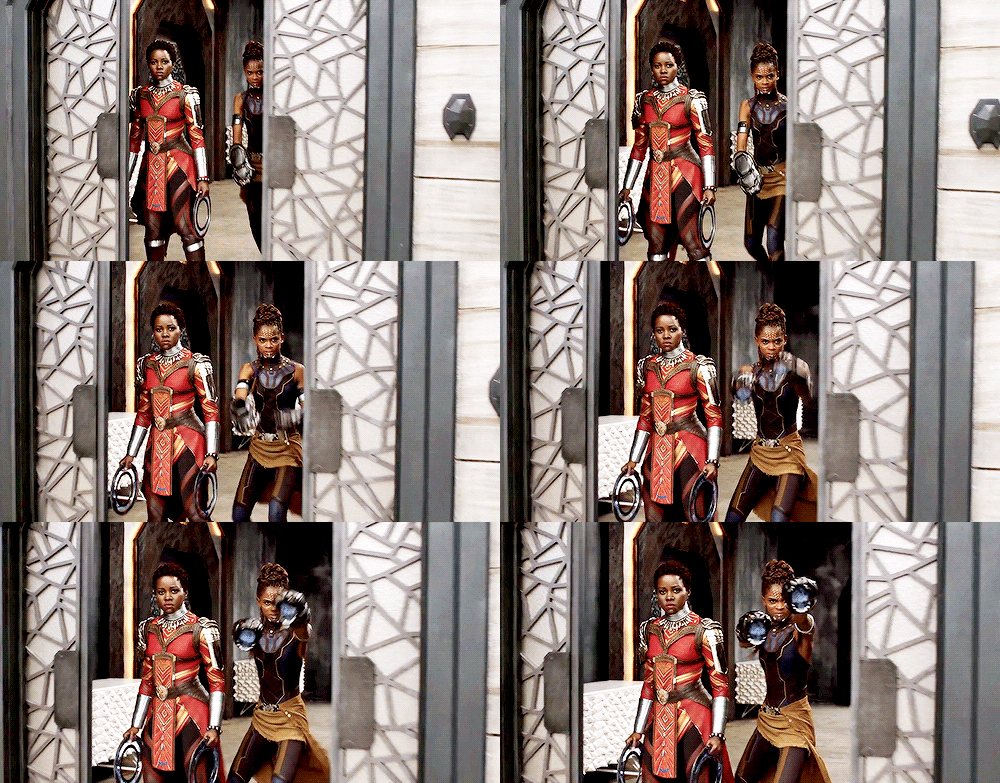
Another aspect of "BLACK PANTHER" that I admired was the film's production designs. Mind you, the film maintained that same flat photography that the MCU has become infamous for. However, I think Rachel Morrison's photography was enhanced by some sharp colors, the movie's visual effects, Hannah Beachler's gorgeous production designs that convey the world of Wakanda, along with the art direction team led by Alan Hook. Aside from Beachler's production designs, I was especially impressed by Oscar and Emmy nominee Ruth E. Carter's costume designs. Someone had compared them to those costumes featured in the 1988 comedy, "COMING TO AMERICA". But honestly . . . I think I prefer Carter's more natural designs, as featured in the images below:

  image

image


But all of the above would have meant nothing without the talented cast for the film. "BLACK PANTHER" featured some first-rate performances from the likes of Daniel Kaluuya, who portrayed Border Tribe leader W'Kabi, who desires his own personal vengeance against Ulysses Klaue; Sterling K. Brown as the revolutionary Prince N'Jobu; both John Kani and son Atandwa Kani as the older and younger versions of King T'Chaka; Angela Bassett as T'Challa's strong-willed, yet loving mother and advisor, Queen Ramonda; Denzel Whitaker, who gave a solid performance as the younger Zuri; and Martin Freeman as C.I.A. Agent Everett Ross, who proved to me more entertaining and relevant in this film than he was in "CAPTAIN AMERICA: CIVIL WAR".

However, there were those performances that really impressed me. One came from Andy Serkis, who was a hoot as the murderous, yet over-the-top South African arms dealer, Ulysses Klaue. Letitia Wright was equally entertaining as T'Challa's witty and charming sister, the tech-savy Princess Shuri. Another came from Lupita Nyong'o, who gave a passionate and heartfelt portrayal of Wakandan intelligence agent and T'Challa's former girlfriend, Nakia. Forest Whitaker gave a first-rate performance as Wakanda's top courtier and former spy, Zuri. Whitaker was especially impressive in one scene in which his character was forced to confess King T'Chaka's past actions regarding N'Jobu and Erik Killmonger. Winston Duke was very impressive, imposing and at times, rather amusing as M'Baku, leader of the mountainous Jabari Tribe. Also, his first appearance in the film - during T'Challa's coronation ceremony - is one of the most memorable moments I have seen in a movie for quite some time. Danai Gurira was equally impressive and imposing as Okoyo, the traditionalist leader of the king's bodyguards - the Dora Milaje. Although I found her character's conservatism a bit annoying at times, I must admit that Gurira gave one hell of a performance.

However, this movie is really about two characters - King T'Challa of Wakanda aka the Black Panther and his paternal cousin Erik "Killmonger" Stevens aka Prince N'Jadaka. Yes, I know that the movie is called "BLACK PANTHER". But to be honest, this movie is about both cousins and how their conflicting views on Wakanda's role in the world and especially upon the African diaspora. 

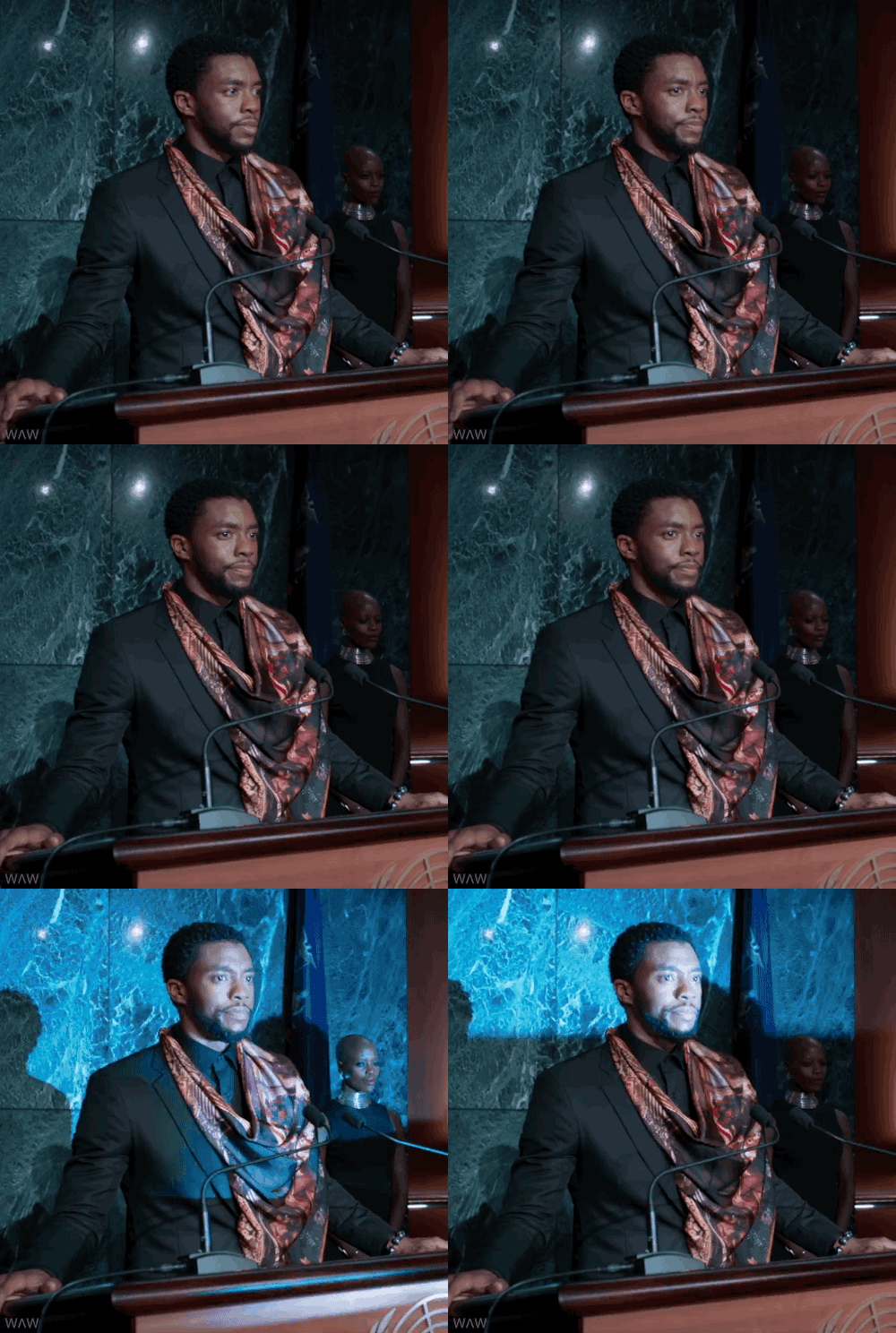
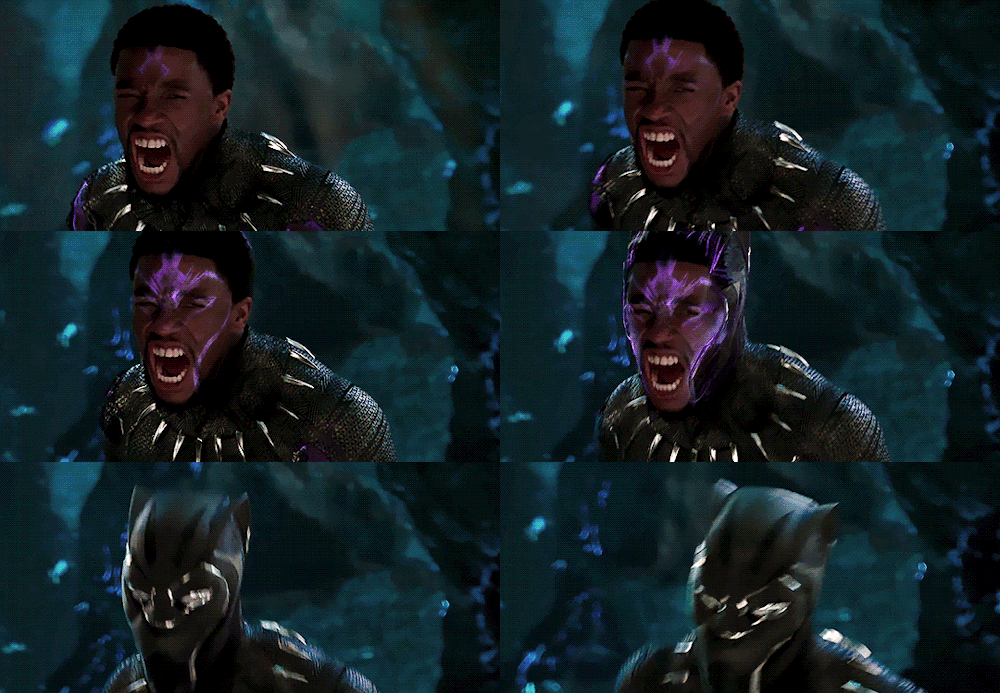
Chadwick Boseman's second turn as T'Challa proved to be a different kettle of fish from the driven newly ascended king determined to seek revenge for the death of his father, T'Chaka in "CAPTAIN AMERICA: CIVIL WAR". In this film, Boseman gave a more relaxed performance as the happy and more satisfied young king, eagerly anticipating, yet slightly fearing his new role as king. However, Boseman's relaxed performance skillfully transformed into one of disbelief, anger and outrage when T'Challa learned about his father's actions back in Oakland 1992. This was especially apparent in two scenes in which Boseman gave outstanding performances. The first scene featured his confrontation with Zuri, who confessed the true circumstances about Oakland. Boseman gave a very intimidating, yet regal performance in that scene. The other featured T'Challa's second dream in which he expressed anger and disappointment at his father's spirit for what happened to Erik. 

Speaking of the latter, Michael B. Jordan has been receiving rave reviews for his performance as Erik "Killmonger". Some have been declaring his character as the best MCU villain ever. I do not know if I agree with that assessment. But I must admit that Jordan gave one of the most skillfully ambiguous performances I have encountered in the franchise. Audiences could easily sympathize with his backstory - the young boy who had lost his parents and abandoned. Also, one cannot help but admired Erik's desire to help those African nations and members of the African diaspora - something that his cousin seemed unwilling to do. And yet, the level of violence Erik seemed willing to utilize in order to achieve his goal or his unwillingness to face that the one person who had truly wronged him was dead justified why the talented Jordan had portrayed him such ambiguity. 

As much as I enjoyed "BLACK PANTHER", I did have some problems with the film. One, there is a chance that I may have stumbled across a major writing blooper. In "CIVIL WAR", Avenger Wanda Maximoff aka the Scarlet Witch had accidentally killed a group of Wakanda subjects during a mission in Lagos, Nigeria. The Wakandans had been there on a goodwill mission. This lead King T'Chaka to publicly support the Sokovia Accords - an act that led to his death. And yet, Ryan Coogler and Joe Robert Cole made it clear in the 2018 movie's screenplay that Wakanda has practiced a policy of isolationism for centuries. Although Coogler and Cole remembered T'Chaka's death in the 2016 movie and Bucky Barnes' presence on Wakanda soil, they apparently forgot about this goodwill mission in Nigeria. Also, why did Erik Stevens wait so long to travel to Wakanda and make a bid for the throne? He could have challenged his uncle T'Chaka for the throne and get his revenge against the very man who had wronged him. Instead, he waited until after T'Chaka's death. Why? 

Exactly when did Steve Rogers and Bucky Barnes arrive in Wakanda, as shown in one of the post-title scenes in "CIVIL WAR'? The movie opened with T'Challa and Okoye returning to Wakanda for the first time since T'Chaka's death. Were both Steve and Bucky aboard T'Challa's plane? Were they aboard the Avenger jet that Steve had used to fly to Russia in the 2016 movie? Where were they? In fact, there was no scene featuring the pair's arrival in Wakanda for the first time, which I found rather odd. Speaking of arrivals, why was Okoye with T'Challa when he first returned to Wakanda? I realize that she was the leader of the Dora Milaje and that King T'Chaka was in Austria at the time of his death. But Okoye was missing in a scene from "CIVIL WAR" in which Avenger Natasha Romanoff aka Black Widow had sought T'Challa's help to track down Steve, Bucky and Sam Wilson aka the Falcon. As the king's leading bodyguard, she should have been there - whether with T'Chaka or T'Challa. Instead, another Dora Milaje bodyguard named Ayo (portrayed by actress/model Florence Kasumba) was there. Yet, the latter was missing aboard T'Challa's plane upon his return to Wakanda. One last question . . . why did T'Challa's closest friend, W'Kabi of the Border Tribe, seemed so willing to help Erik carry out his anti-isolationist policies? Why? I understand that he might be grateful to Erik for finally killing Klaue, the man who had killed his father years ago. But am I really to believe that his gratitude extended to supporting Erik's decision to end Wakanda's isolationist policy . . . especially since he had made it clear earlier in the film that he fully supported the old policy? Was he really that grateful to fight on Erik's behalf when T'Challa had returned alive to resume the challenge against Erik? I truly found this hard to believe.

And why was the only truly negative black character in this film was the only one of some American ancestry? There was something about the film's portrayal of African-Americans that struck me as rather negative and a bit one-dimensional. In this film, African-Americans seemed to consist solely of poor and slightly thuggish people barely capable of surviving on their own, except through criminal activities. The idea of Wakanda coming to their "rescue" with advanced technology made the latter country seem very similar to the White Savior trope. And if Wakanda was going to share their technology, why did T'Challa do so with the entire international community, instead of simply other African nations and the African diaspora . . . as Nakia had originally suggested? Considering that Erik had pointed out that many countries - especially in the West - were catching up technically with Wakanda, along with the international community's generally negative attitude toward African nations and those of the African diaspora; I cannot help but wonder if T'Challa had ever considered that many of the more wealthier nations would take advantage of his generosity at the first opportunity? Or was this plot twist something that Kevin Feige and the other Marvel/Disney suits had insisted that Coogler and Cole include? 

However . . . despite these misgivings I have about "BLACK PANTHER", I cannot deny that I truly enjoyed the movie. I did. I thought Ryan Coogler, along with screenwriter Joe Robert Cole and a talented cast led by Chadwick Boseman, did an exceptional job in bringing comic book hero the Black Panther and the world of Wakanda to life. At this moment, "BLACK PANTHER" has become one of my five favorite movies in the MCU franchise.


image

Thursday, July 26, 2018

"THE AVENGERS: INFINITY WAR" (2018) Photo Gallery

000

Below are images from "THE AVENGERS: INFINITY WAR", the nineteenth entry in the Marvel Cinematic Universe (MCU). The movie was directed by Anthony and Joseph Russo: 


"THE AVENGERS: INFINITY WAR" (2018) Photo Gallery

004


020


022


22THEPOST-superJumbo


023


025


033


036


037


038


077


081


082


083


98261


an-unseen-conversation-between-sisters-gamora-saldana-and-nebula-gillan-reveal-that-gamora-has-k


infinity-war12


kinopoisk.ru-Avengers_3A-Infinity-War-2652820


fury-3


kinopoisk.ru-Avengers_3A-Infinity-War-3090804


kinopoisk.ru-Avengers_3A-Infinity-War-3090809


kinopoisk.ru-Avengers_3A-Infinity-War-3090812


kinopoisk.ru-Avengers_3A-Infinity-War-3106645


kinopoisk.ru-Avengers_3A-Infinity-War-3143614


kinopoisk.ru-Avengers_3A-Infinity-War-3143615


kinopoisk.ru-Avengers_3A-Infinity-War-3143616


kinopoisk.ru-Avengers_3A-Infinity-War-3152125


logan-style-fan-trailer-for-avengers-infinity-war-focuses-on-the-relationship-of-thanos-and-gamora-social


sam-wilson-in-avengers-infinity-war-8b


fury-1

Monday, July 23, 2018

"MARSHALL" (2017) Review


“MARSHALL” (2017) Review
I have a confession. I had no interest in seeing the recent movie, “MARSHALL”, when I first heard about it. I thought it would turn out to be one of those solemn biography flicks about some “great man in history” and his struggles to become successful in his endeavors. But when I learned about the movie’s plot, I changed my mind and decided to see it. 
Directed by Reginald Hudlin, “MARSHALL” was about a “great man in history” – none other than the first African-American to be an Associate Justice of the U.S. Supreme Court, Thurgood Marshall. However, this film focused on his position as a defense counselor for and director of NAACP Legal Defense and Educational Fund and his role in the 1941 case of “the State of Connecticut v. Joseph Spell”.
Following the successful end of a case in Oklahoma in 1941, NAACP defense attorney Thurgood Marshall returns to New York City for a rest. However, his rest and reunion with his wife, Vivien “Buster” Burey, is short-lived when NAACP Director Walter Francis White sends him to Bridgeport, Connecticut to defend Joseph Spell, a chauffeur accused of rape by his white employer, Eleanor Strubing. In order to get Marshall admitted to the local bar and defend Spell, a local member of the Bridgeport NAACP office tries to recruit an insurance attorney named Sam Friedman to help. However, Friedman is more interested in keeping his distance from the controversial case, until his brother Irwin coerces him into getting involved. Judge Foster a family friend of prosecutor Lorin Willis, agrees to admit Marshall to the local bar. But he forbids Marshall from speaking during the trial. This act forces Friedman to act as Spell’s lead counsel, while Marshall guides the former through the jury selection process and the actual trial. Judge Foster’s refusal to allow Marshall to speak proves to be the first of several stumbling blocks in his and Friedman’s efforts to defend Spell.
Despite the movie’s narrative, “MARSHALL” could have remained one of those stately biopics that usually ends up boring me senseless. Thanks to Reginald Hudlin’s direction and the screenplay written by Michael and Jacob Koskoff, the movie proved to be a lot different. Instead, “MARSHALL” proved to be a very interesting re-creation of the 1941 controversial case in which a black man is accused of raping a white woman. Stories or real life incidents involving interracial rape – especially that of white women – have been around for decades. Stories about racism in the U.S. South have been around for a long time, as well. However, I have also noticed that in recent years, Hollywood has turned its eye upon Northern racism, especially in the Northeast. In its portrayal of the “the State of Connecticut v. Joseph Spell” case, “MARSHALL”turned out to be one of those movies that exposed Northern racism.
I was also impressed by how the Koskoff brothers treated the Spell case as a legal mystery. Ironically, the movie did not begin with scenes that led to Joseph Spell’s arrest. I must admit that I had expected “MARSHALL” to begin with a sequence featuring vague details of the crime. Instead, it began with Thurgood Marshall finishing a case in Oklahoma. The audience learned about the Spell case around the same time Walter White assigned him to defend Joseph Spell. This led me to realize that the entire movie was told from the viewpoint of two people – Marshall and Sam Friedman. Some have criticized the movie for including Friedman as a leading character in the film. They believed this situation robbed the Thurgood Marshall character some of his agency as the film’s leading character, by having Friedman as a co-lead. Personally, I did not mind occasionally watching the film from Friedman’s point-of-view. I found it interesting. And to be honest, history itself set up this situation, due to the trial’s presiding judge refusing to recognize Marshall as Spell’s primary attorney.
However, dealing with a potentially hostile judge and a patronizing prosecutor, and being regulated to secondary attorney for the defense seemed to be a walk in the park for Marshall. He also has to deal with Bridgeport’s racially hostile citizens; pressure from the N.A.A.C.P. to successfully defend Spell; and Friedman, who turned out to be a reluctant and wary co-defender, worried about how his defense of Spell would affect his practice. Marshall also has to deal with Friedman’s lack of experience in criminal law. But the biggest roadblock proves to be Marshall’s growing suspicion that his client is lying about the latter’s relationship with the alleged victim. And I thought the movie did an excellent job keeping these aspects of the story balance, due to the Koskoffs’ screenplay and Hudlin’s direction.
I have a minor quibble regarding the movie. Although the movie made it plain that the N.A.A.C.P. regarded Marshall’s successful defense of Spell as a means to lure more donations for the agency, I believed that it ignored an even more important topic. A part of me wished that the movie had also touched upon Northern blacks’ feelings of being ignored by the agency and the latter’s illusion that most of American racism was focused in the South. Another reason why a “not guilty” for Spell was so important was to convey the message that confronting racism from the North and other parts of the country was just as important as confronting as Southern racism. But I get the feeling that the movie’s producers, writers and director were wary of approaching, let alone exploring this topic.
Considering that “MARSHALL” is not what one would consider a large budget film, I was impressed by its production values. Now I cannot say that any of the film’s technical details blew my mind. Well . . . perhaps two of them did. I found Newton Thomas Sigel’s cinematography colorful, sharp and lovely to look at. This seemed especially apparent in the film’s exterior shots. I also enjoyed Ruth E. Carter’s costume designs. Not only did I find them to be a close representation of fashion for both men and women in 1941, but they also seemed to be good representations of the major characters’ economic class. As for Richard Hoover’s production designs, Kara Lindstrom’s set decorations and Jeff Schoen’s art direction; I found satisfying, but not particularly memorable.
“MARSHALL” featured solid performances from supporting cast members like Jeffrey DeMunn, John Magaro, Zanete Shadwick, Derrick Baskin, Barrett Doss, Keesha Sharp, Rozanda Sharp, and Jeremy Bobb. Jussie Smollett gave a brief, yet subtle performance as the famous poet, Langston Hughes. And Roger Guenveur Smith was effectively commanding as N.A.A.C.P. director Walter White. Dan Stevens did an excellent job in conveying the patronizing and self-privileged prosecutor Loren Willis. James Cromwell gave a very interesting performance as Judge Foster. Although Cromwell managed to convey his character’s obvious bigotry, it seemed that some of his character’s decisions – including a willingness to allow Marshall to act as second chair for the defense – seemed to express the latter’s unwillingness to put Northern racism on display for the world to see. Kate Hudson’s portrayal of the alleged victim, Eleanor Strubing struck me as effectively ambiguous. Hudson did an excellent job in conveying mixed signals over her character. I felt anger over her character’s charges of rape against the defendant. Yet at the same time, I felt pity toward the character being an obvious victim of spousal abuse. Ironically, Sterling K. Brown also managed to effectively convey the ambiguity of his character, the defendant Joseph Spell. Now, one might wonder why I would regard Spell as an ambiguous character. Brown did an excellent job in expressing his character’s innocence. And yet, the actor also managed to convey the air that his character was lying to Marshall on a certain level.
I have seen Chadwick Boseman in three other films before “MARSHALL”. And I was impressed. But I felt a lot more impressed by his portrayal of Thurgood Marshall in this film. The actor did a superb job in conveying the different aspects of Marshall’s personality – his charisma, witty sense of humor, intelligence and more importantly, a slight perverse streak in his nature. Boseman was very subtle in expressing Marshall’s arrogance and slight tendency of needling . . . especially with Langston Hughes and Sam Friedman. Another first-rate performance came from Josh Gad, who portrayed Friedman, the man forced to act as Spell’s primary defender. I noticed that although Friedman seemed friendly with the head of Bridgeport’s N.A.A.C.P. office, he seemed very wary of helping Marshall with defending Spell. I understood this. He was worried how his participation in the case would look with his own clients and Bridgeport’s Jewish community. But I realized that if Friedman had truly been that racially tolerant at the time, he would not care . . . like his brother. This is why I found it very satisfying to watch Gad develop into that openly tolerant man who no longer cared about how others would regard his views on race and especially African-Americans.
I would never regard “MARSHALL” as one of the best movies of 2017. To be honest, I do not believe in any “best movies of the year” list. But I enjoyed “MARSHALL” so much that in the end, it became one of my favorite movies of that year. And I can thank director Reginald Hudlin, screenwriters Jacob and Michael Koskoff and an excellent cast led by the always talented Chadwick Boseman for making this film so enjoyable and fascinating for me.