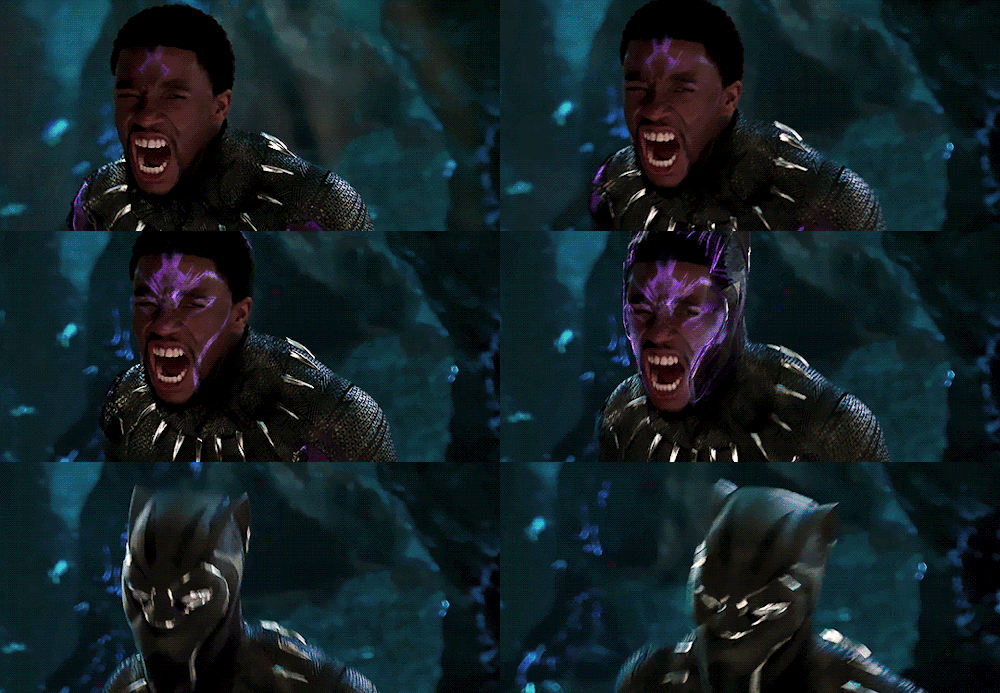
"BLACK PANTHER" (2018) Review
I am going to be brutally honest. For the past three years, I have harbored mixed feelings about the output from the Marvel Cinematic Universe (MCU). The year 2015 produced one movie that I found entertaining, yet disappointing; and another film that I found entertaining and original, but not exactly mind blowing. But the years 2016 and 2017 proved to be very disappointing, as far as MCU movies were concerned. By the end of 2017, I thought the MCU had finally lost its mojo . . . until I saw "BLACK PANTHER", early in the following year.
I realize many might find my comments something of a head scratcher. What exactly was wrong with the MCU films between 2015-2017? Well . . . I thought "THE AVENGERS: AGE OF ULTRON" was entertaining, yet problematic. I enjoyed "ANT-MAN" very much, but I would never regard it as one of the franchise's best. The movies, starting with 2016's "CAPTAIN AMERICA: CIVIL WAR" and ending with 2017's "THOR: RAGNAROK", struck me as very disappointing and somewhat inferior. Despite the fact that the franchise was raking in millions - or billions - with these films, I personally believed it had reached an artistic abyss . . . until I saw "BLACK PANTHER". Not only did I find the latter film entertaining, I also regard it as one of the better MCU films I have seen in the franchise's ten-year history. With "BLACK PANTHER", it seemed the MCU had not only climbed out of the abyss, but had reached (or nearly reached) a pinnacle.
"BLACK PANTHER" basically told the story about King T'Challa aka Black Panther adjusting to his role as the new sovereign of Wakanda, an isolated and fictional African nation that is the most technically advanced in the world, thanks to the vibranium metal within its borders. Wakanda has spent most of its existence pretending to be a poor, third-world nation in order to protect itself from the world - especially Western nations - and prevent them from learning about its rich source of vibranium. The narrative for "BLACK PANTHER" picked up at least a week after the events of "CAPTAIN AMERICA: CIVIL WAR". T'Challa and his premier bodyguard and leader of the Dora Milaje regiment, Okoye; extract Nakia, T'Challa's ex-lover and a Wakandan spy, from an undercover assignment in Nigeria. All three returned to Wakanda's capital to participate in T'Challa coronation as the new king. During the ceremony, the leaders of Wakanda's five tribes are each given the opportunity to challenge the temporarily de-powered (via a potion that expunges his super strength and speed) T'Challa's role as the new king by ritual combat. One of the leaders, M'Baku of the mountainous Jabari Tribe, challenges T'Challa. After a fierce fight, M'Baku concedes defeat and T'Challa is officially acknowledged as King of Wakanda.
Unfortunately, T'Challa's triumph is short-lived when Wakanda intelligence becomes aware of a robbery committed by a group of thieves led by an old foe of the country's, Ulysses Klaue. The latter had stolen an old Wakanda artifact from a London museum that contains vibranium, a metal substance that has allowed Wakanda to become the most technically advanced nation in the world . . . unbeknownst to other nations. When Wakanda intelligence learns that Klaue plans to sell the vibranium to the C.I.A. at a location in Busan, South Korea; T'Challa, Nakia and Okoye travel there to interrupt the planned sale and arrest the arms dealer. Instead of arresting Klaue, T'Challa stumbles across a family secret involving one of Klaue's fellow thieves, an African-American named Eric Stevens aka Killmonger, which will threaten his position on the Wakanda throne and endanger the country itself.
After being disappointed by five MCU movies in a row, I found myself wondering if I would ever enjoy a movie from the franchise again. Thankfully, "BLACK PANTHER" proved to be a more than pleasant surprise. Thanks to Ryan Coogler's direction and the excellent screenplay that he co-wrote with Joe Robert Cole, "BLACK PANTHER" proved to be a unique film that combined the usual elements of a comic book movie, a family drama and a rare exploration into the political and social aspects of the African diaspora.
Family drama is nothing new to the Marvel Cinematic Universe (MCU). Audiences have seen this played out in movies like the Thor trilogy, 2015's "ANT-MAN", and to a certain extent, 2008's "THE INCREDIBLE HULK". "BLACK PANTHER" is another addition in which a deadly encounter between T'Challa's father and uncle - King T'Chaka and Prince N'Jobu in 1992, led to the new king learning about his cousin and N'Jobu's half-American cousin, Erik "Killmonger" Stevens aka Prince N'Jadaka. That 1992 encounter led to Erik becoming an orphan and abandoned by his isolationist uncle T'Chaka. This, in turn, led Erik to see revenge against the nation of Wakanda. Ironically, Erik never got the chance to exact his revenge on the very person responsible for his loss, namely his uncle, who was killed by Helmut Zemo's bomb in "CIVIL WAR". But for him, T'Challa and Wakanda served as a convenient scapegoat for his vengeance.
What made all of this even more fascinating and a lot more original than the MCU's other family dramas was how Coogler and Cole managed to mix a good deal of political controversy into this family saga. One of the reasons Prince N'Jobu had fallen out of favor with his older brother was his growing disenchantment with Wakanda's isolationist policy with the world - including those of the African diaspora around the world. After his experiences in late 20th century Oakland, N'Jobu decided to reveal Wakanda's existence to Ulysses Klaue and help the latter infiltrate Wakanda to smuggle out more vibranium. N'Jobu had planned to use the vibranium to create weapons and lead a revolution of the African diaspora against the dominating Western nations. With his father dead, Erik planned to not only get his revenge against the Royal House of Wakanda, but also carry out N'Jobu's plans. Watching this, I am reminded of Loki's plans in 2011's "THOR" - namely to keep a powerless Thor stranded on Earth, while he sets up the Frost Giants' destruction and win Odin's favor. As much I had enjoyed that movie, Loki's plans seemed rather lame to me in compare to Erik's. But what made this story arc even more interesting is that in the end . . . Erik's plans to use Wakanda weapons to conquer the world eventually led to T'Challa's decision to finally end Wakanda's isolationist policy.
"BLACK PANTHER" featured some pretty solid action sequences. I enjoyed the sequence featuring T'Challa and M'Baku's fight for the throne; Erik and Klaue's confrontation at an abandoned South Korean airfield; T'Challa and Erik's battle for the throne; and the Battle of Mount Bashenga, in which T'Challa and his forces attempted to prevent Erik and the Border Tribe from sending Wakanda weapons to the outside world. All are pretty good action sequences. But if I had to select my favorite, it would be the confrontation at the Busan casino between T'Challa, Nakia and Okoye against Klaue and his minions. With C.I.A. Agent Everett Ross thrown into the mix, this particular sequence was simply boss, especially since it lead to a wild car chase on the streets of Busan. That once scene featuring Okoye slamming her wig into the face of a Klaue minion will probably remain imprinted in my mind for years to come.
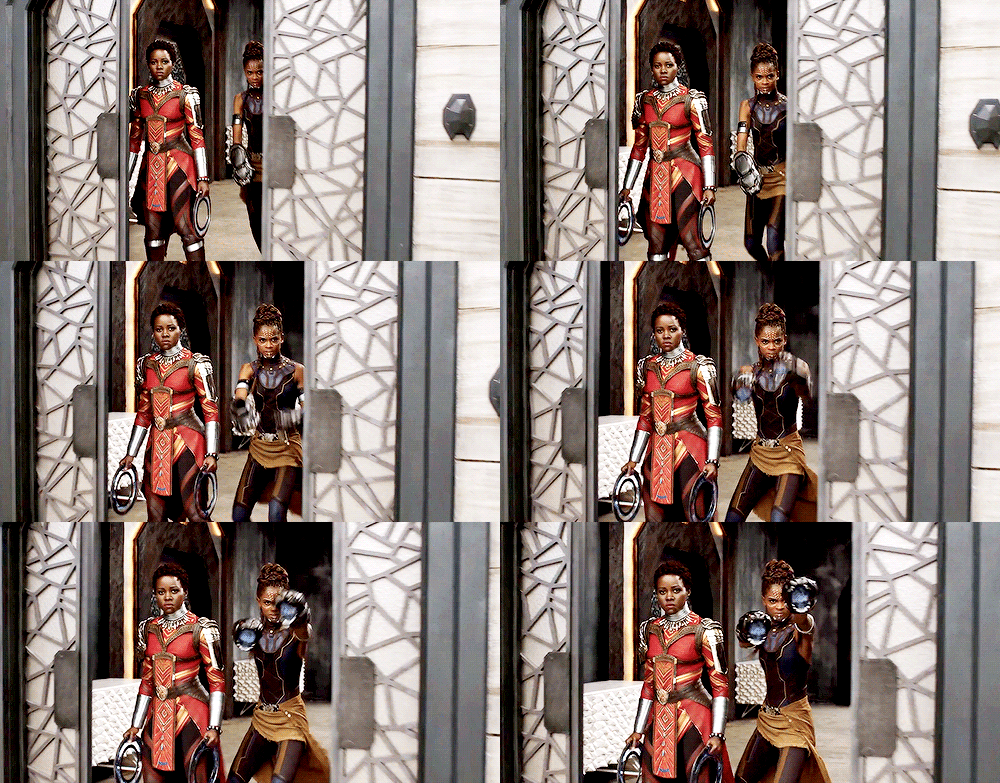
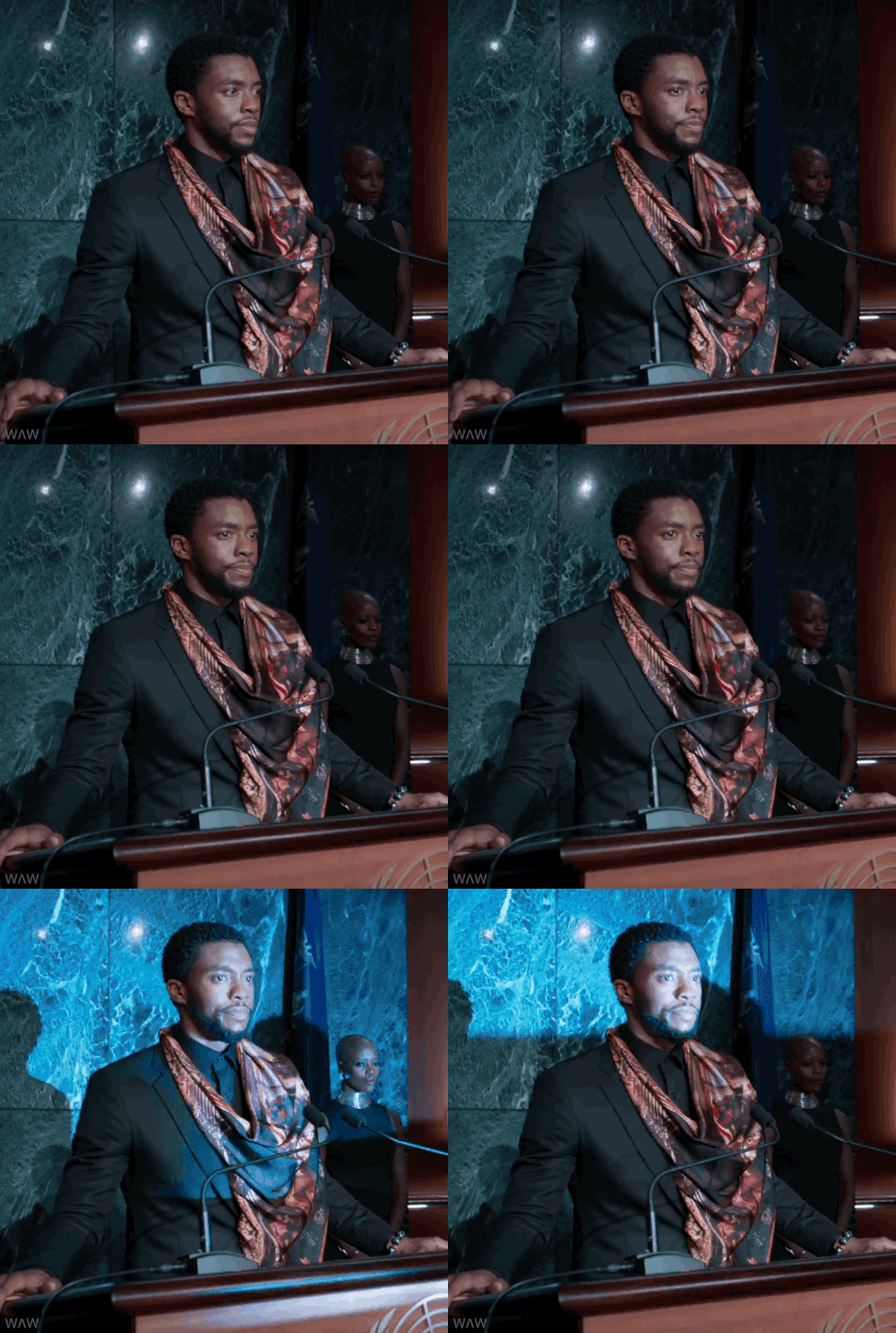
Another aspect of "BLACK PANTHER" that I admired was the film's production designs. Mind you, the film maintained that same flat photography that the MCU has become infamous for. However, I think Rachel Morrison's photography was enhanced by some sharp colors, the movie's visual effects, Hannah Beachler's gorgeous production designs that convey the world of Wakanda, along with the art direction team led by Alan Hook. Aside from Beachler's production designs, I was especially impressed by Oscar and Emmy nominee Ruth E. Carter's costume designs. Someone had compared them to those costumes featured in the 1988 comedy, "COMING TO AMERICA". But honestly . . . I think I prefer Carter's more natural designs, as featured in the images below:
But all of the above would have meant nothing without the talented cast for the film. "BLACK PANTHER" featured some first-rate performances from the likes of Daniel Kaluuya, who portrayed Border Tribe leader W'Kabi, who desires his own personal vengeance against Ulysses Klaue; Sterling K. Brown as the revolutionary Prince N'Jobu; both John Kani and son Atandwa Kani as the older and younger versions of King T'Chaka; Angela Bassett as T'Challa's strong-willed, yet loving mother and advisor, Queen Ramonda; Denzel Whitaker, who gave a solid performance as the younger Zuri; and Martin Freeman as C.I.A. Agent Everett Ross, who proved to me more entertaining and relevant in this film than he was in "CAPTAIN AMERICA: CIVIL WAR".
However, there were those performances that really impressed me. One came from Andy Serkis, who was a hoot as the murderous, yet over-the-top South African arms dealer, Ulysses Klaue. Letitia Wright was equally entertaining as T'Challa's witty and charming sister, the tech-savy Princess Shuri. Another came from Lupita Nyong'o, who gave a passionate and heartfelt portrayal of Wakandan intelligence agent and T'Challa's former girlfriend, Nakia. Forest Whitaker gave a first-rate performance as Wakanda's top courtier and former spy, Zuri. Whitaker was especially impressive in one scene in which his character was forced to confess King T'Chaka's past actions regarding N'Jobu and Erik Killmonger. Winston Duke was very impressive, imposing and at times, rather amusing as M'Baku, leader of the mountainous Jabari Tribe. Also, his first appearance in the film - during T'Challa's coronation ceremony - is one of the most memorable moments I have seen in a movie for quite some time. Danai Gurira was equally impressive and imposing as Okoyo, the traditionalist leader of the king's bodyguards - the Dora Milaje. Although I found her character's conservatism a bit annoying at times, I must admit that Gurira gave one hell of a performance.
However, this movie is really about two characters - King T'Challa of Wakanda aka the Black Panther and his paternal cousin Erik "Killmonger" Stevens aka Prince N'Jadaka. Yes, I know that the movie is called "BLACK PANTHER". But to be honest, this movie is about both cousins and how their conflicting views on Wakanda's role in the world and especially upon the African diaspora.
Chadwick Boseman's second turn as T'Challa proved to be a different kettle of fish from the driven newly ascended king determined to seek revenge for the death of his father, T'Chaka in "CAPTAIN AMERICA: CIVIL WAR". In this film, Boseman gave a more relaxed performance as the happy and more satisfied young king, eagerly anticipating, yet slightly fearing his new role as king. However, Boseman's relaxed performance skillfully transformed into one of disbelief, anger and outrage when T'Challa learned about his father's actions back in Oakland 1992. This was especially apparent in two scenes in which Boseman gave outstanding performances. The first scene featured his confrontation with Zuri, who confessed the true circumstances about Oakland. Boseman gave a very intimidating, yet regal performance in that scene. The other featured T'Challa's second dream in which he expressed anger and disappointment at his father's spirit for what happened to Erik.
Speaking of the latter, Michael B. Jordan has been receiving rave reviews for his performance as Erik "Killmonger". Some have been declaring his character as the best MCU villain ever. I do not know if I agree with that assessment. But I must admit that Jordan gave one of the most skillfully ambiguous performances I have encountered in the franchise. Audiences could easily sympathize with his backstory - the young boy who had lost his parents and abandoned. Also, one cannot help but admired Erik's desire to help those African nations and members of the African diaspora - something that his cousin seemed unwilling to do. And yet, the level of violence Erik seemed willing to utilize in order to achieve his goal or his unwillingness to face that the one person who had truly wronged him was dead justified why the talented Jordan had portrayed him such ambiguity.
As much as I enjoyed "BLACK PANTHER", I did have some problems with the film. One, there is a chance that I may have stumbled across a major writing blooper. In "CIVIL WAR", Avenger Wanda Maximoff aka the Scarlet Witch had accidentally killed a group of Wakanda subjects during a mission in Lagos, Nigeria. The Wakandans had been there on a goodwill mission. This lead King T'Chaka to publicly support the Sokovia Accords - an act that led to his death. And yet, Ryan Coogler and Joe Robert Cole made it clear in the 2018 movie's screenplay that Wakanda has practiced a policy of isolationism for centuries. Although Coogler and Cole remembered T'Chaka's death in the 2016 movie and Bucky Barnes' presence on Wakanda soil, they apparently forgot about this goodwill mission in Nigeria. Also, why did Erik Stevens wait so long to travel to Wakanda and make a bid for the throne? He could have challenged his uncle T'Chaka for the throne and get his revenge against the very man who had wronged him. Instead, he waited until after T'Chaka's death. Why?
Exactly when did Steve Rogers and Bucky Barnes arrive in Wakanda, as shown in one of the post-title scenes in "CIVIL WAR'? The movie opened with T'Challa and Okoye returning to Wakanda for the first time since T'Chaka's death. Were both Steve and Bucky aboard T'Challa's plane? Were they aboard the Avenger jet that Steve had used to fly to Russia in the 2016 movie? Where were they? In fact, there was no scene featuring the pair's arrival in Wakanda for the first time, which I found rather odd. Speaking of arrivals, why was Okoye with T'Challa when he first returned to Wakanda? I realize that she was the leader of the Dora Milaje and that King T'Chaka was in Austria at the time of his death. But Okoye was missing in a scene from "CIVIL WAR" in which Avenger Natasha Romanoff aka Black Widow had sought T'Challa's help to track down Steve, Bucky and Sam Wilson aka the Falcon. As the king's leading bodyguard, she should have been there - whether with T'Chaka or T'Challa. Instead, another Dora Milaje bodyguard named Ayo (portrayed by actress/model Florence Kasumba) was there. Yet, the latter was missing aboard T'Challa's plane upon his return to Wakanda. One last question . . . why did T'Challa's closest friend, W'Kabi of the Border Tribe, seemed so willing to help Erik carry out his anti-isolationist policies? Why? I understand that he might be grateful to Erik for finally killing Klaue, the man who had killed his father years ago. But am I really to believe that his gratitude extended to supporting Erik's decision to end Wakanda's isolationist policy . . . especially since he had made it clear earlier in the film that he fully supported the old policy? Was he really that grateful to fight on Erik's behalf when T'Challa had returned alive to resume the challenge against Erik? I truly found this hard to believe.
And why was the only truly negative black character in this film was the only one of some American ancestry? There was something about the film's portrayal of African-Americans that struck me as rather negative and a bit one-dimensional. In this film, African-Americans seemed to consist solely of poor and slightly thuggish people barely capable of surviving on their own, except through criminal activities. The idea of Wakanda coming to their "rescue" with advanced technology made the latter country seem very similar to the White Savior trope. And if Wakanda was going to share their technology, why did T'Challa do so with the entire international community, instead of simply other African nations and the African diaspora . . . as Nakia had originally suggested? Considering that Erik had pointed out that many countries - especially in the West - were catching up technically with Wakanda, along with the international community's generally negative attitude toward African nations and those of the African diaspora; I cannot help but wonder if T'Challa had ever considered that many of the more wealthier nations would take advantage of his generosity at the first opportunity? Or was this plot twist something that Kevin Feige and the other Marvel/Disney suits had insisted that Coogler and Cole include?
However . . . despite these misgivings I have about "BLACK PANTHER", I cannot deny that I truly enjoyed the movie. I did. I thought Ryan Coogler, along with screenwriter Joe Robert Cole and a talented cast led by Chadwick Boseman, did an exceptional job in bringing comic book hero the Black Panther and the world of Wakanda to life. At this moment, "BLACK PANTHER" has become one of my five favorite movies in the MCU franchise.