Showing posts with label james cromwell. Show all posts

Friday, January 19, 2024

"SCARECROW AND MRS. KING": Top Favorite Season Three (1985-1986) Episodes


Below is a list of my favorite Season Three episodes from the CBS series, "SCARECROW AND MRS. KING". Created by Brad Buckner and Eugenie Ross-Leming, the series starred Kate Jackson and Bruce Boxleitner:


"SCARECROW AND MRS. KING": TOP FIVE FAVORITE SEASON THREE (1985-1986) Episodes

1 - 3.05 Welcome to America Mr. Brand

1. (3.05) "Welcome to America, Mr. Brand" - Amanda King is recruited to serve as babysitter for a vacationing British accountant, a clumsy James Bond wannabe who claims he has stumbled upon evidence that reveals the identity of a Soviet spy. Harvey Jason guest starred.


2 - 3.18 Wrong Number

2. (3.18) "Wrong Number" - Following Agent Francine Desmond is kidnapped in Beirut, Amanda and Agent Lee Stetson become embroiled in a plot created by the latter's old KGB nemesis, Gregory, that involves the kidnapped Francine, an American mathematician and the latter's Soviet doppelganger. James Cromwell, Andrew Divoff and Peter Jurasik guest-starred.


3 - 3.07 Utopia Now

3. (3.07) "Utopia Now" - Amanda and Lee has a camping trip in the Virginia backwoods in order to spy on an outspoken tax protester who may have more than political reform on his agenda and a stash of explosives. Geoffrey Lewis, Frank Bonner, Dan Lauria and David Faustino guest-starred.


4 - 3.17 The Eyes Have It

4. (3.17) "The Eyes Have It" - While Lee recovers in the hospital from a car accident, his contact lenses, which contain a valuable microdot, goes missing. Gary Lockwood guest starred.


5 - 3.02 Were Off to See the Wizard

5. (3.02) "We're Off to See the Wizard" - Lee recalls an old tragedy when a series of murders claim the lives of women he used to work with or dated. Stephen Macht and Michael Patuki guest-starred.


HM - 3.20 Dead Men Leave No Trails

Honorable Mention - (3.20) "Dead Men Leave No Trails" - When Amanda becomes involved in a traffic accident, she accidentally exposes a dead terrorist, who turns out to be living and preparing to strike at an Embassy gathering. Stanley Kamel and Roger Burgos guest-starred.

Friday, May 1, 2020

"SPIDER-MAN 3" (2007) Review


"SPIDER-MAN 3" (2007) Review”

Over the years I have learned not to anticipate or make assumptions about new movies. About two weeks before the debut of the 2007 SPIDER-MAN movie, "SPIDER-MAN 3", I had read mixed reviews of it. Although there were a few positive opinions, most of them seemed to be negative. After reading this, my anticipation of the movie had receded a bit. But I still maintained a "wait-and-see" attitude. When I finally saw "SPIDER-MAN 3", I was happy to discover that that my fears had become meaningless. Although not as well-crafted as "SPIDER-MAN 2", the third film in Sam Rami's SPIDER-MANtrilogy still managed to thrill me. 

Before I can wax lyrical over the movie, I must address the movie’s flaws. And it had a few. One, I felt a sense of disappointment over some of the movie’s action sequences that featured Spider-Man’s web swinging around New York. They seemed to lack the crisp and detailed style shown in the two previous films and almost struck me as confusing and overblown. Two, I had a problem or two with the Gwen Stacy character. I realize that there are differences between the movie versions and the comic book versions of the Spider-Man universe. In the comic books, the blond-haired Gwen happened to be Peter Parker’s first true love. Her death at the hands of the Green Goblin (aka Norman Osborn) eventually paved the way for Peter’s romance with and marriage to Mary Jane Watson. It is quite obvious in "SPIDER-MAN 3" that although classmates at Columbia University, Peter and Gwen were not in love. Just friends. I had no problems with this. Nor did I have any problems with a symbiote-possessed Peter using her to make Mary Jane jealous. But I did have problems with the fact that the story never followed up on the mess that Peter had created between Gwen and Mary Jane. The story never allowed us to learn whether Peter had apologized to Gwen for using her . . . or if she had forgiven him. And what was she doing at Harry’s funeral? I do not recall them being acquainted in the movieverse. In the comics, Gwen and Harry were old high school chums that dated briefly in college.

My last problem with "SPIDER-MAN 3" involved the triangle between Peter, Mary Jane and Harry Osborn (aka Green Goblin 2). Near the beginning of the story, Harry had decided to take the opportunity to get his revenge upon Peter for his father’s death in "SPIDER-MAN". The opportunity resulted in a brutal fight and Harry seriously injured in the hospital. Harry woke up as a partial amnesiac – forgetting the reason behind his animosity toward Peter. And the two managed to resume their friendship, until an evening spent with Mary Jane (who was trying to forget her present unhappiness with Peter) resurrected Harry’s memories. In the end, Harry managed to coerce Mary Jane into breaking up with Peter permanently. Unfortunately, the writers never revealed what argument that Harry had used to coerce Mary Jane. Instead, they left the audience in the dark.

But what did I like about "SPIDER-MAN 3"? For one . . . the story. It was easy for me to see that the story’s main theme seemed to be about vengeance and how – as Aunt May had put it to Peter – it can spread poison within a person until it completely consumes that person. Of all the major characters aside from Aunt May, only two were not touched or consumed by a desire for revenge – Gwen Stacy and Flint Marko. Marko’s actions stemmed from his desperate desire to acquire money to aid his ailing daughter. And poor Gwen became a victim of Peter’s desire for revenge against Mary Jane. But for the rest of the characters, revenge seemed to be the order of the day:

-Peter Parker aka Spider-Man: the Webslinger becomes consumed with revenge when he learns that his Uncle Ben’s true killer – namely Flint Marko – had escaped from prison. He later seeks revenge against Mary Jane for breaking up with him, with Harry for the latter’s earlier vengeful attack against him and for initiating the break-up with Mary Jane; and against Eddie Brock for the libelous photo of Spider-Man and winning the position of staff photographer at the DAILY BUGLE. He certainly was a busy boy.

-Harry Osborn aka New Goblin: Peter’s best friend has desired revenge against Peter (as Spider-Man) for killing his father in the first movie. He also has revenge against Mary Jane because she used him to forget her troubles with Peter.

-Mary Jane Watson: a part of me is not sure whether to include her on this list. But I could not help but wonder if her bitchiness toward Peter was a result of her own professional failure on Broadway, combined with her growing distaste toward Peter’s pride over his popularity as Spider-Man. And when Peter shares a publicized kiss with Gwen Stacy that is reminiscent of that famous kiss from the first movie, Mary Jane’s jealousy eventually overwhelms her . . . and she turns to Harry for comfort. I would not be surprised if her action came from a small desire to get back at Peter.

-Eddie Brock Jr. aka Venom: Even before the alien symbiote had taken over him, Eddie seemed like an unpleasant piece of goods. And when Peter rather maliciously exposed his chicanery over a faked Spider-Man photograph, it did not take Eddie long to rush to the nearest church and ask God . . . to kill Peter Parker. Like I had said, he was an unpleasant person. Eventually, Eddie’s desire for revenge would soon present itself.

-Flint Marko aka Sandman: Although I had earlier stated that Marko had no desire for revenge in the movie. I now realize that I may have been mistaken. After two frustrating encounters with Spider-Man, Marko finally gave in to a desire for revenge when he allowed Venom to manipulate him into using Mary Jane to lure and kill Peter.

The one theme that had dominated the Spider-Man saga in both the comics and the movies seemed to be: "With great power comes great responsibility." I do not know if I fully agree with that motto. I really cannot see how Peter Parker mustbecome a costumed crime fighter, because he accidentally got bitten by a radioactive spider. On the other hand, I do believe that one should face the responsibilities and consequences for the deliberate choices you make in life. And this, along with facing demons that include a desire for vengeance, seemed to be the drive behind the movie’s plot.

Each major character ended up facing his or her own personal demons – Peter’s pride as Spider-Man becomes a forerunner of the exposure of his own darker nature that includes a cruel desire for revenge; Mary Jane’s insecurity about her self-worth; Harry’s desire to revenge the death of his father to fulfill his own lack of self-worth; Marko’s desperation to do anything for his ill daughter; and Eddie’s own shallowness and deceptive nature. What made "SPIDER-MAN 3"’s plot so interesting is that the characters’ flaws and decisions served as different points that converged in the emotional final sequence at the construction site in Manhattan. There, the characters make final choices in how to deal with their demons and only one emerged as the true loser - Eddie Brock.

As in the previous two movies, the third one boasted some fine performances by the cast. J.K. Simmons’ J. Jonah Jameson managed to be his usual funny self. I especially enjoyed his interaction with Elizabeth Banks – secretary Betty Brandt – in a duel of nerves in which Betty seemed determined to annoy Jonah every second with some crazy alarm. If someone knows what it was, please tell me. Although in a smaller role than the previous two movies, Rosemary Harris returned to give a warm performance as Peter’s aging Aunt May. In a marvelous scene in which Peter informs his aunt of Flint Marko’s "death" at Spider-Man’s hands, Harris’ May delivered the movie’s theme in a foreboding line about the true nature of vengeance. Last, but not least there was Bryce Dallas Howard, who portrayed Peter’s beautiful blond classmate, Gwen Stacy. Granted, her role was not as large as it was in the comics, Howard gave a fine performance as the warm and friendly Gwen. Some critic had complained that the movie turned Gwen from Peter’s true love to some kind of temptress. I found this criticism rather ridiculous for two reasons – a) Mary Jane had been established as Peter’s true love since the first movie; and b) Gwen was not portrayed as some temptress, but a nice girl who became a victim of Peter’s vengeance against Mary Jane. 

Thomas Haden Church’s portrayal of Marko Flint aka Sandman seemed like a far cry from his past performances that I have seen in which he portrayed more extroverted characters. His Marko/Sandman must be one of the most introverted villains I have ever seen on the movie screens. In fact, his character reminded me of some melancholy circus clown with a black cloud of tragedy hovering about him. Considering the circumstances of Marko’s life – a failed criminal career, a failed marriage, ill child and imprisoned for a crime that was merely an accident – it was not hard for me to imagine this. In the end, I was very impressed by Church’s subtle performance. And I was also impressed by Topher Grace as Eddie Brock, Jr. aka Venom, as well. Originally, he was not suppose to be part of the movie’s cast of characters. But former CEO Ari Arvad convinced director Sam Rami to include the character. And I am glad. Brock turned out to be a very interesting character. When first introduced, he seemed like an affable and gregarious young man, who also worked as freelance photographer for ”THE DAILY BUGLE”. With great skill and subtlety, Grace allowed the audience to gradually see the character’s dark emptiness, underneath the charm. Two scenes seemed to reflect this – the one that featured Gwen Stacy dangling from a Manhattan high-rise and Brock’s visit to a church after losing his job. In the first scene, I found it interesting that although Brock seemed mildly concerned over Gwen’s near death situation, he seemed more interested in taking photos of her and Spider-Man’s rescue . . . than doing everything in his power to ensure that she would be rescued. After losing his staff photographer job at THE BUGLE, Brock ended up at a church, where I thought he would confess to a priest or express remorse over his past behavior. Instead, he prayed to God . . . for the death of the man who caused his unemployment, Peter Parker. This is the second time I have seen Grace skillfully portray a character with one trait hidden underneath another one. 

When Spidey fans last saw Harry Osborn in "SPIDER-MAN 2", he had learned two disquieting facts – the man he held responsible for his father’s death (namely Spider-Man), turned out to be his best friend, Peter Parker; and his father, Norman Osborn, had been the infamous Green Goblin who terrorized Manhattan in the first movie. Three years later, Harry still wants revenge for Norman’s death and he finally decided to take action as the New Goblin A failed attack upon Peter resulted in a serious injury for Harry and a temporary amnesia. The audience got to see what Harry would be without his insecurity and the ghost of his father haunting him. And he seemed like a pretty nice . . . and well-balanced young man. I tried to find something wrong with James Franco’s performance, but . . . I could not find a thing. Honestly. Franco managed to perfectly capture Harry’s emotional journey from the vengeful son to the sweet-tempered amnesiac to the cruel manipulator who broke up Peter and MJ’s relationship, to the loyal and brave man who sacrificed himself to save his friends. Franco covered it all.

I have always liked Kirsten Dunst as Mary Jane Watson in the first two movies. But I found her a lot more interesting in"SPIDER-MAN 3". Beneath the sweet and cheerful persona, Dunst revealed a Mary Jane still racked by an inferiority complex stemmed from her bad relationship with her verbally abusive father. This lack of self-esteem came from Mary Jane losing her job as leading lady of a Broadway musical. Even worse, Peter’s own success as Spider-Man not only fueled Mary Jane’s insecurity, but fueled her envy as well. Matters did not help when Peter/Spidey had agreed to exchange a public kiss with Gwen Stacy, re-creating Mary Jane’s first kiss with him in the first movie. What I liked about Dunst’s performance is that she allowed all of these negative aspects of Mary Jane’s personality to manifest without resorting to over-the-top theatrics. I have come to the conclusion that very few screen actors and actresses seem capable of avoiding scene chewing. Especially those of Dunst’s generation. Fortunately, she did just that – avoid any hammy acting, while projecting Mary Jane’s darker impulses. As for her singing voice, I got the impression that it had been dubbed during MJ’s Broadway performance. But I could detect Dunst’s voice, when Mary Jane sang at a jazz club during the movie’s final scene. She had a nice, but slightly nasal voice.

As for the man himself – Tobey Maguire – I must say that Sam Rami had not been joking when he called Maguire one of the best actors of his generation. I felt more than impressed by his performance in "SPIDER-MAN 3". Although Maguire was able to briefly tap into Peter Parker aka Spider-Man’s dark psyche in the first movie (when he allowed a thief to get away with money stolen from a wrestling match), he was truly allowed to explore Peter’s darker nature in this film. There are two particular scenes that verified Maguire’s extraordinary skills as an actor:

*Peter’s misguided belief in his "cool" image, while walking the streets of Manhattan. Even evil (thanks to the symbiote suit), Peter could not help being a nerd. Watching Peter wallow in the illusion of his "coolness", while oblivious of passing females’ contempt made this sequence one of the funniest in the movie. It also showcased Maguire’s comedic skills.

*Peter’s second confrontation with Harry, inside the Osborn manor, revealed the depths of how monstrous he could be. He seemed truly dark in this scene. Maguire even managed to allow the contempt and hatred reflected in his eyes, when Peter ridiculed Harry for attempting to follow in Norman Osborn’s footsteps. In all, it was a very excellent performance on Maguire’s part.


From what I have read, "SPIDER-MAN 3" has received mixed reviews. Hmmm. Well, I certainly cannot influence the opinions of others. I can only express my own views. Personally, I enjoyed the movie very much. It possessed an emotional depth that went even further than first two movies. When I first heard that Spider-Man would be facing three villains – the New Goblin (Harry), the Sandman (Flint Marko) and Venom (Eddie Brock, Jr.) – I had my doubts about the movie’s success. It seemed like one or two villains too many. Oddly enough, after seeing the movie, it now seemed to work within its plot for me – despite the number of villains. Now that I think about it, the one true villain of the story – aside from the major characters’ inner darkness – seemed to be Venom. Unlike Peter or Harry, Eddie Brock never could break away from his darker impulses . . . even when Peter managed to force him away from the symbiote. And unlike Marko, Eddie never felt any remorse for his actions . . . right to the end.

To my amazement, I realized that my view of Rami's "SPIDER-MAN" trilogy seemed to match my view of the first three X-MEN movies. For me, the first movie of both trilogies struck me as very entertaining, but slightly mediocre ("SPIDER-MAN" is “almost” mediocre). The second movie for each trilogy was superb. Period. And the third movies for the two trilogies were flawed, but excellent, thanks to filmmaker Sam Rami.

Tuesday, December 3, 2019

"JURASSIC WORLD: FALLEN KINGDOM" (2018) Review


"JURASSIC WORLD: FALLEN KINGDOM" (2018) Review

Following the release of "JURASSIC PARK III" in 2001, I had figured that was it for the JURASSIC PARK movie franchise. Boy, was I proven wrong. Fourteen years after the release of that third film, Universal Pictures and producer Frank Marshall presented a fourth movie for the franchise, "JURASSIC WORLD" in 2015, that proved to be a major hit. Following the success of that film, it was only natural that a fifth movie would be made. 

Set three years after the events of the 2015 movie, "JURASSIC WORLD: FALLEN KINGDOM" began with the United States Senate debating over whether to save the dinosaurs on Isla Nublar from an impending volcanic eruption from the island's volcano Mt. Sibo. Mathematician Dr. Ian Malcolm testifies that the dinosaurs should be allowed to die in order to correct John Hammond's mistake of cloning them. Meanwhile, Jurassic World's former operations manager, Claire Dearing, has established the Dinosaur Protection Group to save the animals. When the Senate decides not to rescue the dinosaurs, Hammond's former partner, Benjamin Lockwood, summons Claire to his Northern California estate, where he and his aide Eli Mills reveal a plan to relocate the dinosaurs to a new island sanctuary. They need Claire to help reactivate the park's dinosaur tracking system in order to locate the animals - especially Blue, the last surviving Velociraptor. Despite being estranged from him, Claire recruits Jurassic World's former Velociraptor trainer and Blue's alpha, Owen Grady, to help capture her. Accompanying them would be the park's former technician Franklin Webb and paleo-veterinarian Zia Rodriguez.

Upon their arrival on Isla Nublar at the now defunct Jurassic World amusement part, Claire and Franklin work to reactivate the park's online tracking system. Meanwhile, Owe, Zia and a mercenary team led by Ken Wheatley search for Blue. When they find the velociraptor, one of Wheatley's men shoots Blue and Wheatley tranquilizes Owen. The mercenaries take Zia with them to treat Blue's injury. The mercenary ship, loaded with the captured dinosaurs, departs for the U.S. mainland, while the dinosaurs left behind die in the eruption. Meanwhile; Claire, Franklin, and Owen manage to escape the dying island and sneak aboard in time and assist Zia in transfusing Blue with Tyrannosaurus blood. The group now realizes that the captured dinosaurs were never being transported to a new island and have been captured for another purpose. And the latter has to do with a financial scheme being involving Eli Mills and Dr. Henry Wu, behind Lockwood's back.

Despite earning over a billion dollars at the box office, "JURASSIC WORLD: FALLEN KINGDOM" received very little positive reviews upon its release. In fact, it is regarded by some as a failure. Many critics and some film goers certainly regard it as inferior to the 2015 movie. How do I feel about "JURASSIC WORLD: FALLEN KINGDOM"? I had a few problems with it. Well . . . to be perfectly honest, I had two major problems with it. My first problem centered around Benjamin Lockwood's estate serving as the setting for the film's second half. I found this rather limiting and claustrophobic. And I found myself wondering if the film's budget was responsible for this decision to limit the setting to a California country estate. The longer the film remained on that estate - especially inside that house - the more I became frustrated. 

And I have a second complaint about "JURASSIC WORLD: FALLEN KINGDOM" - namely the fate of Benjamin Lockwood's granddaughter, Maisie. Why did Owen Grady and Claire Dearing end up as her guardians at the end of the movie? What happened to Maisie's nanny, Iris, who had been with the family for years? I do not recall her being killed by a dinosaur. So what happened to her? Why did she not take care of Maisie, following the death of the latter's grandfather?

Despite my complaints, I enjoyed "JURASSIC WORLD: FALLEN KINGDOM". In fact, I enjoyed it very much. Derek Connolly and Colin Trevorrow created a first-rate tale filled with tension, drama and especially comedy. I remember when the film first hit the theaters, many had complained about the movie's finale. They found it . . . illogical. Messy. I still find this complaint rather hard to swallow. The premise behind the JURASSIC PARKfranchise can be considered illogical. Frankly, considering what happened in a period of twenty-five years and five movies, I thought it was only a matter of time that the franchise would reach this point. It almost did in 1997's "JURASSIC PARK: THE LOST WORLD". However, this film took it a step further with the release of several dinosaurs into the modern world. It was bound to happen. InGen and John Hammond had opened Pandora's Box a quarter of a century ago with the creation of dinosaurs, thousands of years after they naturally went extinct. I would almost equate the creations of these animals with that of nuclear energy and weaponry. Considering the occasional misuse and mishandling of nuclear energy throughout the years, I found it appropriate that a more disastrous scenario would finally befall in the JURASSIC PARK franchise than what happened in the previous films.

"JURASSIC WORLD: FALLEN KINGDOM" is also a popcorn summer film that depends upon a great deal of action. And it had its share of some first-rate action sequences. If I must be great, I enjoyed most of the action in the film's first half. I especially enjoyed the sequence featuring the natural destruction of Isla Nublar and Owen Grady, Claire Dearing and Franklin Webb's efforts to escape from the island after being abandoned by Ken Wheatley's team. For me, it was a breathtaking sequence as the trio raced to reach the boat conveying Wheatley's team and Zia Rodriguez (kidnapped and forced to treat the wounded Blue) to the United States. But there was an action sequence in the film's last hour that also impressed me. It featured the protagonists being hunted throughout the Lockwood mansion by Dr. Henry Wu's latest creation, the Indoraptor, a creation from the DNA of Indominus rex from the last film and Velociraptor - namely Blue. For me, those two sequences featured the best of some pretty damn good action scenes throughout the film.

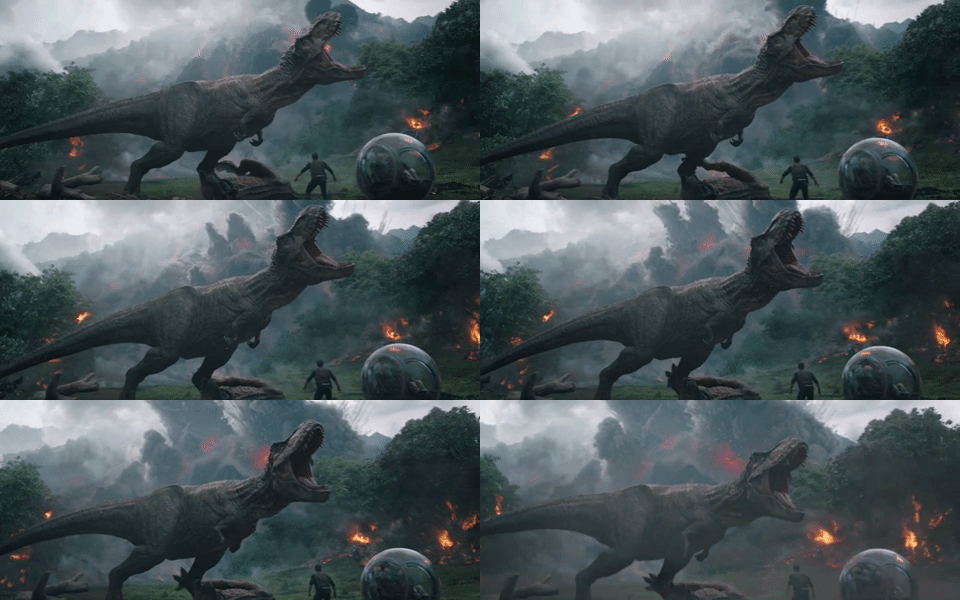
The movie did not feature as many breathtaking visual scenes as "JURASSIC WORLD". But there were a few that caught my eye, including scenes of those dinosaurs roaming the Earth:


But the one scene that produced a knot in my throat featured that last shot of Isla Nublar . . . and the death of the very brachiosaurus that Dr. Alan Grant first saw in 1993's "JURASSIC PARK". Director J.A. Bayona, cinematographer Óscar Faura and the visual effects team really knocked it out of the ballpark by capturing both the grandeur and the pathos of the scene:

image

If there is one thing I can guarantee from a JURASSIC PARK/WORLD movie, it is a first-rate cast featuring excellent performances. Jeff Goldblum returned to give a short, yet solid performance as Dr. Malcolm Campbell, one of the original visitors to Isla Nublar. "JURASSIC WORLD: FALLEN KINGDOM" featured the acting debut of Isabella Sermon, who gave an excellent performance as the young Maisie Lockwood. Trust this franchise to always hire naturally talented child actors. Ted Levine's performance as mercenary Ken Wheatley struck me as a gleeful portrayal of toxic masculinity. B.D. Wong's return as Dr. Henry Wu was somewhat briefer than it was in the 2015 movie. Yet, once again, the actor conveyed the convoluted egoism of Dr. Wu with great skill. I hope he will have a bigger role in the next film. 

Toby Jones gave an entertaining, yet slightly theatrical performance as the weasely auctioneer hired by Eli Mills to help sell those dinosaurs taken from Isla Nublar to potential buyers. James Cromwell struck me as emotional, yet dignified as Hammond's former partner, Benjamin Lockwood. Geraldine Chaplin gave a skillful performance as the Lockwoods' reliable employee Iris. Daniella Pineda was brash and entertaining as the sharp-tongued Dr. Zia Rodriguez. Justice Smith proved to be equally entertaining and quite hilarious as anxiety-ridden systems analyst Franklin Webb. Rafe Spall skillfully portrayed one of the most subtle and corrupt villains in the franchise, Eli Morrow.

Chris Pratt returned as former Navy SEAL-turned-dinosaur trainer Owen Grady. I realized that many might not agree, but I enjoyed Pratt's first-rate portrayal of the no-nonsense Grady more than I did in the 2015 movie. I thought Pratt's performance was more subtle and best of all, his Grady seemed to have dropped that sanctimonious I had found slightly irritating in the previous film. Bryce Dallas Howard managed to skillfully take her character, former operations manager of Jurassic World, to the next level. In "JURASSIC WORLD: FALLEN KINGDOM", Claire's previous encounters with the dinosaurs had led her to develop an appreciation of them as sentient beings. This new Claire is a passionate animal rights activist who has dropped her arrogant disregard of the park's inhabitants. It is possible that this new passion may have slightly affected her common sense, especially during the film's last 10-15 minutes. But thanks to Howard's excellent performance, she managed to convey a sense of plausibility in the slight changes in Claire's personality.

As I had earlier pointed out, the critics did not like "JURASSIC WORLD: FALLEN KINGDOM". In fact, some moviegoers had expressed dismay at the film's ending. I had at least two quibbles with the movie. But if I must be frank, I enjoyed it very much. More importantly, I found its ending very believable for a science-fiction tale. For once, the franchise was willing to face a consequence that its previous films managed to elude so far. The movie featured first-rate direction by J.A. Bayona; a well-written screenplay by Derek Connolly and Colin Trevorrow; and an excellent cast led by Chris Pratt and Bryce Dallas Howard. Good work guys!


image

Tuesday, October 22, 2019

"JURASSIC WORLD: FALLEN KINGDOM" (2018) Photo Gallery

jurassic_world_fallen_kingdom_5k_2018-widescreen_wallpapers

Below are images from "JURASSIC WORLD: FALLEN KINGDOM", the fifth installment in the JURASSIC PARK franchise and the sequel to the 2015 movie, "JURASSIC WORLD". Directed by J.A. Bayona, the movie starred Chris Pratt and Bryce Dallas Howard: 


"JURASSIC WORLD: FALLEN KINGDOM" (2018) Photo Gallery

002


002a


003


004


007


008


009


010


011


012


2482_d046_00071rv2_wide-b0026d1a9dd0a03e6176f0d509cd95fe3a54a89c-s900-c85


BD-WONG-615x410


images


james_cromwell_in_jurassic_world-_fallen_kingdom_-_publicity_-_h_2018


jurassic-world-review-a8780050-4d8a-477a-82da-e5a07915e840


kinopoisk.ru-Jurassic-World_3A-Fallen-Kingdom-2911956


kinopoisk.ru-Jurassic-World_3A-Fallen-Kingdom-3159890


MV5BM2Y3NjBmZjEtZmQ2NS00NzA4LWIwNGEtZTE4YmYxZmYyYzQ0XkEyXkFqcGdeQXVyNjU2NTcyMzY@._V1_


MV5BMGFjN2EzNmYtNzBkMy00ODZmLWIyOGItNmRjZjcwMTdmOTU1XkEyXkFqcGdeQXVyNjU2NTcyMzY@._V1_


MV5BMTk5YmI1ZDQtZWEzNC00OWM3LTkxM2MtMTM3OWJkOWUyOWYxXkEyXkFqcGdeQXVyNjU2NTcyMzY@._V1_


MV5BOWI2M2QxM2EtNGViMC00ZTA3LTg5NTQtMjRhYmVlOGU1ZjU1XkEyXkFqcGdeQXVyNjU2NTcyMzY@._V1_


open_graph3900241667777945151image


S50d61d1afd9a408ec992d00712732c0917c9baae


Toby-Jones-1000-02


x480-_iu

Monday, July 23, 2018

"MARSHALL" (2017) Review


“MARSHALL” (2017) Review
I have a confession. I had no interest in seeing the recent movie, “MARSHALL”, when I first heard about it. I thought it would turn out to be one of those solemn biography flicks about some “great man in history” and his struggles to become successful in his endeavors. But when I learned about the movie’s plot, I changed my mind and decided to see it. 
Directed by Reginald Hudlin, “MARSHALL” was about a “great man in history” – none other than the first African-American to be an Associate Justice of the U.S. Supreme Court, Thurgood Marshall. However, this film focused on his position as a defense counselor for and director of NAACP Legal Defense and Educational Fund and his role in the 1941 case of “the State of Connecticut v. Joseph Spell”.
Following the successful end of a case in Oklahoma in 1941, NAACP defense attorney Thurgood Marshall returns to New York City for a rest. However, his rest and reunion with his wife, Vivien “Buster” Burey, is short-lived when NAACP Director Walter Francis White sends him to Bridgeport, Connecticut to defend Joseph Spell, a chauffeur accused of rape by his white employer, Eleanor Strubing. In order to get Marshall admitted to the local bar and defend Spell, a local member of the Bridgeport NAACP office tries to recruit an insurance attorney named Sam Friedman to help. However, Friedman is more interested in keeping his distance from the controversial case, until his brother Irwin coerces him into getting involved. Judge Foster a family friend of prosecutor Lorin Willis, agrees to admit Marshall to the local bar. But he forbids Marshall from speaking during the trial. This act forces Friedman to act as Spell’s lead counsel, while Marshall guides the former through the jury selection process and the actual trial. Judge Foster’s refusal to allow Marshall to speak proves to be the first of several stumbling blocks in his and Friedman’s efforts to defend Spell.
Despite the movie’s narrative, “MARSHALL” could have remained one of those stately biopics that usually ends up boring me senseless. Thanks to Reginald Hudlin’s direction and the screenplay written by Michael and Jacob Koskoff, the movie proved to be a lot different. Instead, “MARSHALL” proved to be a very interesting re-creation of the 1941 controversial case in which a black man is accused of raping a white woman. Stories or real life incidents involving interracial rape – especially that of white women – have been around for decades. Stories about racism in the U.S. South have been around for a long time, as well. However, I have also noticed that in recent years, Hollywood has turned its eye upon Northern racism, especially in the Northeast. In its portrayal of the “the State of Connecticut v. Joseph Spell” case, “MARSHALL”turned out to be one of those movies that exposed Northern racism.
I was also impressed by how the Koskoff brothers treated the Spell case as a legal mystery. Ironically, the movie did not begin with scenes that led to Joseph Spell’s arrest. I must admit that I had expected “MARSHALL” to begin with a sequence featuring vague details of the crime. Instead, it began with Thurgood Marshall finishing a case in Oklahoma. The audience learned about the Spell case around the same time Walter White assigned him to defend Joseph Spell. This led me to realize that the entire movie was told from the viewpoint of two people – Marshall and Sam Friedman. Some have criticized the movie for including Friedman as a leading character in the film. They believed this situation robbed the Thurgood Marshall character some of his agency as the film’s leading character, by having Friedman as a co-lead. Personally, I did not mind occasionally watching the film from Friedman’s point-of-view. I found it interesting. And to be honest, history itself set up this situation, due to the trial’s presiding judge refusing to recognize Marshall as Spell’s primary attorney.
However, dealing with a potentially hostile judge and a patronizing prosecutor, and being regulated to secondary attorney for the defense seemed to be a walk in the park for Marshall. He also has to deal with Bridgeport’s racially hostile citizens; pressure from the N.A.A.C.P. to successfully defend Spell; and Friedman, who turned out to be a reluctant and wary co-defender, worried about how his defense of Spell would affect his practice. Marshall also has to deal with Friedman’s lack of experience in criminal law. But the biggest roadblock proves to be Marshall’s growing suspicion that his client is lying about the latter’s relationship with the alleged victim. And I thought the movie did an excellent job keeping these aspects of the story balance, due to the Koskoffs’ screenplay and Hudlin’s direction.
I have a minor quibble regarding the movie. Although the movie made it plain that the N.A.A.C.P. regarded Marshall’s successful defense of Spell as a means to lure more donations for the agency, I believed that it ignored an even more important topic. A part of me wished that the movie had also touched upon Northern blacks’ feelings of being ignored by the agency and the latter’s illusion that most of American racism was focused in the South. Another reason why a “not guilty” for Spell was so important was to convey the message that confronting racism from the North and other parts of the country was just as important as confronting as Southern racism. But I get the feeling that the movie’s producers, writers and director were wary of approaching, let alone exploring this topic.
Considering that “MARSHALL” is not what one would consider a large budget film, I was impressed by its production values. Now I cannot say that any of the film’s technical details blew my mind. Well . . . perhaps two of them did. I found Newton Thomas Sigel’s cinematography colorful, sharp and lovely to look at. This seemed especially apparent in the film’s exterior shots. I also enjoyed Ruth E. Carter’s costume designs. Not only did I find them to be a close representation of fashion for both men and women in 1941, but they also seemed to be good representations of the major characters’ economic class. As for Richard Hoover’s production designs, Kara Lindstrom’s set decorations and Jeff Schoen’s art direction; I found satisfying, but not particularly memorable.
“MARSHALL” featured solid performances from supporting cast members like Jeffrey DeMunn, John Magaro, Zanete Shadwick, Derrick Baskin, Barrett Doss, Keesha Sharp, Rozanda Sharp, and Jeremy Bobb. Jussie Smollett gave a brief, yet subtle performance as the famous poet, Langston Hughes. And Roger Guenveur Smith was effectively commanding as N.A.A.C.P. director Walter White. Dan Stevens did an excellent job in conveying the patronizing and self-privileged prosecutor Loren Willis. James Cromwell gave a very interesting performance as Judge Foster. Although Cromwell managed to convey his character’s obvious bigotry, it seemed that some of his character’s decisions – including a willingness to allow Marshall to act as second chair for the defense – seemed to express the latter’s unwillingness to put Northern racism on display for the world to see. Kate Hudson’s portrayal of the alleged victim, Eleanor Strubing struck me as effectively ambiguous. Hudson did an excellent job in conveying mixed signals over her character. I felt anger over her character’s charges of rape against the defendant. Yet at the same time, I felt pity toward the character being an obvious victim of spousal abuse. Ironically, Sterling K. Brown also managed to effectively convey the ambiguity of his character, the defendant Joseph Spell. Now, one might wonder why I would regard Spell as an ambiguous character. Brown did an excellent job in expressing his character’s innocence. And yet, the actor also managed to convey the air that his character was lying to Marshall on a certain level.
I have seen Chadwick Boseman in three other films before “MARSHALL”. And I was impressed. But I felt a lot more impressed by his portrayal of Thurgood Marshall in this film. The actor did a superb job in conveying the different aspects of Marshall’s personality – his charisma, witty sense of humor, intelligence and more importantly, a slight perverse streak in his nature. Boseman was very subtle in expressing Marshall’s arrogance and slight tendency of needling . . . especially with Langston Hughes and Sam Friedman. Another first-rate performance came from Josh Gad, who portrayed Friedman, the man forced to act as Spell’s primary defender. I noticed that although Friedman seemed friendly with the head of Bridgeport’s N.A.A.C.P. office, he seemed very wary of helping Marshall with defending Spell. I understood this. He was worried how his participation in the case would look with his own clients and Bridgeport’s Jewish community. But I realized that if Friedman had truly been that racially tolerant at the time, he would not care . . . like his brother. This is why I found it very satisfying to watch Gad develop into that openly tolerant man who no longer cared about how others would regard his views on race and especially African-Americans.
I would never regard “MARSHALL” as one of the best movies of 2017. To be honest, I do not believe in any “best movies of the year” list. But I enjoyed “MARSHALL” so much that in the end, it became one of my favorite movies of that year. And I can thank director Reginald Hudlin, screenwriters Jacob and Michael Koskoff and an excellent cast led by the always talented Chadwick Boseman for making this film so enjoyable and fascinating for me.


Monday, January 1, 2018

"MARSHALL" (2017) Photo Gallery


Below are images from "MARSHALL", the 2017 biopic about an early legal case in the career of Supreme Court Justice, Thurgood Marshall. Directed by Reginald Hudlin, the movie stars Chadwick Boseman: 


"MARSHALL" (2017) Photo Gallery