Showing posts with label david dukes. Show all posts

Wednesday, June 11, 2025

"THE LOVE LETTER" (1998) Review


"THE LOVE LETTER" (1998) Review

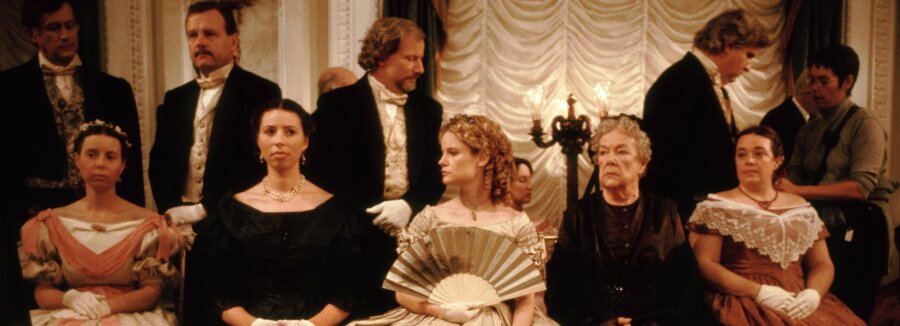
Twenty-seven years ago, CBS's "HALLMARK HALL OF FAME" anthology series aired a television movie titled "THE LOVE LETTER". This movie was an adaptation of Jack Finney's 1959 short story of the same title and has become a big favorite of many television viewers over the years.

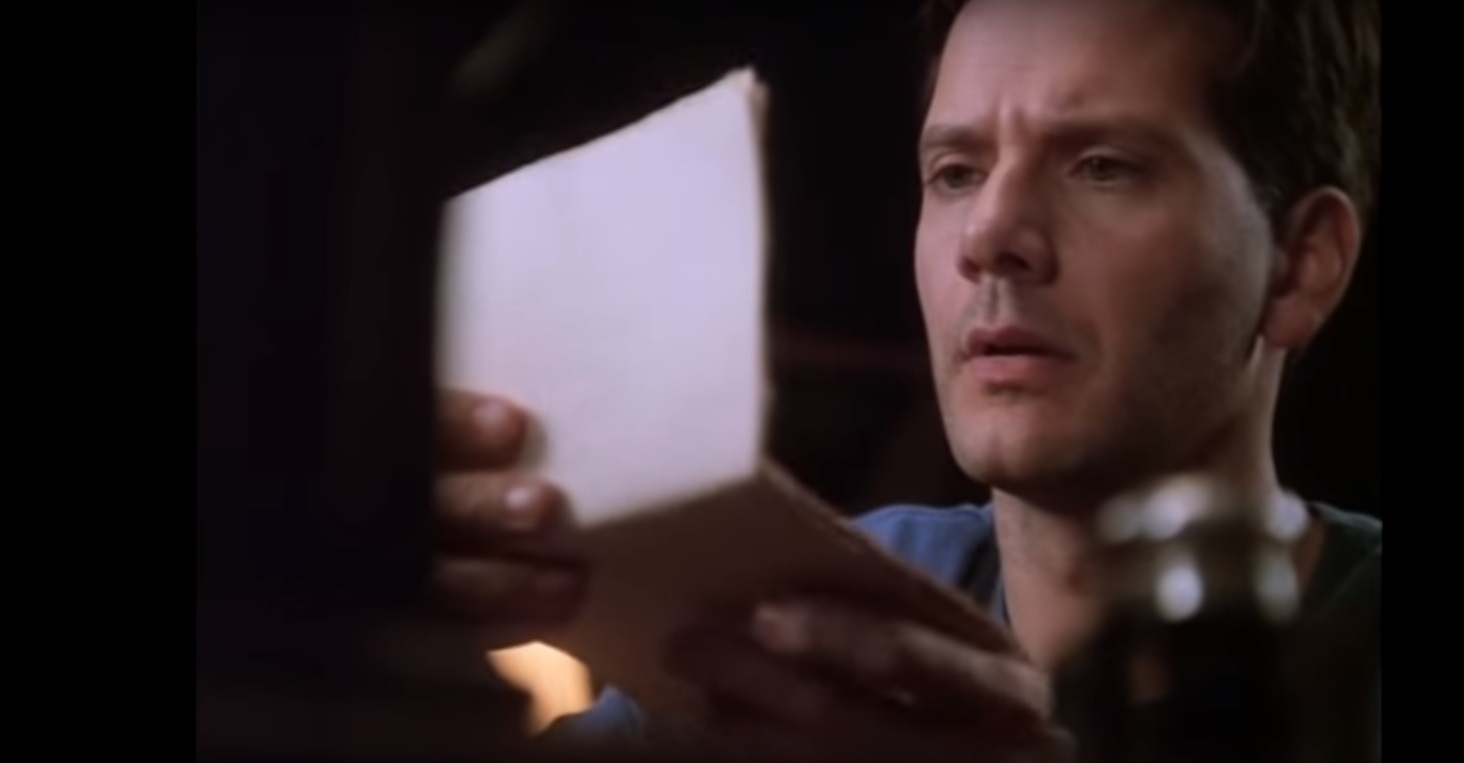
"THE LOVE LETTER" begins when a computer games designer named Scott Corrigan and his fiancée Debra Zabriskie stumble across an old desk at an antiques store in a suburb outside of Boston, Massachusetts. Being a Civil War history buff as well, Scott buys the desk and later, discovers a letter written in 1863, hidden inside a secret compartment. The letter's writer is a woman in her late 20s named Elizabeth Whitcomb, who conveys her secret feelings and desires to no one in particular. Scott shows the letter to his mother, who believes he may actually be able to communicate with Elizabeth across time. Mrs. Corrigan encourages him to reply with his own letter. She also gives Scott a postage stamp from the mid 19th century, and suggests he mail it from a local post office that had been constructed back in 1857. After Scott follows his mother's suggestions, Elizabeth receives his letter from the local postman, setting in motion a line of communication and developing emotions between them that crosses the boundaries of time.

I might as well put my cards on the table. I am not into television movies from the "HALLMARK HALL OF FAME" series. In fact, I can only think of two or three productions that I found interesting. By the time I had come around to watching "THE LOVE LETTER", I did it for only two reasons - I love time travel stories and I am a Civil War buff. Despite having Cameron Scott and Jennifer Jason Leigh in the leads, I did not have any high hopes for this production. I also discovered that "THE LOVE LETTER" was not a faithful adaptation of Finney's short story. Instead of being set in and around both 1998 and 1863 Boston, Finney's story was set in and around 1959 and 1880s Brooklyn, New York. Whereas the Scott Corrigan character was engaged in the 1998 movie, the lead in Finney's story was a single man. Finney's tale also lacked a mother character for his leading man . . . whereas the 1998 television featured a mother character. The Elizabeth Whitcomb character was plagued by headaches and Finney's leading lady was not. In the 1998 movie, Elizabeth was an aspiring character. But the Elizabeth Worley character in the short story was not.

However, I never found it important for a movie or television series to be completely loyal to its source material, especially if the production in question managed to capture its true essence. Being just as good or even better also helps. I have never read Finney's short story, but I have read the synopsis. Personally, I believe the 1998 movie proved to be just as good as the former. Dare I say . . . perhaps slightly better? I believe the additions created by James S. Henderson's screenplay had added more oomph to Finney's tale. Changing the 19th century from 1880s Brooklyn to 1863 New England and making the leading man a Civil War buff really appealed to my sense of history. But what made this movie even more poignant for me was the addition of lookalikes for the two leads in the story. Scott eventually met Elizabeth's lookalike, a dog owner with whom he becomes acquainted in the movie's end; and Elizabeth met Scott's doppelgänger, Union Army officer Colonel Caleb Denby during the movie's second half. Is it any wonder that I was not surprised to learn Henderson had won the Writers Guild of America Award for Television: Long Form – Adapted.

But what made "THE LOVE LETTER" really worked for me was the developing romance between the two character via the exchange of letters. I also enjoyed how their letters affected their lives. Elizabeth's correspondence with Scott had encouraged her reconsider a marriage proposal from one of her father's neighbors - a man she did not love. Their correspondence also led Scott to reconsider his feelings for his fiancée, a very nice woman with whom he seemed to be going through the motions. After Scott's mother had pointed out that his correspondence with Elizabeth seemed equal to emotional cheating, the movie featured one well-done but painful scene in which Scott revealed the true nature of his obsession with the desk to his fiancée. "THE LOVE LETTER" featured other memorable scenes - Scott and Elizabeth sensing each other's presence on the staircase, inside the Whitcombs' house; Scott's biking accident; Elizabeth's romance with Caleb Denby; the old post office fire in 1998, Elizabeth's journey to Gettysburg, and the battle's aftermath; and Scott's first meeting with Elizabeth's doppelgänger. But the after effects of the protagonists' correspondence is what I remembered most about this television movie.

I certainly did not have a problem with the movie's production values, much to my surprise. Although the 1990s did feature some period television movies with decent production values, I never really considered them top notch. One had to turn to television miniseries for that. And although I found the production values for "THE LOVE LETTER" pretty decent, they did not exactly blow me away. I must admit that I found Dorothy Adams' costume designs very impressive. I was also impressed by Bill Blunden's editing, as he alternated the scene shifts between 1998 and 1863 with such ease. I was especially impressed by Blunden's handling of the sequence, which alternated between Scott's biking accident and Elizabeth's first meeting with Colonel Denby.

As much as I had enjoyed "THE LOVE LETTER", I did have a few issues with it. I had a minor issue with the hairstyle worn by actress Jennifer Jason Leigh. I had no problems with her costumes. But why on earth was her hair worn in such a loose and vague fashion . . . as if the movie's hairstylist tried to create some hybrid fusion between 1860s and 1990s hair styles? I really hate it when a production crew tries to infuse modern fashion, dialogue, music and yes, even hair styles in a period setting. But my main issue with the film focused on Scott's communication with Elizabeth. All the latter had to do was write a letter and shove it inside the desk's special compartment in 1863. As the desk's current owner, Scott was bound to discover it. But Scott's method of communicating with Elizabeth struck me as . . . well, contrived. Thanks to his mother's instructions, he had to use a 19th century U.S. stamp on his letters' envelopes and mail them through an old post office constructed in the mid-19th century. This method enabled his letters to magically transport back to Elizabeth in 1863. I realize that the movie's screenwriters had adapted this method of time traveling from the original short story. But why utilize such a contrived method in the first place? Scott was not a wealthy man. The movie made this clear when he found himself bargaining with an antiques store owner in order to purchase the desk. Nor was he a business owner. Scott was an employee at a video game design company. An unused 19th century stamp would have probably be worth a good deal of money, even in 1998. Considering the number of letters that Scott had sent to Elizabeth, I can only wonder how much money he had spent to purchase more 19th century stamps. Would it have been easier for the screenwriters (or even Jack Finney, who wrote the original short story) to allow the desk or its secret compartment to be some kind of magical entity that allowed objects - including letters - transport through time?

But there is one thing I had no complaints about was the movie's cast. "THE LOVE LETTER" featured some solid performances from the likes of David Dukes, Kali Rocha, Myra Carter, Laurie Kennedy and Richard Woods. But I must admit that I found myself especially impressed by supporting performances from Daphne Ashbrook, Estelle Parsons, Irma P. Hall and Gerrit Graham. But why beat around the bush here. The pair who really carried the film . . . who really made this story worked were the movie's leads, Campbell Scott and Jennifer Jason Leigh. I thought Scott (the actor) did an excellent job in conveying his character's penchant for hiding or suppressing his passion for history, along with his growing obsession toward and love for Elizabeth with subtle reactions and a dry wit. Scott also had the additional task of portraying Colonel Caleb Denby, the Union officer who managed to woo Elizabeth with a charismatic charm. Leigh had never received the opportunity to delve into the personality of Elizabeth's 1998 doppelgänger. But I thought she gave a superb performance as the more openly emotional Elizabeth, who reacted with surprise and joy at the idea of corresponding with a mystery man who understood her, and who found herself struggling with a loving family determined to keep her constrained within a social straight jacket.

Over the past two-and-half decades, "THE LOVE LETTER" has become something of a cult favorite among fans of science-fiction/fantasy and period drama. After my recent rewatch of this television drama, I can see why it has remained very popular. I thought director Dan Curtis and screenwriter James S. Henderson did an excellent job in adapting Jack Finney's short story. And their efforts were enhanced by the excellent performances from the cast led by Campbell Scott and Jennifer Jason-Leigh.


Thursday, April 10, 2025

"THE LOVE LETTER" (1998) Photo Gallery


Below are images from "THE LOVE LETTER", the 1998 television adaptation of Jack Finney's 1959 short story. Directed by Dan Curtis, the television movie starred Campbell Scott and Jennifer Jason Leigh:


"THE LOVE LETTER" (1998) Photo Gallery


Friday, June 15, 2018

"GEORGE WASHINGTON" (1984) Review


"GEORGE WASHINGTON" (1984) Review

Twenty-four years before the award-winning HBO miniseries "JOHN ADAMS" aired, the CBS network aired a miniseries about the first U.S. President, George Washington. Simply titled "GEORGE WASHINGTON", this three-part miniseries was based upon two biographies written by James Thomas Flexner - 1965's "George Washington, the Forge of Experience, 1732–1775" and 1968's "George Washington in the American Revolution, 1775–1783"

"GEORGE WASHINGTON" spanned at least forty years in the life of the first president - from 1743, when his father Augustine Washington died from a sudden illness; to 1783, when Washington bid good-bye to the officers who had served under him during the American Revolutionary War. The miniseries covered some of the major events of Washington's life:

*His training and profession as a surveyor of Western lands
*His experiences as an officer of the Virginia militia during the Seven Years War
*His friendship with neighbors George William and Sally Cary Fairfax between the 1750s and the 1770s
*The romantic feelings between him and Sally Fairfax
*His marriage to widow Martha Dandridge Custis and his role as stepfather to her two children
*His life as a Virginia planter
*His role as a member of Virginia's House of Burgesses
*His growing disenchantment with the British Parliament
*His brief experiences as a representative of the Second Continental Congress
*And his experiences as Commander-in-Chief of the Continental Army


Actually, one half of the miniseries covered Washington's life from his childhood to his years as a Virginia planter. The other half covered his experiences during the American Revolution. Glancing at the list above, I realized that "GEORGE WASHINGTON"covered a great deal in Washington's life. More importantly, Jon Boothe and Richard Fielder did a first-rate job by delving into the many aspects of the man's life and his relationships with great details and depth. This was especially apparent in Washington's relationships with his controlling mother, Mary Ball Washington; his friendship with George William Fairfax; his light romance with Sally Fairfax; his relationships with his military aides during the American Revolution and especially his marriage to Martha Custis.

I found it interesting that the miniseries managed to convey how difficult and controlling Mary Washington was as a parent. However, I found it slightly disappointing that the miniseries did not further explore Washington's relationship with his mother, once he became swept up into the Seven Year's War - especially since she had survived long enough to witness him become the first U.S. president. 

Washington's relationship with George William "Will" Fairfax proved to be a complex matter for two reasons. One, Will Fairfax had remained loyal to the British Crown throughout his life. During the decade leading to the outbreak of the American Revolution, that relationship threatened to fall apart due to the two friends' different political belief - something I was happy to see that the miniseries had conveyed. Another aspect that posed a threat to Washington's friendship with Fairfax was his romantic feelings for the man's wife, Sally Fairfax . . . and her feelings for him. There have been rumors that Washington's relationship with Sally had led to physical adultery, but no proof. But there is proof that they had strong feelings for one another and the miniseries; due to Fiedler and Boothe's screenplay, along with the performances of Barry Bostwick and Jaclyn Smith; did an excellent job of conveying the pair's emotional regard for each other in a subtle and elegant manner. What I found even more amazing was the miniseries' portrayal of Washington's courtship of and his marriage to Martha Custis. I was surprised that Boothe and Fiedler had portrayed Washington's feelings toward her with such ambiguity. This left me wondering if he had married her for love . . . or for her fortune. By the last half hour or so of the miniseries, Washington finally admitted to Martha that he did love her. However, the manner in which Bostwick portrayed that scene, I found myself wondering if Washington was himself amazed by how much his feelings for Martha had grown. 

I do not know what to say about the miniseries' portrayal of Washington's relationships with his military aides during the American Revolution. I do not doubt that his aides were loyal to him or probably even worship him. But I must admit that it seemed the miniseries' portrayal of this relationship seemed to make Washington's character just a touch too ideal for my tastes. In fact, one of the miniseries' main problems seemed to be its idealistic portrayal of the main character. Aside from Washington's bouts of quick temper, his ambiguous affections for his wife Martha, and his cold relationship with his less than ideal stepson, John "Jacky" Parke Custis; the miniseries made very little effort to portray Washington in any negative light. In fact, Washington's demand for higher rank within the Virginia militia and British Army during the Seven Years War is portrayed as justified, thanks to Fiedler and Boothe's screenplay. Personally, I found his demand rather arrogant, considering his young age (early to mid-20s) and limited training and experience as a military officer at the time. Not only did I found his demand arrogant, but also rather astounding. What I found even more astounding was the miniseries' attitude that television viewers were supposed to automatically sympathize with Washington's demands.

The miniseries' portrayal of Washington in the second half - the period that covered the American Revolution - nearly portrayed the planter-turned-commander as a demigod. Honestly. Aside from his occasional bursts of temper, General George Washington of the Continental Army - at least in this miniseries - was a man who could do no wrong. And at times, I found this rather boring. I cannot recall any moment during the miniseries' second half that questioned Washington's decisions or behavior. Most of his military failures were blamed on either military rivals or limited support from the Continental Congress. 

And then . . . there was the matter of black soldiers serving in the Continental Army. According to "GEORGE WASHINGTON", Southern representative in Congress wanted blacks - whether they were former slaves or freemen - banned from serving in the army. It was Washington who demanded that Congress allow black men to fight alongside white men in the country's rebellion against the British Empire. By the way . . . this was a complete lie. Despite black men fighting in the Massachusetts militias during the Battles at Lexington and Concord and the Battle of Bunker Hill, Washington signed an order forbidding them to become part of the Continental Army when the white New England militiamen did. Come to think of it, when it came to racism and slavery, "GEORGE WASHINGTON" presented a completely whitewashed portrait of the future president. The miniseries even featured a pre-war scene in which Washington prevented his overseer from breaking apart slave families at Mount Vernon by selling some of the slaves for needed funds for the plantation. In reality, Washington was not above selling off slaves or breaking up families for the sake of profit or punishing a slave. At a time when historians and many factions of the American public were willing to view the Founding Fathers in a more ambiguous light; Fiedler and co-producers Buzz Kulik and David Gerber lacked the guts to portray Washington with a bit more honestly . . . especially in regard to race and slavery. If they had been more honest, they could have portrayed Washington's growing unease over slavery and race, following Congress' decision to allow them within the ranks of the Continental Army in 1777. Unfortunately, putting Washington on a pedestal seemed more important than allowing him some semblance of character development.

Production wise, "GEORGE WASHINGTON" struck me as first-rate. The miniseries had been shot in locales in Virginia and Southern Pennsylvania, adding to the production's 18th century Colonial America atmosphere. I cannot say whether Harry Stradling Jr.'s cinematography also contributed to the miniseries' setting. If I must be honest, I did not find his photography that memorable. But I was impressed by Alfred Sweeney's production designs, along with Sig Tingloff's art direction and Arthur Jeph Parker's set decorations. However, I had a problem with the costume choices selected by a costume team supervised by Michael W. Hoffman. To be honest, I did not have much trouble with the costumes for the men. The women's costumes proved to be another man. A good deal of the story is set among the colonial Virginia gentry. I hate to say this, but I found a good deal of the women's costumes less than impressive. They looked as if they came straight from a costume warehouse in the middle of Hollywood. I especially had a problem with Jaclyn Smith's wardrobe as Sally Fairfax. I realize that she is supposed to be an 18th century version of a Southern belle. But there were one or two costumes that seemed to be some confusing mixture of mid 18th and mid 19th centuries. Yikes.

I certainly had no problem with the performances featured in the 1984 miniseries. The latter featured solid performances from legendary actors like Lloyd Bridges, Jose Ferrer, Trevor Howard, Jeremy Kemp, Clive Revill, Anthony Zerbe, Robert Stack and Hal Holbrook. However, I really enjoyed James Mason's energetic portrayal of the doomed General Edward Braddock; Rosemary Murphy's skillful performance as the future president's demanding mother, Mary Ball Washington; Richard Kiley's emotional portrayal of Washington's neighbor, planter George Mason; and John Glover's ambiguous performance as the ambitious Revolutionary officer, Charles Lee. I was also impressed by Stephen Macht's performance as the ambitious and volatile Benedict Arnold. I could also say the same about Megan Gallagher's portrayal of Arnold's wife, Peggy Shippen. Ron Canada provided a good deal of depth in his limited appearances as Washington's slave valet, Billy Lee. Philip Casnoff, who was a year away from his stint in the "NORTH AND SOUTH" miniseries, gave a very charming and humorous performance as Washington's French-born aide and close friend, the Marquis de Lafayette. And Leo Burmester gave an excellent performance as Eban Krutch, the New England born Continental soldier, who served as the viewers' eyes of both Washington and the war throughout the miniseries' second half.

I really enjoyed David Dukes' performance as Washington's neighbor, mentor and close friend, Will Fairfax. I found it quite energetic and charming. And he managed to develop a first-rate chemistry with Barry Bostwick. Come to think of it, so did Jaclyn Smith, who portrayed Fairfax's wife and the object of Washington's desire, Sally Fairfax. I also found Smith's performance rather complex as she had to convey her character's feelings for Washington in a subtle manner. At first, I found Patty Duke's portrayal of the future First Lady, Martha Washington, solid but not particularly interesting. Thankfully, the last quarter of the miniseries allowed Duke to prove what a first-rate actress she could be, as it explored Mrs. Washington's reaction to the privations suffered by the Continental Army's rank-and-file. Her performance led to an Emmy nomination. And finally, I come to the man of the hour himself, Barry Bostwick. Despite the miniseries being guilty of whitewashing some of Washington's character, I cannot deny that Bostwick gave a superb performance. The actor skillfully conveyed Washington's character from the callow youth who was dominated by his mother and his ambition to the weary, yet iconic military general who carried the rebellion and the birth of a country on his shoulders. It is a pity that he did not receive any award nominations for his performance.

I may have my complaints about "GEORGE WASHINGTON". Despite its detailed account of the first president's life, I believe it went out of its way to protect his reputation with occasional whitewashing. And some of the miniseries' production values - namely the women's costumes - struck me as a bit underwhelming. But despite its flaws, "GEORGE WASHINGTON" proved to be a first-rate miniseries that delved into the history of the United States during the mid-and-late 18th century, via the life of one man. It also benefited from excellent direction from Buzz Kulik and superb performances led by the talented Barry Bostwick. Not surprisingly, the miniseries managed to earn at least six Emmy nominations.

Wednesday, May 2, 2018

"GEORGE WASHINGTON" (1984) Photo Gallery


Below are images from "GEORGE WASHINGTON", the 1984 adapation of 1965's "George Washington, the Forge of Experience, 1732–1775" and 1968's "George Washington in the American Revolution, 1775–1783", two of James Thomas Flexner's biographies on the first U.S. President. Directed by Buzz Kulik, the three-part miniseries starred Barry Bostwick as George Washington: 


"GEORGE WASHINGTON" (1984) Photo Gallery