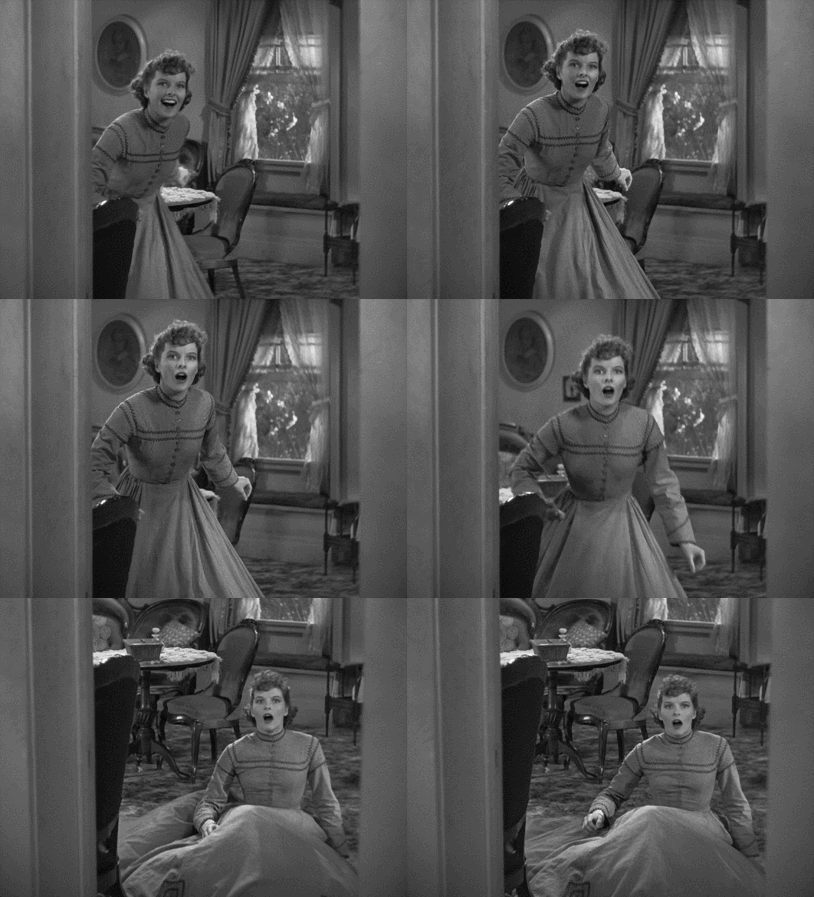
"LITTLE WOMEN" (1933) Review
There have been many adaptations of Louisa May Alcott's 1868-69 best-selling two-volume novel, "Little Women". And I mean many adaptations - on stage and in movies and television. I have personally seen three television adaptations and four movie adaptations. One of the most famous versions of Alcott's novel is the 1933 movie adaptation, produced by Merian C. Cooper and directed by George Cukor.
Although I have seen at four adaptations more than once, I had just watched this version for the very first time. Judging from the reviews and articles I have read, Cukor's "LITTLE WOMEN" seemed to be the benchmark that all other versions are based upon. So, you could imagine my anticipation about this film before watching it. How did I feel about "LITTLE WOMEN"? That would require a complicated answer.
"LITTLE WOMEN" told the story of the four March sisters of Concord, Massachusetts - Margaret (Meg), Josephine (Jo), Elizabeth (Beth) and Amy - during and after the U.S. Civil War. Since second daughter Jo is the main character, the story focuses on her relationships with her three other sisters, her parents (especially her mother "Marmee"), the sisters' Aunt March, and the family's next-door neighbors, Mr. James Laurence and his grandson Theodore ("Laurie"). Although each sister experiences some kind of coming-of-age throughout the story, the movie focuses on Jo's development through her relationship with Laurie and a German immigrant she meets in New York City after the war, the charming and older Professor Friedrich Bhaer. Jo and her sisters deal with the anxiety of their father's involvement in the Civil War, genteel poverty, scarlet fever, wanted and unwanted romance, and Jo's fear of dealing the family breaking apart as she and her sisters grow older.
I must saw that the production values for "LITTLE WOMEN" were certainly top-notch. One has to credit producer Merian C. Cooper in gathering a team of excellent artists to re-create 1860s Massachusetts and New York for the movie. I was especially impressed by Van Nest Polglase's art direction, Sydney Moore and Ray Moyer's set decorations and art direction team of Hobe Erwin, George Peckham, and Charles Sayers. However, I simply have to single out Walter Plunkett's excellent costume designs for the film. I doubt very much that Plunkett's costumes were an accurate depiction of 1860s fashion, I believe he came close enough. Plunkett's career also included work for 1939's "GONE WITH THE WIND", "RAINTREE COUNTY", from 1957 and the 1949 version of "Little Women". I suspect that this film marked his debut for designing costumes for the mid-19th century. I did have a problem with the hairstyles worn by three of the four leads. A good deal of early 1930s hairstyles seemed to have been used - with the exception of the short bob. At least three of the actresses wore bangs . . . a lot. Bangs were not popular with 19th century women until the late 1870s and the 1880s.
Until the release of the 2019 film, George Cukor's adaptation of Alcott's novel has been considered the best by many film critics. Do I agree with this assessment? Well, I cannot deny that I had enjoyed watching "LITTLE WOMEN". One, producer Merian C. Cooper and director George Cukor did an excellent job in their selection of the cast - especially the four actresses who portrayed the March sisters. All four had excellent chemistry. The movie's portrayal of the U.S. Civil War and the years that followed it immediately struck me as pretty solid. And although there were moments when the film threatened to border on saccharine, I must admit that Cukor and the screenplay written by Victor Heerman and Sarah Y. Mason kept both the narrative and the film's pacing very lively. And finally, I enjoyed how the movie depicted Jo's friendship and romance with Professor Friedrich Bhaer. I found it warm, charming, romantic and more importantly . . . not rushed.
However, I do have a few issues with "LITTLE WOMEN". There were times when the movie, especially during its first half hour, seemed in danger of wallowing in saccharine. I get it. Alcott had portrayed the Marches as a warm and close-knit family. But Alcott had included minor conflicts and personality flaws in the family's portrait as well. It seemed as if director George Cukor, along with screenwriters Sarah Y. Mason and Victor Heerman were determined to whitewash this aspect of Alcott's novel as much as possible. This whitewashing led to the erasure of one novel's best sequences - namely Amy March's burning of Jo's manuscript in retaliation for an imagined slight, Amy's conflict with her schoolteacher, the development of Amy and Laurie's relationship in Europe, and Meg's conflict Aunt March over her relationship with tutor John Brooke. These deletions took a lot out of Alcott's story. It amazes me to this day that so many film critics have willingly overlooked this. Do not get me wrong. "LITTLE WOMEN" remained an entertaining film. But in erasing these aspects of Alcott's story, Cukor and the two screenwriters came dangerously close to sucking some of the life out of this film. Ironically, Mason and Heerman repeated their mistake in MGM's 1949 adaption with the same results.
Most critics and movie fans tend to praise Katherine Hepburn's portrayal of Jo March to the sky. In fact, many critics and film historians to this day have claimed Hepburn proved to be the best Jo out of all the actresses who have portrayed the character. Do I agree? No. Although I admired Hepburn's performance in the movie's second half, I found her portrayal of the adolescent Jo in the first half to be a mixed bag. There were times when I admired her spirited performance. There were other times when said performance came off as a bit too strident for my tastes. I honestly do not know what to say about Frances Dee's performance as Meg March. My problem is that I did not find her portrayal that memorable. I barely remember Dee's performance, if I must be honest. I cannot say the same about Joan Bennett's portrayal of the youngest March sibling, Amy. Mind you, Bennett never received the chance to touch upon Amy's less pleasant side of her nature. And it is a pity that the screenplay failed to give Bennett the opportunity to portray Amy's growing maturity in the film's second half. But I have to admit that as a woman who was roughly three years younger than Hepburn, she gave a more subtle performance as a pre-teen and adolescent Amy, than Hepburn did as the teenaged Jo. The one performance that really impressed me came from Jean Parker's portrayal of Beth March, the family's shyest member. I thought Parker did an excellent job of conveying Beth's warmth, fear of being in public and the long, slow death the character had suffered following a deadly bout of scarlet fever.
I can honestly say that Mrs. "Marmee" March would never be considered as one of my favorite Spring Byington roles. Mind you, the actress gave a competent performance as the March family's matriarch. However, there were times when she seemed too noble, good or too ideal for me to regard her as a human being. As is the case in most, if not all versions of "LITTLE WOMEN", the Mr. March character barely seemed alive . . . especially after he returned home from the war. I cannot blame actor Samuel S. Hinds, who portrayed. I blame the screenwriters for their failure to do the character any justice. On the other hand, I did enjoy Henry Stephenson's portrayal of the complicated, yet likeable Mr. Laurence. I enjoyed how Stephenson managed to slowly, but surely reveal the warm human being behind the aloof facade. Edna May Oliver gave a very lively performance as the irascible, yet wealthy Aunt March. In fact, I would go as far to say that her performance had breathed a great deal of fresh air into the production. Not many critics were impressed by Douglass Montgomery's portrayal of the March sisters' closes friend, Theodore "Laurie" Laurence. I can honestly say that I do not share their opinion. Frankly, I felt more than impressed by his portrayal of the cheeky, yet emotional Laurie. I thought he gave one of the film's better performances - especially in one scene Laurie reacted to Jo's rejection of his marriage proposal. I thought Montgomery did an excellent job of reacting emotionally to Jo's rejection, without going over the top. I also enjoyed Paul Lukas' interpretation of Professor Bhaer. There were moments when his performance threatened to get a little hammy. But the actor managed to reign in his excesses - probably more so than Hepburn. And he gave a warm and charming performance as the romantic Professor Bhaer.
Yes, I have some issues with this adaptation of "LITTLE WOMEN". If I must be honest, most of my issues are similar to my issues with the 1949 adaptation. This should not be surprising, since both movies were written by the same screenwriters - Sarah Y. Mason and Victor Heerman. However . . . like the 1949 movie, this "LITTLE WOMEN" adaptation proved to be a solid and entertaining adaptation of Louisa May Alcott's novel. One can thank Mason and Heerman, director George Cukor and the fine cast led by the talented Katherine Hepburn.