Showing posts with label spring byington. Show all posts

Monday, November 7, 2022

"LITTLE WOMEN" (1933) Review


"LITTLE WOMEN" (1933) Review

There have been many adaptations of Louisa May Alcott's 1868-69 best-selling two-volume novel, "Little Women". And I mean many adaptations - on stage and in movies and television. I have personally seen three television adaptations and four movie adaptations. One of the most famous versions of Alcott's novel is the 1933 movie adaptation, produced by Merian C. Cooper and directed by George Cukor.

Although I have seen at four adaptations more than once, I had just watched this version for the very first time. Judging from the reviews and articles I have read, Cukor's "LITTLE WOMEN" seemed to be the benchmark that all other versions are based upon. So, you could imagine my anticipation about this film before watching it. How did I feel about "LITTLE WOMEN"? That would require a complicated answer.

"LITTLE WOMEN" told the story of the four March sisters of Concord, Massachusetts - Margaret (Meg), Josephine (Jo), Elizabeth (Beth) and Amy - during and after the U.S. Civil War. Since second daughter Jo is the main character, the story focuses on her relationships with her three other sisters, her parents (especially her mother "Marmee"), the sisters' Aunt March, and the family's next-door neighbors, Mr. James Laurence and his grandson Theodore ("Laurie"). Although each sister experiences some kind of coming-of-age throughout the story, the movie focuses on Jo's development through her relationship with Laurie and a German immigrant she meets in New York City after the war, the charming and older Professor Friedrich Bhaer. Jo and her sisters deal with the anxiety of their father's involvement in the Civil War, genteel poverty, scarlet fever, wanted and unwanted romance, and Jo's fear of dealing the family breaking apart as she and her sisters grow older.

I must saw that the production values for "LITTLE WOMEN" were certainly top-notch. One has to credit producer Merian C. Cooper in gathering a team of excellent artists to re-create 1860s Massachusetts and New York for the movie. I was especially impressed by Van Nest Polglase's art direction, Sydney Moore and Ray Moyer's set decorations and art direction team of Hobe Erwin, George Peckham, and Charles Sayers. However, I simply have to single out Walter Plunkett's excellent costume designs for the film. I doubt very much that Plunkett's costumes were an accurate depiction of 1860s fashion, I believe he came close enough. Plunkett's career also included work for 1939's "GONE WITH THE WIND", "RAINTREE COUNTY", from 1957 and the 1949 version of "Little Women". I suspect that this film marked his debut for designing costumes for the mid-19th century. I did have a problem with the hairstyles worn by three of the four leads. A good deal of early 1930s hairstyles seemed to have been used - with the exception of the short bob. At least three of the actresses wore bangs . . . a lot. Bangs were not popular with 19th century women until the late 1870s and the 1880s.

Until the release of the 2019 film, George Cukor's adaptation of Alcott's novel has been considered the best by many film critics. Do I agree with this assessment? Well, I cannot deny that I had enjoyed watching "LITTLE WOMEN". One, producer Merian C. Cooper and director George Cukor did an excellent job in their selection of the cast - especially the four actresses who portrayed the March sisters. All four had excellent chemistry. The movie's portrayal of the U.S. Civil War and the years that followed it immediately struck me as pretty solid. And although there were moments when the film threatened to border on saccharine, I must admit that Cukor and the screenplay written by Victor Heerman and Sarah Y. Mason kept both the narrative and the film's pacing very lively. And finally, I enjoyed how the movie depicted Jo's friendship and romance with Professor Friedrich Bhaer. I found it warm, charming, romantic and more importantly . . . not rushed.

However, I do have a few issues with "LITTLE WOMEN". There were times when the movie, especially during its first half hour, seemed in danger of wallowing in saccharine. I get it. Alcott had portrayed the Marches as a warm and close-knit family. But Alcott had included minor conflicts and personality flaws in the family's portrait as well. It seemed as if director George Cukor, along with screenwriters Sarah Y. Mason and Victor Heerman were determined to whitewash this aspect of Alcott's novel as much as possible. This whitewashing led to the erasure of one novel's best sequences - namely Amy March's burning of Jo's manuscript in retaliation for an imagined slight, Amy's conflict with her schoolteacher, the development of Amy and Laurie's relationship in Europe, and Meg's conflict Aunt March over her relationship with tutor John Brooke. These deletions took a lot out of Alcott's story. It amazes me to this day that so many film critics have willingly overlooked this. Do not get me wrong. "LITTLE WOMEN" remained an entertaining film. But in erasing these aspects of Alcott's story, Cukor and the two screenwriters came dangerously close to sucking some of the life out of this film. Ironically, Mason and Heerman repeated their mistake in MGM's 1949 adaption with the same results.

Most critics and movie fans tend to praise Katherine Hepburn's portrayal of Jo March to the sky. In fact, many critics and film historians to this day have claimed Hepburn proved to be the best Jo out of all the actresses who have portrayed the character. Do I agree? No. Although I admired Hepburn's performance in the movie's second half, I found her portrayal of the adolescent Jo in the first half to be a mixed bag. There were times when I admired her spirited performance. There were other times when said performance came off as a bit too strident for my tastes. I honestly do not know what to say about Frances Dee's performance as Meg March. My problem is that I did not find her portrayal that memorable. I barely remember Dee's performance, if I must be honest. I cannot say the same about Joan Bennett's portrayal of the youngest March sibling, Amy. Mind you, Bennett never received the chance to touch upon Amy's less pleasant side of her nature. And it is a pity that the screenplay failed to give Bennett the opportunity to portray Amy's growing maturity in the film's second half. But I have to admit that as a woman who was roughly three years younger than Hepburn, she gave a more subtle performance as a pre-teen and adolescent Amy, than Hepburn did as the teenaged Jo. The one performance that really impressed me came from Jean Parker's portrayal of Beth March, the family's shyest member. I thought Parker did an excellent job of conveying Beth's warmth, fear of being in public and the long, slow death the character had suffered following a deadly bout of scarlet fever.

I can honestly say that Mrs. "Marmee" March would never be considered as one of my favorite Spring Byington roles. Mind you, the actress gave a competent performance as the March family's matriarch. However, there were times when she seemed too noble, good or too ideal for me to regard her as a human being. As is the case in most, if not all versions of "LITTLE WOMEN", the Mr. March character barely seemed alive . . . especially after he returned home from the war. I cannot blame actor Samuel S. Hinds, who portrayed. I blame the screenwriters for their failure to do the character any justice. On the other hand, I did enjoy Henry Stephenson's portrayal of the complicated, yet likeable Mr. Laurence. I enjoyed how Stephenson managed to slowly, but surely reveal the warm human being behind the aloof facade. Edna May Oliver gave a very lively performance as the irascible, yet wealthy Aunt March. In fact, I would go as far to say that her performance had breathed a great deal of fresh air into the production. Not many critics were impressed by Douglass Montgomery's portrayal of the March sisters' closes friend, Theodore "Laurie" Laurence. I can honestly say that I do not share their opinion. Frankly, I felt more than impressed by his portrayal of the cheeky, yet emotional Laurie. I thought he gave one of the film's better performances - especially in one scene Laurie reacted to Jo's rejection of his marriage proposal. I thought Montgomery did an excellent job of reacting emotionally to Jo's rejection, without going over the top. I also enjoyed Paul Lukas' interpretation of Professor Bhaer. There were moments when his performance threatened to get a little hammy. But the actor managed to reign in his excesses - probably more so than Hepburn. And he gave a warm and charming performance as the romantic Professor Bhaer.

Yes, I have some issues with this adaptation of "LITTLE WOMEN". If I must be honest, most of my issues are similar to my issues with the 1949 adaptation. This should not be surprising, since both movies were written by the same screenwriters - Sarah Y. Mason and Victor Heerman. However . . . like the 1949 movie, this "LITTLE WOMEN" adaptation proved to be a solid and entertaining adaptation of Louisa May Alcott's novel. One can thank Mason and Heerman, director George Cukor and the fine cast led by the talented Katherine Hepburn.


Monday, September 5, 2022

"LITTLE WOMEN" (1933) Photo Gallery


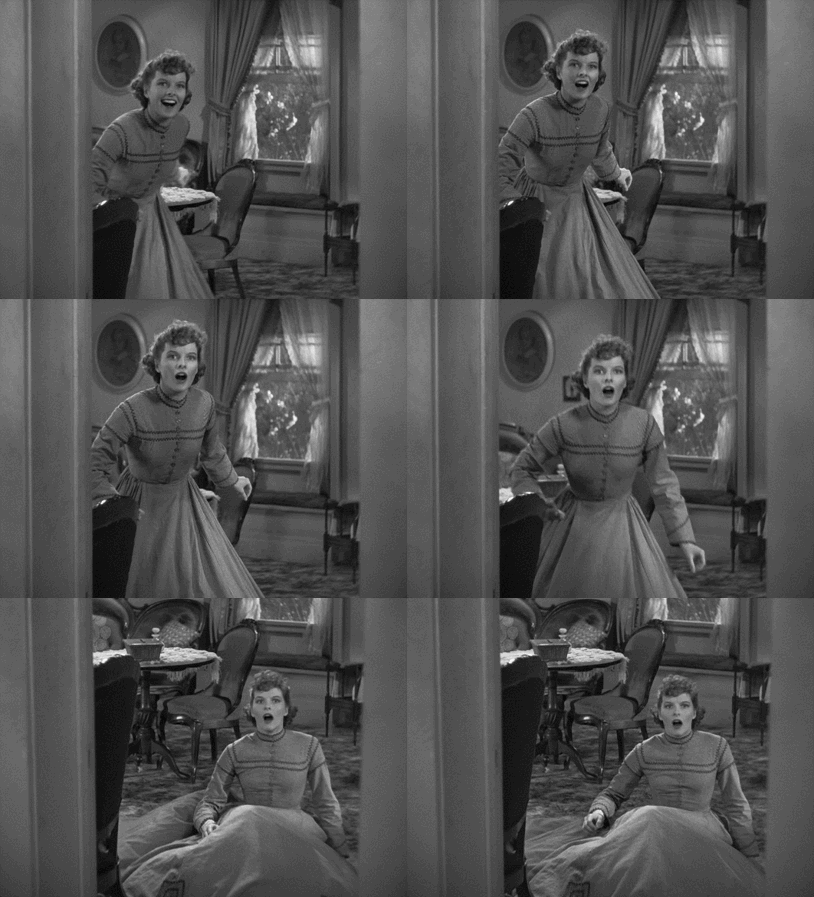
Below are images from "LITTLE WOMEN", the 1933 adaptation of Louisa May Alcott's 1868-69 novel. Directed by George Cukor, the Oscar nominated film starred Katherine Hepburn, Joan Bennett, Frances Dee, Jean Parker and Douglass Montgomery:


"LITTLE WOMEN" (1933) Photo Gallery


Wednesday, February 24, 2021

"DRAGONWYCK" (1946) Review


"DRAGONWYCK" (1946) Review

Being an aficionado of old Hollywood period dramas, I noticed that it was rare to find movies set in the antebellum North. Very rare. I have tried to think of how many of these films I have come across. And to be honest, I can only think of four or five so far, in compare to the numerous films set in the antebellum South. One of those Northern antebellum tales proved to be the 1946 movie, "DRAGONWYCK". 

Based upon Anya Seton's 1944 novel, adapted by Joseph L. Mankiewicz and directed by him; "DRAGONWYCK" began in 1844 Greenwich, Connecticut; when Miranda Wells, the daughter of a religious farm couple, receives a letter from distant cousin Nicholas Van Ryn. Nicholas, the autocratic and charming owner (Patroon) of a Hudson River Valley estate called Dragonwyck, asks if one of Ephraim and Abigail's daughters could act as governess for his eight year-old daughter, Katrine. Miranda, who daydreams about a more romantic and luxurious lifestyle, manages to convince her doubting parents to let her go. 

Upon her arrival at Dragonwyck, Miranda meets the young Katrine and Nicholas' wife, a gluttonous, yet slightly high-strong woman named Johanna. She also meets the handsome local doctor, Dr. Jeff Turner, at the "kermess" - a ceremony where landowner Nicholas receives the rents of his tenants. Not only does Miranda become aware of the strange atmosphere at Dragonwyck and the tense relationship between Nicholas and his tenants; she also finds herself falling in love with her cousin and employer . . . and he with her. This budding relationship between the pair proves to be quite disastrous for all concerned.

After my second viewing of "DRAGONWYCK", I realized that I could never regard it as a personal favorite. The writing for some of the film's supporting characters struck me as theatrical and one-dimensional. Unfortunately, I have to include the Ephraim Wells character, who came off as a clichéd version of the 19th century religious American male and Peggy, the young maid loyal to Miranda. During the film's third act, the narrative revealed that Nicholas Van Ryn's lack of religious belief. Was this supposed to cap his position as an immoral and villainous man? Because honestly . . . I realized that I could not care less about his lack of belief. And I found it ridiculous that his status as a non-believer was supposed to be a sign of his villainy. I understand. Perhaps the majority of moviegoers felt differently in 1946. Needless to say, this aspect of Nicholas' character did not age well over the past 72 to 73 years. I was not that impressed by the film's finale in which Nicholas had a showdown with his discontented tenants. Although it featured an excellent performance by Vincent Price, I found the actual sequence a bit anti-climatic. I noticed that the film's ending was different from the one written by Anya Seton. However, I found Seton's ending in the novel more dramatic, but somewhat ludicrous. I could see why Mankiewicz had changed the ending.

Although I could never regard "DRAGONWYCK" as a personal favorite of mine, I must admit that I found it to be a rather first-rate film. The movie - the story itself - struck me as a prime example of American Gothic literature. In fact, I would go as far to claim that the narrative almost reminds me of Charlotte Brontë's 1847 novel, "Jane Eyre", but with a darker twist. Unlike Brontë's tale, "DRAGONWYCK" included the specter of murder and class conflict. The latter included the historical conflict known as the Anti-Rent War, in which tenants in upstate New York revolted and declared their independence from the manor system operated by patroons, by resisting tax collectors and successfully demanding land reform between 1839 and 1845.

One would think that the Miranda Wells character would be the narrative's center or force. A part of me feels sad that I cannot make that claim. For the most interesting aspect of "DRAGONWYCK" proved to be the Nicholas Van Ryn character. Was he supposed to be a mere villain? If a person viewed him from how he had ended his marriage to the voracious Johanna, he or she could regard him as such. On the other hand, I found it difficult to regard his refusal to embrace his wife's new-founded religious fervor as monstrous. Which meant that in the end, Nicholas became something of a repellent, yet fascinating character to me. A true force of nature. I wish I could have said the same about Miranda. I found her charming and extroverted, but after her marriage to Nicholas turned sour, she became something of an annoyance. Being the offspring of religious parents, I was not surprised that she eventually turned to religion. But I found it annoying that religious fervor was the only literary device used to develop her character and nothing else. Nicholas, on the other hand, proved to be a lot more complex.

A part of me wishes that "DRAGONWYCK" had been filmed in Technicolor. It would have been interesting to view Twentieth Century-Fox's version of antebellum New York State in color. Especially the Hudson River Valley. I am not begrudging Arthur C. Miller's cinematography. His work for the film's interior shots, especially those for the Dragonwyck manor had provided a great deal of atmosphere, adding to the film's Gothic narrative. But I was not that impressed by the exterior shots. I must admit that I have no memories of the film's score by Alfred Newman. I thought Lyle R. Wheeler and J. Russell Spencer's art direction, along with Thomas Little's set decorations were excellent . . . especially for the Dragonwyck manor and New York City hotel's interiors. However, I truly enjoyed René Hubert's beautiful costume designs for the movie. Were they accurate examples of mid-1840s fashion? I have my doubts. But as the images below reveal, they were gorgeous:


I might as well focus on the movie's actual performances. Were there any bad performances? No. "DRAGONWYCK" can honestly boast some solid or excellent performances. The supporting cast featured some solid performances from the likes of Harry Morgan as one of Nicholas' angry tenants, Connie Marshall as Nicholas' daughter Katrine, and Trudy Marshall as neighbor Elizabeth Van Borden. Future Oscar winner Jessica Tandy's portrayal of Miranda's Irish-born maid Peggy O'Malley struck me as a bit theatrical. I could also say the same about another future Oscar winner Walter Huston, who portrayed Miranda's religious father Ephraim Wells. Anne Revere's portrayal of Miranda's mother Abigail Wells seemed a lot more subtle . . . and skillful. Spring Byington portrayed the Van Ryns' manipulative and slightly creepy maid Magda. A part of me wondered if it was Mankiewicz or Seton's intention to create a more benign version of the Mrs. Danvers character from "REBECCA". Vivienne Osborne, on the other hand, gave a very skillful performance as Nicholas' first wife, the gluttonous and insecure Johanna Van Ryn. I did not know whether to share Nicholas' disgust for her or feel any sympathy toward her for being married to a creep.

I was prepared to dismiss Glenn Langan's performance as the handsome local physician, Dr. Jeff Turner, who befriends Miranda. I had assumed that he would be another one of those bland leading men that the Hollywood system tried to transform into a movie star. After my recent viewing of "DRAGONWYCK", I realized that Langan gave an interesting performance by skillfully conveying Jeff's barely concealed anger toward Nicholas' arrogance. However, my vote for the best performance would go to Vincent Price's portrayal of Nicholas Van Ryn. I thought he gave a brilliant and dynamic performance as the arrogant, yet charismatic Nicholas, whose villainy proved to be rather enigmatic. Gene Tierney did an excellent job in carrying the film as the lead Miranda Wells. I was very impressed by her portrayal of the more ebullient and naive Miranda during the first two-thirds of the film. But once Miranda's marriage to Nicholas began to fail, Tierney's portrayal of the character fell flat. I do not blame her. I blame the manner in which the character had become one-dimensional, thanks to Anya Seton's novel and Joseph Mankiewicz's screenplay.

Overall, I rather enjoyed "DRAGONWYCK". It was not perfect. No film is. But I was a little put off by some theatrical acting in the film, the decline of the Miranda Wells character and the writing overall during the movie's final fifteen to twenty minutes. But I must admit I enjoyed most of the film's narrative. Many would dismiss it as costume melodrama. Personally, I see no reason to dismiss melodrama. It can be appreciated, if written well like other forms of fiction. Thanks to Joseph Mankiewicz's screenplay and direction, along with a competent cast led by Gene Tierney and Vincent Price; "DRAGONWYCK" proved to be more entertaining than I had previously surmised.


Tuesday, January 12, 2021

"DRAGONWYCK" (1946) Photo Gallery


Below are images from "DRAGONWYCK", the 1946 adaptation of Anya Seton's 1944 novel. Written and directed by Joseph L. Mankiewicz, the movie starred Gene Tierney and Vincent Price:


"DRAGONWYCK" (1946) Photo Gallery


GeneDragonwyck.jpg


Dragonwyck_1946_e.jpg


e2wum5p6wxrnw2mr.jpg


Dragonwyck_(1946)_1.jpg

Monday, June 22, 2020

"JEZEBEL" (1938) Review


"JEZEBEL" (1938) Review

Following the release of Margaret Mitchell's 1936 novel, "Gone With the Wind", some Hollywood studios scrambled to find a way to cash in on its success. Producer David O. Selznick managed to purchase the film rights to Mitchell's novel. However, Warner Brothers Studios decided to do its own Southern melodrama called "JEZEBEL".

Directed by William Wyler, "JEZEBEL" starred Bette Davis in the title role as a headstrong New Orleans belle named Julie Marsden in the early 1850s. Julie's vanity and willful nature leads her to a series of actions, culminating in the loss of the man she loves, a banker named Preston "Pres" Dillard. The movie begins with Julie and Preston engaged and the former demanding the full attention of the latter. When Pres refuses to drop his work and accompany her on a shopping expedition for the upcoming Olympus Ball, Julie decides to retaliate by ordering a red dress (in New Orleans society, virgins wear white). Although Pres accompanies Julie to the ball and dances with her, he eventually has enough of her temperamental and foolhardy behavior and breaks off their engagement. Then he leaves New Orleans to spend some time up North in New York City. Julie eventually realizes she had made a major blunder and spends a year grieving over her broken engagement. However, she becomes determined to mend fences with him, when he returns to New Orleans. But their reunion proves to be bittersweet, due to Pres' new companion - his bride - and the potential danger of a yellow fever pandemic within the city.

The road to the 1938 movie began with playwright Owen Davis Jr., whose play of the same title made its Broadway debut in December 1933. Starring Miriam Hopkins, the play only ran on Broadway for over a month before it eventually flopped. Someone at Warner Brothers must have seen some kind of potential in this Southern melodrama for the studio had purchased the play back in 1937. Rumor has it that the studio had specifically purchased it for Bette Davis as compensation for her failure to win the part of Scarlett O'Hara for David O. Selznick's film adaptation of Mitchell's novel. The truth is that Selznick had yet to consider his leading lady for the 1939 film back in 1937. I think Warner Brothers saw the story provided a juicy role for Davis and purchased it. Miriam Hopkins, who had starred in the 1933 play, had hoped to be cast in the coveted role. Needless to say, she was very disappointed when Wallis informed her that he had only "considered her" for the role. Warner Brothers had originally cast Jeffrey Lynn for the role of Julie's true love, banker Preston Dillard. However, the producers of a play he was appearing in refused to release him and the studio eventually turned to 20th Century-Fox star Henry Fonda as a last minute replacement. As for the film's director, Wallis and studio chief Jack Warner's first choice as director was Edmund Goulding (who had directed "GRAND HOTEL"), who was eventually dropped. Next, they approached Michael Curtiz (future "CASABLANCA" director), who dropped out at the last moment. They finally hired William Wyler, who had a contract with Samuel Goldwyn at the time.

There have been many comparisons between "JEZEBEL" and the 1939 movie, "GONE WITH THE WIND". Considering the settings and leading female roles for both films, I could see why. But this is about my opinion of "JEZEBEL". The 1938 movie is not perfect. Since the film is set in the Antebellum South, naturally it would feature characters that are African-American slaves. With the exception of two characters, the majority of them are portrayed in the usual "happy slaves" literary trope that has marred a good number of Old Hollywood films set during the 19th century. You know . . . infantilizing the black characters. One scene featuring Julie's maid, Zette, enthusiastically accepting Julie's infamous red gown as a present. Now, any maid worth her salt would recognize the gown as trash. A black maidfrom the 1939 comedy, "DAY TIME WIFE", certainly regarded a cheap rabbit fur as trash and contemptuously rejected it as a throwaway present. But this wince-inducing portrayal of blacks in "JEZEBEL" seemed to be at its zenith in one particular scene that featured the Halcyon slaves greeting Julie's guests upon their arrival at her plantation . . . with cheers. Mind you, I have seen worse in the 1957 movie, "BAND OF ANGELS". Another major scene that I found equally wince-inducing featured Julie and a group of young slaves surrounding her, while they sing "Raise a Ruckus" to her guests. Yikes. I find ironic that a film like "GONE WITH THE WIND", which was equally guilty of its cliched portrayal of African-Americans, managed to feature at least three or four memorable black characters. I cannot say the same for "JEZEBEL", despite having the likes of Eddie Anderson (who was also in the 1939 Best Picture winner) and Theresa Harris in its cast. William Wyler redeemed himself, I am happy to say, in his 1956 movie, "FRIENDLY PERSUASION". Ironically, a good number of the white minor characters - namely men - seemed to be stuck in some kind of "Southern gentlemen" cliché from stories set in the Old South. You know the type - he wears a wide planter's hat, while either holding a glass of booze, a cigar or both; while discussing duels or putting down Yankees. This was especially apparent in one of the film's first scenes at a saloon, inside the famous St. Louis Hotel.

There is also one scene, earlier in the film, that left me scratching my head. It featured Preston Dillard at his bank's board meeting, discussing the possibility of constructing rail lines through New Orleans and throughout Louisiana. I realize that the other board members' negative reaction to Pres' support for the railroad was suppose to be a sign of the South's backwardness and unwillingness to accept the advancement of technology. But I found this hard to accept. The movie began in 1852. During this period, the state of Louisiana was already expanding the railroad throughout the state. Nor was the South adverse to accept technological advances, as long as its elite profit from it. If the region - especially the Mississippi Valley - was willing to use steamboats to ship their cotton and sugar to the North, why not railroads? One mode of transportation was just as good as the other. And Southern planters certainly had no qualms in using Eli Whitney's invention of the cotton gin to become the number one producer and exporter of cotton in the first place. So, this scene seemed a bit unreal to me from a historical point-of-view.

I have two other problems with "JEZEBEL" that I consider aesthetic. One of those problems featured the film's production designs, supervised by Robert Fellows. I had no problems with the production designs for New Orleans' French Quarter. I had a big problem with the production designs for Julie Marsden's plantation, Halcyon. At least the exterior designs. In the scene that featured the arrival of Julie's guests, Halcyon's front lawn and the exterior designs for the house resembled a large house in a Southern suburb, instead of a plantation house. I did not expect Halcyon's exteriors to resemble some clichéd Southern manor. But it seemed quite clear to me that Fellows, along with art director Robert M. Haas and the film's art department did not put much thought in the plantation's exterior design. Quite frankly, it almost resembled a facade constructed in front of a matte painting, on the Warner Brothers back lot.

I certainly did not have a problem with most of Orry-Kelly's costumes for the film. But I had a problem with one in particular . . . namely the infamous Olympus Ball "red gown":


I realize that in the movie, the gown had been originally created for one of New Orleans' most infamous courtesans. And I did not have a problem with the gown's full skirt, which accurately reflected the movie's early 1850s setting. But that bodice . . . seriously? A strapless ballgown in 1852? I do not care if the gown was originally created for a prostitute. No such ballgown existed in the 1850s. The gown's bodice struck me as pure late 1930s. The ballgown is practically schizophrenic as far as historical accuracy is concerned. And I am surprised that so many film critics and movie fans have failed to realize this.

Surprisingly, there is a good deal to admire in "JEZEBEL" . . . actually a lot. Many critics have compared it unfavorably to "GONE WITH THE WIND", due to the latter being a historical drama. Somewhat. Well, aside from its use of the New Orleans 1853 Yellow Fever Epidemic and the U.S. sectional conflict of the antebellum period in its narrative, "JEZEBEL" is not what I would describe as a historical drama. Which is why I find the movie's comparison to "GONE WITH THE WIND" rather questionable. Besides, the movie is basically a character study of one Julie Marsden, an orphaned Louisiana belle who also happened to be the owner of a plantation called Halcyon. Screenwriters Clements Ripley, Abem Finkel and John Huston structured the film's narrative as a three-act play - which is not surprising considering its literary source. All three segments of the film - "The Dress", "The Duel" and "The Fever" - served as different stages in Julie's tenuous relationship with Pres Dillard. But the best I can say about "JEZEBEL" it is a well-balanced mixture of character study, melodrama and a touch of historical drama for good measure. I can honestly say that "JEZEBEL" was not some uneven mixture of genres.

There is something about "JEZEBEL" that I found rather odd. On one level, the whole movie seemed to be about how a willful and over-privileged woman finally received her comeuppance after causing so much chaos and even tragedy in the lives of those close to her. Yes, Julie Marsden was a selfish and rather childish woman who believed the worlds of others - especially Pres Dillard - should revolve around her. After all, it was her petulant reaction to Pres' refusal to accompany her on a shopping trip that set their break-up in motion. But I must admit that I was surprised to find some aspect of the film's narrative that questioned the 19th society that demanded Julie remained in her place, as a woman. Yes, she was selfish and childish. But she possessed a bold personality that seemed unfit for conforming to society's rigid rules. In a way, I could not help but wonder if some of her attempts to do what she wanted had sprung from some kind of frustration at being expected to remaining below the glass ceiling. Surprisingly, one example was the character Preston Dillard. As I had pointed out earlier, "JEZEBEL" featured the usual "happy slaves" clichés in its portrayal of the African-American characters. But it also used the Pres Dillard character to criticize the South's dependence on slavery. Pres denied more than once of being a follower of abolition. Yet, his criticism of slave labor, his respectful attitude toward slaves like Uncle Cato, his decision to live in the North and his support for technological advances in transportation and an improved sanitation system for New Orleans seemed to hint otherwise.

A better example of the film's criticism of 19th century Southern society came from the film's second act, "The Duel". Yes, I felt contempt at Julie's efforts to humiliate Pres and his new bride Amy by manipulating her former beau, the hot-headed Buck Cantrell, into goading them. And I also felt disgusted when her manipulations led to a duel between Buck and Pres' younger brother, Theodore "Ted" Dillard. This proved to be especially ironic due to the close friendship between the pair. But what really disgusted me was not only did Julie eventually realized she had went too far and tried to prevent the duel; both Buck and Ted knew that Julie had manipulated them into that duel and her reason behind her action. Yet, those two morons insisted upon carrying out the duel. For face. I was especially disgusted with Buck and his blind adherence to this "gentleman's honor" nonsense. Buck and Ted's insistence upon carrying out their duel, despite knowledge of Julie's role in it, seemed to be a harsh criticism of a society that encouraged such duels. This is pretty rare for a Hollywood film made before the 1960s, let alone the 1950s.

Despite a few quibbles, I was very impressed by the production and art designs for "JEZEBEL". Red ballgown aside, I thought Orry-Kelly did an exceptional job with the film's costumes. The Australian-born designer's costumes came very close to reflecting the fashions of the early 1850s - not only for women, but also for men. I was also impressed by the production and art designs that also did an excellent job of reflecting the film's setting - 1852-1853 Louisiana. The exterior designs for the Halcyon plantation may have been a bust, but I cannot say for the other exterior and set designs. This was certainly the case for the exterior designs for the New Orleans French Quarter scenes, as seen in the image below:

Jezebel.jpg

I simply found them exquisite. This artistry was on full display, thanks to the movie's long opening shot that introduced movie fans to New Orleans circa 1852. And we can thank both director William Wyler and cinematographer Ernest Haller for this memorable scene. And this was just the first. Another creative sequence from Wyler, Haller and the film's art designers featured a montage that introduced movie audiences to the film's third and final act - the Yellow Jack epidemic.

I did not have a problem with the film's performances. In general. But as I had stated earlier, I found some of the performances for minor white planters and black slaves a bit over-the-top. One of those over-the-top performances came from Donald Crisp, of all people, who portrayed Dr. Livingstone - Pres Dillard's mentor. I thought Crisp took the whole Southern gentleman cliche just a bit too far. I was also a bit troubled by Theresa Harris' portrayal of Julie's maid, Zette. It seemed a bit too cliched in my opinion and I wish that William Wyler had reined in her performance a bit. Harris had better luck portraying another maid in the 1941 period comedy, "THE FLAME OF NEW ORLEANS". There was one more performance that failed to impress me and it came from Margaret Lindsay, who portrayed Pres' Northern-born wife Amy. How can I say this? Would one consider a limp and underwhelming character like Amy as another literary trope? At least for a story set in the mid-19th century? I could say that Lindsay was a bad actress, but I find this hard to accept, considering her performance in the 1940 melodrama, "THE HOUSE OF THE SEVEN GABLES".

Fortunately for "JEZEBEL", it did feature some very solid performances. Eddie Anderson gave a pretty solid performance as Julie's competent stable hand, Gros Bat. Matthew "Stymie" Beard struck me as equally solid as his young son, Ti Bat. Spring Byington was amusing as Julie's slightly snobbish neighbor, Mrs. Kendrick. Margaret Early gave a lively performance as the former's daughter, Stephanie Kendrick. Henry O'Neill was pretty solid as one of Julie's guardians, General Theopholus Bogardus. But I did not find him particularly memorable. Lew Payton gave excellent support as Julie's major domo, Uncle Cato. And Richard Cromwell really impressed me as Pres' younger brother, the intelligent yet temperamental Ted Dillard. But there were two supporting performances that truly impressed me. One came from George Brent, who I believe gave one of the best performances of his screen career, as the uber-macho Buck Cantrell. One, his grasp of a Lower South accent really impressed me. The actor also managed to convey the glimmer of Buck's intelligence behind his masculine posturing - something that made the rupture of his friendship with Ted Dillard rather tragic. The other impressive supporting performance came from Fay Bainter, who portrayed Julie's other guardian, Aunt Belle Massey. Bainter did such an excellent job of conveying the character's tiring efforts to make Julie conform to society's rules, especially those for women. Bainter made Belle Massey's struggles so apparent that when Julie's manipulations led to the Buck-Ted duel, Bainter gave that infamous "Jezebel" speech with a superb performance that may have sealed her win as Best Supporting Actress Oscar.

I have read a good number of reviews for "JEZEBEL". And for the likes of me, I cannot understand why Henry Fonda's portrayal of banker Preston "Pres" Dillard was dismissed as either wooden or weak. I find the contempt toward the character rather mind-boggling. I even came across an article in which the author could not decide which male character was this film's Rhett Butler - Pres Dillard or Buck Cantrell. Was that why so many had dismissed Fonda's character? Because he was no Rhett Butler? I hope not. Personally, I found Fonda's performance spot on as the intelligent, yet beleaguered Pres, who finally decided that he had enough of Julie's antics. Fonda's Pres Dillard wooden? I beg to differ. Fonda did an excellent job of conveying Pres' emotions throughout the film - whether it was his initial passion for Julie, a combination of confusion and exasperation in dealing with Julie's childishness, his determination to save New Orleans' citizens in dealing with a potential pandemic, any lingering physical attraction he might feel for Julie following his marriage, and his anger. Like his younger brother, Pres had a temper, but he controlled it through a very intimidating stare that left others unwilling to confront or challenge him. It is a pity that he was never acknowledged with an acting nomination for his performance.

Bette Davis, on the other hand, more than deserved her Best Actress Oscar for her performance as the spoiled Julie Marsden. What can I say? She was superb. She would probably be the first to thank William Wyler for his direction of her performance. And perhaps the director deserved some credit for guiding her performance and eliminating some of her bad habits of exaggerated behavior. But Wyler could only do so much. The talent was there - within Davis. She recognized that she had a first-rate director on her hands and did everything she could to give a stellar performance as the bold, yet childish and vindictive Julie. And Davis knocked it out of the ballpark with some of the most subtle and skillful acting of her career.

I realized that I have not discussed the movie's most famous scene - namely the Olympus Ball. I can see why so many critics and moviegoers were impressed by it. The film's production manager had scheduled one day for Wyler to shoot it. The director shot it in five days and created a cinematic masterpiece. Each moment was exquisitely detailed - from Julie and Pres' arrival, the other guests' reaction to Julie's dress, Pres' insistence that the band begin playing, the dance, the manner in which the other guests slowly pulled away from couple . . . I could go on. But what really made this scene for me were Davis and Fonda's performances. Between Davis expressing Julie's growing unease and humiliation and Fonda conveying Pres' intimidation of everyone in the room, it was easy for me to see why these two, along with Wyler, became Hollywood icons.

I cannot deny that "JEZEBEL" had its problems - including some of its production designs, one particular costume, and the inclusion of Southern character stereotypes - especially African-American slaves. But . . . I cannot deny that when push comes to shove, "JEZEBEL" is a well-written melodrama and a character study of a complex woman. The movie greatly benefited from a pretty damn good script written by Clements Ripley, Abem Finkel and John Huston; an excellent cast led by Oscar winner Bette Davis and Henry Fonda; and superb direction from the likes of William Wyler. I never understood why "JEZEBEL" had to exist within the shadows of "GONE WITH THE WIND". It is more than capable of standing on its own merits.