Showing posts with label liam neeson. Show all posts

Sunday, June 1, 2025

"What Jedi Feud?"


"WHAT JEDI FEUD?"

For over two decades, many STAR WARS fans have claimed that the franchise's prequel characters Anakin Skywalker (the future Darth Vader) and Jedi Master Mace Windu were constantly at odds during the three Prequel Trilogy movies. I find this claim very difficult to accept. Why? Because I never saw any real evidence of this.

The trilogy's first movie, "STAR WARS: EPISODE I - THE PHANTOM MENACE" established not only the existence of the Jedi Order, it also established Jedi Master Yoda and Mace Windu as the Council and Order's top leaders. After his connection to the Force was tested, the Council rejected him as one of the Order's future acolytes. I cannot deny that Master Windu proved to the one member who informed both nine-year-old Anakin and his sponsor Jedi Master Qui-Gon Jinn that the former would not be accepted within the Jedi Order. But I believe many fans had failed to realize that Mace was not solely responsible for the Council's rejection of Anakin. He had made this decision along with the entire Jedi Council. Mace had merely expressed what they had decided. I have grave doubts that the Council would allow Mace to be the only one to decide upon Anakin joining the Order. What would be the point of the Order existing in the first place? Even in the following movie, "STAR WARS: EPISODE II - ATTACK OF THE CLONES", both Mace and Yoda had discussed the Order's diminishing connection to the Force. Although Mace had suggested they inform the Galactic Senate of the situation, it was Yoda who made the final decision to keep it a secret. So much for Mace Windu being the sole decision-maker of the Jedi Council.

In "THE PHANTOM MENACE", the Jedi Council had sensed Anakin's connection to the Force due to his actions during the Battle of Naboo. Because of this, the Council had reversed its decision and allowed Anakin to join the Order. Only one Council member proved to be the sole voice of dissent . . . and it was not Mace Windu. Actually, Yoda proved to be the only Council member who did not want Anakin to join the Order, fearing the nine-year-old would prove to be a future threat. Yoda also disapproved of former Jedi padawan-turned-Knight Obi-Wan Kenobi becoming Anakin's new Jedi tutor. Realizing he was seriously outvoted, Yoda finally changed his vote in order to align with his fellow Council members. But there is no denying that Yoda proved to be the last holdout against allowing Anakin into the Order.

Another reason why I find it difficult to believe that Master Windu had been in conflict with Anakin throughout the Prequel Trilogy was his conversation with Obi-Wan in one of the scenes from "ATTACK OF THE CLONES". During a stroll with Obi-Wan inside the Jedi Temple, the latter had accused Anakin of growing arrogant about his abilities. He also expressed doubt about the Chosen One prophecy. Mace, who seemed opened to the latter, had expressed surprise at Obi-Wan’s negative attitude toward Anakin. Yoda joined in the conversation. Although the latter remained silent about the Chosen One prophecy, he expressed a warning that many of the Order's members had been growing increasingly arrogant lately.

I can only recall one Prequel Trilogy in which Master Windu had expressed open hostility toward Anakin. Before the release of the trilogy's third film, "REVENGE OF THE SITH", George Lucas had sanctioned the creation of the 2005 novel, "Labyrinth of Evil", which served as a direct prequel to the 2005 movie. Written by James Lucerno and released four months before "REVENGE OF THE SITH", Lucerno's novel featured Count Dooku aka Darth Tyrannus' capture of the Galactic Republic Chancellor Sheev Palpatine. The novel also featured the Jedi Council's discovery that someone within the Chancellor's circle had connections to Dooku and another Sith Lord.

This discovery had led to the Jedi Council's growing distrust and hostility toward Anakin, due to his friendship with Palpatine. With the exception of Obi-Wan, whose attitude toward Anakin and the prophecy had changed after three years, other members of the Council had more or less began expressing a distant or cold attitude toward the 22-year-old knight - including Mace Windu. When Obi-Wan had suggested that Anakin spy on Chancellor Palpatine on behalf of the Council, the younger man rebuffed the idea in anger. However, Anakin was not the only one who had protested against the plan. Both Yoda and Windu also questioned Obi-Wan's plan. Mace openly admitted that he did not trust Anakin. Yoda went even further and questioned the plausibility of the Chosen One prophecy. For their own reasons, both Windu AND Yoda had simply refused to trust Anakin or believe in the prophecy.

Which leads me to this question . . . why do so many fans still claim that Mace Windu had been hostile toward Anakin Skywalker throughout the entire Prequel Trilogy? Why do so many of them, to this day, want to believe that the Jedi Master and Jedi Knight had a feud? It seemed quite obvious that Anakin had problems with the Order at different occasions - even with his own Jedi Master, Obi-Wan Kenobi. Yet, many fans have turned a blind eye to this and decided that Mace Windu . . . and no one else, had been in conflict with Anakin. Is this some attempt by fans to blame Master Windu for Anakin's downfall? I hope not. Anyone with common sense could see that Anakin's relationship with the Order and specifically, members of the Council, had been a lot more complicated.

I might as well make this plain. I have never seen any one-on-one conflict between Anakin Skywalker and Master Mace Windu on the movie or television screens. Not in the Prequel Trilogy movies or in "THE CLONE WARS" animated series. So, why is it still important for fans to believe that a feud between the pair had existed?


Saturday, November 11, 2023

"The Moral Landscape of the STAR WARS Saga" - The Jedi Order II


Here is my third article on moral ambiguity found in the STAR WARS saga:


"THE MORAL LANDSCAPE OF THE STAR WARS SAGA"

The Jedi Order – Part Two

In my previous essay, I had generally touched upon the moral ambiguity that permeated the Jedi characters in the ”STAR WARS” saga. In the following essay, I hope to give a more detailed account on some of the more questionable actions committed by the major Jedi characters in the story:

Before I do, I want to focus upon something that had just occurred to me. In ”A NEW HOPE”, one of the Imperial admirals serving under Grand Moff Tarkin made this comment about the Jedi:

"VADER: Don't be too proud of this technological terror you've constructed. The ability to destroy a planet is insignificant next to the power of the Force.

MOTTI: Don't try to frighten us with your sorcerer's ways, Lord Vader. Your sad devotion to that ancient religion has not helped you conjure up the stolen data tapes, or given you clairvoyance enough to find the Rebel's hidden fort . . ."


Judging from Admiral Motti’s comments, are we led to believe that the Jedi Order was a religious one? Considering that its members devoted a great deal of time studying and adhering to the mystical energies of the Force, perhaps it would not be wrong to say yes. And if the Jedi was a religious order, why did they allow themselves to serve a political body like the Galactic Republic? As I had mentioned in the previous essay, Obi-Wan Kenobi had informed Luke Skywalker in "A NEW HOPE" that the Jedi had served as guardians of peace and justice for the Galactic Republic. In other words, the Jedi acted as diplomats, agents of political intrigue, investigators and even warriors for the Galactic Senate. And I cannot help but wonder if the Jedi Council had made a mistake in forming such a connection.

But serving the Galactic Republic as its cadre of warriors, diplomats and intelligence agents was not the only mistake that the Jedi Order had committed. In the Prequel Trilogy, the major Jedi characters committed a series of questionable acts to preserve the Galactic Republic, which had become corrupt and fractured; and the survival of the Jedi Order. This is not surprising, considering how attached they had become to both the Order and its position within the Republic's power structure. Here is a look into some of the more questionable mistakes that some of the major Jedi characters had made:


Jedi Master Ki-Adi Mundi

At the time of "THE PHANTOM MENACE", the Cerea-born Jedi Master, Ki-Adi Mundi was a member of the Jedi Order Council. And he was among those who rejected Anakin Skywalker as an initiate for the Order. Apparently, he agreed with his colleagues that Anakin, at the age of nine, was too old to be initiated into the Order. In "ATTACK OF THE CLONES", he was among the Jedi who accompanied Yoda and the Clone troopers to rescue their Jedi colleagues and attack the Separatists on Geonosis – an action that began the three-year Clone Wars. But it was in "REVENGE OF THE SITH" where Master Mundi made a questionable suggestion. It was he who had suggested that the Jedi Council assume control of the Galactic Senate if Palpatine refuses to step down at the end of war. Not much came from this suggestion, despite Masters Yoda and Mace Windu supporting his suggestion. But it was a sign that the Jedi were willing to commit questionable acts in order to preserve the Republic and more importantly, preserve the Jedi’s status and existence.


Jedi Master Qui-Gon Jinn

When Jedi Master Qui-Gon Jinn first came to my mind, I found it difficult to spot any flaws in his personality, especially since he happens to be my favorite character in the entire saga. This is ironic – at least to me – considering that many other STAR WARS fans have heavily criticized him. However, despite my feelings for Master Jinn, I have become aware of a few flaws in his psyche. But my criticism of the Jedi Master does not match those expressed by other fans.

Many STAR WARS fans have criticized Master Jinn for ignoring Master Yoda’s warnings about initiating Anakin Skywalker into the Jedi Order. They have also criticized him for defying the Jedi Council on a regular basis. In fact, they see his unwillingness to abide by the rules and act like the good little Jedi Master as a sign of his potential to succumb to his inner darkness. I do not agree with this legion of STAR WARS fans. I saw nothing wrong with Master Jinn’s defiance of the Jedi Council. I believe that it is healthy to question and defy authority when you need to. Blind obedience strikes me as not a good path to character development. And Master Jinn had been right about Anakin. The boy did turn out to be the Chosen One. Yoda, Windu, the rest of the Jedi Council and Obi-Wan were so focused upon their fears of the future that they failed to heed Qui-Gon’s warning that the future is not set in stone. However, this did not make Master Jinn the only perfect character in the STAR WARS saga. Trust me, he had his flaws.

While watching "THE PHANTOM MENACE", I was struck by Master Jinn’s tendency toward stubbornness. It is one thing to know one’s mind. It is another to do so without considering the advice or words of others. I suspect that Master Jinn may have been one of those types who are so intent upon adhering to his own beliefs that he would blindly refuse to consider those of others. Although Qui-Gon had been right about Anakin, I cannot help but wonder if there had been any past advice he had ignored due to his own stubbornness. Judging from how Master Jinn managed to procure Anakin’s freedom from Tatooine shop owner, Watto, one could also accuse him of being a manipulator. Naboo’s young queen, Padme Amidala not only seemed aware of Qui-Gon’s manipulative nature, she had also commented upon it with an air of disapproval.


Jedi Master Mace Windu

Like his fellow Jedi Master, Ki-Adi Mundi, Mace Windu was a member of the Jedi Council in "THE PHANTOM MENACE". He was the one who tested Anakin Skywalker’s connection to the Force. And although he seemed impressed by Anakin’s abilities, he also rejected the nine year-old boy’s initiation into the Order. Along with Yoda, he questioned Anakin’s attachments to Shmi Skywalker, completely ignoring the possibility that he and his fellow Jedi were just as attached to the Jedi Order. Nor did he bother to consider Jedi Master Qui-Gon Jinn’s suggestion that Anakin might be the Chosen One mentioned in the Journal of the Whills prophecy. When Master Yoda suggested that they refrain from informing the Senate of the Jedi’s diminished connection to the Force in "ATTACK OF THE CLONES", Master Windu supported this decision – another example of the Jedi’s willingness to do anything to maintain the Order’s status quo. Master Windu’s arrogance came into play during the Jedi’s attempt to rescue Jedi Knight Obi-Wan Kenobi from Count Dooku and the Separatists forces on Geonosis. He seemed so certain that the Jedi would prevail that he had failed to consider the possibility that they would end up outnumbered.

However, Master Windu’s worst mistakes occurred in "REVENGE OF THE SITH". When Anakin had first been introduced to the Jedi Council in "THE PHANTOM MENACE", he had been among those who did not believe that the former slave was the ”Chosen One” who would bring balance to the Force. His opinion had changed to Anakin’s favor in "ATTACK OF THE CLONES". Yet, after the Jedi Council had learned there was a Sith Lord amongst Chancellor Palpatine’s circle, Windu’s belief in Anakin becoming the "Chosen One" took a nose dive, due to the latter’s friendship with the chancellor – and for no other reason. He also supported Ki-Adi Mundi’s suggestion that the Jedi Council assume control of the Galactic Senate if Palpatine ever failed to step down as chancellor. But in the end, Windu made his biggest mistake when he set out to arrest Palpatine after learning from Anakin that he was a Sith Lord.

Many fans have complained that Master Windu should have done the following: 1) wait for Master Yoda’s return from Kashyyyk; or 2) confront Palpatine with Anakin by his side. One, I never saw the need for Windu to wait for Yoda. I believe that he was certainly capable of confronting Palpatine on his own. Which he did not do. Jedi Masters Kit Fisto, Agen Kolar, and Saesee Tiin had accompanied him to Palpatine’s office. Granted, they had failed to give him much support, but I do not see how Windu could have foreseen this. As for his decision to leave Anakin behind . . . I saw nothing wrong with it, either. Windu had correctly sensed the fear that threatened to cloud Anakin’s judgment. If I had been Windu, I would have also left Anakin behind.

But the Jedi Master did make two serious mistakes – from my point of view. One, he had confronted Palpatine without informing the Senate or any evidence that the Chancellor was a Sith Lord. He had arrogantly assumed that as a Jedi Master, he had the right to confront Palpatine without considering the latter’s role as the political leader of the galaxy’s ruling body. And two, ignoring his earlier resolve to simply arrest Palpatine, Windu decided to kill the latter. It was not a matter of whether he was capable of committing this deed. He failed to consider that his determination to destroy what he perceived as evil, had led him to an ugly place and his own death.


Jedi Master Yoda

Because he had been portrayed as the embodiment of Jedi wisdom in the Original Trilogy, many STAR WARS fans – especially the long time fans – have been inclined to dismiss or make excuses for Master Yoda’s mistakes and flaws in the Prequel Trilogy. And Yoda made just as many as Mace Windu. Yoda was one of the senior members of the Jedi Council who rejected Anakin’s bid to join the Order in "THE PHANTOM MENACE". Like the other members of the Order, Yoda viewed Anakin as a threat to their way of life, claiming that his future was clouded. Many fans had viewed this as confirmation that Yoda probably sensed Anakin’s future as a Sith Lord, when the latter was first introduced to the Council. Personally, I rather doubt it. I suspect that Yoda and the other Council members viewed the nine year-old Anakin as someone with an established outside connection or someone with a connection that might clash with their influence. Which would explain why they viewed Anakin as "a loose cannon or an unknown factor". If there is one thing that individuals fear more than anything it is an unknown future. I find it rather odd that the Jedi had never sensed Count Dooku as a future threat. Especially Yoda, who had been Dooku’s personal Jedi tutor.

When the Council finally agreed to initiate Anakin into the Order, Yoda was the only one who disagreed with this decision. He also disagreed with Obi-Wan Kenobi’s decision to choose Anakin as his padawan. I would not have had a problem with this if Yoda had agreed to give Anakin some initial training before Obi-Wan could assume the role as the nine year-old’s personal Jedi master. But he did not. The movie never confirmed that Yoda had foreseen Anakin becoming a Sith Lord. So, why did he seem determined to have nothing to do with Anakin? How was it that he viewed Anakin as a future threat, yet had failed to do the same in regard to his former protégé, Count Dooku? Or sense that Chancellor Palpatine was a Sith Lord? Had Yoda’s own fears of Anakin’s unusual initiation into the Order and high midichlorian count intimidate him? Did he view Anakin as some symbol of an unknown future? Had this fear of Anakin led to the young initiate being one of the very few who had never received any training – whether as a youngling or a padawan – from Yoda? I cannot help but wonder.

Moving on to "ATTACK OF THE CLONES", I tried to recall any mistake or bad judgment call that Yoda may have committed. At first, I believed there was nothing I could criticize him for . . . until I remembered the conversation between him and Windu regarding the Jedi’s connection to the Force. After the two Jedi Masters had received a message from Obi-Wan Kenobi about the Kamino drone factory, Windu suggested they inform the Galactic Senate of their diminishing connection to the Force. Yoda nay-sayed the idea, claiming their list of adversaries would grow if they had announced this disturbing news. One could say that Yoda made a sensible decision. Or did he? Why did Yoda insist upon this suppression of the truth? Was it perhaps he feared that if the Senate knew the truth about the Jedi’s weakening connection to the Force, the political body would find a reason to get rid of the Order? Or end the Jedi’s role as the galaxy’s guardians of peace? In other words, is it possible that Yoda had feared the decline of the Jedi’s role as a major influence in the galaxy? If so, his decision struck me as a sign of the Jedi’s willingness to do anything to perpetrate the status quo and survival of their Order.

One of the more ironic moments in "ATTACK OF THE CLONES" had occurred during the Battle of Geonosis. It was Yoda who led the clone troopers into an attack upon the Separatist forces. It was he who as leader of the Republic forces, acted as the aggressor in the start of the Clone Wars. One could defend Yoda’s actions, claiming that he did so on the behalf of the Chancellor and the Galactic Senate. And that person would be right. But this would have never come about if the Jedi Order had not agreed to serve as the Senate’s political, intelligence, diplomatic and military force.

"REVENGE OF THE SITH", in my opinion, truly exposed some of Yoda’s personal fallacies. Like Windu and the rest of the Jedi Council, they had made the assumption that Anakin’s friendship with Chancellor Palpatine made automatically made him untrustworthy. Then again, Yoda never really warmed up to Anakin. And his unwillingness to bend to Anakin would prove to be catastrophic. And like Windu, Yoda had agreed to the ludicrous plan to use Anakin to spy upon the Chancellor, not realizing that it would alienate the young Jedi Knight even further from the Jedi Order. But Yoda made even bigger mistakes. Again, like Mace Windu, he agreed to Ki-Adi Mundi’s suggestion that the Jedi commit a coup d’état against Chancellor Palpatine by removing him from office if he fails to give up his political powers by the end of the Clone Wars. Although Yoda stated that such an idea would be dangerous, he still seemed willing to act upon it. This was another sign of the Jedi’s willingness to resort to questionable acts in order to maintain their Order’s status quo and survival.

However, Yoda made his biggest mistake when he decided to kill Palpatine, following the Order’s destruction via the Chancellor/Emperor’s Order 66. Unlike Windu, Yoda had no interest in arresting Palpatine. And he certainly made no attempt to reveal what he knew about the Emperor. Blinded by his anger over the Jedi Order’s destruction, Yoda simply tried to kill Palpatine, believing it would be a simple solution to the Jedi’s precarious situation. It almost seemed as if Yoda did not want to acknowledge that the old Jedi Order’s time was over. Or that nothing lasts forever. One could easily accuse the Jedi Master of arrogance and of allowing his attachment to the Jedi Order to blind him from its fate. Even if he had managed to kill Palpatine, the Galactic Senate could have easily accuse him of murder . . . and they would be right to do so. Yoda’s act of aggression against Palpatine – whether he had succeeded or not – may have damaged the Jedi’s reputation within the Republic-turned-Empire even further. When he failed in his attempt to kill Palpatine and found himself fleeing from the Senate building, I suspect that Yoda finally realized the extent of his many mistakes.

Following the events of "REVENGE OF THE SITH", Yoda spent the next 22 years living on the remote planet of Dagobah. Then he met Luke Skywalker, the son of former Jedi Knight Anakin Skywalker and Naboo Senator Padme Amidala. Luke had been sent by Obi-Wan Kenobi’s ghost to learn the ways of the Force by Yoda. One would think that after years of contemplating his mistakes and learning more aspects of the Force by the ghost of Jedi Master Qui-Gon Jinn, Yoda could do no wrong. The events of "THE EMPIRE STRIKES BACK" proved otherwise. Like Obi-Wan, Yoda failed to tell Luke that his father – Anakin Skywalker – and the Emperor’s apprentice – Darth Vader – were one and the same. Both Yoda and Obi-Wan wanted Luke familiar with the ways of the Force in order to confront both the Emperor and Vader. Perhaps they feared if Luke knew the truth about his paternity, he would not be so eager confront the two Sith Lords – especially Vader. I suppose they believed they were only doing good. Yet, both Jedi Masters nearly tripped over their lies, when Luke learned the truth from Vader on Bespin. And what would have happened if Vader had never told Luke his real identity? Either the Sith Lord would have eventually killed Luke . . . or Luke would have killed Vader without learning that he had just killed his father. And could you image Luke’s reaction upon finally learning the truth about Vader? I suspect that his reaction to learning that Yoda and Obi-Wan had lied to him in "RETURN OF THE JEDI" would have been benign in comparison.

Before I end this article, I want to say one last thing about Yoda. Many have regarded some of his advice as words of wisdom and pointed out that if certain characters had heeded them, the Republic would have been spared a great deal of grief. In "THE PHANTOM MENACE", it was Yoda who pointed out that Anakin’s future was clouded by fear and attachment to the memory of his mother, Shmi Skywalker. And Anakin’s inability to let go of his attachments eventually led to his downfall. Yoda pointed out that the majority of Jedi Knights and Masters had become arrogant over the years in "ATTACK OF THE CLONES". Once again, he was right. And in "REVENGE OF THE SITH", he gave a lecture to Anakin about how the fear of loss could lead an individual to succumb to his/her inner ugliness. Yet, Yoda’s reaction to the loss of Mace Windu and other members of the Jedi Order was to seek out Palpatine and kill him without considering the consequences of such an act. Like many others, Yoda was very good at dispensing advice. Unfortunately, he did not seem that adept at heeding his own advice.


Conclusion

Before one comes to the conclusion that I have a dislike of the Jedi Order. I do not. What I was trying to prove was that despite their reputation among STAR WARS fans for being morally above board, they had their flaws. The Jedi Masters featured in the saga were not above allowing their emotions and ego to drive them into making some serious mistakes. They were not invincible . . . and should never be viewed as such. Also, my criticisms of the Jedi Order are not a reflection of my opinion of George Lucas as a storyteller. I have come across many STAR WARS fans who have either criticized Lucas for portraying the Jedi as flawed characters, or made excuses for their actions. I can do neither. One of the reasons why I have such a high regard for Lucas’ saga is that he was willing to show that characters such as Yoda, Mace Windu and the other Jedi are capable of great flaws – regardless of whether they would are deemed "good or evil". It is this ambiguity that makes "STAR WARS" a personal favorite of mine.

In the following article, I will discuss one last Jedi character – namely Jedi Master Obi-Wan Kenobi. And I have a lot to say about him.


Wednesday, July 1, 2020

"BATTLESHIP" (2012) Review


"BATTLESHIP" (2012) Review

Several years ago, the toy company Hasbro made a deal with Universal Pictures to produce and release a series of movies based upon their games and toys. The first movie to emerge from this deal turned out to be the 2009 movie, "G.I. JOE" THE RISE OF COBRA". Recently, another movie emerged from this deal, namely an alien invasion tale called "BATTLESHIP".

Named after the popular board game, "BATTLESHIP" told the story of a fleet of U.S. and Japan Navy ships forced to do battle with an advanced group of invading aliens. The story began in 2005, when NASA discovers an extrasolar planet with conditions similar to Earth. The space agency transmits a powerful signal from a communications array in Hawaii. Also, an undisciplined slacker named Alex Hopper tries to impress a woman by getting her a chicken burrito by breaking into a convenience store. The woman in question is Samantha Shane, the daughter of the U.S. Navy Pacific Fleet commander Admiral Terrance Shane, who is the superior of Commander Stone Hopper, Alex's older brother. After Alex is arrested, an infuriated Stone forces Alex to join the Navy.

Seven years later, Alex is a lieutenant and the Tactical Action Officer aboard the destroyer, U.S.S. John Paul Jones, while Stone is the commanding officer of U.S.S. Sampson. Alex is still dating Samantha and wants to marry her, but is afraid to ask her father for permission. During the opening ceremony for the RIMPAC naval exercises, Alex clashes with Japanese officer Captain Nagata. This incident proves to be the latest in a string of incidents that could result in the end of his Navy career. Meanwhile, Samantha, who is a physical therapist, accompanies retired Army veteran and amputee Mick Canales on a hike to help him adapt to his prosthetic legs. However, the arrival of five alien ships places Alex and Samantha's problems on the back burner, when the U.S. Navy and forces from the Pacific Rim nations to deal with the alien invading force, after it places a force field around the Hawaiian Islands.

When I first saw the trailer for "BATTLESHIP", I found myself wondering if Universal Pictures and Hasbro came up with the idea of a movie about the U.S. Navy battling aliens, from the naval warfare service. And I found myself wondering if the Navy wanted their own alien invasion movie, following the success of last year's "BATTLE: LOS ANGELES", which was about U.S. Marines fighting aliens. However, production for "BATTLESHIP" began some two years ago; so I nixed that idea. Whoever came up with the idea for "BATTLESHIP" . . . I wish that he or she never had in the first place.

There were aspects of "BATTLESHIP" that I liked. I thought it had a solid cast. Taylor Kitsch was very effective as Alex Hopper, who developed from an undisciplined slacker to a responsible and resourceful naval officer. He also had good chemistry with singer Rihanna, who portrayed a weapons specialist under Hopper's command; and Alexander Skarsgård, who portrayed Alex's uber disciplined older brother, Stone. But I was especially impressed with Kitsch's chemistry with Tadanobu Asano, who portrayed Japanese naval officer, Captain Nagata. Both Kitsch and Asano did a great job in developing the relationship between the two men. I was also impressed by Tobias A. Schliessler's breathtaking photography of the Hawaiian Islands and the nearby Pacific Ocean. And I was also impressed by the visual effects team led by Akemi Abe. Although I found the aliens themselves a little too mechanical, I must admit that visually, they were effectively frightening.

But when all has been said and done in the end, I must admit that I did not like "BATTLESHIP". Not one damn bit. Well . . . at least most of it. I feel that it was one of the most over-the-top action movies I have ever seen. Even worse, I got the feeling that Peter Berg, who has proven to be a solid director in the past, was trying to channel Michael Bay and the latter's TRANSFORMER movies. And it just did not work. It is bad enough that I am not a fan of the TRANSFORMER franchise. For me, it is like watching a science-fiction version of the TWILIGHT films. But that a decent director like Berg felt he had to lower himself to that level . . . dear God! Why? What director in his or her right mind want to become a second-rate Michael Bay?

So . . . what was it about "BATTLESHIP" that I disliked? After watching this film, I realized that a movie about an alien invasion set aboard naval ships is not very effective. The aliens in this movie limited themselves to naval ships and a communication array in the hills above Honolulu, Hawaii. Very limiting. And how on earth did a character like Alex Hopper lasted seven years in the U.S. Navy? Apparently, seven years of military service had done nothing to curb his undisciplined personality. It took an alien invasion to get him in line. Really? Give me a break. I bet that a character like Alex would not even last during officer training school, let alone seven years in the Navy. How on earth did a guy who had been arrested for breaking into a convenience store ended up as a naval officer in the first place? Guys like Alex would have ended up as an enlisted man. 

And yes, I found some of the performances rather mediocre - especially from the inexperienced Gregory Gadson, who was a former U.S. Army Colonel amputee; and actor Jesse Plemons, who came off as a second-rate Matt Damon, "the early years".  And Liam Neeson proved to be wasted in this film, due to his appearances in the movie's first 30 minutes and last 10 minutes. But what proved to be the last straw for me was the initial encounter between the survivors of the destroyed U.S.S. John Paul Jones and a group of World War II veterans aboard the museum ship U.S.S. Missouri. This scene was so ridiculous that it took me at least five minutes to stop rolling my eyes in disgust.

I wish I could say that I liked "BATTLESHIP". But I would be lying through my teeth. It had certain aspects that I found . . . admirable, including a strong screen chemistry between leading man Taylor Kitsch and Tadanobu Asano. In the end, "BATTLESHIP" made director Peter Berg seem like a second-rate Michael Bay. And you know what? That is not good for a solid director like Berg.


Thursday, January 30, 2020

"MEN IN BLACK: INTERNATIONAL" (2019) Review


"MEN IN BLACK: INTERNATIONAL" (2019) Review

Last year, Sony Pictures had announced its intentions to add a fourth entry to the MEN IN BLACK" movie franchise. I have to be honest. I did not receive the news with any real enthusiasm. And my feelings had failed to change when I learned the identities of the movie's two main stars.

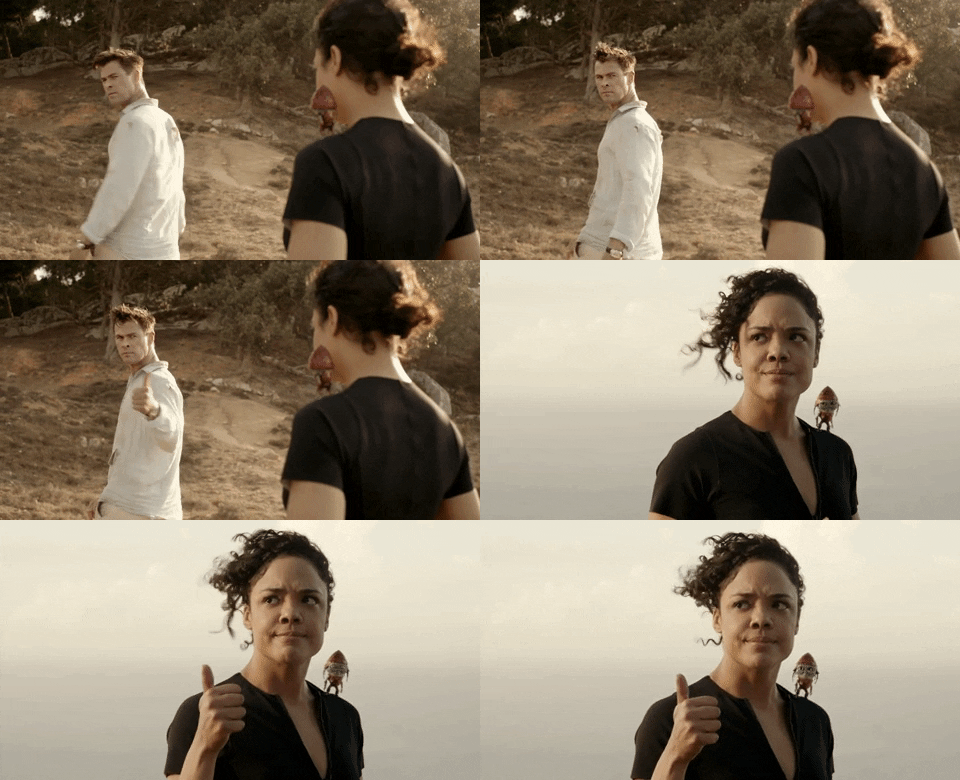
"MEN IN BLACK: INTERNATIONAL" only shared a few similarities to the franchise's past three films. One of the co-stars proved to be Emma Thompson, who had returned for her second appearance in the franchise as Q, the MIB agency's director. The agency's Manhattan office also appeared in the film. And the MIB agents were up against another deadly alien trying to conquer Earth. Otherwise, there were major differences in this fourth film. Instead of Will Smith and Tommy Lee Jones, "MEN IN BLACK: INTERNATIONAL" starred Chris Hemsworth and Tessa Thompson, who had been co-stars in the 2017 Marvel film, "THOR: RAGNAROK". Most of the "MEN IN BLACK: INTERNATIONAL" locations were set outside of the U.S. in London, Marrakesh, Naples and Paris. The last difference featured the circumstances surrounding the recruitment of Tessa Thompson's character into the agency. Unlike Will Smith's Agent J, Thompson's character had become aware of the Men in Black agency years before she joined it. The biggest difference between this film and the previous three movies involved a potential threat within the internal affairs of the Men in Black.

In 1996 Brooklyn, a young girl named Molly Wright witnesses her parents being neuralysed by Men in Black agents, while she helps an alien escape. Twenty years later, Agents H and High T of the MiB London office travel to Paris to stop an invasion of the Hive – a parasitic race who invade planets by merging with the DNA of the conquered species – at the Eiffel Tower using a wormhole included in the original migration to Earth. After being rejected from the F.B.I. and the C.I.A., due to her "delusions" regarding alien life, Molly tracks down an alien landing and follows MiB agents to their New York City headquarters. Caught entering the agency, Molly makes an impression on the agency's director, Agent O and becomes probationary agent status as "Agent M". She is eventually assigned to the London branch.

Agent M's new supervisor is High T, who has become head of the London office. The latter assigns her to become Agent H's new partner, who has developed a God complex, unconcerned with his duties and only keeping his job due to High T covering for him. Both M and H are assigned to guard a royal alien named Vungus the Ugly, during the latter's visit to Earth. A pair of alien twins manage to fatally injure Vungus. The latter gives M a strange crystal before he dies. And the agents of the London office realizes that a MiB agent may have betrayed Vungus to the alien assassins. Due to his lackadaisical behavior, H has become the main suspect. However, this does not last long and M eventually becomes tagged as the agency's traitor. M and H take matters into their hands and decide to conduct their own investigation - an act that leads them to become fugitives from the Men in Black agency.

Following the release of "MEN IN BLACK: INTERNATIONAL", many critics and fans of the franchise had rained criticism and scorn upon it. Needless to say, the movie proved to be a box office failure, despite making a small profit. It is considered to be the worst film in the franchise. While many blamed the movie's narrative; the majority of the film's negative press seemed to stem from the fact that the movie had not been directed by Barry Sonnenfeld, who was responsible for the franchise's first three films. And there were a handful of disgruntled fans who seemed to resent the presence of Tessa Thompson as one of the film's leads, due to her gender.

How do I feel about all of this? I do have a few problems with "MEN IN BLACK: INTERNATIONAL". One, this movie is not funny. What I meant is . . . it lacked the twisted and sardonic humor of Barry Sonnenfeld. If I have to be more specific, the film's humor barely generated any real laughs from me. I merely found myself feeling amused by some of the more comic moments. My second problem with "MEN IN BLACK: INTERNATIONAL" was Agent H's fate near the end of the movie. I did not like it. Considering his age and recent mental condition, I thought he was unnecessarily rewarded for his actions in stopping the main villain. My final problem with the film is basically minor. "MEN IN BLACK: INTERNATIONAL" featured the character of Agent O from the 2012 film, "MEN IN BLACK 3". To me, this was an indication that "MEN IN BLACK: INTERNATIONAL" was a continuation of the previous three films. If so, I thought screenwriters Art Marcum and Matt Holloway could have hinted on the fates of Agents J and K from the first three movies. What happened to them?

Despite my complaints about the film, I did not dislike "MEN IN BLACK: INTERNATIONAL". In fact, I enjoyed it very much. And this was due to certain aspects of the film. One, I found some of the movie's special effects rather impressive, thanks to the visual effects team, Stuart Dryburgh's cinematography and Thomas Brown's art direction team. I was especially impressed by those scenes featuring Vungus' death in London, H, M and Pawny's escape from Marrakesh and especially their final showdown against the Big Bad at the Eiffel Tower in Paris.

Another aspect of "MEN IN BLACK: INTERNATIONAL" that I enjoyed was its cast. Personally, I thought it was first-rate. The movie benefitted from a solid supporting cast that included Laurent and Larry Nicolas Bourgeois (aka Les Twins), who did an excellent job of conveying the silent, yet physical menace of the shape-shifting aliens known as "the Twins"; Tim Blaney, who returned to voice Frank the Pug; Kayvan Novak, who voiced the royal alien Vungus the Ugly; and Spencer Wilding. I found Rafe Spall's portrayal of Agent C of the UK branch rather sardonic, yet entertaining. Emma Thompson was excellent as usual as the Men in Black director, Agent O. Rebecca Ferguson gave an eccentric, yet funny performance as an alien intergalactic arms dealer and H's ex-girlfriend Riza Stavros. Liam Neeson's portrayal of High T, the head of the MIB UK branch, struck as equally off-beat and funny. And I felt that Kumail Nanjiani gave the best voice performance of all as Pawny, the small alien warrior that Agents M and H befriend.

And of course, we have the movie's two leads - Chris Hemsworth and Tessa Thompson. Many crtics had been impressed by their screen dynamic in the Marvel film, "THOR: RAGNAROK". This led the producers of this film to cast them together as Agents H and M. And they did not fail. Thompson did a wonderful job as the uber observant and clever Molly Wright, who becomes the agency's newest recruit, Agent M. Hemsworth did an equally fantastic job in portraying Agent H, one of the agency's best agents who seemed to be suffering from some kind of post traumatic stress disorder (PTSD), following his and Agent High T's defeat of the Hive, three years earlier. Not only did the two leads gave great performances, they also proved that their on-screen dynamic had not dimmed one bit. If I must be brutally honest, I was more impressed by their screen chemistry in this film than I was in "THOR: RAGNAROK".

I realize that many people may not agree with me on this next topic. But if there is one thing that truly impressed me about "MEN IN BLACK: INTERNATIONAL", it was the screenplay written by Art Marcum and Matt Holloway. I found it very original for a movie from the MEN IN BLACK movie franchise. The previous three movies usually introduced the Big Bad either in the opening scene or not long after the opening. I cannot say the same for this film. Both Marcum and Holloway had not only created a mystery surrounding the Big Bad, they also included a possible traitor or mole within the Men in Black agency that might be assisting the main villain. Now this might be normal in a MISSION: IMPOSSIBLE movie or some other spy thriller. But in a MEN IN BLACK film? For the first time, this franchise had created a combination of a science-fiction movie and an espionage flick. It is a pity that many critics and film goers could not appreciate this. Perhaps it would have been easier if the film had followed the franchise's usual formula.

In the end, I realized that I would not waste my time lamenting on the box office failure of "MEN IN BLACK: INTERNATIONAL". It was not the first box office bomb that I ended up enjoying. And I doubt that it will be the last. Although I found the film's humor rather lukewarm - worthy more of a small chuckle instead of a belly laugh - I cannot deny that I truly enjoyed the film's narrative, along with the exciting action sequences and the talented cast led by Chris Hemsworth and Tessa Thompson, thanks to director F. Gary Gray. Many others may have been disappointed by this film. But I was not.

-----------------------------------------------


Post-Script - I recently viewed the movie on DVD. I enjoyed it even more than I did the first time I saw it. And I realized it was funnier than I had originally believed.


image

Thursday, December 12, 2019

"MEN IN BLACK: INTERNATIONAL" (2019) Photo Gallery


Below are images from "MEN IN BLACK: INTERNATIONAL", the 2019 entry in the "MEN IN BLACK" movie franchise. Directed by F. Gary Gray, the movie starred Chris Hemsworth and Tessa Thompson:


"MEN IN BLACK: INTERNATIONAL" (2019) Photo Gallery


Friday, February 22, 2019

"STAR WARS" Cuisine


Below are a few samples of food and drinks that were created for the "STAR WARS" franchise - including the ten movies and two television series produced by Lucasfilm, the current Disney canon novels, the non-canon Extended Universe (EU) novels and video games: 


"STAR WARS" CUISINE


Blue Milk aka Bantha Milk - A rich blue-colored milk that was produced by female banthas. Sentients drank it, and used it in ice cream, butter and yogurt. It was especially available on Outer Rim planets like Tatooine, Lothal, and Lah'mu.


Eopie Cream Pie - A delicious and popular dessert that was kept as a closely guarded secret by the Kingal family. It is believed that the dessert was made from the cream of the Eopie, a quadruped herbivore native to the planet Tatooine. No one knows whether the cream was created from Eeopie milk or the animal's meat.


Tranna Nougat Cream - A sweet candy that was extremely difficult to make. It was favored by the rich and powerful.


Corellian Fried Ice Cream - A popular dessert that originated on Corellia. It was made from ice cream native to the planet; Soypro, a meat substitute, Carbosyrup and water. It could also be found on Endor.


Shuura - An exotic yellow and cream colored fruit that was sweet and juicy. It was a favorite of Senator Padmé Amidala of Naboo. The syrup from the fruit was used as a flavouring for a certain drink at Dex's Diner on Coruscant.


Nuna Drumsticks - A type of food that came from the Nuna, a reptavian gamebird that was native to Naboo. The animal was commonly called a "swamp turkey".


Shawda Club Sandwich - A sandwich made from slices of Manpha-fowl meat, Nuna bacon, Revwien lettuce, and topatos on toasted or therm-zapped pseudograin bread. It was a popular item at Dex's Diner on Coruscant.