
"JURASSIC WORLD: FALLEN KINGDOM" (2018) Review
Following the release of "JURASSIC PARK III" in 2001, I had figured that was it for the JURASSIC PARK movie franchise. Boy, was I proven wrong. Fourteen years after the release of that third film, Universal Pictures and producer Frank Marshall presented a fourth movie for the franchise, "JURASSIC WORLD" in 2015, that proved to be a major hit. Following the success of that film, it was only natural that a fifth movie would be made.
Set three years after the events of the 2015 movie, "JURASSIC WORLD: FALLEN KINGDOM" began with the United States Senate debating over whether to save the dinosaurs on Isla Nublar from an impending volcanic eruption from the island's volcano Mt. Sibo. Mathematician Dr. Ian Malcolm testifies that the dinosaurs should be allowed to die in order to correct John Hammond's mistake of cloning them. Meanwhile, Jurassic World's former operations manager, Claire Dearing, has established the Dinosaur Protection Group to save the animals. When the Senate decides not to rescue the dinosaurs, Hammond's former partner, Benjamin Lockwood, summons Claire to his Northern California estate, where he and his aide Eli Mills reveal a plan to relocate the dinosaurs to a new island sanctuary. They need Claire to help reactivate the park's dinosaur tracking system in order to locate the animals - especially Blue, the last surviving Velociraptor. Despite being estranged from him, Claire recruits Jurassic World's former Velociraptor trainer and Blue's alpha, Owen Grady, to help capture her. Accompanying them would be the park's former technician Franklin Webb and paleo-veterinarian Zia Rodriguez.
Upon their arrival on Isla Nublar at the now defunct Jurassic World amusement part, Claire and Franklin work to reactivate the park's online tracking system. Meanwhile, Owe, Zia and a mercenary team led by Ken Wheatley search for Blue. When they find the velociraptor, one of Wheatley's men shoots Blue and Wheatley tranquilizes Owen. The mercenaries take Zia with them to treat Blue's injury. The mercenary ship, loaded with the captured dinosaurs, departs for the U.S. mainland, while the dinosaurs left behind die in the eruption. Meanwhile; Claire, Franklin, and Owen manage to escape the dying island and sneak aboard in time and assist Zia in transfusing Blue with Tyrannosaurus blood. The group now realizes that the captured dinosaurs were never being transported to a new island and have been captured for another purpose. And the latter has to do with a financial scheme being involving Eli Mills and Dr. Henry Wu, behind Lockwood's back.
Despite earning over a billion dollars at the box office, "JURASSIC WORLD: FALLEN KINGDOM" received very little positive reviews upon its release. In fact, it is regarded by some as a failure. Many critics and some film goers certainly regard it as inferior to the 2015 movie. How do I feel about "JURASSIC WORLD: FALLEN KINGDOM"? I had a few problems with it. Well . . . to be perfectly honest, I had two major problems with it. My first problem centered around Benjamin Lockwood's estate serving as the setting for the film's second half. I found this rather limiting and claustrophobic. And I found myself wondering if the film's budget was responsible for this decision to limit the setting to a California country estate. The longer the film remained on that estate - especially inside that house - the more I became frustrated.
And I have a second complaint about "JURASSIC WORLD: FALLEN KINGDOM" - namely the fate of Benjamin Lockwood's granddaughter, Maisie. Why did Owen Grady and Claire Dearing end up as her guardians at the end of the movie? What happened to Maisie's nanny, Iris, who had been with the family for years? I do not recall her being killed by a dinosaur. So what happened to her? Why did she not take care of Maisie, following the death of the latter's grandfather?
Despite my complaints, I enjoyed "JURASSIC WORLD: FALLEN KINGDOM". In fact, I enjoyed it very much. Derek Connolly and Colin Trevorrow created a first-rate tale filled with tension, drama and especially comedy. I remember when the film first hit the theaters, many had complained about the movie's finale. They found it . . . illogical. Messy. I still find this complaint rather hard to swallow. The premise behind the JURASSIC PARKfranchise can be considered illogical. Frankly, considering what happened in a period of twenty-five years and five movies, I thought it was only a matter of time that the franchise would reach this point. It almost did in 1997's "JURASSIC PARK: THE LOST WORLD". However, this film took it a step further with the release of several dinosaurs into the modern world. It was bound to happen. InGen and John Hammond had opened Pandora's Box a quarter of a century ago with the creation of dinosaurs, thousands of years after they naturally went extinct. I would almost equate the creations of these animals with that of nuclear energy and weaponry. Considering the occasional misuse and mishandling of nuclear energy throughout the years, I found it appropriate that a more disastrous scenario would finally befall in the JURASSIC PARK franchise than what happened in the previous films.
"JURASSIC WORLD: FALLEN KINGDOM" is also a popcorn summer film that depends upon a great deal of action. And it had its share of some first-rate action sequences. If I must be great, I enjoyed most of the action in the film's first half. I especially enjoyed the sequence featuring the natural destruction of Isla Nublar and Owen Grady, Claire Dearing and Franklin Webb's efforts to escape from the island after being abandoned by Ken Wheatley's team. For me, it was a breathtaking sequence as the trio raced to reach the boat conveying Wheatley's team and Zia Rodriguez (kidnapped and forced to treat the wounded Blue) to the United States. But there was an action sequence in the film's last hour that also impressed me. It featured the protagonists being hunted throughout the Lockwood mansion by Dr. Henry Wu's latest creation, the Indoraptor, a creation from the DNA of Indominus rex from the last film and Velociraptor - namely Blue. For me, those two sequences featured the best of some pretty damn good action scenes throughout the film.
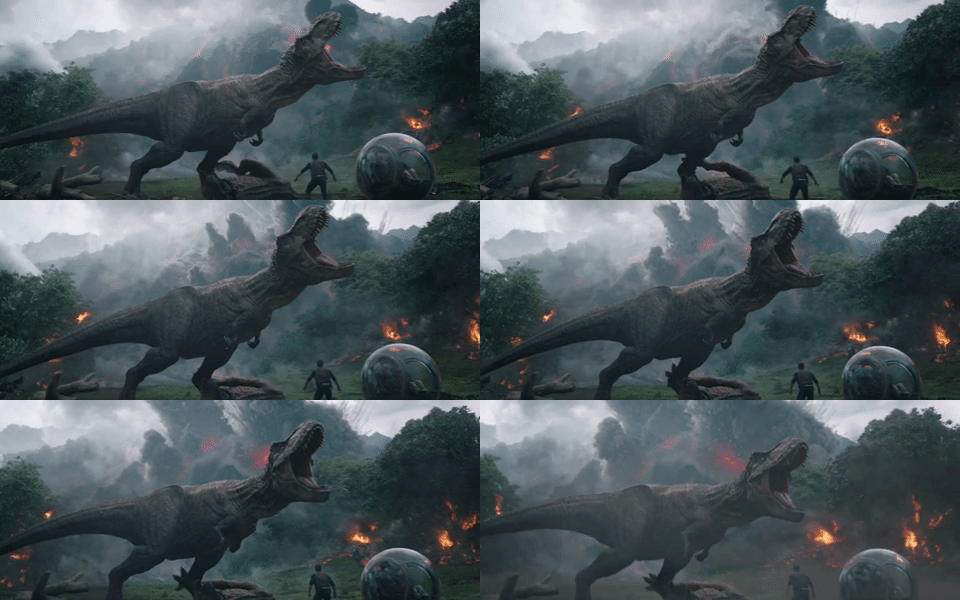
The movie did not feature as many breathtaking visual scenes as "JURASSIC WORLD". But there were a few that caught my eye, including scenes of those dinosaurs roaming the Earth:

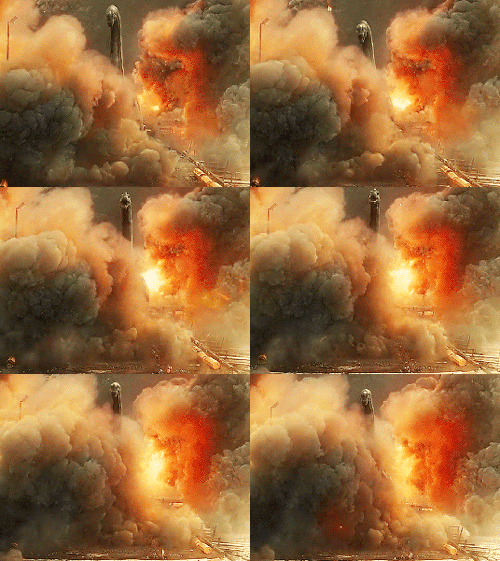
But the one scene that produced a knot in my throat featured that last shot of Isla Nublar . . . and the death of the very brachiosaurus that Dr. Alan Grant first saw in 1993's "JURASSIC PARK". Director J.A. Bayona, cinematographer Óscar Faura and the visual effects team really knocked it out of the ballpark by capturing both the grandeur and the pathos of the scene:
If there is one thing I can guarantee from a JURASSIC PARK/WORLD movie, it is a first-rate cast featuring excellent performances. Jeff Goldblum returned to give a short, yet solid performance as Dr. Malcolm Campbell, one of the original visitors to Isla Nublar. "JURASSIC WORLD: FALLEN KINGDOM" featured the acting debut of Isabella Sermon, who gave an excellent performance as the young Maisie Lockwood. Trust this franchise to always hire naturally talented child actors. Ted Levine's performance as mercenary Ken Wheatley struck me as a gleeful portrayal of toxic masculinity. B.D. Wong's return as Dr. Henry Wu was somewhat briefer than it was in the 2015 movie. Yet, once again, the actor conveyed the convoluted egoism of Dr. Wu with great skill. I hope he will have a bigger role in the next film.
Toby Jones gave an entertaining, yet slightly theatrical performance as the weasely auctioneer hired by Eli Mills to help sell those dinosaurs taken from Isla Nublar to potential buyers. James Cromwell struck me as emotional, yet dignified as Hammond's former partner, Benjamin Lockwood. Geraldine Chaplin gave a skillful performance as the Lockwoods' reliable employee Iris. Daniella Pineda was brash and entertaining as the sharp-tongued Dr. Zia Rodriguez. Justice Smith proved to be equally entertaining and quite hilarious as anxiety-ridden systems analyst Franklin Webb. Rafe Spall skillfully portrayed one of the most subtle and corrupt villains in the franchise, Eli Morrow.
Chris Pratt returned as former Navy SEAL-turned-dinosaur trainer Owen Grady. I realized that many might not agree, but I enjoyed Pratt's first-rate portrayal of the no-nonsense Grady more than I did in the 2015 movie. I thought Pratt's performance was more subtle and best of all, his Grady seemed to have dropped that sanctimonious I had found slightly irritating in the previous film. Bryce Dallas Howard managed to skillfully take her character, former operations manager of Jurassic World, to the next level. In "JURASSIC WORLD: FALLEN KINGDOM", Claire's previous encounters with the dinosaurs had led her to develop an appreciation of them as sentient beings. This new Claire is a passionate animal rights activist who has dropped her arrogant disregard of the park's inhabitants. It is possible that this new passion may have slightly affected her common sense, especially during the film's last 10-15 minutes. But thanks to Howard's excellent performance, she managed to convey a sense of plausibility in the slight changes in Claire's personality.
As I had earlier pointed out, the critics did not like "JURASSIC WORLD: FALLEN KINGDOM". In fact, some moviegoers had expressed dismay at the film's ending. I had at least two quibbles with the movie. But if I must be frank, I enjoyed it very much. More importantly, I found its ending very believable for a science-fiction tale. For once, the franchise was willing to face a consequence that its previous films managed to elude so far. The movie featured first-rate direction by J.A. Bayona; a well-written screenplay by Derek Connolly and Colin Trevorrow; and an excellent cast led by Chris Pratt and Bryce Dallas Howard. Good work guys!

Following the release of "JURASSIC PARK III" in 2001, I had figured that was it for the JURASSIC PARK movie franchise. Boy, was I proven wrong. Fourteen years after the release of that third film, Universal Pictures and producer Frank Marshall presented a fourth movie for the franchise, "JURASSIC WORLD" in 2015, that proved to be a major hit. Following the success of that film, it was only natural that a fifth movie would be made.
Set three years after the events of the 2015 movie, "JURASSIC WORLD: FALLEN KINGDOM" began with the United States Senate debating over whether to save the dinosaurs on Isla Nublar from an impending volcanic eruption from the island's volcano Mt. Sibo. Mathematician Dr. Ian Malcolm testifies that the dinosaurs should be allowed to die in order to correct John Hammond's mistake of cloning them. Meanwhile, Jurassic World's former operations manager, Claire Dearing, has established the Dinosaur Protection Group to save the animals. When the Senate decides not to rescue the dinosaurs, Hammond's former partner, Benjamin Lockwood, summons Claire to his Northern California estate, where he and his aide Eli Mills reveal a plan to relocate the dinosaurs to a new island sanctuary. They need Claire to help reactivate the park's dinosaur tracking system in order to locate the animals - especially Blue, the last surviving Velociraptor. Despite being estranged from him, Claire recruits Jurassic World's former Velociraptor trainer and Blue's alpha, Owen Grady, to help capture her. Accompanying them would be the park's former technician Franklin Webb and paleo-veterinarian Zia Rodriguez.
Upon their arrival on Isla Nublar at the now defunct Jurassic World amusement part, Claire and Franklin work to reactivate the park's online tracking system. Meanwhile, Owe, Zia and a mercenary team led by Ken Wheatley search for Blue. When they find the velociraptor, one of Wheatley's men shoots Blue and Wheatley tranquilizes Owen. The mercenaries take Zia with them to treat Blue's injury. The mercenary ship, loaded with the captured dinosaurs, departs for the U.S. mainland, while the dinosaurs left behind die in the eruption. Meanwhile; Claire, Franklin, and Owen manage to escape the dying island and sneak aboard in time and assist Zia in transfusing Blue with Tyrannosaurus blood. The group now realizes that the captured dinosaurs were never being transported to a new island and have been captured for another purpose. And the latter has to do with a financial scheme being involving Eli Mills and Dr. Henry Wu, behind Lockwood's back.
Despite earning over a billion dollars at the box office, "JURASSIC WORLD: FALLEN KINGDOM" received very little positive reviews upon its release. In fact, it is regarded by some as a failure. Many critics and some film goers certainly regard it as inferior to the 2015 movie. How do I feel about "JURASSIC WORLD: FALLEN KINGDOM"? I had a few problems with it. Well . . . to be perfectly honest, I had two major problems with it. My first problem centered around Benjamin Lockwood's estate serving as the setting for the film's second half. I found this rather limiting and claustrophobic. And I found myself wondering if the film's budget was responsible for this decision to limit the setting to a California country estate. The longer the film remained on that estate - especially inside that house - the more I became frustrated.
And I have a second complaint about "JURASSIC WORLD: FALLEN KINGDOM" - namely the fate of Benjamin Lockwood's granddaughter, Maisie. Why did Owen Grady and Claire Dearing end up as her guardians at the end of the movie? What happened to Maisie's nanny, Iris, who had been with the family for years? I do not recall her being killed by a dinosaur. So what happened to her? Why did she not take care of Maisie, following the death of the latter's grandfather?
Despite my complaints, I enjoyed "JURASSIC WORLD: FALLEN KINGDOM". In fact, I enjoyed it very much. Derek Connolly and Colin Trevorrow created a first-rate tale filled with tension, drama and especially comedy. I remember when the film first hit the theaters, many had complained about the movie's finale. They found it . . . illogical. Messy. I still find this complaint rather hard to swallow. The premise behind the JURASSIC PARKfranchise can be considered illogical. Frankly, considering what happened in a period of twenty-five years and five movies, I thought it was only a matter of time that the franchise would reach this point. It almost did in 1997's "JURASSIC PARK: THE LOST WORLD". However, this film took it a step further with the release of several dinosaurs into the modern world. It was bound to happen. InGen and John Hammond had opened Pandora's Box a quarter of a century ago with the creation of dinosaurs, thousands of years after they naturally went extinct. I would almost equate the creations of these animals with that of nuclear energy and weaponry. Considering the occasional misuse and mishandling of nuclear energy throughout the years, I found it appropriate that a more disastrous scenario would finally befall in the JURASSIC PARK franchise than what happened in the previous films.
"JURASSIC WORLD: FALLEN KINGDOM" is also a popcorn summer film that depends upon a great deal of action. And it had its share of some first-rate action sequences. If I must be great, I enjoyed most of the action in the film's first half. I especially enjoyed the sequence featuring the natural destruction of Isla Nublar and Owen Grady, Claire Dearing and Franklin Webb's efforts to escape from the island after being abandoned by Ken Wheatley's team. For me, it was a breathtaking sequence as the trio raced to reach the boat conveying Wheatley's team and Zia Rodriguez (kidnapped and forced to treat the wounded Blue) to the United States. But there was an action sequence in the film's last hour that also impressed me. It featured the protagonists being hunted throughout the Lockwood mansion by Dr. Henry Wu's latest creation, the Indoraptor, a creation from the DNA of Indominus rex from the last film and Velociraptor - namely Blue. For me, those two sequences featured the best of some pretty damn good action scenes throughout the film.
The movie did not feature as many breathtaking visual scenes as "JURASSIC WORLD". But there were a few that caught my eye, including scenes of those dinosaurs roaming the Earth:
But the one scene that produced a knot in my throat featured that last shot of Isla Nublar . . . and the death of the very brachiosaurus that Dr. Alan Grant first saw in 1993's "JURASSIC PARK". Director J.A. Bayona, cinematographer Óscar Faura and the visual effects team really knocked it out of the ballpark by capturing both the grandeur and the pathos of the scene:
If there is one thing I can guarantee from a JURASSIC PARK/WORLD movie, it is a first-rate cast featuring excellent performances. Jeff Goldblum returned to give a short, yet solid performance as Dr. Malcolm Campbell, one of the original visitors to Isla Nublar. "JURASSIC WORLD: FALLEN KINGDOM" featured the acting debut of Isabella Sermon, who gave an excellent performance as the young Maisie Lockwood. Trust this franchise to always hire naturally talented child actors. Ted Levine's performance as mercenary Ken Wheatley struck me as a gleeful portrayal of toxic masculinity. B.D. Wong's return as Dr. Henry Wu was somewhat briefer than it was in the 2015 movie. Yet, once again, the actor conveyed the convoluted egoism of Dr. Wu with great skill. I hope he will have a bigger role in the next film.
Toby Jones gave an entertaining, yet slightly theatrical performance as the weasely auctioneer hired by Eli Mills to help sell those dinosaurs taken from Isla Nublar to potential buyers. James Cromwell struck me as emotional, yet dignified as Hammond's former partner, Benjamin Lockwood. Geraldine Chaplin gave a skillful performance as the Lockwoods' reliable employee Iris. Daniella Pineda was brash and entertaining as the sharp-tongued Dr. Zia Rodriguez. Justice Smith proved to be equally entertaining and quite hilarious as anxiety-ridden systems analyst Franklin Webb. Rafe Spall skillfully portrayed one of the most subtle and corrupt villains in the franchise, Eli Morrow.
Chris Pratt returned as former Navy SEAL-turned-dinosaur trainer Owen Grady. I realized that many might not agree, but I enjoyed Pratt's first-rate portrayal of the no-nonsense Grady more than I did in the 2015 movie. I thought Pratt's performance was more subtle and best of all, his Grady seemed to have dropped that sanctimonious I had found slightly irritating in the previous film. Bryce Dallas Howard managed to skillfully take her character, former operations manager of Jurassic World, to the next level. In "JURASSIC WORLD: FALLEN KINGDOM", Claire's previous encounters with the dinosaurs had led her to develop an appreciation of them as sentient beings. This new Claire is a passionate animal rights activist who has dropped her arrogant disregard of the park's inhabitants. It is possible that this new passion may have slightly affected her common sense, especially during the film's last 10-15 minutes. But thanks to Howard's excellent performance, she managed to convey a sense of plausibility in the slight changes in Claire's personality.
As I had earlier pointed out, the critics did not like "JURASSIC WORLD: FALLEN KINGDOM". In fact, some moviegoers had expressed dismay at the film's ending. I had at least two quibbles with the movie. But if I must be frank, I enjoyed it very much. More importantly, I found its ending very believable for a science-fiction tale. For once, the franchise was willing to face a consequence that its previous films managed to elude so far. The movie featured first-rate direction by J.A. Bayona; a well-written screenplay by Derek Connolly and Colin Trevorrow; and an excellent cast led by Chris Pratt and Bryce Dallas Howard. Good work guys!


