"INDIANA JONES AND THE RAIDERS OF THE LOST ARK" (1981) ReviewI suspect that many would be astounded to read the following - I did not want to see "INDIANA JONES AND THE RAIDERS OF THE LOST ARK" when it first hit the theaters back in 1981. I simply did not. And there were a few reasons why I felt this way.Back in the late 1970s and early 1980s, I was not a particular fan of George Lucas. Aside from 1973's "AMERICAN GRAFFITI" (which I saw on television), I was not in love with his movies. I heartily disliked "STAR WARS: A NEW HOPE", when it first hit the movie theaters during the summer of 1977. "MORE AMERICAN GRAFFITI" did not impress me in 1979 (and it still does not). And I had felt torn about 1980's "STAR WARS: THE EMPIRE STRIKES BACK". A part of me felt impressed by the movie. Another part of me was distressed by its darker tone and cliffhanger ending. My feelings about Steven Spielberg were equally muted. I was not a big fan of 1977's "CLOSE ENCOUNTERS OF THE THIRD KIND" or any other movie he did during the 1970s. And "E.T." was a year away. When "RAIDERS OF THE LOST ARK" first arrived during the summer of 1981, I read a negative review that completely turned me off from wanting to see it. However, movie attendance was (and still is) a family affair. So, I found myself forced to watch the movie. I fell in love with it and wondered how I could have ever harbored doubts about it in the first place.The plot for "RAIDERS OF THE LOST ARK" focused on the adventures of an archaeologist/university professor named Dr. Henry "Indiana" Jones, Jr. The movie began with Dr. Jones trekking through a South American jungle in 1936, with two local guides, in search of a golden fertility idol. After securing the artifact with great difficulty, Indy lost it, thanks to a conniving competitor and fellow archaeologist named Dr. René Belloq. But he also managed to escape with his life from a group of Hovitos tribesmen set upon him by Belloq. Indy made it back to the States and resumed his job as a professor at Marshall College. Not long after his return, two U.S. Army Intelligence agents questioned him and fellow colleague Dr. Marcus Brody about a Nazi communique that mentioned the name of Indy's former mentor, Professor Abner Ravenwood. When Indy and Brody explained that Ravenwood was an expert on the ancient Egyptian city of Tanis and possessed the headpiece of the Staff of Ra, they came to the conclusion that the Nazis were after the Ark of the Covenant. The agents tasked Indy with finding the Ark before the Nazis, on behalf of the American government. Indiana's search for Ravenwood and the Ark took him on a globe-trotting adventure to Nepal, Egypt and finally to a small island in the middle of the Aegean Sea. Along the way he reunited with his former lover and Ravenwood's daughter, Marion Ravenwood, formed a new friendship with a professional excavator from Cairo named Sallah el-Kahir and clashed with his old rival Belloq . . . and the latter's Nazi allies.For the past three decades, critics and filmgoers have acknowledged "RAIDERS OF THE LOST ARK" as one of the greatest adventure films of all time. They also regard it as the best film in the INDIANA JONES franchise. Not only do I agree with the first assessment, I believe the same could be said for the other three INDIANA JONES movies. As for "RAIDERS OF THE LOST ARK" being the best film in the franchise . . . well, it is all subjective, is it not? I must admit that the movie holds up very well, after so long. Aside from some narrative flaws and a major historical blooper, screenwriter Lawrence Kasdan wrote a tight adventure filled with memorable characters, exciting action sequences, snappy dialogue, a complex love story and most importantly, well-constructed character development.One cannot discuss the 1981 movie without recalling the memorable action sequences that many still talk about. Who can forget Indy's escape from Belloq and the Hovitos in South America? Or the shoot-out inside Marion Ravenwood's Nepal tavern? Or even Indy's attempt to save the kidnapped Marion from thugs hired by the Nazis in Cairo? But it was Indy's epic-like attempt to recover the Ark of the Covenant from Belloq and the Nazis that proved to be the most memorable action sequence . . . at least for me. Not only did it turned out to be the film's longest action sequence, but also the most exciting. More importantly, Lucas, Spielberg and stunt coordinator Glenn Randall, Jr. utilized an old stunt from John Ford's 1939 Western, "STAGECOACH" with equal success.However, "RAIDERS OF THE LOST ARK" was not all memorable action sequences, thanks to Kasdan's tight writing. He did an excellent job in establishing the relationship between the protagonist and the main villain even before he established the main plot. Kasdan's screenplay created the main narrative with a somewhat witty discussion about the Ark of the Covenant between Indy, Brody and the two Army Intelligence agents. There were other dramatic or comedic scenes that made this movie a joy to watch. One of my favorites include a visit by Indy and Sallah to an old friend of the latter's named Imam, who managed to translate the Staff of Ra's headpiece for them; Indy and Belloq's conversation about Marion's "death" and their rivalry; Belloq's attempt to seduce a captive Marion; Indy and Brody's last conversation before the former's departure . . . and especially Indy and Marion's rather funny romantic scene aboard the Bantu Wind.I certainly had no problems with the movie's production values. Lucas and Spielberg were wise to hire Douglas Slocombe as the movie's cinematographer. Thanks to Slocombe's work, "RAIDERS OF THE LOST ARK" featured some beautiful scenes rich in color and style, as shown in the images below:
 I also have to commend the special effects team for some of the most iconic moments in film history, including Indy's escape from the rolling boulder and the sequence that featured the opening of the Ark. Norman Reynolds' production designs, along with Michael Ford's set decorations and Leslie Dilley's art direction beautifully re-created the mid-1930s in the U.S. and Egypt. And I cannot mention "RAIDERS OF THE LOST ARK" without bringing up John Williams' memorable score. Unfortunately, Williams failed to win an Oscar for his exceptional work and lost to Vangelis' score for "CHARIOTS OF FIRE'. Pity. I thought Williams truly deserved that statuette.As much as I love "RAIDERS OF THE LOST ARK", I cannot deny that it has flaws. I was in my mid-teens when I first saw the movie. And I believe that my enthusiastic reaction to the film's virtues may have blinded me from its flaws. Despite a strong narrative, "RAIDERS" suffered from a weak ending. I could probably say the same for two other films in the franchise. The finale for "RAIDERS OF THE LOST ARK" struck me as anti-climactic. In other words, Indy played no part in the villains' defeat. The wrath of God did. I understand that Lucas and Spielberg wanted to show the consequences of the villains' lack of respect toward the Ark's power. But I still wish Indy had played some kind of role in their downfall. And once the power of God destroyed Belloq and the Nazis on that Aegean Sea island, how did Indy and Marion get off that island? I doubt the two of them could operate the U-boat that delivered them to the island on their own.Another problem I had with "RAIDERS" proved to be certain costumes worn by actress Karen Allen, who portrayed Marion Ravenwood. I was not particularly impressed by two costumes designed by Deborah Nadoolman. The first was the red-and-white outfit worn by Marion in the Cairo street scene, which struck me as some bizarre take on mid-1930s fashion. If "RAIDERS" had been set during the year of the movie's release (1981), I would have no trouble with the outfit. But for a movie set in 1936? To make matters worse, Allen wore wedge-heeled shoes with it. And the white dress that Marion received from Belloq blended well with the 1936 setting. Unfortunately, Marion was in her mid-to-late twenties in the film. And the dress seemed more appropriate for a 17-year-old debutante. Either the dress was some expression of how Belloq truly regarded Marion . . . or an example of what Deborah Nadoolman regarded as the height of fashion for a woman in 1936. And in both cases, I find this unfortunate.The main problem I found in "RAIDERS OF THE LOST ARK" turned out to be a case of a major historical blunder. Although the movie's main villain is the French-born René Belloq, the latter's allies are a Gestapo agent and more importantly, two senior German Army officers . . . with a complete regiment at their command. And entire German Army regiment roaming freely throughout Egypt in 1936? What were Lucas, Spielberg and Kasdan thinking? Egypt was a British Imperial protectorate between 1882 and 1936. In the latter year, both Egypt and Britain signed the Anglo-Egyptian Treaty of 1936, which led to the withdrawal of British troops from the country . . . with the exception of 10,000 personnel stationed around the Suez Canal. I doubt that the commander of those 10,000 British troops would sit on his heels and allow a regiment of German troops to roam nilly willy all over Egypt. I doubt that the Egyptian government would have allow this, as well.Harrison Ford had already made a name for himself in the first two "STAR WARS" films. But he was a supporting character in the movies, not the leading man. And Lucas' first choice as Indiana Jones was Tom Selleck. But the latter lost the role, due to obligations to CBS's "MAGNUM P.I.". And the rest is Hollywood history . . . for both Ford and Selleck. I suspect that Selleck would have been superb in the role. But you know what? So was Ford. He did an excellent job in portraying all aspects of Henry Jones Jr.'s personality quirks - both the good and the bad. He also created a strong screen chemistry with his leading lady, Karen Allen. Not only was she magnificent as Indy's former flame Marion Ravenwood, but she also did a great job in balancing her pseudo machismo and feminine allure. I was originally surprised to learn that Paul Freeman, who portrayed Indy's rival René Belloq, was actually English. And he did a great job in portraying a Continental European without the cliches and portraying an intelligent, suave and villainous character."RAIDERS OF THE LOST ARK" proved to be the first time I had laid eyes upon John Rhys-Davies on screen. His portrayal of Egyptian-born excavator Sallah el-Kahir seemed a touch theatrical. Surprisingly, it worked. I believe Rhys-Davies is one of those actors who can do theatrics with perfection. And he also injected a great deal of intelligence and pragmatism into the role. Wolf Kahler gave a performance just as subtle as Freeman, in his portrayal of Colonel Herman Dietrich, commander of the German regiment. I was relieved to see that his performance avoided the old "Ve haf vays of making you tahk" crap from old Hollywood World War II films. Anthony Higgins managed to avoid the same cliche in portrayal of Dietrich's second-in-command, Major Gobler. However, I was amused to discover a certain degree of cockiness in his performance. Ronald Lacey's portrayal of Gestapo agent Arnold Taht seemed less subtle. In fact, his performance seemed to be a strange mixture of subtle dialogue and gestures, blended with theatrical moments. I found Lacey's performance to be the most interesting in the movie. Denholm Elliot's role as Indy's mentor, Dr. Marcus Brody, struck me as charming and witty. But he was not in the movie long enough for me to really enjoy his performance. George Harris gave a commanding performance as the captain of the Bantu Wind, Captain Simon Katanga. He was especially effective in his character's encounter with the arrogant Colonel Dietrich.What else can I say about "RAIDERS OF THE LOST ARK"? George Lucas and Steven Spielberg created an imaginative and exciting movie that kick-started a first-rate movie franchise that has withstood the test of time. The movie also featured some memorable action sequences and dramatic moments, thanks to Lawrence Kasdan's well-written screenplay and Spielberg's superb direction. And although "INDIANA JONES AND THE RAIDERS OF THE LOST ARK" has some obvious flaws; it still remains one of my favorite adventure films of all time . . . period.

"CLASS OF '61" (1993) Review
Twenty-six years, ABC Television aired the pilot episode for an American war drama about the U.S. Civil War. Written by Jonas McCord, "CLASS OF '61" told the story about three West Point graduates from the class of 1861, who found themselves on opposites sides following the outbreak of war.
I have a few corrections to make. "CLASS OF '61" told the story about one West Point graduate, an Irish immigrant named Devlin O'Neil of Baltimore, and one cadet who had dropped out of the Academy following the outbreak of war, Shelby Peyton of Virginia. And the third man turned out to be a young George Armstrong Custer, who did graduate with the Class of '61, but only served as a supporting character in this production. Actually, the third major character in "CLASS OF '61" is a young man named Lucius, who happened to be a slave owned by Shelby's father, a doctor and plantation owner. The movie followed Devlin, Shelby, Lucius and yes, even young Custer from that last day of peace before the bombardment of Fort Sumter to the waning moment of the Battle of Bull Run (or Manassas).
After Shelby dropped out of West Point, following the Fort Sumter bombardment and surrender, Shelby Peyton visits Devlin O'Neil's home in Baltimore and discovers that the latter's father has withdrawn his permission for Shelby to marry Devlin's sister, Shannon, due to Shelby's decision to follow his state into the Confederacy. Shelby also discovers that Devlin and Shannon's younger brother, Terry, has joined a local street mob that happened to be pro-Confederate. After participating in the Pratt Street Riot on April 19, 1861; Terry ends up temporarily imprisoned at Fort McHenry before heading south to join the Confederate Army. Following his graduation from West Point, Devlin experiences difficulty in receiving an Army assignment, due to Terry's actions. Devlin meets a Virginia belle from nearby Alexandria named Lily Magraw at a soirée hosted by long-time Washington socialite named Rose O'Neal Greenhow. Unbeknownst to Devil, both Lily and Mrs. Greenhow are Confederate spies. Shelby's friendship with his father's slave Lucius is tested due to the latter's brief attempt to escape slavery with his pregnant wife, Lavinia. After killing one (or two) of the slave catchers who had spotted him, Lucius is forced to leave the Shelby plantation without his wife and head north via the Underground Railroad.
One would immediately notice that "CLASS OF '61" has no main narrative other than a handful of major characters experiencing the first three months of the U.S. Civil War. That is because this 93-minute movie was supposed to serve as a pilot for a new series . . . which never materialized. But this loose narrative structure featuring a handful of plot lines did not deter me from enjoying the production. When I first saw "CLASS OF '61", I was in the throes of an obsession for the U.S. Civil War. An obsession that has not abated with time, I might add. There is a possibility that due to this obsession, I may have viewed "CLASS OF '61" through rose-colored glasses when I first saw it. Do not get me wrong. I still managed to enjoy it. But due to the "sands of time", I have finally noticed the flaws.
"CLASS OF '61" has a great deal of virtues. Its biggest virtue seemed to be the cast. The television pilot featured many young players who would eventually become well known or major stars. Dan Futterman, an excellent character actor in his own right and a two-time Academy Award nominated screenwriter, gave a complex performance as Shelby Peyton. Clive Owen, who became a bigger star, gave an emotional performance as Devlin O'Neil, the Irish immigrant torn between his friendship with Peyton and his family's patriotism toward their new country. Andre Braugher was already somewhat known for his performance in the 1989 movie, "GLORY", when he shot this pilot. He eventually became a major television star and has received numerous nominations and won two Emmys for his work. Frankly, I thought he gave the best performance in the production as the embittered Virginia slave whose initial attempt to escape slavery would lead to him being apart from his wife and mother for several years.
The television movie also featured solid performances from the like of Josh Lucas (as George C. Custer) Dana Ivey, Penny Johnson, Sue-Ann Leeds (as Rose O'Neal Greenhow), Barry Cullison, Peter Murnik, Timothy Scott, Stephen Root, Christien Anholt and Andrew Stahl. However, I believe there were better supporting performances. One came from Sophie Ward, who gave a poignant performance as Devlin's sister Shannon. Beverly Todd was excellent as Lucius' pragmatic mother. Another came from future star Laura Linney, who portrayed the charming and charismatic Lily Magraw. Mark Pelligrino gave a very interesting performance as a fellow cadet from South Carolina named Skinner, especially in a scene in which the character provided off-putting instructions on how to breed healthy slaves to the discomfort of the Peytons. Robert Newman gave an intelligent performance as one of the main characters' West Point instructors who become a Union artillery officer, Captain Wykoff. Len Cariou was effective as Shelby's warm and intelligent father, Dr. Leland Peyton. Lorraine Toussaint shone brilliantly in her brief role as a slave woman named Sarah, who was accompanying her mistress on a southbound train also conveying Shelby had encountered on a southbound train from New York City. Niall O'Brien gave a very complex performance as Devlin and Shannon's emotionally patriotic father, James O'Neil.
The production values for "CLASS OF '61" struck me as solid, but not particularly top-notch. Although the movie's setting stretched from West Point, New York to the Peyton plantation outside of Richmond, Virginia; it was easy for me to see that the television movie was set in South Carolina and Georgia . . . in the Deep South. I have noticed that many of these productions with an Antebellum or Civil War setting are shot in the Deep South states, even the narratives are set in the Upper South. Has the Upper South been developed too extensively to serve as locations for such movies? I found Michael T. Boyd's costumes for the women characters very attractive and nearly accurate. However, I thought the men's costumes looked as if they had came straight from a costume warehouse in Hollywood.
Recently, I had come across an old review of "CLASS OF '61". The New York Times reviewer seemed to dismiss the production as a nostalgic television movie with a failed plot. He seemed unaware that the movie was basically a pilot for a potential television series. When I first saw the movie, I knew that this was basically a pilot. Which is why I was not that surprised that it ended with the Battle of Bull Run without any of the plot lines being resolved. As for "CLASS OF '61" being nostalgic . . . I am not sure about that criticism. Jonas McCord's narrative seemed to be a mixture of a straight forward look at how Americans behaved and spoke during this tumultuous period in 19th century American history and a slightly critical look at their society. And I found its portrayal of the Bull Run battle rather interesting and detailed. However, the television movie featured a good deal more criticism of Northern racism and the Abraham Lincoln Administration. Shelby's encounter with an abolitionist, a Maryland woman and her enslaved maid led to the latter's soliloquy about the racism she had encountered in New York City. And another scene featured Devlin revealing his family troubles to Lily Magraw and Rose Greenhow - namely brother Terry's incarceration inside Baltimore's Fort McHenry and how this led to his failure to being assigned to an Army regiment.
I must admit that I found it odd that McCord seemed to focus so much on the flaws of Northern society and the Lincoln's Administration . . . and not on the flaws of Confederate President Jefferson Davis' own administration. After all, the state of Virginia had lost its northwestern counties during the three-month period between Fort Sumter and Bull Run, due to its citizens breaking away from the state. Considering that Shelby's family lived in Virginia, I found it rather odd that western Virginia's break from the state was never mentioned. On the other hand, the series did focus a great deal on slavery. Although the Peyton family were portrayed as kind slave owners who almost treated their slaves as family, the movie still managed to portray their role in slavery as something to condemn - especially through Lucius' bitterness over being a slave, the patronizing manner of Dr. Peyton's kindness and Shelby's inability to understand Lucius' desire for freedom or lack of faith in the latter's ability to survive as a free man. I have noticed in many other productions about slavery during the Antebellum period or the Civil War, slave owners are either portrayed as kind or cruel . . . with no ambiguity in between. I must applaud McCord for his more ambiguous portrayal of Shelby and his family in regard to the slavery topic.
Were there aspects of "CLASS OF '61" that troubled me? Well . . . yes. There were a few things. When Devlin was first introduced to Rose Greenhow at her soirée, the latter revealed that she knew a great deal about him - including where his family lived and his ranking among the West Point Class of '61. I am sorry, but I found this hard to swallow. Was this McCord's idea of conveying Mrs. Greenhow's greatness as a spy? Why on earth would she have bothered to collect so much information on a recent West Point graduate who had ranked in the middle of his class? Seriously? Also in the movie, Mr. O'Neil had accused a visiting Shelby of joining a volunteer regiment called the Palmetto Guards. Earlier in the production, a cadet named Upton had accused the South Carolinian Skinner of doing the same right after the news of Sumter was announced. So I checked the Internet and discovered that "Palmetto Guards" was one of the nicknames for the 2nd South Carolina Infantry. I could understand Skinner being considered for this regiment. But why on earth would Mr. O'Neil accuse Shelby, a Virginian, of joining it? Unsurprisingly, "CLASS OF '61" had failed to be picked up as a series. But imagine my surprise to discover that McCord had added a brief epilogue to reveal the characters' fates. He must have been very bitter over the pilot's fate, because he had committed some kind of "Scorch Earth" policy on the characters. Only three or four of them had survived the war . . . and one of them was George Armstrong Custer. Worse, two of his characters died in a way that was historically impossible.
Ironically, my biggest problem with "CLASS OF '61" proved to be Shelby and Lucius' friendship. Now I realize that human beings are ambiguous creatures. And I am also aware that some complex friendships or relationships may have formed between slaves and the owners - especially relationships that began in childhood like Shelby and Lucius. But there were aspects of the pair's friendship that struck me as unrealistic. I found it unrealistic that Lucius would honestly express his bitterness over being a slave to Shelby, of all people. I also found it unrealistic that Lucius would tell Shelby about his lethal encounter with those slave catchers. The movie never portrayed Shelby as someone with pro-abolitionist leanings. And although he was friendly and familiar with his father's slaves, he also shared Dr. Peyton's patronizing attitude. It just seemed unnatural that Shelby would react with nothing more than mere surprise after Lucius had confessed to killing two slave catchers. I do not care how friendly he was with Lucius or any of the other Peyton slaves. He still harbored a good deal of his society's casual racism and I could not see him allowing Lucius to leave the plantation after that confession.
Even after twenty-six years, I still managed to enjoy "CLASS OF '61" Despite its flaws, the television movie managed to be an interesting and enjoying look into American society during the first three months of the U.S. Civil War. I thought Jonas McCord provided an interesting, yet inconclusive plot that showcased a first-rate cast starring Dan Futterman and Clive Owen. It is a pity that this pilot never became a series.

"JURASSIC WORLD: FALLEN KINGDOM" (2018) Review
Following the release of "JURASSIC PARK III" in 2001, I had figured that was it for the JURASSIC PARK movie franchise. Boy, was I proven wrong. Fourteen years after the release of that third film, Universal Pictures and producer Frank Marshall presented a fourth movie for the franchise, "JURASSIC WORLD" in 2015, that proved to be a major hit. Following the success of that film, it was only natural that a fifth movie would be made.
Set three years after the events of the 2015 movie, "JURASSIC WORLD: FALLEN KINGDOM" began with the United States Senate debating over whether to save the dinosaurs on Isla Nublar from an impending volcanic eruption from the island's volcano Mt. Sibo. Mathematician Dr. Ian Malcolm testifies that the dinosaurs should be allowed to die in order to correct John Hammond's mistake of cloning them. Meanwhile, Jurassic World's former operations manager, Claire Dearing, has established the Dinosaur Protection Group to save the animals. When the Senate decides not to rescue the dinosaurs, Hammond's former partner, Benjamin Lockwood, summons Claire to his Northern California estate, where he and his aide Eli Mills reveal a plan to relocate the dinosaurs to a new island sanctuary. They need Claire to help reactivate the park's dinosaur tracking system in order to locate the animals - especially Blue, the last surviving Velociraptor. Despite being estranged from him, Claire recruits Jurassic World's former Velociraptor trainer and Blue's alpha, Owen Grady, to help capture her. Accompanying them would be the park's former technician Franklin Webb and paleo-veterinarian Zia Rodriguez.
Upon their arrival on Isla Nublar at the now defunct Jurassic World amusement part, Claire and Franklin work to reactivate the park's online tracking system. Meanwhile, Owe, Zia and a mercenary team led by Ken Wheatley search for Blue. When they find the velociraptor, one of Wheatley's men shoots Blue and Wheatley tranquilizes Owen. The mercenaries take Zia with them to treat Blue's injury. The mercenary ship, loaded with the captured dinosaurs, departs for the U.S. mainland, while the dinosaurs left behind die in the eruption. Meanwhile; Claire, Franklin, and Owen manage to escape the dying island and sneak aboard in time and assist Zia in transfusing Blue with Tyrannosaurus blood. The group now realizes that the captured dinosaurs were never being transported to a new island and have been captured for another purpose. And the latter has to do with a financial scheme being involving Eli Mills and Dr. Henry Wu, behind Lockwood's back.
Despite earning over a billion dollars at the box office, "JURASSIC WORLD: FALLEN KINGDOM" received very little positive reviews upon its release. In fact, it is regarded by some as a failure. Many critics and some film goers certainly regard it as inferior to the 2015 movie. How do I feel about "JURASSIC WORLD: FALLEN KINGDOM"? I had a few problems with it. Well . . . to be perfectly honest, I had two major problems with it. My first problem centered around Benjamin Lockwood's estate serving as the setting for the film's second half. I found this rather limiting and claustrophobic. And I found myself wondering if the film's budget was responsible for this decision to limit the setting to a California country estate. The longer the film remained on that estate - especially inside that house - the more I became frustrated.
And I have a second complaint about "JURASSIC WORLD: FALLEN KINGDOM" - namely the fate of Benjamin Lockwood's granddaughter, Maisie. Why did Owen Grady and Claire Dearing end up as her guardians at the end of the movie? What happened to Maisie's nanny, Iris, who had been with the family for years? I do not recall her being killed by a dinosaur. So what happened to her? Why did she not take care of Maisie, following the death of the latter's grandfather?
Despite my complaints, I enjoyed "JURASSIC WORLD: FALLEN KINGDOM". In fact, I enjoyed it very much. Derek Connolly and Colin Trevorrow created a first-rate tale filled with tension, drama and especially comedy. I remember when the film first hit the theaters, many had complained about the movie's finale. They found it . . . illogical. Messy. I still find this complaint rather hard to swallow. The premise behind the JURASSIC PARKfranchise can be considered illogical. Frankly, considering what happened in a period of twenty-five years and five movies, I thought it was only a matter of time that the franchise would reach this point. It almost did in 1997's "JURASSIC PARK: THE LOST WORLD". However, this film took it a step further with the release of several dinosaurs into the modern world. It was bound to happen. InGen and John Hammond had opened Pandora's Box a quarter of a century ago with the creation of dinosaurs, thousands of years after they naturally went extinct. I would almost equate the creations of these animals with that of nuclear energy and weaponry. Considering the occasional misuse and mishandling of nuclear energy throughout the years, I found it appropriate that a more disastrous scenario would finally befall in the JURASSIC PARK franchise than what happened in the previous films.
"JURASSIC WORLD: FALLEN KINGDOM" is also a popcorn summer film that depends upon a great deal of action. And it had its share of some first-rate action sequences. If I must be great, I enjoyed most of the action in the film's first half. I especially enjoyed the sequence featuring the natural destruction of Isla Nublar and Owen Grady, Claire Dearing and Franklin Webb's efforts to escape from the island after being abandoned by Ken Wheatley's team. For me, it was a breathtaking sequence as the trio raced to reach the boat conveying Wheatley's team and Zia Rodriguez (kidnapped and forced to treat the wounded Blue) to the United States. But there was an action sequence in the film's last hour that also impressed me. It featured the protagonists being hunted throughout the Lockwood mansion by Dr. Henry Wu's latest creation, the Indoraptor, a creation from the DNA of Indominus rex from the last film and Velociraptor - namely Blue. For me, those two sequences featured the best of some pretty damn good action scenes throughout the film.
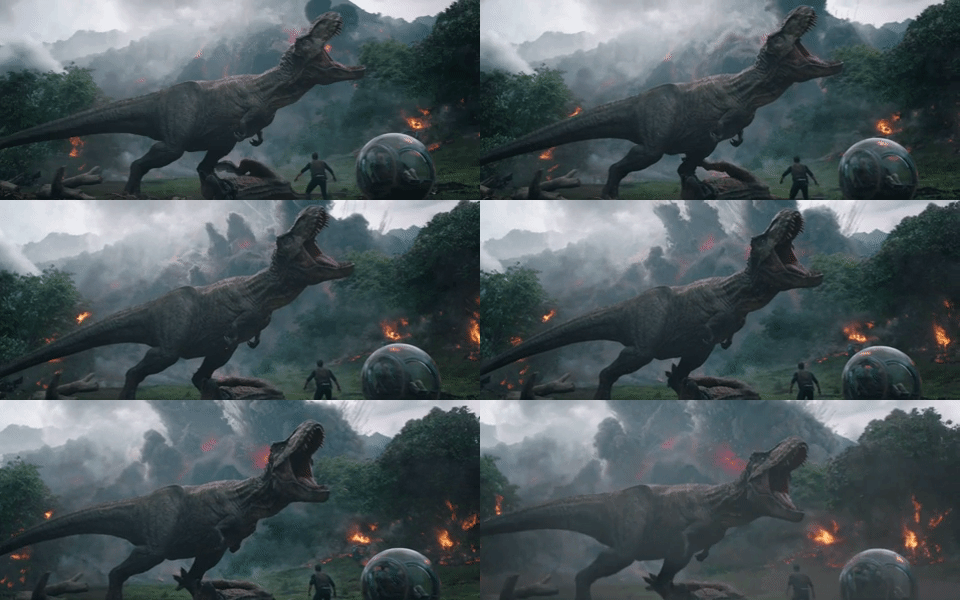
The movie did not feature as many breathtaking visual scenes as "JURASSIC WORLD". But there were a few that caught my eye, including scenes of those dinosaurs roaming the Earth:

But the one scene that produced a knot in my throat featured that last shot of Isla Nublar . . . and the death of the very brachiosaurus that Dr. Alan Grant first saw in 1993's "JURASSIC PARK". Director J.A. Bayona, cinematographer Óscar Faura and the visual effects team really knocked it out of the ballpark by capturing both the grandeur and the pathos of the scene:

If there is one thing I can guarantee from a JURASSIC PARK/WORLD movie, it is a first-rate cast featuring excellent performances. Jeff Goldblum returned to give a short, yet solid performance as Dr. Malcolm Campbell, one of the original visitors to Isla Nublar. "JURASSIC WORLD: FALLEN KINGDOM" featured the acting debut of Isabella Sermon, who gave an excellent performance as the young Maisie Lockwood. Trust this franchise to always hire naturally talented child actors. Ted Levine's performance as mercenary Ken Wheatley struck me as a gleeful portrayal of toxic masculinity. B.D. Wong's return as Dr. Henry Wu was somewhat briefer than it was in the 2015 movie. Yet, once again, the actor conveyed the convoluted egoism of Dr. Wu with great skill. I hope he will have a bigger role in the next film.
Toby Jones gave an entertaining, yet slightly theatrical performance as the weasely auctioneer hired by Eli Mills to help sell those dinosaurs taken from Isla Nublar to potential buyers. James Cromwell struck me as emotional, yet dignified as Hammond's former partner, Benjamin Lockwood. Geraldine Chaplin gave a skillful performance as the Lockwoods' reliable employee Iris. Daniella Pineda was brash and entertaining as the sharp-tongued Dr. Zia Rodriguez. Justice Smith proved to be equally entertaining and quite hilarious as anxiety-ridden systems analyst Franklin Webb. Rafe Spall skillfully portrayed one of the most subtle and corrupt villains in the franchise, Eli Morrow.
Chris Pratt returned as former Navy SEAL-turned-dinosaur trainer Owen Grady. I realized that many might not agree, but I enjoyed Pratt's first-rate portrayal of the no-nonsense Grady more than I did in the 2015 movie. I thought Pratt's performance was more subtle and best of all, his Grady seemed to have dropped that sanctimonious I had found slightly irritating in the previous film. Bryce Dallas Howard managed to skillfully take her character, former operations manager of Jurassic World, to the next level. In "JURASSIC WORLD: FALLEN KINGDOM", Claire's previous encounters with the dinosaurs had led her to develop an appreciation of them as sentient beings. This new Claire is a passionate animal rights activist who has dropped her arrogant disregard of the park's inhabitants. It is possible that this new passion may have slightly affected her common sense, especially during the film's last 10-15 minutes. But thanks to Howard's excellent performance, she managed to convey a sense of plausibility in the slight changes in Claire's personality.
As I had earlier pointed out, the critics did not like "JURASSIC WORLD: FALLEN KINGDOM". In fact, some moviegoers had expressed dismay at the film's ending. I had at least two quibbles with the movie. But if I must be frank, I enjoyed it very much. More importantly, I found its ending very believable for a science-fiction tale. For once, the franchise was willing to face a consequence that its previous films managed to elude so far. The movie featured first-rate direction by J.A. Bayona; a well-written screenplay by Derek Connolly and Colin Trevorrow; and an excellent cast led by Chris Pratt and Bryce Dallas Howard. Good work guys!