Thursday, August 9, 2018

"THOSE DARING YOUNG MEN IN THEIR JAUNTY JALOPIES" (1969) Photo Gallery

Akrob-MonteCarloorBust-7

Below are images from the 1969 comedy, "THOSE DARING YOUNG MEN IN THEIR JAUNTY JALOPIES". Directed by Ken Annakin, the movie starred Tony Curtis, Susan Hamphshire and Terry-Thomas: 


"THOSE DARING YOUNG MEN IN THEIR JAUNTY JALOPIES" (1969) Photo Gallery

001ba3a5_medium


001ba3a7_medium


001c6438_medium


008


4147_4_large


4147_6


4147_8


4147_10


4147_14


4147_16


4147_18


11878912933_f8538f117c_z


Eric-Sykes-in-Monte-Carlo-002


iopGqCPSY8T1mxyzVkfj1PXAtz1


jalopies-03


jalopies-04


jalopies-05


jalopies-06


jalopies-07


jalopies-08


jalopies-09


jalopies-10


jalopies-12


large_those_daring_young_men_jaunty_blu-ray_1


large_those_daring_young_men_jaunty_blu-ray_2


large_those_daring_young_men_jaunty_blu-ray_3


large_those_daring_young_men_jaunty_blu-ray_4


large_those_daring_young_men_jaunty_blu-ray_5


large_those_daring_young_men_jaunty_blu-ray_6


large_those_daring_young_men_jaunty_blu-ray_7


large_those_daring_young_men_jaunty_blu-ray_8


monte%20carlo%20or%20bust%201


monte%20carlo%20or%20bust%202


montecarlo


monte-carlo-or-bust1


those-daring-young-men-in-their-jaunty-jalopies

Monday, August 6, 2018

Top Five Favorite Episodes of "THE CROWN" Season One (2016)


Below is a list of my favorite episodes from Season One of the Netflix series, "THE CROWN". Created by Peter Morgan, the series starred Claire Foy and Matt Smith as Queen Elizabeth II and Philip, Duke of Edinburgh: 


TOP FIVE FAVORITE EPISODES OF "THE CROWN" SEASON ONE (2016)


1. (1.02) "Hyde Park Corner" - Due to King George VI's poor health, Princess Elizabeth and her husband Philip, Duke of Edinburgh embark upon a tour of the Commonwealth on his behalf. However, a family tragedy forces the couple to end their tour in Kenya and return home to Britain.


2. (1.05) "Smoke and Mirrors" - This episode focuses on the death of Queen Mary, Queen Elizabeth II's grandmother and on her own coronation over two months later. Meanwhile, the Queen's uncle, the Duke of Windsor, clashes with her private secretary, Tommy Lascelles, after being asked not to attend the coronation.


3. (1.08) "Pride & Joy" - While Elizabeth and Philip embark upon a stressful Commonwealth tour in 1954, the Queen's younger sister Princess Margaret takes on more royal engagements, much to the consternation of Prime Minister Winston Churchill.


4. (1.07) "Scientia Potentia Est" - While the Soviet Union tests their new H-bomb, both Prime Minister Churchill and Deputy Prime Minister experience major health crisis, unbeknownst to the Queen. Meanwhile, she becomes aware of her limited education and hires a tutor.


5. (1.06) "Gelignite" - When Princess Margaret and her divorced lover, Peter Townsend, ask Elizabeth's permission to get married, the latter promises to give her support. Unfortunately, Private Secretary Lascelles and the Queen Mother advise against supporting the marriage.


Saturday, August 4, 2018

"BLACK PANTHER" (2018) Review

merlin_133187918_5fbcffdc-abaa-4e42-a938-24b9217b675c-master768


"BLACK PANTHER" (2018) Review

I am going to be brutally honest. For the past three years, I have harbored mixed feelings about the output from the Marvel Cinematic Universe (MCU). The year 2015 produced one movie that I found entertaining, yet disappointing; and another film that I found entertaining and original, but not exactly mind blowing. But the years 2016 and 2017 proved to be very disappointing, as far as MCU movies were concerned. By the end of 2017, I thought the MCU had finally lost its mojo . . . until I saw "BLACK PANTHER", early in the following year. 

I realize many might find my comments something of a head scratcher. What exactly was wrong with the MCU films between 2015-2017? Well . . . I thought "THE AVENGERS: AGE OF ULTRON" was entertaining, yet problematic. I enjoyed "ANT-MAN" very much, but I would never regard it as one of the franchise's best. The movies, starting with 2016's "CAPTAIN AMERICA: CIVIL WAR" and ending with 2017's "THOR: RAGNAROK", struck me as very disappointing and somewhat inferior. Despite the fact that the franchise was raking in millions - or billions - with these films, I personally believed it had reached an artistic abyss . . . until I saw "BLACK PANTHER". Not only did I find the latter film entertaining, I also regard it as one of the better MCU films I have seen in the franchise's ten-year history. With "BLACK PANTHER", it seemed the MCU had not only climbed out of the abyss, but had reached (or nearly reached) a pinnacle. 

"BLACK PANTHER" basically told the story about King T'Challa aka Black Panther adjusting to his role as the new sovereign of Wakanda, an isolated and fictional African nation that is the most technically advanced in the world, thanks to the vibranium metal within its borders. Wakanda has spent most of its existence pretending to be a poor, third-world nation in order to protect itself from the world - especially Western nations - and prevent them from learning about its rich source of vibranium. The narrative for "BLACK PANTHER" picked up at least a week after the events of "CAPTAIN AMERICA: CIVIL WAR". T'Challa and his premier bodyguard and leader of the Dora Milaje regiment, Okoye; extract Nakia, T'Challa's ex-lover and a Wakandan spy, from an undercover assignment in Nigeria. All three returned to Wakanda's capital to participate in T'Challa coronation as the new king. During the ceremony, the leaders of Wakanda's five tribes are each given the opportunity to challenge the temporarily de-powered (via a potion that expunges his super strength and speed) T'Challa's role as the new king by ritual combat. One of the leaders, M'Baku of the mountainous Jabari Tribe, challenges T'Challa. After a fierce fight, M'Baku concedes defeat and T'Challa is officially acknowledged as King of Wakanda. 

Unfortunately, T'Challa's triumph is short-lived when Wakanda intelligence becomes aware of a robbery committed by a group of thieves led by an old foe of the country's, Ulysses Klaue. The latter had stolen an old Wakanda artifact from a London museum that contains vibranium, a metal substance that has allowed Wakanda to become the most technically advanced nation in the world . . . unbeknownst to other nations. When Wakanda intelligence learns that Klaue plans to sell the vibranium to the C.I.A. at a location in Busan, South Korea; T'Challa, Nakia and Okoye travel there to interrupt the planned sale and arrest the arms dealer. Instead of arresting Klaue, T'Challa stumbles across a family secret involving one of Klaue's fellow thieves, an African-American named Eric Stevens aka Killmonger, which will threaten his position on the Wakanda throne and endanger the country itself. 

After being disappointed by five MCU movies in a row, I found myself wondering if I would ever enjoy a movie from the franchise again. Thankfully, "BLACK PANTHER" proved to be a more than pleasant surprise. Thanks to Ryan Coogler's direction and the excellent screenplay that he co-wrote with Joe Robert Cole, "BLACK PANTHER" proved to be a unique film that combined the usual elements of a comic book movie, a family drama and a rare exploration into the political and social aspects of the African diaspora.

Family drama is nothing new to the Marvel Cinematic Universe (MCU). Audiences have seen this played out in movies like the Thor trilogy, 2015's "ANT-MAN", and to a certain extent, 2008's "THE INCREDIBLE HULK". "BLACK PANTHER" is another addition in which a deadly encounter between T'Challa's father and uncle - King T'Chaka and Prince N'Jobu in 1992, led to the new king learning about his cousin and N'Jobu's half-American cousin, Erik "Killmonger" Stevens aka Prince N'Jadaka. That 1992 encounter led to Erik becoming an orphan and abandoned by his isolationist uncle T'Chaka. This, in turn, led Erik to see revenge against the nation of Wakanda. Ironically, Erik never got the chance to exact his revenge on the very person responsible for his loss, namely his uncle, who was killed by Helmut Zemo's bomb in "CIVIL WAR". But for him, T'Challa and Wakanda served as a convenient scapegoat for his vengeance.

What made all of this even more fascinating and a lot more original than the MCU's other family dramas was how Coogler and Cole managed to mix a good deal of political controversy into this family saga. One of the reasons Prince N'Jobu had fallen out of favor with his older brother was his growing disenchantment with Wakanda's isolationist policy with the world - including those of the African diaspora around the world. After his experiences in late 20th century Oakland, N'Jobu decided to reveal Wakanda's existence to Ulysses Klaue and help the latter infiltrate Wakanda to smuggle out more vibranium. N'Jobu had planned to use the vibranium to create weapons and lead a revolution of the African diaspora against the dominating Western nations. With his father dead, Erik planned to not only get his revenge against the Royal House of Wakanda, but also carry out N'Jobu's plans. Watching this, I am reminded of Loki's plans in 2011's "THOR" - namely to keep a powerless Thor stranded on Earth, while he sets up the Frost Giants' destruction and win Odin's favor. As much I had enjoyed that movie, Loki's plans seemed rather lame to me in compare to Erik's. But what made this story arc even more interesting is that in the end . . . Erik's plans to use Wakanda weapons to conquer the world eventually led to T'Challa's decision to finally end Wakanda's isolationist policy.

"BLACK PANTHER" featured some pretty solid action sequences. I enjoyed the sequence featuring T'Challa and M'Baku's fight for the throne; Erik and Klaue's confrontation at an abandoned South Korean airfield; T'Challa and Erik's battle for the throne; and the Battle of Mount Bashenga, in which T'Challa and his forces attempted to prevent Erik and the Border Tribe from sending Wakanda weapons to the outside world. All are pretty good action sequences. But if I had to select my favorite, it would be the confrontation at the Busan casino between T'Challa, Nakia and Okoye against Klaue and his minions. With C.I.A. Agent Everett Ross thrown into the mix, this particular sequence was simply boss, especially since it lead to a wild car chase on the streets of Busan. That once scene featuring Okoye slamming her wig into the face of a Klaue minion will probably remain imprinted in my mind for years to come.

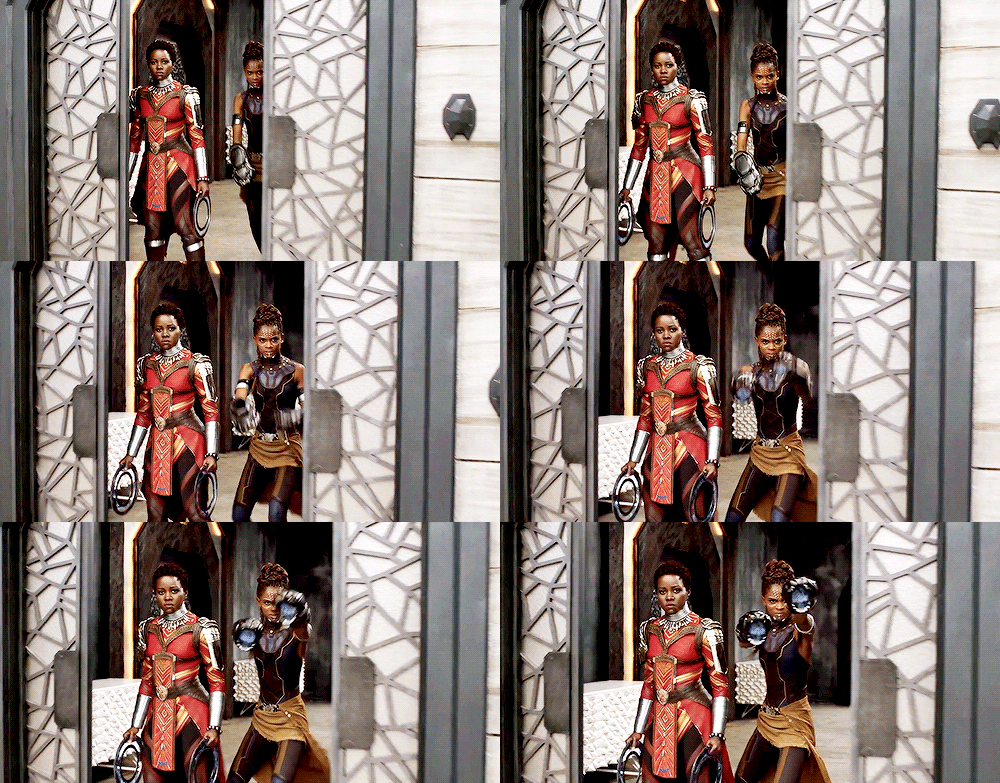
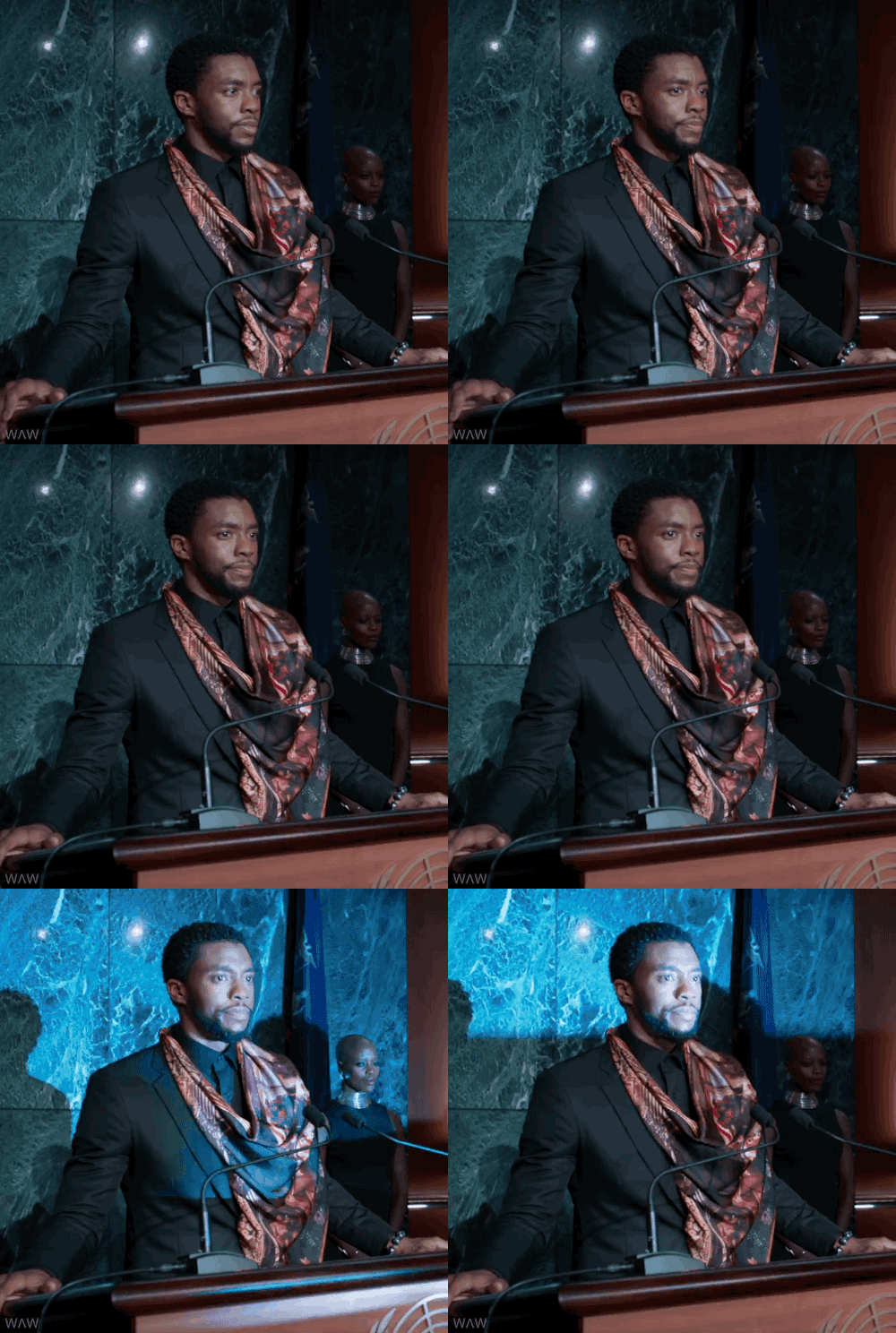
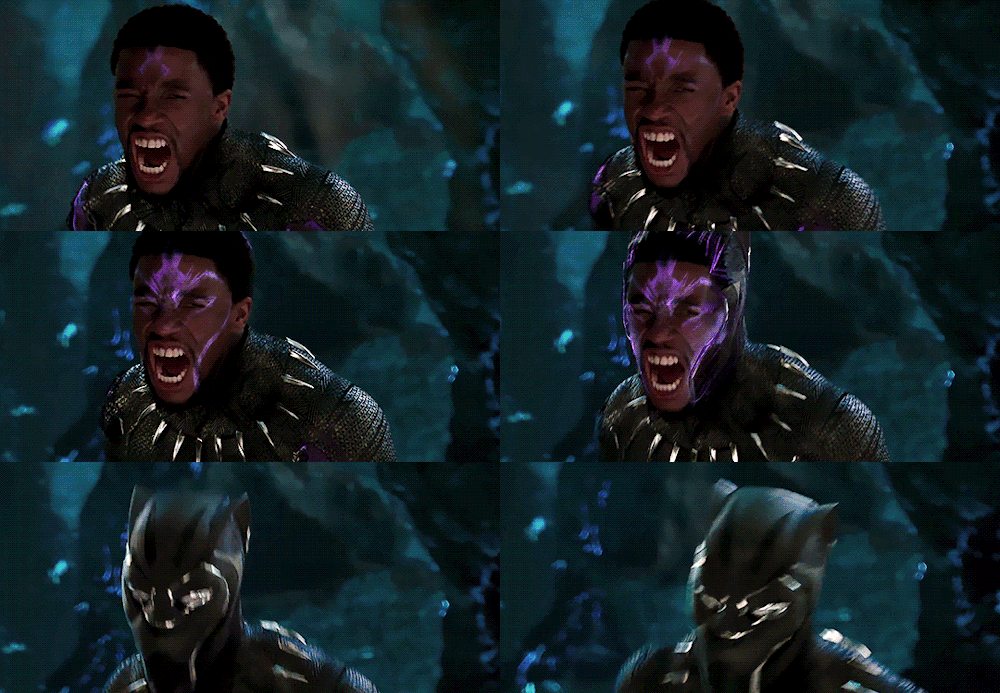
Another aspect of "BLACK PANTHER" that I admired was the film's production designs. Mind you, the film maintained that same flat photography that the MCU has become infamous for. However, I think Rachel Morrison's photography was enhanced by some sharp colors, the movie's visual effects, Hannah Beachler's gorgeous production designs that convey the world of Wakanda, along with the art direction team led by Alan Hook. Aside from Beachler's production designs, I was especially impressed by Oscar and Emmy nominee Ruth E. Carter's costume designs. Someone had compared them to those costumes featured in the 1988 comedy, "COMING TO AMERICA". But honestly . . . I think I prefer Carter's more natural designs, as featured in the images below:

  image

image


But all of the above would have meant nothing without the talented cast for the film. "BLACK PANTHER" featured some first-rate performances from the likes of Daniel Kaluuya, who portrayed Border Tribe leader W'Kabi, who desires his own personal vengeance against Ulysses Klaue; Sterling K. Brown as the revolutionary Prince N'Jobu; both John Kani and son Atandwa Kani as the older and younger versions of King T'Chaka; Angela Bassett as T'Challa's strong-willed, yet loving mother and advisor, Queen Ramonda; Denzel Whitaker, who gave a solid performance as the younger Zuri; and Martin Freeman as C.I.A. Agent Everett Ross, who proved to me more entertaining and relevant in this film than he was in "CAPTAIN AMERICA: CIVIL WAR".

However, there were those performances that really impressed me. One came from Andy Serkis, who was a hoot as the murderous, yet over-the-top South African arms dealer, Ulysses Klaue. Letitia Wright was equally entertaining as T'Challa's witty and charming sister, the tech-savy Princess Shuri. Another came from Lupita Nyong'o, who gave a passionate and heartfelt portrayal of Wakandan intelligence agent and T'Challa's former girlfriend, Nakia. Forest Whitaker gave a first-rate performance as Wakanda's top courtier and former spy, Zuri. Whitaker was especially impressive in one scene in which his character was forced to confess King T'Chaka's past actions regarding N'Jobu and Erik Killmonger. Winston Duke was very impressive, imposing and at times, rather amusing as M'Baku, leader of the mountainous Jabari Tribe. Also, his first appearance in the film - during T'Challa's coronation ceremony - is one of the most memorable moments I have seen in a movie for quite some time. Danai Gurira was equally impressive and imposing as Okoyo, the traditionalist leader of the king's bodyguards - the Dora Milaje. Although I found her character's conservatism a bit annoying at times, I must admit that Gurira gave one hell of a performance.

However, this movie is really about two characters - King T'Challa of Wakanda aka the Black Panther and his paternal cousin Erik "Killmonger" Stevens aka Prince N'Jadaka. Yes, I know that the movie is called "BLACK PANTHER". But to be honest, this movie is about both cousins and how their conflicting views on Wakanda's role in the world and especially upon the African diaspora. 

Chadwick Boseman's second turn as T'Challa proved to be a different kettle of fish from the driven newly ascended king determined to seek revenge for the death of his father, T'Chaka in "CAPTAIN AMERICA: CIVIL WAR". In this film, Boseman gave a more relaxed performance as the happy and more satisfied young king, eagerly anticipating, yet slightly fearing his new role as king. However, Boseman's relaxed performance skillfully transformed into one of disbelief, anger and outrage when T'Challa learned about his father's actions back in Oakland 1992. This was especially apparent in two scenes in which Boseman gave outstanding performances. The first scene featured his confrontation with Zuri, who confessed the true circumstances about Oakland. Boseman gave a very intimidating, yet regal performance in that scene. The other featured T'Challa's second dream in which he expressed anger and disappointment at his father's spirit for what happened to Erik. 

Speaking of the latter, Michael B. Jordan has been receiving rave reviews for his performance as Erik "Killmonger". Some have been declaring his character as the best MCU villain ever. I do not know if I agree with that assessment. But I must admit that Jordan gave one of the most skillfully ambiguous performances I have encountered in the franchise. Audiences could easily sympathize with his backstory - the young boy who had lost his parents and abandoned. Also, one cannot help but admired Erik's desire to help those African nations and members of the African diaspora - something that his cousin seemed unwilling to do. And yet, the level of violence Erik seemed willing to utilize in order to achieve his goal or his unwillingness to face that the one person who had truly wronged him was dead justified why the talented Jordan had portrayed him such ambiguity. 

As much as I enjoyed "BLACK PANTHER", I did have some problems with the film. One, there is a chance that I may have stumbled across a major writing blooper. In "CIVIL WAR", Avenger Wanda Maximoff aka the Scarlet Witch had accidentally killed a group of Wakanda subjects during a mission in Lagos, Nigeria. The Wakandans had been there on a goodwill mission. This lead King T'Chaka to publicly support the Sokovia Accords - an act that led to his death. And yet, Ryan Coogler and Joe Robert Cole made it clear in the 2018 movie's screenplay that Wakanda has practiced a policy of isolationism for centuries. Although Coogler and Cole remembered T'Chaka's death in the 2016 movie and Bucky Barnes' presence on Wakanda soil, they apparently forgot about this goodwill mission in Nigeria. Also, why did Erik Stevens wait so long to travel to Wakanda and make a bid for the throne? He could have challenged his uncle T'Chaka for the throne and get his revenge against the very man who had wronged him. Instead, he waited until after T'Chaka's death. Why? 

Exactly when did Steve Rogers and Bucky Barnes arrive in Wakanda, as shown in one of the post-title scenes in "CIVIL WAR'? The movie opened with T'Challa and Okoye returning to Wakanda for the first time since T'Chaka's death. Were both Steve and Bucky aboard T'Challa's plane? Were they aboard the Avenger jet that Steve had used to fly to Russia in the 2016 movie? Where were they? In fact, there was no scene featuring the pair's arrival in Wakanda for the first time, which I found rather odd. Speaking of arrivals, why was Okoye with T'Challa when he first returned to Wakanda? I realize that she was the leader of the Dora Milaje and that King T'Chaka was in Austria at the time of his death. But Okoye was missing in a scene from "CIVIL WAR" in which Avenger Natasha Romanoff aka Black Widow had sought T'Challa's help to track down Steve, Bucky and Sam Wilson aka the Falcon. As the king's leading bodyguard, she should have been there - whether with T'Chaka or T'Challa. Instead, another Dora Milaje bodyguard named Ayo (portrayed by actress/model Florence Kasumba) was there. Yet, the latter was missing aboard T'Challa's plane upon his return to Wakanda. One last question . . . why did T'Challa's closest friend, W'Kabi of the Border Tribe, seemed so willing to help Erik carry out his anti-isolationist policies? Why? I understand that he might be grateful to Erik for finally killing Klaue, the man who had killed his father years ago. But am I really to believe that his gratitude extended to supporting Erik's decision to end Wakanda's isolationist policy . . . especially since he had made it clear earlier in the film that he fully supported the old policy? Was he really that grateful to fight on Erik's behalf when T'Challa had returned alive to resume the challenge against Erik? I truly found this hard to believe.

And why was the only truly negative black character in this film was the only one of some American ancestry? There was something about the film's portrayal of African-Americans that struck me as rather negative and a bit one-dimensional. In this film, African-Americans seemed to consist solely of poor and slightly thuggish people barely capable of surviving on their own, except through criminal activities. The idea of Wakanda coming to their "rescue" with advanced technology made the latter country seem very similar to the White Savior trope. And if Wakanda was going to share their technology, why did T'Challa do so with the entire international community, instead of simply other African nations and the African diaspora . . . as Nakia had originally suggested? Considering that Erik had pointed out that many countries - especially in the West - were catching up technically with Wakanda, along with the international community's generally negative attitude toward African nations and those of the African diaspora; I cannot help but wonder if T'Challa had ever considered that many of the more wealthier nations would take advantage of his generosity at the first opportunity? Or was this plot twist something that Kevin Feige and the other Marvel/Disney suits had insisted that Coogler and Cole include? 

However . . . despite these misgivings I have about "BLACK PANTHER", I cannot deny that I truly enjoyed the movie. I did. I thought Ryan Coogler, along with screenwriter Joe Robert Cole and a talented cast led by Chadwick Boseman, did an exceptional job in bringing comic book hero the Black Panther and the world of Wakanda to life. At this moment, "BLACK PANTHER" has become one of my five favorite movies in the MCU franchise.


image

Friday, August 3, 2018

"WAR AND PEACE" (2016) Photo Gallery


Below are images from "WAR AND PEACE", the BBC's 2016 adaptation of Leo Tolstoy's 1869 novel. Adapted by Andrew Davies and directed by Tom Harper, the six-part miniseries starred Paul Dano, Lily James and James Norton: 


"WAR AND PEACE" (2016) Photo Gallery


Wednesday, August 1, 2018

"FLASHMAN" (1969) Book Review


"FLASHMAN" (1969) Book Review

Forty-nine years ago, an old literary character was re-introduced to many readers, thanks to a former Scottish journalist named George MacDonald Fraser. The author took a character from a famous Victorian novel and created a series of novels that placed said character in a series of historical events throughout the middle and second half of the 19th century. 

The 1857 novel, "TOM BROWN’S SCHOOLDAYS", told the story of a young English boy named Tom Brown and his experiences at the famous school, Rugby, during the 1830s. One of Tom’s travails focused on his abuse at the hands of an older student – a bully – named Flashman. However, Flashman got drunk at a local tavern and in the following morning was expelled by Rugby’s famous headmaster, Dr. Thomas Arnold. Fraser took the Flashman character, gave him a first name – Harry – and continued his story following the expulsion from Rugby in the 1969 novel, "FLASHMAN".

The beginning of the novel saw the seventeen year-old Harry Flashman trying to find a new profession following his expulsion from Rugby. Due to his father’s wealth and his maternal Uncle Bindley Paget’s social connections, Flashman found a position as a junior officer in one of Britain’s most elite Army regiments, the 11th Hussars aka the Cherrypickers. And thanks to his talent for toadying and projecting a sense of style (inherited from his aristocratic late mother), Flashman managed to win the support and favor of the regimental commander, the haughty James Thomas Brudenell, 7th Earl of Cardigan. Unfortunately, Flashman’s ideal life as a leisurely Army officer came to an end. His involvement with the French mistress of a fellow officer kicked off a series of events that led to Flashman being swept into the First Anglo-Afghan War (1839-1842). One of those events included seducing one Elspeth Morrison, the sixteen year-old daughter of a wealthy Scottish merchant. After being forced to marry her by her relations, Flashman was kicked out of the 11th Hussars and sent to India by Lord Cardigan, who regarded the marriage as a step down the social ladder for the usually favored young Army officer.

It was in Afghanistan that Flashman earned the nickname, “Bloody Lance” by taking credit for his servant’s killing of four Afghan attackers. There, he also met one Ilderim Khan, the son of a pro-British Afghan nobleman and became the latter’s lifelong friend and blood brother. This friendship would end up saving Flashman’s life during the Sepoy Rebellion in "FLASHMAN IN THE GREAT GAME". Flashman also managed to earn two deadly enemies – an Afghan warlord named Gul Shah and his mistress (later wife), a dancer named Narreeman. The source of the pair’s enmity toward Flashman originated with his rape of Narreeman.

More importantly, "FLASHMAN" allowed readers to view many important events of the First Anglo-Afghan War. Not only did Flashman meet many historical figues such as Lord Cardigan, Queen Victoria, Prince Albert, the Duke of Wellington, but also Alexander Burnes, Akbar Khan, William Macnaghten, Thomas Arnold, and the incompetent commander of the British Army in Afghanistan, General William Elphinstone. 

I must admit that my opinion of the novel has changed a great deal over the years. Originally, I held a low opinion of "FLASHMAN" for years, comparing it to the more epic-like sagas such as "FLASHMAN AT THE CHARGE" (1973), "FLASHMAN IN THE GREAT GAME" (1975), "FLASHMAN AND THE REDSKINS" (1982) and "FLASHMAN AND THE DRAGON" (1985). I still regard these four novels in a higher regard than "FLASHMAN". But I must admit that perhaps I had been a little unfair in my regard for the 1969 novel. It is actually a solid adventure story filled with historical interest, witty humor, sharp action and excellent pacing. Some fans of The Flashman Papers have expressed disgust or disenchantment with the Harry Flashman character portrayed in this novel. I suspect that a great deal of these negative opinions may have stemmed from Flashman’s rape of Narreeman. And I understand. However, many of these fans also complained about the young British officer’s crass style and manner – especially toward his father’s mistress, Judy. One has to remember that Harry Flashman aged from 17 to 20 years old in this story. He did convey some semblance of the style, common sense and instinct that would fool many people and serve him for years. But as an adolescent on the threshold of twenty, he had yet to learn some of the hard facts of life. As for his rough treatment and negative opinion of Judy, I suspect that his ego suffered a massive blow when she rejected him, following their one-time bout under the sheets. A blow that he obviously had failed to recover from after six decades, while "writing" his memoirs.

"FLASHMAN" also had its share of interesting fictional characters. I have already mentioned the villainous Gul Shah and his mistress (later wife) Narreeman. I have also mentioned the young Afghan who became a close friend of Flashy’s, Ilderim Khan. But he had an even larger role in "FLASHMAN IN THE GREAT GAME". And as I had mentioned, Elspeth also appeared in the novel. However, her presence in the novel would not be truly felt, until the last chapter that featured Harry’s homecoming. Fraser barely explored her personality in the novel, but he did allow a peek into her promiscuous and self-absorbed nature in that last chapter. One particular character, Sergeant Hudson, proved to be a reliable source of defense for Flashman during the retreat from Kabul. During this event, Flashman experienced one of the most bizarre moments of his life, while being rejected by the young wife of an Army officer named Mrs. Betty Parker, whom he was trying to seduce:

"'What the devil' says I. 'What’s the matter?'

'Oh, you brute!' she hissed - for she had the sense to keep her voice down – 'you filthy, beastly brute! Get out of my tent at once! At once, d’you her?'

I could make nothing of this, and said so. 'What have I done? I was only being friendly. What are you acting so damned missish for?'

'Oh base!' says she. 'You . . . you . . .'

'Oh, come now,' says I. 'You’re in very high ropes, to be sure. You weren’t so proper when I squeezed you the other night.'

'Squeezed me?' says she, as though I had uttered some unmentionable word.

'Aye, squeezed. Like this.' And I reached over and, with a quick fumble in the dark, caught one of her breasts. To my amazement, she didn’t seem to mind.

'Oh, that!' she says. 'What an evil creature you are! You know that is nothing; all gentlemen do that, in affection. But you, you monstrous beast, presume on my friendship to try to . . . Oh, oh, I could die of shame!'

If I had not heard her I shouldn’t have believed it. God knows I have learned enough since of the inadequacies of education given to young Englishwomen, but this was incredible."


This last encounter with Mrs. Betty Parker struck me as a hilarious metaphor for the blindingly naïve morality that had began to encroach early Victorian society.

"FLASHMAN" also provided some interesting historical vignettes from the First Anglo-Afghan War. And young Flashman managed to witness or participate in a good number of them. The novel allowed him to be the sole surviving British witness to the murder of political officer, Sir Alexander Burnes and his younger brother, Charles. He also witnessed the murder of another political officer named Sir William Macnaghten, along with Last Stand at Gandamak and the Siege of Jalalabad. But Fraser’s pièce de résistance in "FLASHMAN" proved to be the disasterous Kabul retreat in which the British contingent under General Elphinstone were forced to march from Afghanistan to India in cold weather and dire circumstances:

"From other accounts of that frightful march that I have read – mostly Mackenzie’s and Lawrence’s and Lady Sale’s – I can fit a few of my recollections into their chronicle, but in the main it is just a terrible, bloody nightmare even now, more than sixty years after. Ice and blood and groans and death and despair, and the shrieks of dying men and women and the howling of the Ghazis and Gilzais. They rushed and struck, and rushed and struck again, mostly at the camp-followers, until it seemed there was a slashed brown body every yard of the way. The only place of safety was in the heart of Shelton’s main body, where the sepoys still kept some sort of order; I suggested to Elphy when we set off that I and my lancers should ride guard on the womenfolk, and he agreed at once. It was a wise move on my part, for the attacks on the flanks were now so frequent that the work we had been doing yesterday was become fatally dangerous. Mackenzie’s jezzailchis were cut to ribbons stemming the sorties."

Reading the above passage made me wonder about the wisdom of the current Western presence in Afghanistan. And there is nothing like a British military disaster to bring out the best of Fraser’s writing skills. It proved to be the first of such passages in novels like "FLASHMAN IN THE GREAT GAME" and "FLASHMAN AND THE REDSKINS".

In the end, Fraser did a solid job in initiating what would proved to be The Flashman Papers in his first novel, "FLASHMAN". Granted, the novel’s first part set in England struck me as slightly rushed. And the Harry Flashman character seemed a bit crude in compare to his characterizations in the novels that followed. Like many other readers, I found his rape of the Narreeman character hard to stomach. But Fraser did an excellent job in re-creating early Victorian Britain, British India, Afghanistan and the First Anglo-Afghan War. In short, "FLASHMAN" turned out to be a solid start to an excellent series of historical novels.


Tuesday, July 31, 2018

"THE LADY EVE" (1941) Review


"THE LADY EVE" (1941) Review

I must admit that I have never been a diehard fan of Preston Sturges. I realize that he is the one Hollywood director and screenwriter credited for taking the screwball comedy format to a more mature level. And this is certainly apparent in his films. But of all of his movies, I can only think of two that I consider personal favorites of mine. And one of those two happen to be his 1941 comedy classic, ”THE LADY EVE”.

Starring Barbara Stanwyck and Henry Fonda, ”THE LADY EVE” told the story about a mismatched romance between a beautiful con artist (Stanwyck) named Jean Harrington and Charles Pike (Fonda), the naïve heir to the Pike Ale fortune and a reptile expert. The pair met aboard an ocean liner bound from South America to the United States. Jean and her father, Colonel Harrington (Charles Coburn) decided to fleece Charles at cards, but she fell in love with him and ruined her father’s plans for a quick score. But Charles broke up the romance after learning that Jean and Colonel Harrington were gamblers and con artists, thanks to his ever vigilant valet/minder, Mugsy (William Demarest). Furious at being scorned, Jean re-entered Charles’ life, while masquerading as the posh "Lady Eve Sidwich" - niece of Sir Alfred McGlennan Keith (Eric Blore), another con man who's been swindling the rich folk of Connecticut.

What can I say about ”THE LADY EVE”? It is one of the funniest movies I have ever seen. Period. And that is quite an achievement for a film that is almost seventy (70) years old. Do not get me wrong. I can think of other comedies made during this period that were just as funny. Unfortunately, a good number of them tend to lose steam by the film’s last fifteen minutes or so. A good example of this would be the two comedies that Cary Grant and Irene Dunne made together - ”THE AWFUL TRUTH” and ”MY FAVORITE WIFE”. But thanks to Sturges and Monckton Hoffe, who wrote the movie’s original story, allowed Jean’s deception and torment of Charles in order to keep the laughs going . It began with that first moment when Jean and Colonel Harrington spotted Charles boarding the ocean liner and ended right up to the film’s last flickering moment when a reconciled Charles and Jean kicked Mugsy out of her stateroom.

Some of my favorite scenes from the movie included the following:

*Jean’s criticisms of many other female passengers, determined to seduce poor Charles in some of the most hilarious and awkward ways ever conceived;

*Jean’s seduction of Charles inside her stateroom;

*Mr. Pike’s (Eugene Pallette) frustration at the lack of a breakfast prepared for him;

*Mugsy’s attempts to determine whether Lady Eve Sidwich and Jean Harrington are ”the same dame”, during the Pikes’ dinner party for their aristocratic guests;

*Charles’ many pratfalls that threatened to ruin the dinner party;

*Lady Eve’s revelation of her less than virginal past with a score of men to a very stunned Charles during their honeymoon aboard a train
.

Naturally, I have to speak about the cast. Sturges filled it with some first-rate performers – whether they were character actors with minor roles that did not require any lines (think of the numerous shipboard females that attempted and failed to woo Charles Pike), or the two leads – Stanwyck and Fonda. There were certain performances that caught my eye. William Demarest was a hoot as Mugsy, Charles’ paranoid and very faithful retainer, whose suspicions of Jean as the Lady Eve provided some of the funniest moments in the film’s second half. Eugene Pallette was equally funny as the gruff Horace Pike, who seemed incapable of understanding his shy and scholarly son. And Charles Coburn made a cool Colonel Harrington, a card sharp who is also shrewd enough to gauge his daughter Jean’s feelings for Charles. And Eric Blore portrayed a deliciously over-the-top Sir Alfred McGlennan Keith, a fellow con artist of the Harringtons, who is recruited by Jean to portray her relative during her Lady Eve impersonation.

But this movie obviously belonged Barbara Stanwyck and Henry Fonda as the two lovers – Jean Harrington and Charles Pike. Her Jean is so deliciously manipulative, yet passionate when she first falls for Charles. And Charles Pike has to be one of Fonda’s funniest role in his long career. Watching him struggle and fail to resist Jean’s charms filled me with a lot of laughs, along with his series of pratfalls during the sequence that featured the Pikes’ dinner party. Stanwyck and Fonda first worked together in the 1938 comedy mystery, ”THE MAD MISS MENTON”. In both ”MISS MENTON” and ”THE LADY EVE”, it seemed quite apparent that they truly enjoyed working together.

Monckton Hoffe had received a nomination for an Academy Award for Best Writing, Original Story. This is the only Academy Award nomination that the film had received, I find that a criminal oversight on the part of the Academy of Motion Picture Arts and Sciences. The New York Times had voted ”THE LADY EVE” as one of the ”10 Best Films of 1941”. The movie industry and the media in 1941 had vastly underrated the quality of this film, as far as I am concerned. Personally, I believe that it is one of the best movie comedies ever made. Period.