Tuesday, November 22, 2022

"THE SUICIDE SQUAD" (2021) Review


"THE SUICIDE SQUAD" (2021) Review

No one had felt more surprised than myself when I learned that Warner Brothers had plans for a new movie featuring the D.C. Comics characters - the Suicide Squad. Although a box office hit, the 2016 movie was a critical failure. "SUICIDE SQUAD" is also regarded as one of the worst films of the D.C. Extended Universe (DCEU) franchise.

Yet, Warner Brothers had went ahead with their plans. And the studio hired James Gunn; who had directed 2014's "GUARDIANS OF THE GALAXY" and its 2017 sequel, "GUARDIANS OF THE GALAXY, VOL. 2" for Disney Studios/Marvel Films; to write and direct its new film. Both Gunn and Warner Brothers claimed that their new movie, "THE SUICIDE SQUAD", was not a sequel to the 2016 film. Yet, they also claimed that it was also not a reboot. Both claimed that it is a "do-over". Huh. A do-over sounds like a reboot to me.

If "THE SUICIDE SQUAD" was not a sequel, I found it interesting that it had utilized at least four characters from the 2016 film - Harley Quinn, Amanda Waller, Rick Flagg and George Harkness aka Captain Boomerang. It would have featured Floyd Lawton aka Deadshot as well, but Will Smith was unable to do the film. Even David Ayer, the 2016's film's director, had been slated to helm this second film . . . as a sequel. But in the end, Gunn received the assignment. And both the latter and Warner Brothers had decided this new movie would be a reboot. Hmmmm. Okay.

"THE SUICIDE SQUAD" began with Amanda Waller, Director of A.R.G.U.S., assembling members from Task Force X - inmates from the Belle Reve prison - for a new mission. Broken into two teams, "A" and "B", they were sent to the South American island nation of Corto Maltese after its government is overthrown by an anti-American regime, and are tasked with destroying the Nazi-era laboratory Jötunheim which holds a secretive experiment known as "Project Starfish". Waller's immediate subordinate Colonel Rick Flagg led Team A to land on the island and is nearly wiped out from Corto Maltese forces. Apparently, another Suicide Squad member, Richard "Dick" Hertz aka Blackguard, had informed the Corto Maltese of their landing. Only Flagg and Harley Quinn had survived. Team B, lead by sharpshooter/mercenary Robert DuBois aka Bloodsport, managed to land without being detected, due to the Corto Maltese being distracted by Team A's landing. The Corto Maltese managed to capture Harley. Team B searched for Flagg and discovered him taking refuge at a base camp for rebel soldiers lead by one Sol Soria. Flagg and the Team B managed to convince Soria to help them achieve their mission to destroy Project Starfish.

What can I say about "THE SUICIDE SQUAD"? It seemed to possess James Gunn's crazy brand of humor. This was especially apparent in the interactions between Bloodsport and another Team B member, the aggressively patriotic Christopher Smith aka Peacemaker; the deaths of most Team A members on the Colto Maltese beach; Harley's constant failure to recognize one of Soria's rebel soldiers and her final interaction with her captor dictator Silvio Luna. It also featured some interesting action sequences. I especially enjoyed the Suicide Squad's crazy ride through Valle Del Mar's streets, as the Squad and Soria's forces race to save Harley.

The movie definitely benefited from first-rate performances from the cast. "THE SUICIDE SQUAD" featured excellent performances from Idris Elba as Robert DuBois aka Bloodsport, Viola Davis as Amanda Waller, Joel Kinnaman as Rick Flagg, David Dastmalchian as Abner Krill aka Polka-Dot Man, Alice Braga as Sol Soria, Taika Waititi the Ratcatcher, Juan Diego Botto as Silvio Luna, Storm Reid as Bloodsport's daughter Tyla, Joaquín Cosío as Major General Mateo Suárez and Sylvester Stallone's voice performance as Nanaue aka King Shark. However, the movie had its standout performances.

One such performance came from Margot Robbie, who managed to knock it out of the park as Harley Quinn . . . as usual, despite some cringey dialogue. I was also impressed by John Cena's portrayal of the uber-aggressive Peacemaker. In fact, I would go as far to say that his comic timing may have rivalled Robbie's. I was surprised to see Peter Capaldi as the Thinker, let alone in a comic book movie. Yet, he gave a complex performance as Gaius Grieves aka The Thinker, the lead scientist of Project Starfish who finally revealed the truth and the U.S. government's role in it to the Squad. For me, the best performance came from Daniela Melchior, who portrayed Cleo Cazo aka Ratcatcher 2, daughter of the Ratcatcher. Melchior gave a very poignant performance in one scene in which she described her relationship with her father to Bloodsport during the team's respite inside a bar.

Despite its virtues, certain aspects of "THE SUICIDE SQUAD" did not sit well with me. For example . . . the details behind the slaughter of Team A. If Blackguard had not ratted out the mission to the Corto Maltese military, Team A - along with himself - would have never been slaughtered. How did he do it? How did Blackguard managed to make contact and make a deal with the Corto Maltese Armed Forces before leaving the U.S. for the island? While he was a prisoner at a maximum prison like Belle Reve? How did he do it? What makes this so frustrating is that Gunn's screenplay never revealed how Blackguard was able to contact the Corto Maltese in the first place.

And why did Amanda Waller assign Rick Flagg, her trusted second-in-command, to lead Team A? You know, the team that nearly got wiped out by the Corto Maltese troops upon landing? The team that was used as a distraction from Team B's landing. Why did she do this? At first, I thought she had finally regarded Flagg as disposable. And yet, once she had discovered that Flagg had survived Team A's slaughter, she ordered Bloodsport and Team B to rescue him. So, if she wanted Flagg rescued, why in the hell did she assign him to Team A in the first damn place?

If Waller never had any intentions of killing Flagg, why did she bother to recruit Bloodsport to act as Team B's leader? Why did she do that? Why not simply assign Flagg as leader of Team B? In fact, she wanted Bloodsport as leader of Team B so badly that she blackmailed him by threatening to incarcerate his delinquent daughter Tyla at the Belle Reve prison. It seemed bad enough that Waller did not assign Flagg as Team B's leader. But she had to blackmail Bloodsport into assuming the role? Why? If she had wanted Bloodsport on the mission so badly, Waller should have reminded him of the mini bomb planted in his skull. This whole scenario regarding the Corto Maltese landing, Rick Flagg's situation, and the leaderships of both Teams A and B seemed like a vicious circle of contrived writing that produced several plot holes in the end.

I find it amazing that both Gunn and Warner Brothers had insisted that "THE SUICIDE SQUAD" was a "do-over" or reboot of "SUICIDE SQUAD". Not only were four characters from the original film brought back for this movie, Gunn had utilized a good number of characterizations and plot points from the 2016 movie.

For example, Bloodsport nearly came off as a remake of Deadshot. I realize that Gunn had originally intended for Deadshot to be one of the leading characters. But once he was unable to cast Will Smith, he hired Idris Elba to portray Deadshot. Then he changed his mind and decided to have Elba portray another D.C. Comics marksman - Bloodsport. The problem is that aside from some minor differences, Bloodshot reminded me a bit too much of Deadshot. Both were portrayed by actors of African descent. Both are considered among the best marksmen within the D.C. Comics universe. And both characters had complicated relationships with their daughters. When Gunn realized that he was going to have Elba portray Bloodsport, instead of Deadshot, I feel he should have been more original with the former character.

Like "SUICIDE SQUAD", Harley Quinn had a romantic interest in "THE SUICIDE SQUAD". In the 2021 film, she had a romance with Corto Malta's leading dictator Silvio Luna. My problem with this romance is that it had no impact upon the movie's main narrative . . . unlike her relationship with the Joker in "SUICIDE SQUAD". Yes, I found Harley's breakup with the dictator to be one of the film's funniest moments. But I found the entire romance a big waste of time. I wish Gunn had thought of another way to handle Harley's experiences between surviving Team A's slaughter and joining Team B. Gunn had Harley discover Luna's plans to use Project Starfish against other nations. But so what? Even Waller had suspected that might happen. That is why she had sent Task Force X to Corto Malta in the first place. I am sorry, but I found Harley's romance with Luna to be a big waste of time.

Gunn had created his own "bar scene" in "THE SUICIDE SQUAD". Perhaps he had added this sequence to give his protagonists a breather. Or perhaps he wanted to repeat the bar scene from "SUICIDE SQUAD", which is regarded as one of the best aspects of the latter film. How did I feel about it? This sequence featured a great performance from Daniela Melchior as Ratcatcher 2. Yet, it failed to impress me, unlike the 2016 film's bar scene. For me, a woman discussing her loving relationship with her father was not as interesting as a man regretfully confessing to killing his loving wife and kids in a fit of rage. And I still ended with the feeling that Gunn had simply attempted to plagiarize David Ayer's scene.

I also found it interesting that the main villains for both movies were telepathic. And both - the Enchantress and Starro - had been exploited by the U.S. government. However, the Enchantress had been revealed as villainous before being discovered by Dr. June Moone and used by Waller. Starro did not work as a main villain for me. He had simply been an innocent captured and experimented on by the U.S. government. And his experiences had driven him to murderous behavior. Frankly, I feel as if the Thinker would have made a better "Big Bad" than Starro. The latter simply ended up as cartoonish and over-the-top to me. And his death . . . gruesome.

There were other aspects of the movie that bothered me. Whereas Ayer had wasted the Slipknot character in "SUICIDE SQUAD", Gunn managed to waste a slew of characters in this film's first twenty minutes. And one of those characters proved to be Jai Courtney's Captain Boomerang. Another wasted character proved to be Michael Rooker's Brian Durlin aka Savant. The movie's opening sequence had spent a good deal of time on Savant's time in prison and preparation for the Corto Malto mission that his fate took me by surprise.

And then there was the matter of the mini bombs planted inside the heads of the Task Force X members. In the film's final sequence, Waller tried to prevent the remaining team members from stopping Starro in his rampage against the Corto Malta inhabitants. Why did she want to prevent the team from saving the Corto Malta citizens in the first place? In the end, her staff knocked her out and prevented her from setting off the bombs inside the remaining squad members' heads. The problem I have with this scenario is the device Waller had planned to use to set off the mini bombs. It resembled a piece of technology straight from the mid-to-late 20th century, instead of the late 2010s or early 2020s. What happened to the smart phones used by Waller and Flagg in the 2016 film? Did Gunn deliberately downplayed the bomb switch technology so that he had an excuse to prevent Waller from carrying out her executions . . . and give Bloodsport enough time to set her up for blackmail, using the Operation Starfish file? And why was Waller’s operations stationed at the Belle Reve Prison, instead of the A.R.G.U.S. headquarters in Washington D.C.? All of this . . . it simply smacked of contrived writing to me.

I also had a problem with King Shark. Earlier, I had pointed out that Sylvester Stallone gave a first-rate voice performance as this character. But I cannot say the same about how Gunn had written King Shark. The latter character struck me as rather infantile and cartoonish. Now I realize that King Shark was originally a human/shark hybrid from Hawaii named Nanaue. But was he portrayed in such a childish manner in "THE SUICIDE SQUAD", to the point I almost found it irritating and offensive. After all, the character had been portrayed with a great deal more intelligence in the comic books, the Harley Quinn animated series and in Arrowverse's "THE FLASH". Why Gunn had decided to portray King Shark as someone with limited intelligence, I do not know.

Over the years, I have noticed that when non-American directors - especially those from Europe - make action films set in the United States, they have a tendency to raise the level of gore and violence that American directors rarely use. I also noticed that Gunn utilized an unusually high level of gore and violence for "THE SUICIDE SQUAD". I found it ironic. Many critics had praised this movie to the skies and rarely anyone complained about the level of violence in this film. Whereas DCEU movies like "BATMAN V. SUPERMAN: DAWN OF JUSTICE" received a great deal of complaints about its violence, "THE SUICIDE SQUAD" did not. Yet, I found the violence in the 2021 film ridiculously excessive. Huh.

Yes, "THE SUICIDE SQUAD" had its virtues. It featured some good action sequences and excellent performances from the cast led by Margot Robbie and Idris Elba. But I believe that thanks to James Gunn's writing, the movie featured an unsatisfying main villain, too many plot holes, too many flaws and unnecessarily excessive violence and gore. By the time the surviving members of the Suicide Squad had its final confrontation with the main villain, I found myself despising this film. Perhaps one day, I will give this movie another chance and learn to appreciate it. Who knows? But right now, I despise and regard it as one of my least favorite comic book movies of all time.


Monday, November 14, 2022

Five Favorite "MAD MEN" Season Three (2009) Episodes

 20091109_madmen_2_560x375


Below is a list of my top five (5) favorite episodes from Season Three (2009) of "MAD MEN". Created by Matthew Weiner, the series stars Jon Hamm:


FIVE FAVORITE "MAD MEN" SEASON THREE (2009) Episodes

1 - 3.11 The Gypsy and the Hobo

1. (3.11) "The Gypsy and the Hobo" - Don's past finally catches up with him when Betty confronts him about his identity theft. Roger Sterling meets a former client/lover who wishes to rekindle their affair. And Joan discovers that her husband, Greg Harris, has joined the Army after failing to start a medical career in New York.


2 - 3.12 The Grown Ups

2. (3.12) "The Grown Ups" - The assassination of President John Kennedy serves as the backdrop of the wedding for Roger's daughter and the final breakup of the Draper marriage.


3 - 3.07 Seven Twenty-Three

3. (3.07) "Seven Twenty-Three" - Don's attempts to land the Conrad Hilton account leads to him being blackmailed by Bert Cooper to sign a three-year contract with Sterling Cooper. Peggy begins an affair with former Sterling-Cooper Accounts Head, Duck Phillips. And Betty expresses interest in the Governor's aide, Henry Francis, when she becomes involved in civic politics.


4 - 3.06 Guy Walks into an Advertising Agency

4. (3.06) "Guy Walks into an Advertising Agency" - A visit by the British owners of the Sterling Cooper agency and an account involving a motorized lawn motor results in mishap and bloodshed.


5 - 3.09 Wee Small Hours

5. (3.09) "Wee Small Hours" - An executive from Sterling Cooper's client, Lucky Strikes, demands that the agency fire art director Sal Romano after the latter rejects the executive's sexual advances. Betty grows closer to Henry Francis and Don begins an affair with Sally's teacher, Suzanne Farrell.


Saturday, November 12, 2022

"THE IRREGULARS" (2021) Photo Gallery


Below are images from the 2021 Netflix limited series, "THE IRREGULARS". The series was created by Tom Bidwell for Netflix and based on the works of Sir Arthur Conan Doyle:


"THE IRREGULARS" (2021) Photo Gallery


Monday, November 7, 2022

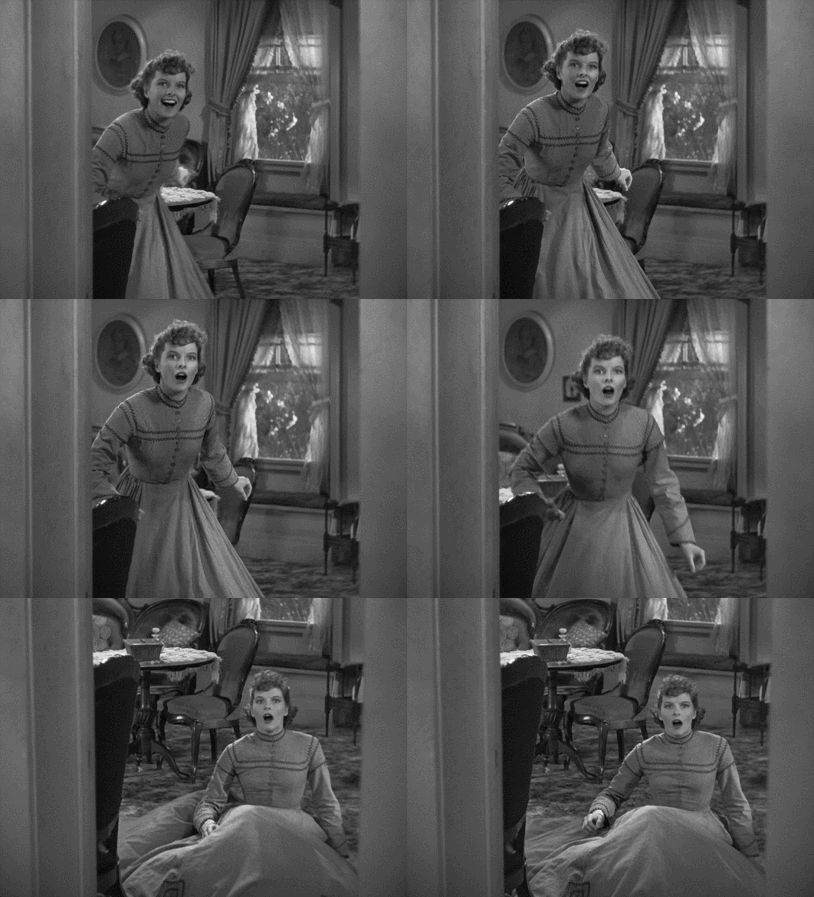
"LITTLE WOMEN" (1933) Review


"LITTLE WOMEN" (1933) Review

There have been many adaptations of Louisa May Alcott's 1868-69 best-selling two-volume novel, "Little Women". And I mean many adaptations - on stage and in movies and television. I have personally seen three television adaptations and four movie adaptations. One of the most famous versions of Alcott's novel is the 1933 movie adaptation, produced by Merian C. Cooper and directed by George Cukor.

Although I have seen at four adaptations more than once, I had just watched this version for the very first time. Judging from the reviews and articles I have read, Cukor's "LITTLE WOMEN" seemed to be the benchmark that all other versions are based upon. So, you could imagine my anticipation about this film before watching it. How did I feel about "LITTLE WOMEN"? That would require a complicated answer.

"LITTLE WOMEN" told the story of the four March sisters of Concord, Massachusetts - Margaret (Meg), Josephine (Jo), Elizabeth (Beth) and Amy - during and after the U.S. Civil War. Since second daughter Jo is the main character, the story focuses on her relationships with her three other sisters, her parents (especially her mother "Marmee"), the sisters' Aunt March, and the family's next-door neighbors, Mr. James Laurence and his grandson Theodore ("Laurie"). Although each sister experiences some kind of coming-of-age throughout the story, the movie focuses on Jo's development through her relationship with Laurie and a German immigrant she meets in New York City after the war, the charming and older Professor Friedrich Bhaer. Jo and her sisters deal with the anxiety of their father's involvement in the Civil War, genteel poverty, scarlet fever, wanted and unwanted romance, and Jo's fear of dealing the family breaking apart as she and her sisters grow older.

I must saw that the production values for "LITTLE WOMEN" were certainly top-notch. One has to credit producer Merian C. Cooper in gathering a team of excellent artists to re-create 1860s Massachusetts and New York for the movie. I was especially impressed by Van Nest Polglase's art direction, Sydney Moore and Ray Moyer's set decorations and art direction team of Hobe Erwin, George Peckham, and Charles Sayers. However, I simply have to single out Walter Plunkett's excellent costume designs for the film. I doubt very much that Plunkett's costumes were an accurate depiction of 1860s fashion, I believe he came close enough. Plunkett's career also included work for 1939's "GONE WITH THE WIND""RAINTREE COUNTY", from 1957 and the 1949 version of "Little Women". I suspect that this film marked his debut for designing costumes for the mid-19th century. I did have a problem with the hairstyles worn by three of the four leads. A good deal of early 1930s hairstyles seemed to have been used - with the exception of the short bob. At least three of the actresses wore bangs . . . a lot. Bangs were not popular with 19th century women until the late 1870s and the 1880s.

Until the release of the 2019 film, George Cukor's adaptation of Alcott's novel has been considered the best by many film critics. Do I agree with this assessment? Well, I cannot deny that I had enjoyed watching "LITTLE WOMEN". One, producer Merian C. Cooper and director George Cukor did an excellent job in their selection of the cast - especially the four actresses who portrayed the March sisters. All four had excellent chemistry. The movie's portrayal of the U.S. Civil War and the years that followed it immediately struck me as pretty solid. And although there were moments when the film threatened to border on saccharine, I must admit that Cukor and the screenplay written by Victor Heerman and Sarah Y. Mason kept both the narrative and the film's pacing very lively. And finally, I enjoyed how the movie depicted Jo's friendship and romance with Professor Friedrich Bhaer. I found it warm, charming, romantic and more importantly . . . not rushed.

However, I do have a few issues with "LITTLE WOMEN". There were times when the movie, especially during its first half hour, seemed in danger of wallowing in saccharine. I get it. Alcott had portrayed the Marches as a warm and close-knit family. But Alcott had included minor conflicts and personality flaws in the family's portrait as well. It seemed as if director George Cukor, along with screenwriters Sarah Y. Mason and Victor Heerman were determined to whitewash this aspect of Alcott's novel as much as possible. This whitewashing led to the erasure of one novel's best sequences - namely Amy March's burning of Jo's manuscript in retaliation for an imagined slight, Amy's conflict with her schoolteacher, the development of Amy and Laurie's relationship in Europe, and Meg's conflict Aunt March over her relationship with tutor John Brooke. These deletions took a lot out of Alcott's story. It amazes me to this day that so many film critics have willingly overlooked this. Do not get me wrong. "LITTLE WOMEN" remained an entertaining film. But in erasing these aspects of Alcott's story, Cukor and the two screenwriters came dangerously close to sucking some of the life out of this film. Ironically, Mason and Heerman repeated their mistake in MGM's 1949 adaption with the same results.

Most critics and movie fans tend to praise Katherine Hepburn's portrayal of Jo March to the sky. In fact, many critics and film historians to this day have claimed Hepburn proved to be the best Jo out of all the actresses who have portrayed the character. Do I agree? No. Although I admired Hepburn's performance in the movie's second half, I found her portrayal of the adolescent Jo in the first half to be a mixed bag. There were times when I admired her spirited performance. There were other times when said performance came off as a bit too strident for my tastes. I honestly do not know what to say about Frances Dee's performance as Meg March. My problem is that I did not find her portrayal that memorable. I barely remember Dee's performance, if I must be honest. I cannot say the same about Joan Bennett's portrayal of the youngest March sibling, Amy. Mind you, Bennett never received the chance to touch upon Amy's less pleasant side of her nature. And it is a pity that the screenplay failed to give Bennett the opportunity to portray Amy's growing maturity in the film's second half. But I have to admit that as a woman who was roughly three years younger than Hepburn, she gave a more subtle performance as a pre-teen and adolescent Amy, than Hepburn did as the teenaged Jo. The one performance that really impressed me came from Jean Parker's portrayal of Beth March, the family's shyest member. I thought Parker did an excellent job of conveying Beth's warmth, fear of being in public and the long, slow death the character had suffered following a deadly bout of scarlet fever.

I can honestly say that Mrs. "Marmee" March would never be considered as one of my favorite Spring Byington roles. Mind you, the actress gave a competent performance as the March family's matriarch. However, there were times when she seemed too noble, good or too ideal for me to regard her as a human being. As is the case in most, if not all versions of "LITTLE WOMEN", the Mr. March character barely seemed alive . . . especially after he returned home from the war. I cannot blame actor Samuel S. Hinds, who portrayed. I blame the screenwriters for their failure to do the character any justice. On the other hand, I did enjoy Henry Stephenson's portrayal of the complicated, yet likeable Mr. Laurence. I enjoyed how Stephenson managed to slowly, but surely reveal the warm human being behind the aloof facade. Edna May Oliver gave a very lively performance as the irascible, yet wealthy Aunt March. In fact, I would go as far to say that her performance had breathed a great deal of fresh air into the production. Not many critics were impressed by Douglass Montgomery's portrayal of the March sisters' closes friend, Theodore "Laurie" Laurence. I can honestly say that I do not share their opinion. Frankly, I felt more than impressed by his portrayal of the cheeky, yet emotional Laurie. I thought he gave one of the film's better performances - especially in one scene Laurie reacted to Jo's rejection of his marriage proposal. I thought Montgomery did an excellent job of reacting emotionally to Jo's rejection, without going over the top. I also enjoyed Paul Lukas' interpretation of Professor Bhaer. There were moments when his performance threatened to get a little hammy. But the actor managed to reign in his excesses - probably more so than Hepburn. And he gave a warm and charming performance as the romantic Professor Bhaer.

Yes, I have some issues with this adaptation of "LITTLE WOMEN". If I must be honest, most of my issues are similar to my issues with the 1949 adaptation. This should not be surprising, since both movies were written by the same screenwriters - Sarah Y. Mason and Victor Heerman. However . . . like the 1949 movie, this "LITTLE WOMEN" adaptation proved to be a solid and entertaining adaptation of Louisa May Alcott's novel. One can thank Mason and Heerman, director George Cukor and the fine cast led by the talented Katherine Hepburn.


Saturday, November 5, 2022

Beggar's Chicken


Below is an article about the dish known as Beggar's Chicken:


BEGGAR'S CHICKEN

I have eaten my share of chicken dishes during my lifetime. But while perusing a food history website, I came across one that originated on the other side of the world called Beggar's Chicken.

Like a good number of dishes from other parts of the world - including the United States - the origin of Beggar's Chicken seemed to be shrouded in mystery and mythology. Beggar's Chicken is a popular dish in China. And many of the country's regions have claimed it as the dish's original location. However, most experts agree the dish may have originated in Hangzhou province or the Jiangsu province.

The dish was traditionally prepared with a chicken that is first stuffed with various ingredients. Then it was wrapped in clay and lotus leaves (or banana or bamboo leaves as alternatives) and baked slowly using low heat. Preparation of a single portion of Beggar's Chicken usually took up to six hours.

Various legends surround the origins of Beggar's Chicken. One story featured a beggar who had stolen a chicken from a farm. Lacking a pot or utensils, he wrapped the bird in lotus leaves and packed clay or mud around it, set it in a hole where he had lit a fire, and buried it. When he dug up the chicken and cracked open the clay, he found the meat was tender and aromatic. In another version, the beggar stole the chicken from the Emperor of China during the Qing Dynasty (1644-1911) and used the mud-hole method to avoid smoke that might attract the Imperial guards. When the emperor stopped to dine with the beggar, he enjoyed the dish so much that he added it to the Imperial menu. The beggar prospered by selling the dish to locals. According to another legend, Beggar's Chicken was a childhood favorite of Emperor Gaozu of Han, who had been born a peasant. When Gaozu became emperor, the recipe became an Imperial specialty.

During the present day, changes have been made for the preparation of Beggar's Chicken. Dough is sometimes substituted for clay for the dish's preparation. However, some recipes still call for the use of non-toxic clay to cover the chicken and retain moisture. Non-toxic clay can be obtained from hardware or arts and craft stores. However, cooks must pay attention when baking the dish with clay, because if too much heat may prematurely crack the clay. This might be proved to be dangerous due to the pressure buildup in the clay shell. Preparing the dish with dough is safer. Beggar's Chicken can be also prepared in ovens, outdoor grills, smokers, and campfires. Ceramic cooking pots can also be used to retain moisture, but these are expensive to purchase. But even an oven bag or aluminum foil can be used when cooking the chicken in a domestic oven.

Below is a recipe for Beggar's Chicken on the Schoolofwok.co.uk website:


Beggar's Chicken

Ingredients

1 fresh whole baby chicken (Poussin)
4 Large Lotus Leaves / Aluminium foil sheets
2-4 strong toothpicks
225 ml tepid water
150g plain flour

Marinade
2 tablespoons dark soy sauce
1 tablespoon Chinese rice wine or dry sherry
1 cube finely chopped ginger
2 teaspoons salt

Stuffing
2 dried shiitake mushrooms
1 lean pork loin steaks
2 tbsp Chinese pickled cabbage
3 spring onion ends
1 tablespoon light soy sauce
1 capful rice wine or dry sherry
1 tsp granulated sugar
1/2 tsp sesame oil
1/4 tsp five-spice powder
Salt to taste


Preparations

1. Finely chop the ginger and place in large mixing bowl.
2. Place the chicken in the bowl and add all the marinade mix well and base the chicken inside and out with the marinade.
3. Cover and place in the fridge to marinade for 1 hour.
4. Finely chop all stuffing ingredients.
5. Heat 1 tbsp oil in a wok and fry the finely chopped spring onions with the pork loin on high heat.
6. Once the pork is golden brown, add the mushrooms, pickled cabbage and five spice.
7. Add the soy sauce, rice wine, sugar and salt to taste.
8. Once the sauce is well mixed, add the sesame oil, bring to a high simmer and then remove from heat.
9. Stuff the marinated chicken cavity with the stuffing and pour the sauce into the cavity.
10. Close the cavity by threading the toothpicks through the skin.
11. Now wrap the whole chicken in the lotus leaves and place pouring the sauce over the chicken before closing neatly on the top of the chicken.
12. Make a dough by gradually mixing in the water with the flour in a large mixing bowl. Knead for roughly 3-5 minutes.
13. Now roll out the dough and wrap the whole lotus leaf chicken in the dough. Closing the dough together on the top of the chicken.
14. Place in the oven to cook for 45-60 mins depending on the size of the chicken.