 TIME MACHINE: ASSASSINATION OF SENATOR ROBERT F. KENNEDY (1925-1968)
This month marks the 50th anniversary of the assassination of Senator Robert F. Kennedy of New York, in Los Angeles, California. Kennedy was fatally shot by a gun man, while walking through the kitchen of the Ambassador Hotel with his wife Ethel Kennedy, former FBI agent William Barry, Olympian athlete Rafer Johnsonand former football player Rosey Grier.
Kennedy was the seventh child of former U.S. Ambassador to Britain and businessman Joseph P. Kennedy Sr. and Rose Fitzgerald Kennedy. Following the election of his older brother John F. Kennedy as the 35th U.S. President in 1960, Kennedy served as Attorney General for his brother's administration. In November 1968, Jack Kennedy was assassinated by a sniper in Dallas, Texas. Nine months following his brother's death, Robert Kennedy ran for a seat in the U.S. Senate, representing the State of New York and beat his opponent, Kenneth Keating. Kennedy spent his years in the Senate, Kennedy advocated gun control and the Johnson Administration's Great Society program for the elimination of poverty and racial injustice. He served on the Senate Labor Committee and supported the campaigns for better working conditions for laborers. And by 1968, Kennedy had shifted his opinion on American involvement in Vietnam by advocating the eventual withdrawal of American and North Vietnamese soldiers from South Vietnam.
While meeting with labor activist Cesar Chavez in Delano, California in February 1968, Kennedy decided to challenge President Lyndon B. Johnson for the Democratic nomination for U.S. President. However, Johnson changed his mind about running for re-election following the Tet Offensive in Vietnam that occurred between late January and late March 1968. Kennedy officially announced his candidacy on March 16, 1968. His main opponents for the Democratic nomination were Senator Eugene McCarthy of Minnesota and later, Vice-President Hubert Humphrey. Kennedy ran on a platform of racial and economic justice, non-aggression in foreign policy, decentralization of power, and social change. His policy objectives did not sit well with the business community, where he was viewed as something of a liability. Many businessmen also opposed Kennedy's support of tax increases to social programs.
Kennedy learned of the assassination of civil rights activist Martin Luther King Jr. in Memphis, Tennessee; while visiting Indianapolis, Indiana. Riots broke out in many cities following King's death, with the exception of Indianapolis. There, Kennedy gave his famous "On the Mindless Menace of Violence" speech on April 5, 1968. Later, he attended King's funeral with his younger brother Senator Edward Kennedy of Massachusetts and his sister-in-law, former First Lady Jacqueline Kennedy. He won the Indiana Democratic primary on May 7, 1968; and the Nebraska primary on May 14. But he lost the Oregon primary to Senator McCarthy on May 28. The Kennedy campaign hoped that the senator would beat McCarthy for the California primary, knocking the latter out of the race; and eventually face Vice-President Humphrey in Chicago, Illinois.
The 1968 California presidential primary elections were held on Tuesday, June 4, 1968. Kennedy claimed victory over McCarthy at the Ambassador Hotel in Los Angeles, four hours after the California polls closed. He spoke on the telephone with one of his major supporters, Senator George McGovern of South Dakota. Then around 12:10 a.m., Kennedy addressed his campaign supporters in the hotel's Embassy Room ballroom. He ended his speech with the following words:
"My thanks to all of you; and now it's on to Chicago, and let's win there!"
Since presidential candidates were not entitled to Secret Service protection back in 1968, Kennedy's only official security was William Barry, a former F.B.I. agent. Both Rafer Johnson and Rosey Grier served as unofficial bodyguards. He had planned to meet another gathering of supporters in another part of the Ambassador Hotel by making his way through the Embassy Room ballroom. However, reporters wanted a second press conference and Kennedy's campaign aide, Fred Dutton, suggested to Barry that the senator should forgo the second gathering and instead head for the press area, via the hotel's kitchen and pantry area behind the ballroom. After his speech, Kennedy started to leave the ballroom, when Barry stopped him and suggested the alternate route through the kitchen corridor. Both Barry and Dutton tried to clear a path for Kennedy, but he was hemmed in by a crowd and followed maître d'hôtel Karl Uecker through a back exit. While Kennedy allowed Uecker to lead him through the hotel's kitchen area, he shook hands with people he encountered. As they started down a narrow passageway, Kennedy turned and shook hands with busboy Juan Romero. At that moment, Sirhan Sirhan stepped down from a low tray-stacker beside the ice machine, rushed past Uecker, and fired a .22 caliber Iver Johnson Cadet revolver at Kennedy at least three times or more, before the latter fell to the floor.
Romero cradled the wounded Kennedy's head, while sitting on the floor. Sirhan was subdued by Barry, Johnson, Grier, and writer George Plimpton, while he continued to shoot in random directions. Five other people were wounded:
*William Weisel of ABC News
*Paul Schrade of the United Auto Workers union,
*Democratic Party activist Elizabeth Evans
*Ira Goldstein of the Continental News Service
*Irwin Stroll, Kennedy campaign volunteer
Ethel Kennedy, who was three months pregnant, stood outside the crush of people at the scene seeking help. Someone led her to her husband and she knelt beside him. Thirty minutes later, Kennedy was transferred to the Hospital of the Good Samaritan. Surgery began at 3:12 a.m. and lasted three hours and forty minutes. Spokesman Frank Mankiewicz announced at 5:30 p.m. that Kennedy's doctors were concerned over his failure to show any improvement. Kennedy had been shot three times. Despite extensive neurosurgery to remove the bullet and bone fragments from his brain, he was pronounced dead at 1:44 a.m. on June 6, 1968; nearly 26 hours after being shot.
Historians believed that Sirhan Sirhan, a Palestinian Arab with Jordanian citizenship, had shot Kennedy in retaliation for the latter's support of Israel during the Six Day War. However, others have criticized this oversimplification of Sirhan's motives, pointing out that these historians have failed to take account of his psychological problems. Sirhan's lawyers attempted to use a defense of diminished responsibility during the trial, while he tried to confess to the crime and change his plea to guilty on several occasions. With Lynn Compton serving as prosecutor, Sirhan was eventually convicted of the murder of Robert F. Kennedy on April 17, 1969. He was sentenced to death six days later. However, the sentence was commuted to life in prison with the possibility of parole in 1972; after the California Supreme Court invalidated all pending death sentences that were imposed prior to 1972. This was due to the California v. Anderson ruling. Since that time, Sirhan has been denied parole 15 times and is currently incarcerated at the Richard J. Donovan Correctional Facility in southern San Diego County.
Robert Kennedy's funeral was held on June 8, 1968 at St. Patrick's Cathedral in New York City. His brother, Ted Kennedy, gave the eulogy. Following the mass, Kennedy's body was transported by a slow-moving train to Washington, D.C., where he was buried near his older brother John, in Arlington National Cemetery.
After the assassination, Congress altered the Secret Service's mandate to include protection for presidential candidates. Ethel gave birth to Rory Elizabeth Katherine Kennedy in December 1968. Although he had a slight lead over Kennedy at the time of the latter's death, Vice-President Humphreys became the leading Democratic nominee for the 1968 Presidential election and won the nomination during the 1968 Democratic National Convention in Chicago, Illinois, later that summer. He eventually lost the election to the Republican candidate, former Vice-President Richard M. Nixon, in November 1968.

 "I, TONYA" (2017) ReviewLike others who had grown up in the mid-to-late 20th century, I remember the sports scandal that surrounded Olympic figure skaters, Nancy Kerrigan and Tonya Harding. The media wallowed in the scandal on television screens, newspapers and magazines. It all culminated when both women participated in the 1994 Winter Olympics Games in Lillehammer, Norway.Several months after the '94 Olympic Games, NBC aired the 1994 television movie, "TONYA AND NANCY: THE INSIDE STORY". Actually, the television movie appeared two months after the Lillehammer games. Did I see it? No. In fact, I did not even bother to watch the two skaters' compete in the Olympic Games. I barely gave Harding or Kerrigan a thought through those years in which the scandal was mentioned or spoofed in a series of television episodes, movies, songs and documentaries. However, during the fall of 2017, I found myself watching the trailer for biopic about Harding called "I, TONYA". The trailer seemed so intriguing and somewhat off-the-wall that for the first time in twenty-three years, I found myself intrigued by the subject and decided to watch it.Directed by Craig Gillespie and written by Steven Rogers (one of the film's co-producers), "I, TONYA" is basically a biography about Tonya Harding and her connection to the January 6, 1994 attack on rival Nancy Kerrigan. To be honest, Kerrigan played a supporting role - and not a very big one - in this biopic. This movie was all about Tonya. Starring Margot Robbie in the title role, "I, TONYA" followed Harding's life from the age of four to the immediate aftermath of the Lillehammer Games. The movie was written a mockumentary style that featured fictional interviews of Harding and others who had a major role in her life:*Ex-husband Jeff Gillooly*LaVona Golden, Tonya's husband*Diane Rawlinson, Tonya's first and last skating coach*Shawn Eckhardt, Gillooly's close friend and Tonya's so-called bodyguard*Martin Maddox, a fictional character who is basically a composite of many television producers that exploited the 1994 scandalIronically, Nancy Kerrigan is the only major character in this movie who was not interviewed. Perhaps Gillespie and Robbie, who served as one of the film's other three producers, felt that the real Kerrigan would be offended at the thought of her cinematic counterpart being featured as a supporting character in a film about Harding. Judging from Kerrigan's reaction to the movie, they were right. Another aspect of this film that I found surprising is that it was basically a biopic about Harding. The latter did not share top billing with her rival in this film, unlike the 1994 television film. It turns out that screenwriter/co-producer Steven Rogers found Harding's personal life more complex and compelling. He also noticed that both Harding and her ex-husband, Jeff Gillooly, had very conflicting accounts of what really happened with Kerrigan and realized this would make an interesting narrative for a film.Was "I, TONYA" an interesting film? Well . . . yes. Yes, it was. But it had its flaws. Actually, I could only find one major flaw in the film's narrative. For a film that allegedly was supposed to be about Harding from the viewpoints of several people, it seemed to me that aside from trainer Diane Rawlinson, only Harding's point-of-view really seemed to matter. Or the one audiences were expected to take seriously. Most of Jeff Gillooly's account of his relationship with Harding were portrayed with a grain of salt. At the same time, audiences were expected to accept his account of his relationship with Shawn Eckhardt as the real deal. This . . . contradiction seemed a bit hard to swallow at times. Look . . . I realize that Tonya Harding is at the center of this tale. But if one is going to utilize the narration of more than one character, all viewpoints should be equally judged on whether to take them seriously or not.But you know what? I still found "I, TONYA" rather interesting. I also found it entertaining. One, screenwriter Steven Rogers and director Craig Gillespie took what could have been a basic Hollywood biopic and created what turned out to be one of the most original and somewhat bizarre film biographies I have ever seen, hands down. As I had earlier pointed out, Rogers and Gillespie utilized the "mockdocumentary" style to include scenes that feature interviews of the main characters. I thought this movie device was utilized with great wit, along with a dash of dark humor and great satisfaction for me. This was especially the case when both the screenwriter and director used it to break the "fourth wall" - a narrative device used when a character breaks away from the story to address the audience.Many people have wondered why Rogers had focused his screenplay on Tonya Harding. Why not write a movie about both Harding and Nancy Kerrigan? Well . . . as I had earlier pointed out, such a story had already been told in that 1994 NBC television movie I had earlier mentioned. Rogers could have done a movie about Kerrigan and her family's struggles to support her skating career. It probably would have been a very uplifiting film. But if one looks into Harding's personal history . . . well, I might as well be frank . . . it is the stuff from which movie biopics are made. Between Harding's contentious and abusive relationships with both her mother La Vona Golden and first husband Jeff Gillooly, her earthy and frank personality and her more aggressive and modern style of skating that led her to clash with the judges . . . I mean, honestly, can you really blame both Steven Rogers and Craig Gillespie for choosing to do a movie about her? I certainly cannot. Between the off-the-wall directorial style that Gillespie had utilized and Rogers' sharp screenplay, is it any wonder that I found this movie so fascinating to watch? What I found even more fascinating is that the movie put the screws to everyone - Harding's mother, ex-husband, his friend Shawn Eckhardt, the men recruited to attack Kerrigan, the ice skating organizations (both national and international) and yes . . . even Harding herself. Whenever the script had the former ice skating making excuses for some of her questionable actions, it also revealed her excuses or comments as lies. But the most interesting moment occurred when Harding (as narrator) turned to the camera and made this comment about the media and the public's reaction to her legal travails:" It was like being abused all over again. Only this time it was by you. All of you. You're all my attackers too."Now . . . one could dismiss this as petulant complaining from the leading character's part. Perhaps it is. Perhaps it is not. But I could not help thinking there was a great deal of truth in those words. As much as the media and the public loves worshiping a celebrity, once the latter slips or make a mistake, both will bash or drag that celebrity through the mud for as long as they can. It almost seemed as if they revel in that celebrity's misfortune. Like I said, Harding and those close to her were not the only ones skewered in this film.In order to make a movie work, one needs a first-rate story, director and cast. "I, TONYA" was very lucky to have Steven Rogers and Craig Gillespie as its screenwriter and director. It was also blessed with a first-rate cast. The movie featured solid performances from the likes of Julianne Nicholson, Mckenna Grace, the very entertaining Bobby Cannavale, Bojana Novakovic and Caitlin Carver. However, the performances that really impressed me came from four people - Margot Robbie, Sebastian Stan, Paul Walter Hauser and Allison Janney.Paul Walter Hauser gave a very funny performance as the clueless Shawn Eckhardt, whose enthusiasm toward his role as Harding's "bodyguard" may have led him to go too far. Sebastian Stan gave a very complex performance as Harding's first husband, Jeff Gillooly. Stan portrayed his character with a combination of quiet charm and violent intensity. Frankly, he should have been nominated for his performance. The wonderful Allison Janney won both a Golden Globe Award and an Academy Award for her portrayal of Harding's sharp-tongued and abrasive mother, La Vona Golden. I could never decide whether the character was funny or horrifying. But thanks to Janney's performance, she was very interesting. Margot Robbie (who also served as one of the film's producers) is the last actress I could see portraying Tonya Harding. If I must be blunt, she is taller and better looking than the Olympic skater. And yet . . . she gave one of the best performances of her career (so far) as the ambitious and aggressive Harding. I really admire how Robbie managed to convey so many aspects of the skater's personality without being overwhelmed. She really earned her Golden Globe and Oscar nominations.Aside from the story, the direction and performances, there were other aspects of "I, TONYA" that I admired. My mind was not particularly blown away by Nicolas Karakatsanis' cinematography. But I thought his work served both the film's story and setting rather well. I could also say the same about Jennifer Johnson's costume designs, which more than an adequate job of serving both the film's late 20th century setting and Harding's historic skating costumes. I do not recall Peter Nashel's score. But I must admit that I admire how he utilize well known tunes from the late 20th century throughout the film. The one technical aspect of "I, TONYA" that I truly admired was Tatiana S. Riegel's editing. I thought she did a superb job in the way she shaped Harding's tale from Gillespie's narrators, fourth walls and sequences on the ice rink. For her work, Riegel earned an Academy Award nomination for Best Editing and won the American Cinema Editors Award for Best Edited Feature Film – Comedy or Musical.I never thought I would find myself watching a movie about Olympic ice skater, Tonya Harding. Hell, I never thought I would end up enjoying it. Yet, I did enjoy "I, TONYA" very much. I thought it was one of the most bizarre and fascinating biopics I have ever seen. In fact, thanks to director Craig Gillespie, screenwriter Steven Rogers and a superb cast led by Margot Robbie, "I, TONYA" proved to be one of my favorite movies of 2017.
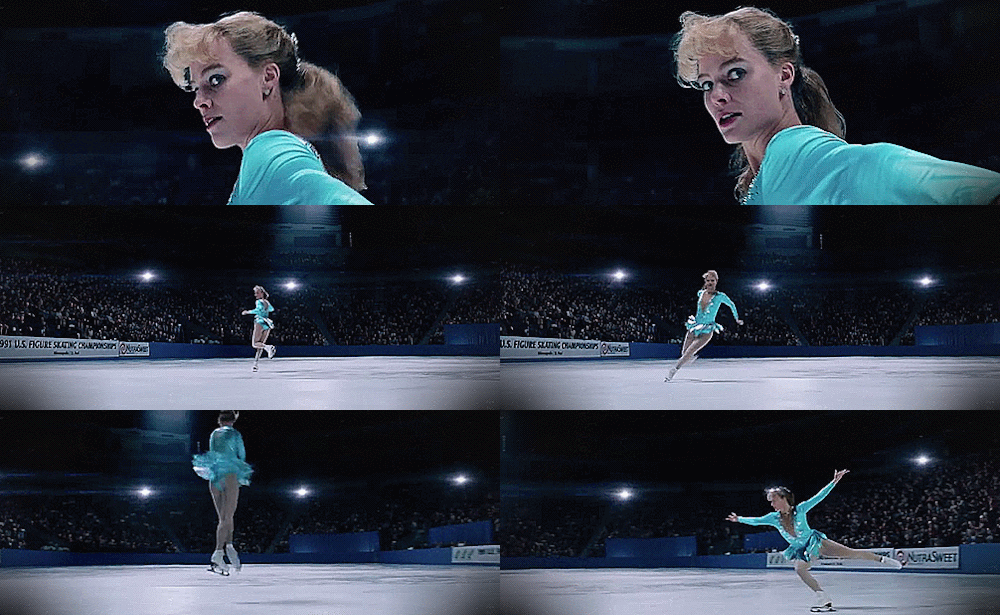 "There's no such thing as truth. It's bullshit. Everyone has their own truth, and life just does whatever the fuck it wants."

Below is an article about the sandwich known as Muffuletta:
MUFFULETTA SANDWICH
The name Muffuletta is known for two things - the bread and the sandwich. The bread, originally known as "Muffoletta", is used for the famous sandwich of the same name. As for the sandwich, it was created by an Italian immigrant - Sicilian actually - named Salvatore Lupo. The latter owned a story called Central Grocery Company on Decatur Street in New Orleans, Louisiana. The bread had been made and eaten by Sicilians for centuries.
Sometime during the early years of the 20th century, Lupo made an agreement with a local baker, another Sicilian immigrant, to supply Muffoletta bread to his store. Lupo then re-sold the bread to his customers. With that agreement, the unknown Sicilian baker became a wholesaler, and the workers no longer bought their bread from him, but from Lupo's Central Grocery. There, workers not only bought the Muffoletta bread, but also their lunch ingredients - bread, meats, cheese and salad. In 1906, Lupo Salvatore decided to combine these ingredients into a sandwich. He decided to use the Muffoletta bread, because of its ability to hold the filling without leaking. To make each sandwich; Lupo filled a Muffoletta loaf with olive salad, meats and cheeses; wrapped the sandwich in paper; and sold it as a Muffoletta sandwich. However, Lupo misspelled the name as "Muffuletta". As a grocer and not a baker, Lupo was not familiar with the spellings of the many Sicilian breads.
As I had just pointed out, the traditional Muffuletta sandwich begins with the Muffoletta or Muffuletta loaf - a large, round, and flattened bread that is similar to the Focaccia bread, but is lighter, crispy on the outside and soft inside. The loaf is split horizontally and covered with layers of salami, ham, Mortadella, Swiss cheese, Provolone cheese, and olive salad. The olive salad consists of green and kalamata olives diced with the celery, cauliflower and carrot mixed in a jar of giardiniera, seasoned with oregano and garlic, covered in olive oil, and allowed to combine for at least 24 hours. In Greater New Orleans a seafood sandwich is made with muffuletta bread and fried seafood, often including oysters, shrimp, catfish and occasionally softshell crab. However, the Seafood Muffuletta sandwich omits the olive salad in favor of the traditional dressings of a seafood Po'Boy sandwich, such as melted butter and pickle slices, or mayonnaise and lettuce.
Since many of Lupo's customers regarded the Mufuletta sandwich as easier to carry, than the ingredients for it, it became an immediate success. The success of Lupo's Muffuletta sandwich led other local grocery stores, including the nearby Progress Grocery, to construct and sell their own versions of the Muffuletta sandwich.
Below is a recipe for a traditional Muffuletta Sandwich from the LauraFuentes.com website:
Muffuletta Sandwich
Ingredients
1 10" round loaf Italian bread with Sesame (or a soft round Italian bread)
1 cup Olive Salad
1/4 lb Genoa Salami
1/4 lb Capicola or deli ham
1/4 lb Mortadella
1/8 lb Sliced Mozzarella (3-4 thin slices)
1/8 lb Provolone (3-4 thin slices)
Preparation
1. Cut the bread in half length wise.
2. Brush both sides with the oil from your Olive Salad or really good extra
virgin olive oil, go a little heavier on the bottom.
3. Begin layering your ham, mortadella and salami on the bottom half of the
bread. Top with your cheeses.
4. Next, add the olive salad from the center out. Put the lid on and press it
down without smashing the bread.
5. Optional: toast/warm up in you oven for a few minutes.
6. Quarter it. You’ve just created pure heaven!


"OCTOPUSSY" (1983) Review
While perusing some of the Bond forums, I have noticed that 1983’s ”OCTOPUSSY” is not highly regarded by many fans. Personally, I have always found this hard to understand or accept, considering that the movie has been one of my favorite entries in the Bond franchise for years. But after watching it recently . . . I still do not understand its low standing amongst the fans.
”OCTOPUSSY”’s pre-title sequence is merely a little teaser about Bond’s attempt to sabotage a missile system in the Banana Republic (aka Cuba). It was light, humorous and filled with plenty of solid action. I particularly enjoyed the fact that what started out as failure on Bond’s part after he found himself captured by enemy soldiers, ended up as a success partially through the actions of the enemy, when they attempt to shoot down the Acrostar Mini-Jet he used for a quick escape. Although entertaining, the pre-title sequence has nothing to do with the main story, which involves a power-hungry Soviet general, a mysterious and beautiful smuggler/circus owner and a duplicitous Afghan prince.
Written by George MacDonald Fraser, Richard Maibaum, and Michael G. Wilson, ”OCTOPUSSY” starts out in East Germany with 009 dressed as a clown and being pursued by a knife-wielding villain. The villain turns out to be a pair of twins (Mischska and Grischska) who want something that 009 has – namely a fake Faberge egg called Property of a Lady. One of the twins manages to fatally wound 009 with a knife. But before he can die, the British agent manages to reach the local British embassy and deliver the egg in dramatic fashion. James Bond is assigned to investigate his colleague’s death. The investigation leads to an auction at Christie’s where the real Property of a Lady egg is being sold . . . and Bond’s first meeting with the villainous Kamal Khan, his henchmen Gobinda and the lovely Madga. Bond’s investigations lead him to India, where he makes his acquaintance with Kamal Khan for the second time. He survives several attempts on his life and incarceration at Khan’s Monsoon Palace and eventually meet the mysterious Octopussy, who turns out to be the daughter of a former rogue agent whom Bond had met years ago. Bond’s encounters with Octopussy and Khan provides him with clues that lead back to East Germany and Soviet General Orlov and Khan’s plot to detonate a nuclear bomb on a U.S. Air Force base in West Germany. Fortunately, Bond (with Octopussy’s help) foils Orlov and Khan’s plans.
Roger Moore returned for the sixth time as British agent James Bond. At age 55 during the film’s production, he struck many Bond fans as too old to be portraying the super spy. Personally, I had no problems with Moore’s age around this time. He still looked handsome and healthy enough to star in the action-packed spy thriller. And he portrayed Bond with a world-weariness and style that seemed to befit his age. Even better, he managed to retain some of that gritty toughness that he utilized so effectively in his previous outing, ”FOR YOUR EYES ONLY” . . . and retained his sense of humor at the same. Speaking of that humor, I usually have nothing against Moore’s humorous style (unlike many fans and critics). But I can think of four occasions when even I found it a bit too much:
-Chase sequence in Udaipur with street performers
-Bond focusing short circuit camera on Indian operative’s cleavage
-The Tarzan yell during Bond’s escape from Khan’s Monsoon Palace
-Bond using fake crocodile submarine to sneak into Octopussy’s estate
Despite the extreme silliness listed above, I still found Moore’s performance satisfactory. I enjoyed his sense of humor during his encounters with the West German citizenry, while trying to stop Orlov and Khan’s bomb. And I admired his dramatic skills in scenes featuring the discovery of Vijay’s body and his romantic scene with Octopussy. But I was especially impressed by his acting in the scene that featured Bond’s only encounter with General Orlov.
Maud Adams returned to appear in her second Bond film, this time portraying the leading female character – smuggler/circus owner, Octopussy. I cannot honestly say I would consider Adams to be among the best actresses that appeared in the Bond franchise. The nine years between ”THE MAN WITH THE GOLDEN GUN” (in which she portrayed the villain’s doomed mistress) and ”OCTOPUSSY” seemed to have shown no real improvement in her acting skills. But she seemed competent enough to carry the role. And her looks and screen presence certainly helped. The secondary female lead – Kristina Weyborn – portrayed Madga, Octopussy’s right-hand woman and personal liaison to Kamal Khan. Like Adams, Weyborn is a tall Swedish-born beauty with limited acting skills. And like the leading lady, she possessed enough looks and presence to carry her role. Although I do wish that someone had given her more lessons in performing martial arts on screen.
French actor Louis Jordan portrayed Kamal Khan, an exiled Afghan prince who desire for a piece of the Imperial Russian treasure leads him to take part in General Orlov's plot to bomb a U.S. Air Force base and change the political landscape of Western Europe. Khan serves as the liaison between Orlov and Octopussy, who traveling circus/smuggling operation allows the two men to smuggle a nuclear bomb into West Germany. Like Yaphet Kotto and Christopher Lee before him, Jordan seems to be a doppleganger of Moore's James Bond - smooth, suave and very deadly. One scene in particular - Bond and Khan's game of dice at an Udaipur hotel - reflects the mirror image of the two men in a very effective manner. Not only did Jordan perfectly portray Kamal Khan's smooth style and sophistication, he did an excellent job of reflecting the Afghan prince's darker nature - especially his cold-blooded tendency to betray anyone who stood between him and self-preservation. Including Octopussy and his men.
"OCTOPUSSY"'s cast of minor villains include Steven Berkhoff as the bombastic General Orlov, whose desire for completely Communist Europe and a higher position in the Soviet hierarchy sets off the movie's plot. Although I found his scenes with Moore, Jordan and Adams effective and subtle, Berkhoff unfortunately revealed a tendency toward hammy acting in a scene that feature a meeting between the Soviet premier and several generals - including Gogol. And when I mean hammy, I mean . . . ham served with eggs. Indian actor Kabir Bedi portrayed Khan's right-hand man, the silent and intimidating Gobinda. One of the Bond sites - "MI-6" Forum - stated the following about the character:"Kamal Khan's faithful bodyguard, big and tough but none too bright.". I do not know if I agree with that assessment. On second thought . . . I do not agree. Gobinda's flaw may have been that he was too devoted and loyal to Khan - after all, he actually obeyed the Afghan prince's order that he climb out of a plane in mid-flight and kill Bond. But less than bright? No, I do not agree. Gobinda struck me as a very observant and intelligent man. And the very handsome Bedi portrayed the henchman with a nice balance of intelligence and menace. In fact, Gobinda happens to be one of my favorite henchmen. Actors David Meyer and Anthony Meyer portray the knife-throwing assassins who killed 009, Mischka and Grischska. They did not say much in the movie, but both did a nice job of projecting competent and menacing killers.
With the death of Bernard Lee in 1980, the character of M did not appear in "FOR YOUR EYES ONLY". The character returned in the form of actor Robert Brown, who began the first of his four movie run as the head of MI-6 in "OCTOPUSSY". Brown portrayed M with authority, but very little imagination. Personally, I think he was simply too young to be portraying an authority figure against Roger Moore, who was six years younger. Not until Timothy Dalton's tenure will Brown show that along with Lee and Judi Dench, he could also be an interesting M. Lois Maxwell returned as Moneypenny in one of the most amusing Bond-Moneypenny scenes in the franchise. The scene involved a 'Miss Penelope Smallbone' and Moore and Maxwell managed to inject a lot of humor and charm into the scene, as befitting two old friends. Desmond Llewellyn had once stated that "LICENSE TO KILL" was his favorite Bond film. Which does not seem surprising, since he had a strong role in it. But he also had a strong role in "OCTOPUSSY" and I could tell that he had enjoyed himself. Especially in the scene that featured his rescue of Madga and some of Octopussy's other followers. It seemed too bad that Q's embellished role in this movie seemed just as unecessary as his embellished role in "LICENSE TO KILL". General Gogol returned in the form of Walter Gotell. And he portrayed the Soviet KGB general with his usual competence. Tennis star, Vijay Amritraj made his screen debut as Indian intelligence agent . . . Vijay. Okay this is not exactly an example of original casting, but what the hell? He did a pretty good job, anyway. And he was rather charming.
"OCTOPUSSY" marked John Glen's second time in the director chair. And like "FOR YOUR EYES", he did an admirable job. I have to give the man kudos for once again, bringing a touch of realistic grit in Moore's portrayal of Bond and in the franchise. Although I do feel that he made a misstep in allowing those silly moments I had earlier mentioned, in the movie. But I do wonder who had included those ridiculous little scenes? Was it Glen? Moore? Or were the screenwriters - Fraser, Maibum and Wilson - responsible? If the writers were responsible, it was a misstep on their parts. Otherwise, they created an admirable script. One of the scenes highly criticized by critics was the sight of Bond disguised as a clown to infiltrate the circus where the bomb was located. I never understood their criticism of this disguise. Perhaps they disliked the idea of James Bond dressed as a clown. If so, I find their attitude extremely shallow . . . and rather stupid.
Also, I wonder why George MacDonald Fraser had been included in this project? Was it because he was a British Army veteran who had served in India? Or that he had incorporated his experiences in India in his Harry Flashman novels? I do not know what to admire more - the screenwriters' creation of the villains' objectives and Bond's efforts to stop the bomb, or Glen's direction of those scenes. Perhaps both. I wish I could say that I enjoyed the movie's theme song, "All Time High", which was sung by Rita Coolidge. But in the end, it simply bored me. However, I did enjoy John Barry's lush and exciting score. And I must commend cinematographer, Alan Hume, for the film's photography. His shots of India and the English countryside (serving as East and West Germany) made "OCTOPUSSY" one of the most colorful entries in the Bond franchise.
Despite the low opinion held by many Bond fans, "OCTOPUSSY" remains one of my favorite Bond films. In fact, I consider it to be Moore's second best film (despite a few stupid jokes) and the franchise's sixth best. I give it . . . 8/10.


